pyrorisk.net · Fire Science & Risk Fire in Daily Life
The Science of a Kitchen Fire: Why Water Makes It Worse
A kitchen fire starts when cooking oil creeps up to its 368 °C autoignition point. Here's the physics of why water makes a burning pan catastrophically worse.
Online: pyrorisk.net/blog/kitchen-fire-science/
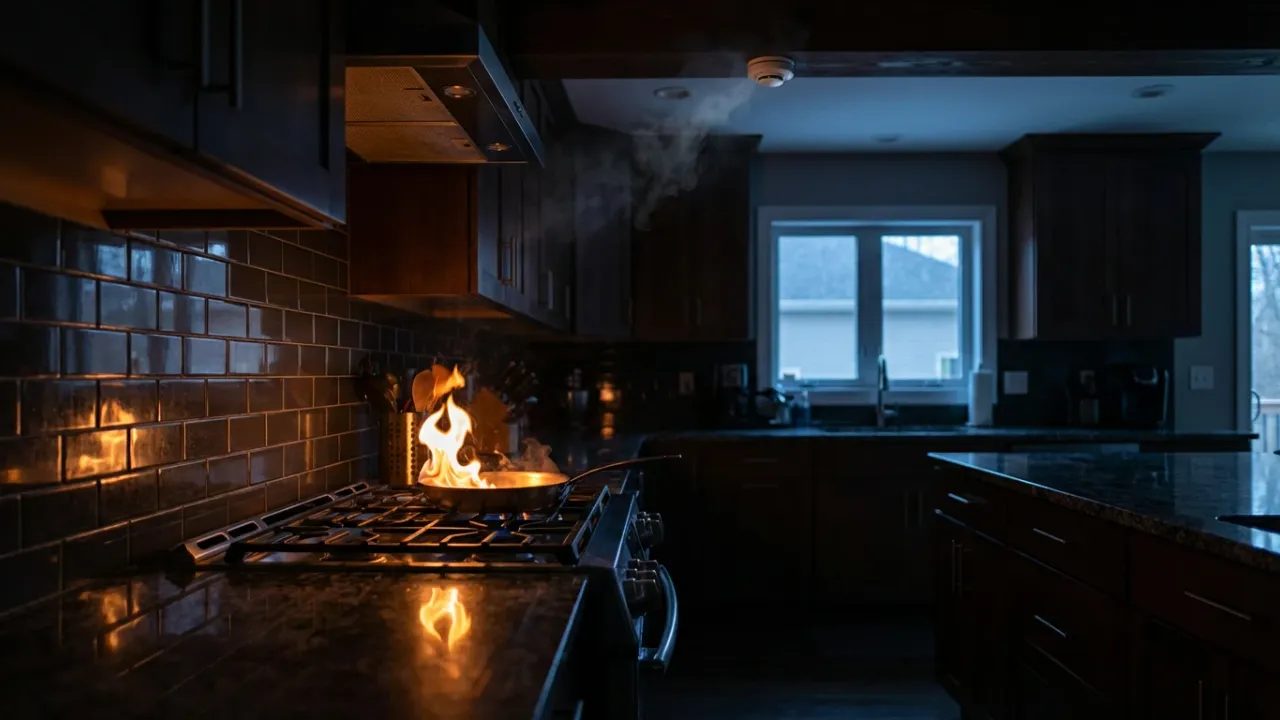
Your kitchen ranks, statistically, as the most dangerous room in your house. In the United States and England, a kitchen fire outnumbers every other kind of home fire, and the pattern has held for decades. Cooking causes about 44% of US home fires and 42% of accidental dwelling fires in England.
So why does a kitchen fire prove so hard to fight, and why does our instinct to grab water make it worse? The answer comes down to pure fire physics. Specifically, nowhere else in your home do you heat a flammable liquid to 180 °C on an open burner. Moreover, you often do it while distracted. This post walks through the numbers, the physics, and the fixes.
TL;DR
- Cooking causes about 44% of US home fires and 42% of accidental dwelling fires in England.
- A deep fryer at 180 °C sits about 190 °C below vegetable oil’s 368 °C autoignition point, a gap a forgotten pan on high heat can close in about 20 minutes.
- Water dropped on burning oil flashes into 1,700 to 2,900 times its volume of steam and throws the oil out as a fireball, which fire engineers call a slopover.
- Never use water on a grease fire. Smother it with a lid, then use a Class K (U.S.) or Class F (Europe) wet-chemical extinguisher if needed.
- In UL tests, modern synthetic furnishings cut flashover time from about 30 minutes to under 5 minutes.
- In one survey, 73% of households whose smoke alarm had sounded blamed cooking. So install a photoelectric alarm at least 3 metres from the stove.
Kitchen fire statistics are worse than you think
The NFPA’s 2023 Home Cooking Fires report found that U.S. fire departments responded to an average of 158,400 home cooking fires per year in 2017–2021. These incidents killed 470 civilians, injured 4,150, and caused $1.15 billion in direct damage. In short, cooking leads every other cause of reported home fires and fire injuries. NFPA’s newer Home Structure Fires report puts the 2019–2023 average at 159,400 cooking fires and 430 deaths a year.
For example, apartments fare far worse than houses. Cooking causes 72% of apartment fires, but only 37% of fires in one- or two-family homes. Similarly, England’s fire statistics recorded 23,795 accidental dwelling fires in the year ending March 2026. Cooking appliances sparked 42% of them. Meanwhile, the London Fire Brigade says around 60% of fires in the home start in the kitchen.
In France, fire services attend 60,000 to 70,000 dwelling fires a year. According to the Finistère prefecture, these fires kill more than 200 people and injure over 9,000 each year.
Temporal patterns reveal the mechanism. Fires cluster between 5 p.m. and 8 p.m., right in the middle of dinner prep. Thanksgiving tops every other day of the year for kitchen fire risk, with more than three times the daily average. Similarly, Christmas Eve, Christmas Day, and Easter all run 54–72% above average. Therefore, the common thread has nothing to do with equipment. It comes down to distraction.
NFPA also found that unattended equipment played a part in 28% of home cooking fires and 48% of cooking fire deaths. In addition, the U.S. Fire Administration, counting only fires where a cause factor was recorded, puts it at 37% of non-confined residential cooking fires. Consequently, stepping away from the stove ranks as the single riskiest thing a cook does.
The physics of a pan that wants to kill you
A kitchen fire differs from a miniature campfire. Instead, it behaves as a flammable-liquid pool fire waiting to happen, with the fuel already heated partway to its autoignition temperature. Four temperatures matter here, and people routinely confuse them.
First, the smoke point is when the oil starts shedding volatile decomposition products. Next, the flash point is where the vapours will ignite briefly if a spark reaches them. Then, the fire point is where combustion becomes self-sustaining. Finally, the autoignition temperature is where the oil ignites on its own, with no spark needed.
The canonical values come from the Institute of Shortening and Edible Oils. Canola oil smokes at 236 °C, flashes at 326 °C, and reaches fire point at 350 °C. Similarly, soybean, peanut, corn, and sunflower oils cluster in the 319–334 °C flash range. Moreover, a peer-reviewed study by Liu et al. (2004) measured an autoignition temperature of 368 °C for a commercial canola and soybean frying oil. Once it ignited, the burning oil climbed to about 400 °C. In a large industrial cooker, the same lab later saw canola oil self-ignite at 351–361 °C.
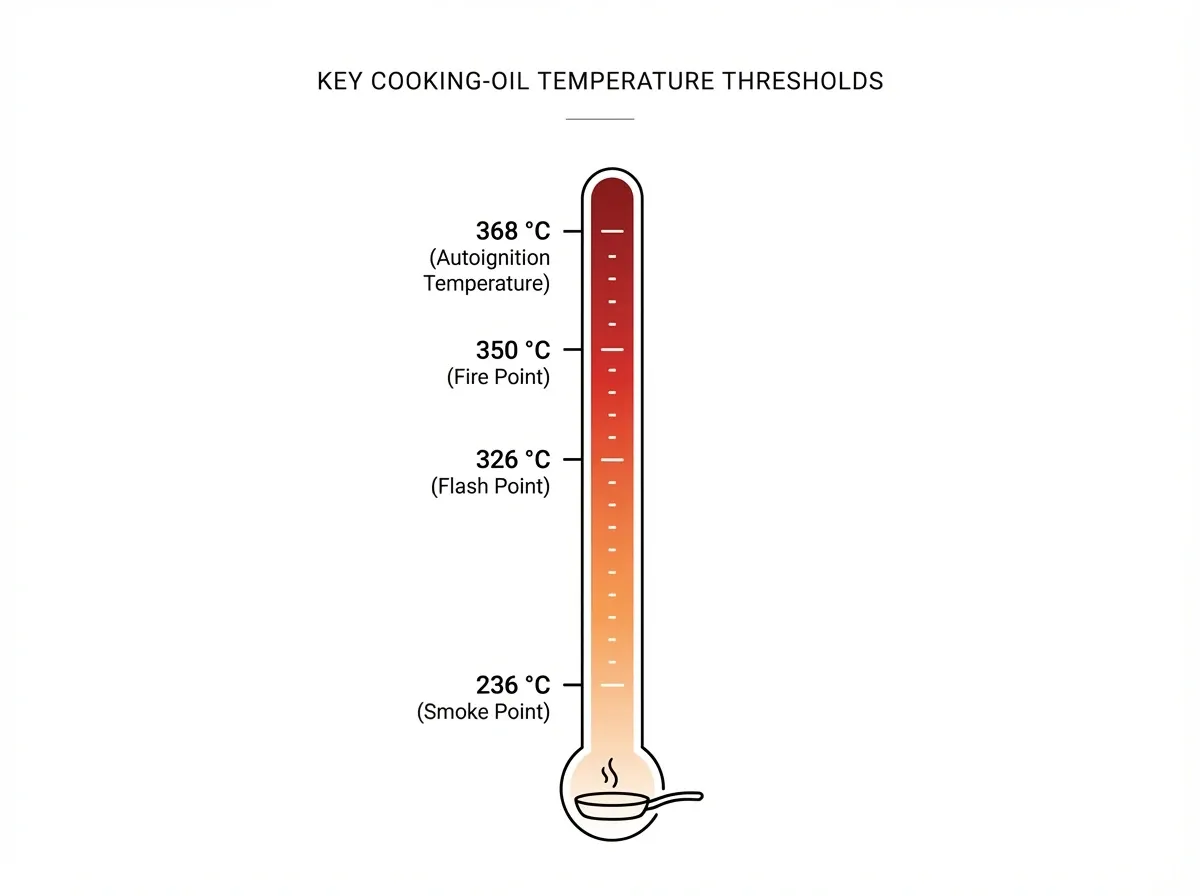
The takeaway cuts to the chase. When you deep-fry at 180 °C, you sit about 190 °C below autoignition. That sounds like a wide margin, yet the burner keeps pouring in heat while you answer the doorbell. In NIST cooktop tests, a small pan of oil on a high electric coil reached autoignition from cold in about 18 minutes. For the full picture of how combustion sustains itself, see our science of fire post.
Why water makes a kitchen fire catastrophically worse
Every chemistry student learns that water expands into steam by a factor of about 1,700 at 100 °C. However, very few people know what that number becomes over burning oil. NIST steam data put it near 2,600 at 300 °C and 2,900 at 370 °C. Therefore, a single cup (250 mL) of water tipped into a burning pan can release 400 to 730 litres of steam within seconds.
Geometry makes the outcome worse. Water at 20 °C has a density near 1,000 kg/m³. By contrast, measured oil densities, extended to fire temperatures, fall to roughly 750–800 kg/m³. As a result, the water sinks through the burning oil and boils violently from below. Fire-safety researchers study a close cousin of this effect, called thin-layer boilover, in fuel burning on top of water. Garo and colleagues found that eruption begins once the fuel-water interface reaches about 120 °C.
The eruption then throws fine droplets of burning oil into an aerosol fireball. In diesel pool tests, Ferrero et al. (2007) found that boilover sharply raises the fire’s emissive power, and that the rise grows as the pool gets smaller. That foundational work comes from fuel pool fires, so the pan case involves some extrapolation. Still, the core mechanism of water flashing to steam beneath hot oil applies directly. Strictly, NFPA 30 keeps “boil-over” for long-burning crude oil tanks and calls water sprayed onto burning oil a “slop-over”. Our post on the turkey fryer fireball sorts out the terms. For deeper context on how oils decompose before they ignite, see our post on the science of pyrolysis.
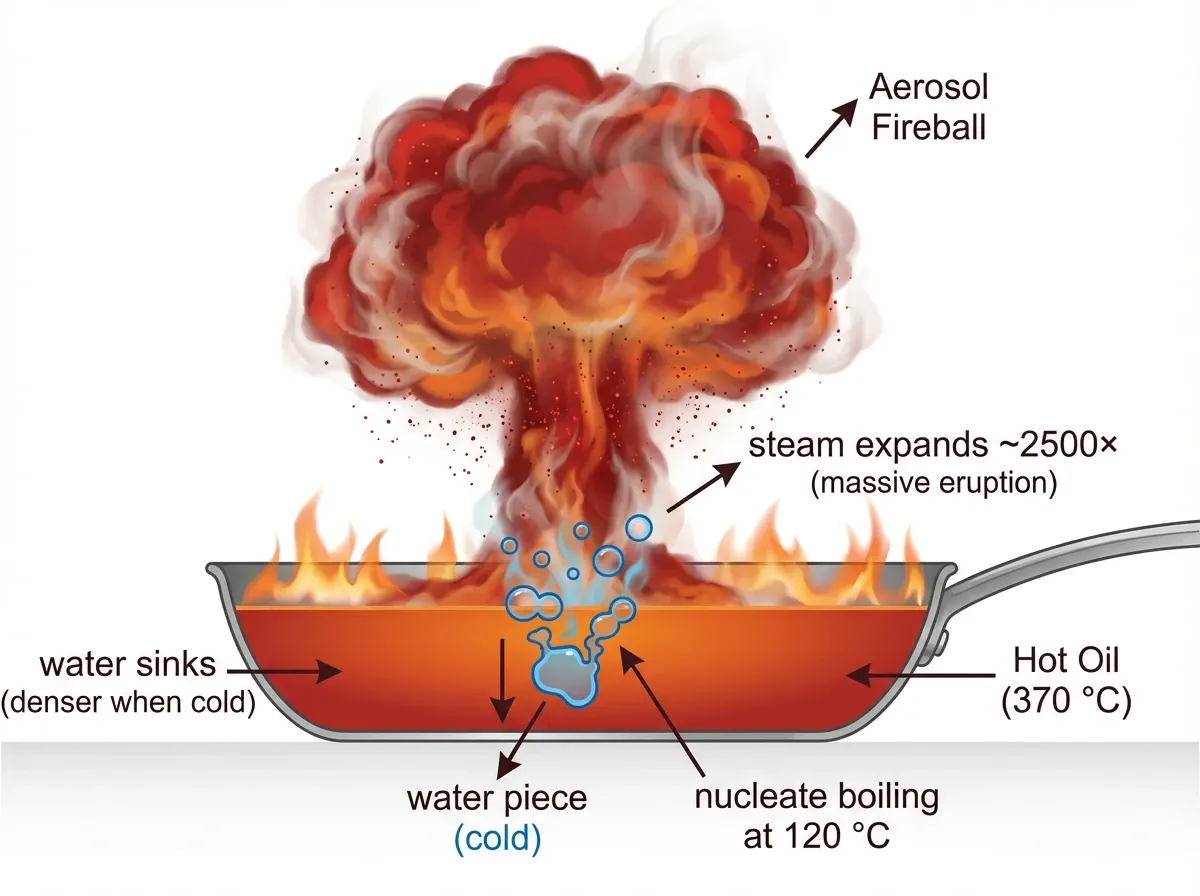
This is why fire services speak with one voice on the subject. The London Fire Brigade, the NFPA, and their peers across the industrialised world share a single message. Never, under any circumstances, pour water on a grease fire.
What actually works, ranked by science
The correct response to a kitchen fire follows a clear hierarchy. Each step targets a different side of the fire tetrahedron: fuel, oxidiser, heat, and chain reaction.
First, the lid. Sliding a metal lid or cookie sheet over the pan starves the fire of oxygen. Then, turn off the burner. Most hydrocarbon flames go out once oxygen falls to roughly 12–15%, depending on the fuel, according to Morehart, Zukoski and Kubota. Leave the lid in place until the pan cools completely. Otherwise, reflash — the re-ignition that follows — becomes the most common failure mode.
Second, a fire blanket. Blankets certified to BS EN 1869:2019 must pass cooking-oil and electrical-resistance tests, and since 2019 a Class B heptane fire test as well. The standard rates them for cooking-oil fires of up to 3 L, and treats them as single-use. Keep yours within easy reach of the cooker, but not directly above it, so the fire cannot block access.
Third, a wet-chemical extinguisher. In the United States the rating is Class K. In Europe and the UK, the same class goes by Class F. Wet-chemical agents use potassium acetate, citrate, or carbonate. Consequently, they do three things at once. First, they exploit the latent heat of vaporisation of water (2,257 kJ/kg) to cool the oil below its autoignition point. Second, they displace oxygen with steam. Finally, they saponify the hot triglyceride fuel into a thick potassium soap that physically seals the oil surface.
The same wet-chemical approach underpins commercial kitchen systems tested to UL 300, a fire test standard in force since November 1994. The mildly alkaline potassium salt solution, with a pH of about 8.5, reacts with the triglyceride to form soap and glycerol. As a result, the soap layer blocks vapour release and keeps oxygen out.
Fourth — and often harmful — the standard ABC dry-chemical extinguisher. The household kind uses monoammonium phosphate. On a cooking-oil fire, however, it fails three ways at once. First, it offers little cooling, so the oil stays near 400 °C and can re-ignite once the powder settles. Next, its high-pressure discharge can splatter burning oil out of the pan. Finally, it does not saponify. NFPA 10 therefore requires Class K extinguishers wherever people cook with oils and fats. NFPA 17 goes further, noting that multipurpose dry chemical “should not be used on fires in deep-fat fryers.”
A final household-remedy note on kitchen fire response. Baking soda can work on very small, incipient fires because it starts to break down above about 50 °C and releases CO₂. However, never dump it on a deep fryer — the rapid gas release splatters hot oil. Likewise, never throw flour. Finely divided flour has a minimum explosible concentration near 50–60 g/m³. Therefore, tossing it toward an open flame creates a dust-cloud deflagration — a fireball, not a smother.
The smoke alarm paradox
In US homes with working smoke alarms, the death rate per reported fire runs about 60% lower. Yet nearly three of every five U.S. home-fire deaths happen in homes without an alarm, or with a non-working one. Cooking also causes most nuisance alarms, a leading reason people disconnect them. In a 2010 Harris poll for NFPA, 73% of households whose alarm had sounded in the past year blamed cooking.
The physics explains the paradox. Ionisation alarms trigger on small combustion particles, so cooking smoke sets them off far more often. Photoelectric alarms, by contrast, respond best to larger smoke particles and trip less often on cooking. Our post on ionization vs photoelectric smoke alarms covers the field trials. Consequently, NFPA 72 requires alarms to sit at least 10 feet (3.0 m) from a fixed cooking appliance. Moreover, under a 2022 amendment, alarms installed from January 2025 between 10 and 20 feet from the cooker must meet UL 217 8th edition or later, which adds a cooking-nuisance test.
France took a different path. Under the Loi Morange of 9 March 2010, every French home has needed at least one smoke alarm since 8 March 2015, and French law bans ionisation detectors outright. The effect on deaths remains hard to read. The law’s sponsors cited more than 800 deaths a year from home fires. Yet official fire-service counts, which measure differently, recorded about 280 fire deaths in 2014 and a similar toll a decade later.
The two minutes that decide everything
The most important behavioural finding of the last decade concerns how quickly modern homes actually burn. For example, UL’s Fire Safety Research Institute has shown that living rooms furnished with synthetic materials flash over in under five minutes. By contrast, rooms with the natural materials of decades ago took about 30 minutes. Therefore, once a kitchen fire sets off your smoke alarm, NFPA warns that you may have as little as one or two minutes to escape.
This collapses the decision window. Fight a kitchen fire only when every one of these conditions holds: the flame stays small, contained, and steady; everyone else has left the room; emergency services have your call; and you have a clear path of retreat. Otherwise, get out. Then close the door behind you. UL’s “Close Before You Doze” experiments found that rooms with closed doors stayed below 100 °F while open-door rooms exceeded 1,000 °F.
Call emergency services first — 911 in the U.S., 999 in the UK, 112 across the EU. In addition, never move a burning pan. Both the London Fire Brigade and Lancashire Fire and Rescue warn against it, and Lancashire notes that this is how many burn victims get their injuries. Finally, if you must leave the kitchen for even thirty seconds, turn the burner off.
Key takeaways
Your kitchen ranks as the most dangerous room in your house for a simple reason. You routinely heat oil to 180 °C on an open burner, often while juggling other tasks, and a forgotten pan can reach autoignition in about 20 minutes. Meanwhile, a room full of modern synthetic furnishings can reach flashover in under five minutes.
The practical implications stay narrow, yet non-negotiable. First, install a photoelectric smoke alarm at least 3 metres from the stove, plus a heat detector inside the kitchen itself. Second, keep a BS EN 1869-certified fire blanket within easy reach of the cooker. Third, keep a lid that fits your largest pan within arm’s reach. Fourth, if you own an extinguisher, make it Class K (U.S.) or Class F (Europe) — not ABC.
Finally, remember the hierarchy when something goes wrong. Turn off the heat. Smother with a lid or blanket. Close the door. Call the fire service. Get out. In short, water does more than merely fail on a kitchen fire. It can turn a contained pan fire into a fireball that fills the room. The deadliest mistake in the kitchen is the one your reflexes will tell you to make.
Cite this articleHow to cite
Dinh, D. C. (2026, April 19). The Science of a Kitchen Fire: Why Water Makes It Worse (Updated October 1, 2026). PyroRisk. https://pyrorisk.net/blog/kitchen-fire-science/
Recent posts
Featured posts
Categories
Comments
Related posts
Fire in Daily Life
Chimney Fire Science: Why Creosote Turns Flues Into Fuel
A chimney fire can hit 1090 °C and crack a clay flue liner in minutes. Here is the creosote science behind it, and why an annual sweep stops it.
Fire in Daily Life
Christmas Tree Fire: Flashover in 60 Seconds Explained
A dry Christmas tree fire can hit 7 megawatts and flash a whole room in under a minute. Here is the NIST science, second by second, and why water stops it.
Fire in Daily Life
Turkey Fryer Fireball: The Physics of Water in Hot Oil
A turkey fryer holds five gallons of hot oil over an open flame. See why 100 g of ice makes 200 L of steam, how pots overflow, and how to fry safely.