5 Sprinkler Design Mistakes That Cause Catastrophic Fires
The five sprinkler design mistakes that show up again and again in fire loss data — from commodity errors to ESFR clear-zone failures and cold-storage timing.
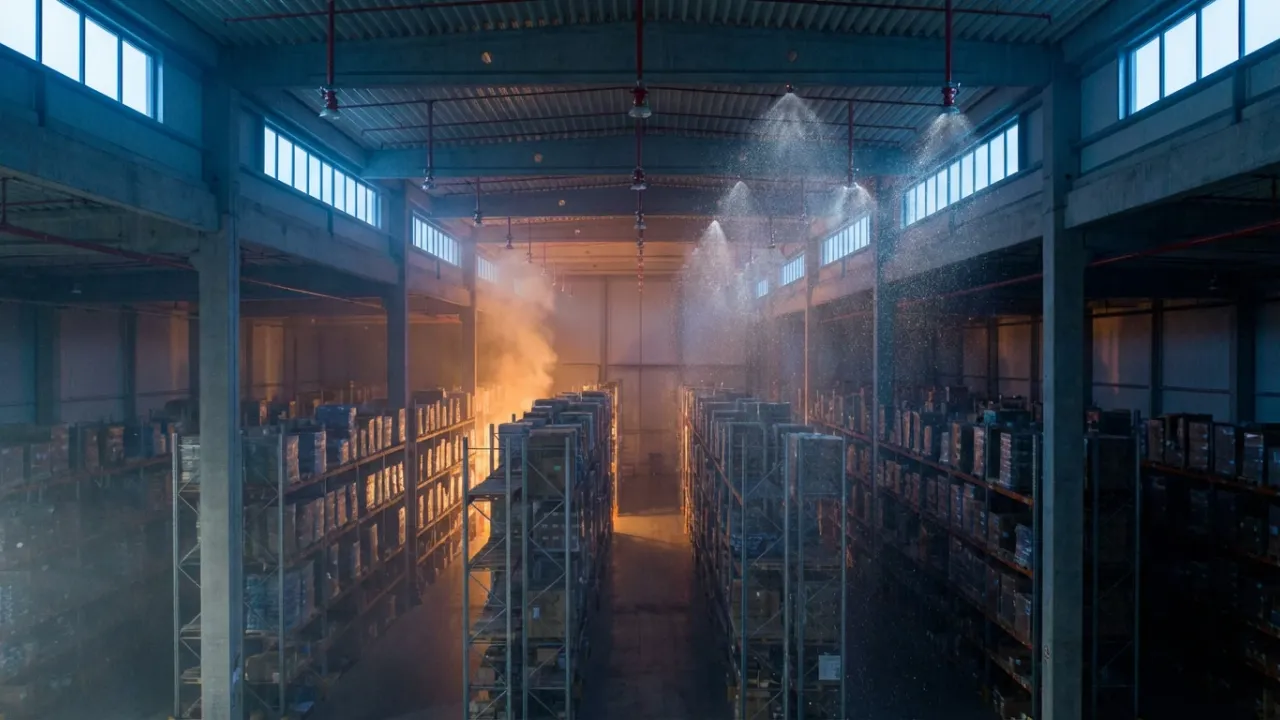
When a fire sprinkler fails to stop a fire, the sprinkler itself is almost never the culprit. Instead, the root cause usually traces to a sprinkler design decision from years earlier. The NFPA’s 2024 U.S. Experience with Sprinklers report shows that in U.S. structure fires large enough to open a head, sprinklers operate 92% of the time. Moreover, when they operate, they control the fire in 97% of cases. Consequently, the 89% combined success rate ranks as one of the strongest engineering records in construction. However, a small slice of systems still fail in spectacular ways. Those failures nearly always trace back to five recurring sprinkler design mistakes.
This post walks through each one, with the numbers, the codes, and the landmark loss cases that prove the point.
TL;DR
- U.S. sprinklers operate 92% of the time and control the fire 97% of the time they operate — an 89% combined success rate.
- The five recurring sprinkler design mistakes: wrong commodity classification, inadequate water supply, wrong sprinkler type or K-factor, obstruction and spacing errors, and cold-storage or corrosion traps.
- Misclassifying a warehouse’s stored commodity can triple water demand — the 2020 Redlands Amazon fire topped $200 million after undisclosed expanded plastics.
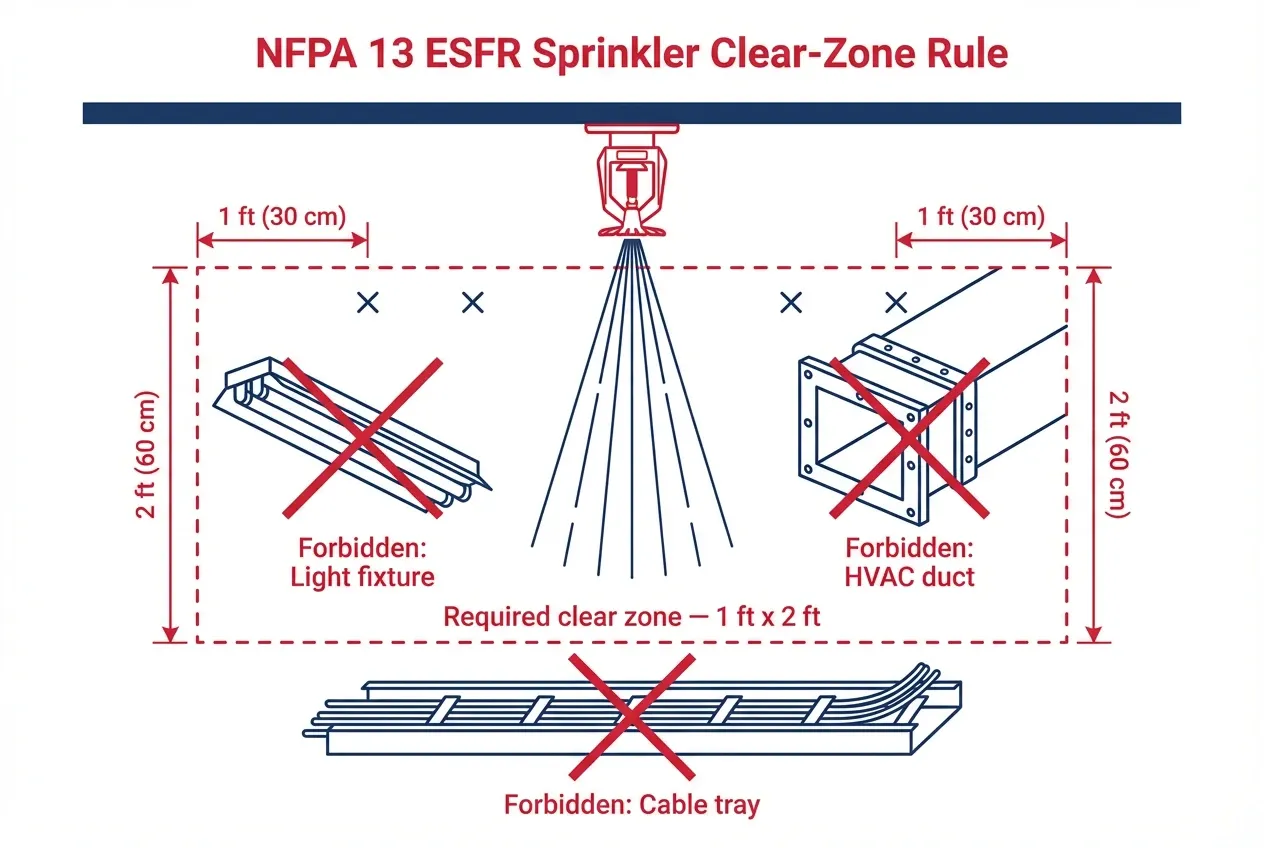
- ESFR sprinklers need a strict 1 ft × 2 ft clear zone below every pendent head; any obstruction inside it disqualifies the system.
- Dry-pipe systems must deliver water to the remote head within 60 seconds (30 seconds for high-hazard freezer storage) — some freezer warehouses have measured 3 minutes.
- Closed shut-off valves alone cause 61% of sprinkler non-operation, but design-stage errors cause the most total losses.
The stakes: what sprinkler failure data actually shows
Before we dig into the mistakes, it helps to see what the reliability statistics hide. For example, UK data from the NFCC and NFSN Optimal Economics study is even stronger: 94% operational reliability and 99% effectiveness across 2,294 incidents. Yet fire still drives the largest share of business-interruption losses. Allianz Commercial’s 2024 analysis pins fire at 36% of all BI claim value — over $1.3bn.
Strip away the headline non-operation cause — a closed shut-off valve, which drives 61% of cases — and what remains is smaller but far more destructive. These are the design-stage errors. When a sprinkler design error causes a system to fail, the failure is usually total. Similarly, the loss is usually total. In short, design mistakes do not bend the odds; they break them.
Dry-pipe systems perform worse than wet. Wet systems hit 92% combined reliability, but dry-pipe drops to 77%. That gap alone shapes much of what follows.
Mistake 1: getting the hazard or commodity classification wrong
Classification is the foundation of every sprinkler design. Every downstream number — density, design area, K-factor, pipe size, pump head, tank volume — flows from one early judgement. Therefore, getting it wrong ruins everything downstream.
Under NFPA 13 Chapter 4, occupancies run from Light Hazard (0.10 gpm/ft² over 1,500 ft²) through Ordinary Hazard Group 1 and 2, up to Extra Hazard (0.30–0.40 gpm/ft² over 2,500 ft²). EN 12845 uses a parallel scheme: LH at 2.25 mm/min over 84 m², OH1–OH4 at 5.0 mm/min, and HHP/HHS classes up to 17.5+ mm/min.
The gap between right and wrong can triple the water demand. For instance, a warehouse classified as Ordinary Hazard Group 2 but really storing expanded Group A plastics needs an Extra Hazard sprinkler design. The density alone jumps from 0.20 to 0.40 gpm/ft². Moreover, the design area expands by 67%. Swap wood pallets for plastic and, unless the pallets are UL 2335 or FM 4996 listed, the commodity bumps up two classes automatically. Even 5% expanded plastic in packaging can push an entire facility into a new category.
The Redlands, California Amazon warehouse fire of 6 June 2020 is the textbook modern case. The 600,000 ft² site had ESFR sprinklers and a 2,500 gpm fire pump — nominally strong. However, the high-piled storage plans did not disclose exposed expanded plastics. The loss topped $200 million. Zurich’s management-of-change briefing shows this pattern repeats year after year.
How to avoid it. First, produce a written commodity report signed by the owner. Next, identify the controlling commodity — the highest class across product, packaging, and pallet. Finally, cross-check NFPA 13 against FM Global Data Sheet 8-9 and design to the stricter of the two.
Mistake 2: inadequate water supply and hydraulic errors
A sprinkler head is a flow device: Q = K·√P. In other words, if pressure at the remote head is too low, the head closest to the fire is the one that starves. For that reason, water supply errors never announce themselves. They stay silent until the fire arrives.
The usual culprits are predictable. First, designers use flow-test data over a year old, even though a municipal supply can lose 30–50% of its pressure seasonally. Second, they assume a Hazen-Williams C-factor of 150 for aged steel when NFPA 13 demands 100 for dry systems. Third, they forget the hose-stream allowance. Fourth, they skip the 10% safety margin between demand and supply curves. Any one of these errors alone can sink a sprinkler design.
Duration matters just as much. EN 12845 §8.1.1 sets the water duration at 30 minutes for LH, 60 minutes for OH, and 90 minutes for HHP/HHS. NFPA 13 meanwhile requires hose-stream allowances of 100, 250, and 500 gpm at the base of the riser — a figure that engineers often drop when calculating sprinkler demand alone.
The Kmart Distribution Center fire in Falls Township, Pennsylvania on 21 June 1982 is still the canonical loss. A 1.2-million-square-foot warehouse burned to the ground. Meanwhile, the sprinkler design targeted only 0.40 gpm/ft² over 3,000 ft². That was far too little for the aerosol commodity. Worse, the local fire chief had warned the water supply was thin one month before the fire. The $100+ million loss drove the development of NFPA 30B, in-rack sprinklers, and, eventually, ESFR technology itself.
How to avoid it. Witness a calibrated flow test within 12 months of design. Then plot a demand curve with a 10% safety factor and confirm the supply clears it. Where the municipal supply is unreliable — in drought-prone regions, for example — specify on-site storage per NFPA 22 and a dedicated pump per NFPA 20.
Mistake 3: the wrong sprinkler type or K-factor
The sprinkler catalogue has grown crowded. For example, K-factors span K5.6 to K25.2. Technology families include standard-spray control mode, CMDA, CMSA, and ESFR. On top of that, Response Time Index splits heads into Quick Response (RTI ≤ 50) and Standard Response (RTI ≥ 80). A sprinkler design that mixes these categories by mistake will underperform — often badly.
ESFR is the most misapplied of all. It is a suppression-mode technology, not a control technology. Its listings are extraordinarily tight. For example, NFPA 13 demands a clear zone of 1 foot horizontally by 2 feet below every pendent ESFR head. Any light fixture, conduit, duct, or cable tray inside that envelope disqualifies the system. Moreover, solid-shelf rack storage defeats ESFR entirely, because flue-space gaps are blocked. In-rack sprinklers then become mandatory, no matter what the ceiling density is.
EN 12845 is even stricter on head selection. Section 14.2.2 explicitly bans flush, recessed, and concealed sprinklers in OH4, HHP, and HHS classes. Temperature rating mismatches add a second trap. Ordinary-temperature heads near process heat cause nuisance trips. High-temperature heads over a Light Hazard fire may not open in time.
When ESFR fails, it fails in a cascade. Droplets lack momentum to punch through the plume. Therefore, ceiling heads over-operate. Demand then exceeds supply. Finally, the whole system collapses. This “skipping” pattern appears again and again in FM Global warehouse case files, including early Group A plastic losses in the 1990s.
How to avoid it. Use the decision tree in NFPA 13 Chapter 22 or FM Global DS 2-0. Never default to ESFR on cost grounds. Enforce the 1 ft × 2 ft clear zone during MEP coordination. Under EN 12845, apply the K-factor tables strictly.
Mistake 4: obstructions, spacing, and coverage errors
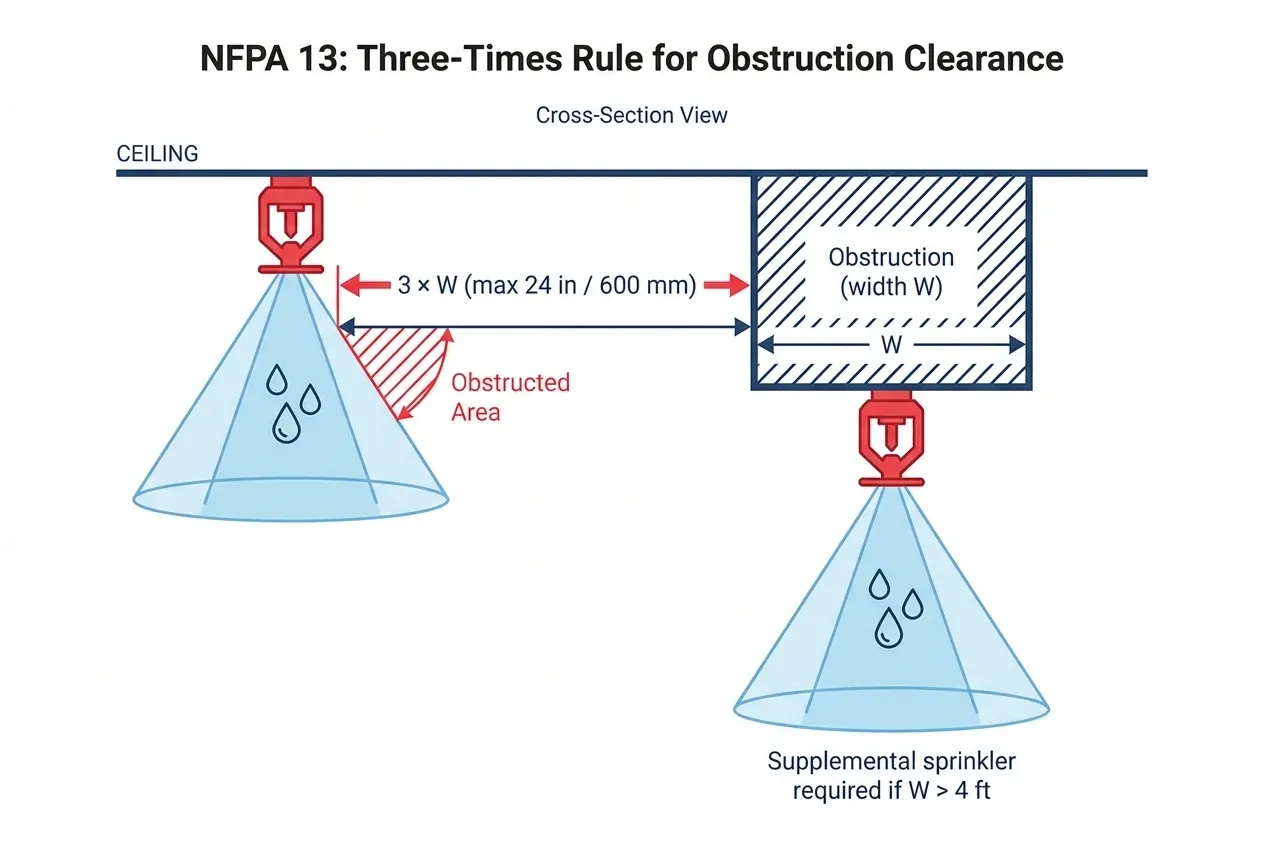
Obstruction-related citations are the single most common finding from sprinkler inspectors, per HFM Magazine’s compliance reviews. NFPA 13 Chapter 10 spells out the rules. First, the three-times rule says a head must sit at least three times the obstruction’s maximum dimension away from it, capped at 24 inches. Next, the wide-obstruction rule calls for supplemental heads under any obstruction wider than 4 feet. Finally, the 18-inch rule fixes minimum clearance between storage and ceiling deflectors (36 inches for CMSA and ESFR).
Coverage-area limits follow a parallel matrix. NFPA 13 caps Light Hazard at 225 ft² per head. Similarly, Ordinary Hazard drops to 130 ft². Extra Hazard and storage then tighten to 100 ft². For comparison, the EN 12845 values for ceiling heads are 21 m², 12 m², and 9 m² respectively. Moreover, the minimum spacing between any two heads is 1.8 m (6 ft) in both standards. That rule exists to stop one head from cold-soldering the fusible link of the next.
Beams, bar joists, HVAC ducts, cloud ceilings, late-stage light fixtures — every single one of these can violate the three-times rule. In-rack sprinklers placed in the wrong flue space fail for the same reason. Even a single obstructed head above the fire origin can lead to an uncontrolled fire, per FM Data Sheet 2-2.
How to avoid it. Mandate BIM clash detection between sprinkler, architectural, structural, and MEP models before fabrication. Apply the three-times rule to every object larger than 8 inches. For ESFR, treat the 1 ft × 2 ft clear zone as a non-negotiable architectural constraint.
Mistake 5: cold-storage, dry-pipe, and corrosion traps
This is really two linked errors with a shared root. Both treat sprinkler design as a mechanical discipline when in fact it is a water-chemistry problem too. Both are getting worse as warehouse heights, freezer capacities, and pipe ages all climb.
Water delivery time. NFPA 13 §8.2.3 caps water delivery to the remote head at 60 seconds for dry-pipe systems. For high-hazard freezer rack storage, FM Global tightens this to 30 seconds. J. F. Ahern’s 2025 cold-storage analysis found freezer warehouses where water took three minutes to arrive. That is long enough to guarantee an uncontrolled fire. One NFPA case study documents an $87.5 million refrigerated warehouse loss that needed 21 million gallons and 48 hours to control.
Corrosion. FM Global Data Sheet 2-1 upended decades of conventional wisdom. After reviewing over 300 case studies, FM concluded that oxygen — not microbiologically influenced corrosion — drives most sprinkler corrosion. For example, trapped air pockets in wet systems cause oxygen pitting. Similarly, every trip-and-refill cycle in dry systems lets fresh oxygenated water in. Counter-intuitively, galvanized dry pipe often fails faster than black steel, because pinhole zinc breakthrough concentrates pitting at single points.
NFPA 13 §7.1.5 now requires automatic air vents at every wet-pipe high point. FM Global calls for nitrogen inerting to at least 98% for dry and pre-action systems. In addition, pre-action sprinkler design carries its own penalty: a 30% design-area increase for double-interlock systems. Designers who pick double-interlock to prevent freezer leaks often forget this.
How to avoid it. For any space below 4 °C, run a fluid-delivery-time calculation. Prefer double-interlock pre-action for freezers, and apply the 30% area increase. Specify nitrogen inerting at ≥98% for all dry and pre-action systems. Finally, use black steel — not galvanized — for dry piping.
Emerging frontiers: batteries, robots, and post-Grenfell flats
Three forces are reshaping sprinkler design faster than codes can catch up.
Lithium-ion battery storage has broken the old model. NFPA 13 (2025) Annex A.20.4 explicitly excludes Li-ion batteries from its commodity tables. As a result, no prescriptive commodity class yet exists. NFPA 855 calls for 0.3 gpm/ft² over 2,500 ft², but only when energy storage systems stay under 600 kWh per fire area. Most utility-scale sites cannot live within that cap. FM Global DS 7-112 now leads, banning cells in ASRS altogether. The McMicken BESS explosion in Arizona on 19 April 2019 and the January 2025 Moss Landing fire in California both proved that water alone cannot suppress thermal runaway. For more on these failure modes, see our lithium-ion battery basics post.
Warehouse automation is outpacing NFPA 13. Grid-type ASRS setups like AutoStore and Ocado, with open-top totes and 35+ ft heights, fall outside every ESFR listing. FM DS 8-34 is now the leading reference.
Post-Grenfell rules have reshaped UK residential sprinkler design. Since 26 November 2020, England’s Approved Document B has required sprinklers in new flats above 11 m — down from 30 m. Wales went further in 2016 with mandatory sprinklers in all new dwellings. Scotland followed in March 2021. BS 9251:2021 introduced a new Category 4 for buildings above 18 m, with duplicate pumps and UPS backup. Car parks were rewritten too: after the Liverpool Echo Arena fire of 31 December 2017 destroyed 1,400 vehicles, NFPA 88A (2023) now demands sprinklers in all parking structures.
How to catch these five sprinkler design mistakes
The five mistakes share a common diagnostic. Each one lives at the seam between an engineering assumption and a real-world variation. Best practice, therefore, is to close those seams systematically.
First, mandate independent third-party review — the cheapest intervention that catches the most errors. Second, require a witnessed flow test with calibrated gauges within 12 months of design. Third, specify only UL- or FM-approved components (or LPCB, VdS, or CNPP-listed ones in Europe). Fourth, run formal commissioning tests and record the baseline pressures.
Finally, adopt a formal management-of-change procedure. The Redlands Amazon loss, the Kmart Falls Township loss, and dozens of FM warehouse cases all share the same failure mode. Someone changed the stored goods, stacked them higher, or wrapped them differently — and no one re-engaged the fire engineer. For that reason, the owner should re-issue Owner’s Certificates per NFPA 13 §4.3 every time use changes.
For the statistical backbone behind these design decisions, see our event tree vs fault tree post.
Key takeaways
Sprinkler failure is overwhelmingly a systems-engineering problem, not a device problem. The NFPA’s 89% combined success rate and the UK’s 99% effectiveness both prove the technology works. However, it only works when five design decisions go right: classify rigorously, calculate conservatively, choose the correct sprinkler family, respect obstruction rules, and account for cold-space and corrosion chemistry.
Where sprinklers fail catastrophically, the fingerprint is almost always one of these five sprinkler design mistakes. All five are decidable at the design desk, years before the fire arrives. That is the whole point, and also the whole opportunity.
Cite this article
Dinh, D. C. (2026, April 18). 5 Sprinkler Design Mistakes That Cause Catastrophic Fires. PyroRisk. https://pyrorisk.net/blog/sprinkler-design-mistakes/
Recent posts
Featured posts
Categories
Comments
Related posts

Stack Effect: Why Stairwell Pressurization Fails in Winter
On the coldest night of the year, stack effect can reverse a stairwell pressurization system and pull smoke into the stairs occupants flee through.

ASET vs RSET: The Inequality Behind Every Evacuation Plan
ASET vs RSET decides whether a building passes. Here come the timeline, the tenability limits, the equations, and the one term that swings the answer most.

Event Tree vs Fault Tree: Two Ways to Count Fire Risk
A fault tree asks how a fire happens; an event tree asks what happens next. The logic, the algebra, and a worked warehouse example.