pyrorisk.net · Fire Science & Risk Battery Fire Safety
Why a LiPo Battery Is Really a Lithium-Ion Battery
A LiPo battery is a lithium-ion battery. The polymer only names the gel and pouch. Here is why that matters for fire safety.
Online: pyrorisk.net/blog/lipo-battery-is-lithium-ion/
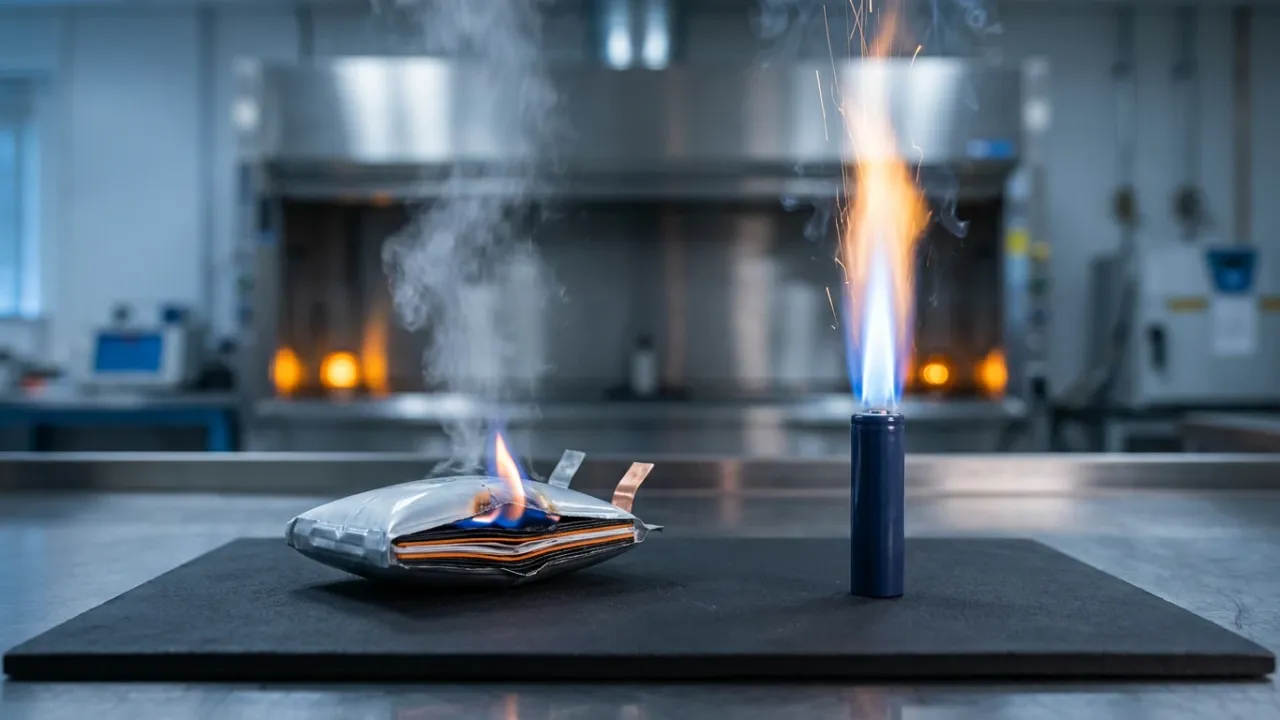
A LiPo battery powers your drone, your phone, and many new cars. Yet most hobby forums still call it a “different thing” from lithium-ion. That myth hurts people. So this post puts it to rest.
First, the short answer. A LiPo battery is just a lithium-ion cell in a soft pouch. The cathode, the anode, and the salt all match a standard 18650. Only the shape and the gel change. Therefore, every fire rule for lithium-ion also holds for LiPo.
TL;DR
- A LiPo battery is a standard lithium-ion cell in a soft pouch — same cathode, anode, and LiPF₆ electrolyte as an 18650.
- UN shipping codes 3480 and 3481 explicitly classify “lithium ion polymer batteries” as lithium-ion, not a separate class.
- The gel electrolyte is 60–80% flammable solvent by weight and ignites near room temperature, same as a liquid cell.
- Failure follows the same five-stage cascade as any lithium-ion cell: SEI breakdown near 100 °C, separator melt near 130 °C, oxygen release above 180 °C.
- Retire any pack that swells, smells sweet, or drops below 3.0 V at rest.
- Fight a LiPo fire with water, not Class D powder — keep cooling until every cell drops below 80 °C to prevent reignition.
A LiPo battery shares its chemistry with every other lithium-ion cell
Three cell shapes leave the factory each day. First, there is the round can, like the 18650 or the 21700. Next, there is the hard box, called prismatic. Finally, there is the soft pouch, sold as “LiPo.”
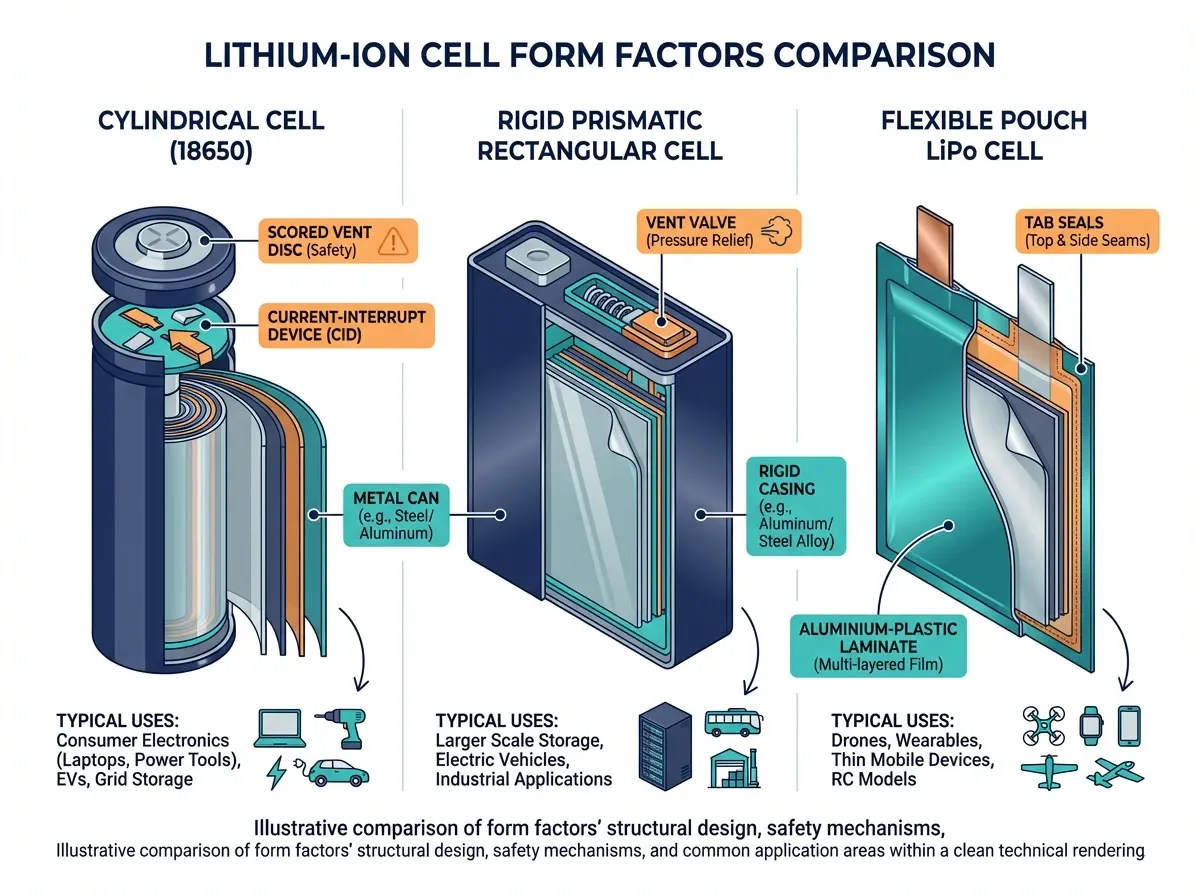
However, the guts of each one look the same. The plus side still uses a lithium metal oxide. Common picks are LCO, NMC, NCA, or LFP. The minus side still uses graphite. Sometimes makers mix in a little silicon for more range.
The salt still sits as LiPF₆. It still floats in a mix of carbonate solvents. So the fuel is the same. As Battery University puts it, both systems use the “identical cathode and anode material.” In short, the chemistry does not change with the shape.
What the word polymer really means inside a LiPo battery
Most hobby LiPo cells use a gel electrolyte. The gel starts as a PVDF-HFP polymer. Makers then soak it with the same liquid a cylindrical cell carries. Therefore, the solvent still burns as freely.
For example, dimethyl carbonate flashes near 18 °C. Ethyl methyl carbonate flashes at 23.5 °C. Both catch fire at room temperature. The gel only slows leaks. It does not turn the solvent into a safe fluid.
True solid-polymer cells do exist. However, they need to run at 60 °C or above. As a result, you will not find them in any drone pack. In short, every retail LiPo battery today holds a soft, flammable gel.
The pouch itself uses thin aluminium foil between nylon and plastic layers. Sharp objects pierce it with ease. Keys, coins, or debris from a neighbour cell can all cut the seal. So the LiPo battery trades toughness for the highest energy density of any shape.
The shipping rules already settled the question
If chemistry alone does not convince you, the law will. The US DOT Lithium Battery Guide and the IATA Guidance Document sort batteries into four UN codes.
First, UN 3090 and UN 3091 cover lithium metal primary cells. These include the coin cells in your car key or remote. Next, UN 3480 and UN 3481 cover lithium-ion rechargeable cells. The text reads, word for word, “including lithium ion polymer batteries.”
So the law itself puts a LiPo battery inside the lithium-ion group. Meanwhile, the same safety checks apply to each shape. UN 38.3, UL 1642, UL 2054, IEC 62133-2, and NFPA 855 all test pouch, prismatic, and cylindrical cells in the same way. The crush test, the short test, and the heat test do not care about the wrapper.
For a buyer, the rule is easy. If the pack can recharge, it counts as lithium-ion. Ship it under UN 3480 or UN 3481. Never ship it under UN 3090 or UN 3091.
Fire hazards of a LiPo battery: same story, different ending
A LiPo battery fails in the same five steps any other lithium-ion cell follows. First, the SEI layer breaks down near 100 °C. Next, the liquid reacts with the charged graphite. Then the separator melts near 130 °C. After that, the cathode gives up oxygen above 180 °C. Finally, the vent gas ignites.
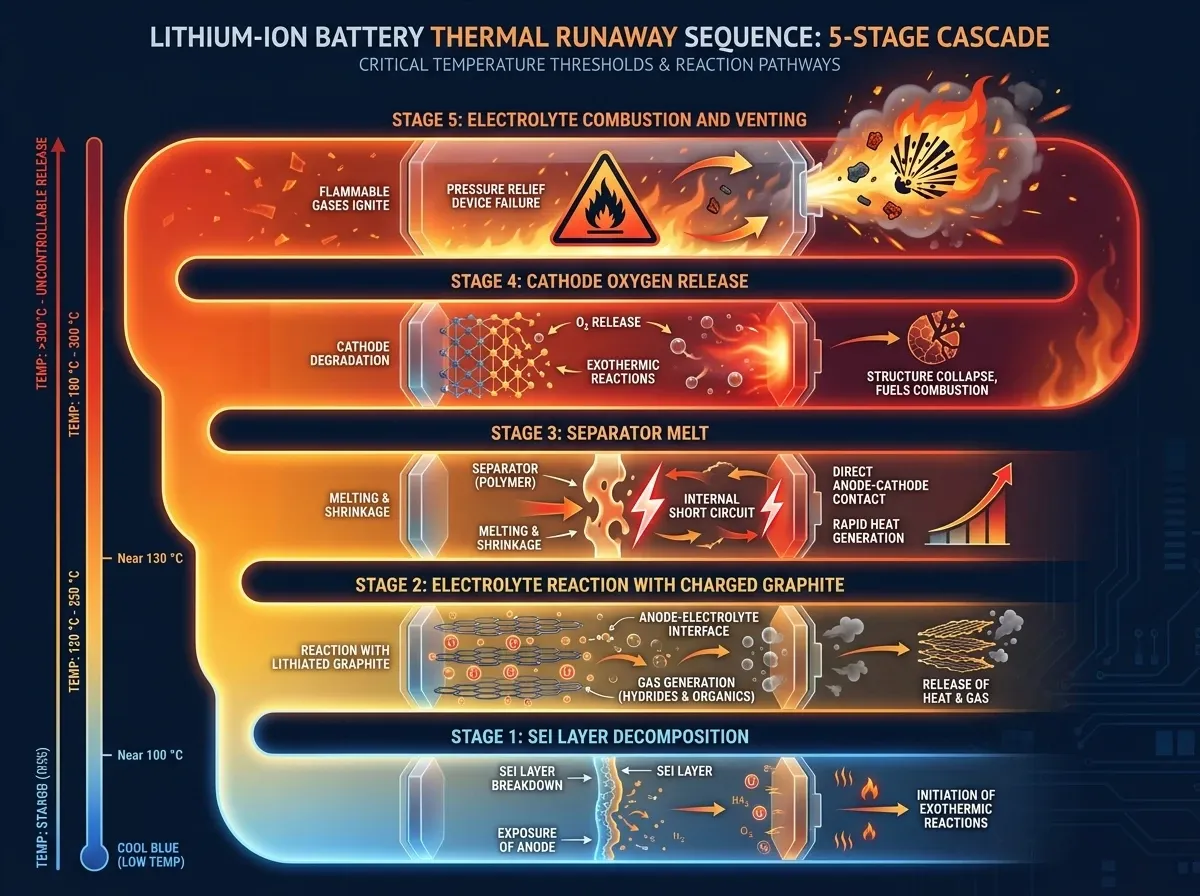
However, the final stage looks very different for a pouch. A cylindrical 18650 shoots a sonic jet through a scored vent. The jet can reach roughly 162 m/s. A LiPo battery, on the other hand, bulges first. The pouch puffs up as gas collects. Eventually, the seal tears. A flat sheet of flame then covers the swollen pack.
Moreover, pouch cells pass heat faster inside a module. Their flat faces touch each other. So the fire runs from one cell to the next in seconds. The FAA’s TC-TN21-54 report measured this effect directly.
The toxic vent gas also matches. Larsson and colleagues recorded 20–200 mg of hydrogen fluoride per watt-hour across pouch and round cells alike. So the gel does not cut the poison load. Therefore, firefighter gear needs stay the same.
How to store and charge a LiPo battery safely
First, store each pack between 40 and 60 percent charge. That level slows ageing and limits the fuel in a runaway event. In addition, park the packs at 15 to 25 °C. Keep them far from paper, wood, or cloth.
Second, always use a balance charger. Match it to your cell count and chemistry. NMC, LCO, and NCA cells top out at 4.20 V per cell. LFP cells top out at 3.65 V per cell. A LiPo battery will lose a weak cell fast if the charger skips the balance step.
Third, never charge a LiPo battery below 0 °C. Cold charging plates metal lithium onto the graphite. The plated metal can grow tiny spikes. Those spikes short the cell later. Similarly, avoid charging above 45 °C. Heat ages the SEI layer fast.
Finally, retire any LiPo battery that swells, smells sweet, or drops below 3.0 V at rest. A swollen pack has already started to fall apart. Quarantine it in dry sand or vermiculite. Then send it through a take-back program.
Firefighting a LiPo battery the right way
First, skip the Class D powder. Class D agents target bulk lithium metal. A LiPo battery does not hold any. For a pouch pack, water works best. It cools the cells, and cooling ends the cascade.
Next, expect the pack to reignite. Flames can die down in minutes. However, a hot cell inside can restart the fire hours later. So keep water flowing until every cell drops below 80 °C. F-500 and AVD also work well for small packs.
Finally, wear full breathing gear. A burning LiPo battery vents HF, POF₃, CO, and benzene. The NFPA Fire Protection Research Foundation confirms all four in field tests. SCBA is never optional.
Quick answers about a LiPo battery
Does a LiPo battery hold metallic lithium? No. A healthy cell holds lithium only as ions. Metal lithium shows up only as a defect from bad charging or damage.
Is the gel safer than a liquid? No. The gel still holds 60 to 80 percent flammable solvent by weight. It ignites near room temperature, just like a liquid cell.
Which UN code covers a LiPo battery shipment? UN 3480 by itself, or UN 3481 packed with gear. Both codes name “lithium ion polymer batteries.”
Do I need a special extinguisher? No. Water stays the main tool. F-500 and AVD serve as good backups. Class D powder belongs to metal cells, not to a LiPo battery.
Why does my drone pack swell? Gases build up inside the pouch over time. High charge, high heat, or a hard knock speed the process. A puffy pack has left its safe window. Retire it before you plug it in again.
The bottom line for anyone who owns a LiPo battery
One chemistry, three shapes, one set of rules. That framing puts the myth to bed. A LiPo battery runs on the same reactions as an 18650. It vents the same toxic gas when it fails. The difference lives in the shape, not the science.
So treat every pack with respect. Balance-charge it. Store it at partial charge. Ship it under the right UN code. For first responders, reach for water, not powder, and never drop the SCBA.
In short, the word polymer only labels the gel and the pouch. The chemistry beneath is lithium-ion, top to bottom. Once you see that, every other safety step falls into place.
Cite this articleHow to cite
Dinh, D. C. (2026, April 20). Why a LiPo Battery Is Really a Lithium-Ion Battery. PyroRisk. https://pyrorisk.net/blog/lipo-battery-is-lithium-ion/
Recent posts
Featured posts
Categories
Comments
Related posts
Battery Fire Safety
LFP vs NMC Battery Safety: Why Chemistry Decides Fire Risk
LFP vs NMC battery chemistry sets the fire risk before any vent opens. Here is why one chemistry burns hotter, vents more gas, and explodes more often.
Battery Fire Safety
Are EV Fires Really More Common Than Gas Car Fires?
Across U.S., Swedish, Australian, Norwegian and Polish data, EV fires happen 20 to 80 times less often than gas car fires per registered vehicle.
Battery Fire Safety
Lithium-Ion Battery Basics: How They Work and Why They Burn
What a lithium-ion battery is, how the 'rocking chair' of ions works, and why this Nobel-winning chemistry also carries real fire risk.