pyrorisk.net · Fire Science & Risk Battery Fire Safety
Solid-State Battery Fire Risk: A Sober Look at What Changes
A solid-state battery drops the flammable solvent, not the oxidizer or the lithium. Here comes what changes in thermal runaway, and what stays put.
Online: pyrorisk.net/blog/solid-state-battery-fire-risk-a-sober-look/

Every solid-state battery press release repeats one line. Swap the flammable liquid for a non-flammable solid, and the fire risk goes away. The first half of that line holds. The second half mixes up two different things, and this post sets out why. A cell in thermal runaway burns as a closed redox system, never as a pool of solvent. The charged cathode gives up oxygen. A lithiated anode grabs that oxygen. Enough stored energy sits between them to heat the whole cell by hundreds of kelvin with no air at all. The liquid electrolyte plays one role in that system. Remove it, and the two most energetic reactants still sit a few tens of microns apart.
TL;DR
What a solid-state battery changes
- Inorganic solid electrolytes remove the solvent vapour that turns a hot cell into a jet fire.
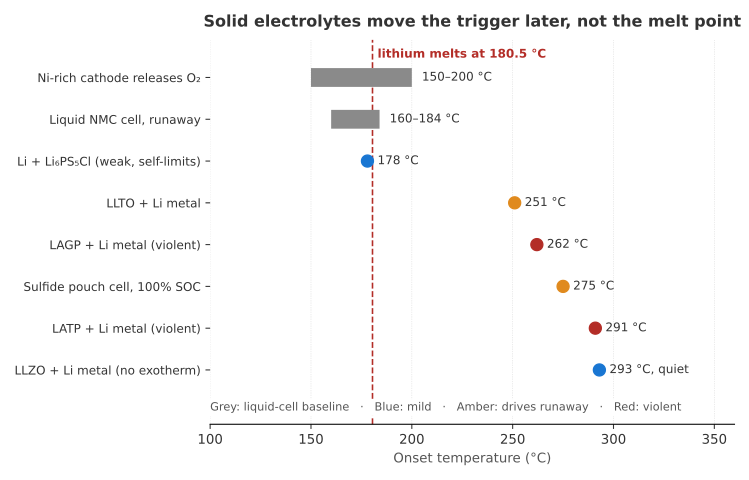
- Runaway starts later. A sulfide pouch cell held to 275 °C before it ran away, about 100 K above a liquid NMC cell.
- The best pairings, argyrodite or LLZO next to lithium, remove one whole exothermic reaction.
- External heating, the abuse mode in every vendor video, gets safer.
What a solid-state battery leaves alone
- The oxidizer. A charged Ni-rich cathode still gives up oxygen from 150 to 200 °C.
- A short circuit still dumps the stored energy as heat. A lithium metal cell stores 1.5 to 2 times more of it per kilogram.
- Lithium metal melts at 180.5 °C, then flows, then reacts with an oxide cathode as a thermite.
- Sulfides add H₂S, halides add Cl₂, and polymers burn on their own.
- Every “solid-state” car on sale today runs a hybrid cell with 5 to 20 wt% liquid. Treat those as lithium-ion.
What does the liquid electrolyte do in a lithium-ion fire?
The liquid supplies the vapour-phase fuel, plus the first exotherm in a low-nickel cell. It supplies no oxygen. In the most energetic cells it never starts the runaway at all.
Carbonate electrolytes, EC, DMC and EMC with LiPF₆, do three things under abuse. First, they break down against the lithiated anode from roughly 90 to 120 °C and give off heat. Second, they boil off and vent as a flammable mix of H₂, CO, CH₄, C₂H₄ and solvent vapour. Then they burn with the oxygen the cathode releases. That venting makes the picture most people hold of a battery fire, and a solid electrolyte removes it. Our post on off-gas detection walks through the vent cloud in detail.
Does the electrolyte start the runaway?
Not in a high-nickel cell. There the trigger comes from oxygen that crosses from cathode to anode.
A 2018 study in Joule froze cells mid-runaway with liquid nitrogen. In high-nickel NMC cells the charged cathode released oxygen through a phase change, and the lithiated graphite consumed it. The heat peak came at 274 °C, yet no internal short showed at all. The authors flagged the solid-state battery by name. A charged Li₁₋ₓNi₀.₈Co₀.₁Mn₀.₁O₂ grain gives up oxygen at 150 to 200 °C no matter what sits around it.
So a solid electrolyte removes the vapour fuel and, for inorganic families, the low-heat reaction between electrolyte and anode. It leaves the oxidizer in place. And once it enables a lithium metal anode, the whole commercial point, it swaps the reductant for a far more reactive one.
Why does “non-flammable” fall short of “safe”?
Because the energy budget lives in the electrodes, never in the solvent. Take the solvent out, and the same charged oxide still faces the same reducing anode.
Sandia’s 2022 perspective in Joule built the first heat-release models that pit a liquid cell, an all-solid cell and a hybrid cell against each other. A solid-state battery comes out safer under external heating. Yet it comes out no safer under a short circuit or a breached electrolyte, and a lithium metal build should see a larger temperature rise because the same heat lands in a smaller mass. The LLZO model spreadsheet ships with the paper, so anyone can re-run it for another chemistry.
Why does a lighter cell get hotter?
Because the adiabatic temperature rise scales with heat over mass. Cut the mass, keep the heat, and the excursion grows.
A lithium metal cell stores 1.5 to 2 times the energy per kilogram of an NMC-graphite cell. Suppose the reactants can still find each other. Then the same fraction of that energy released as heat drives a larger jump, because shrinks while for a ceramic sits close to the materials it replaced. Energy density and worst-case heat move together, never apart.
What happens when lithium meets the cathode oxygen?
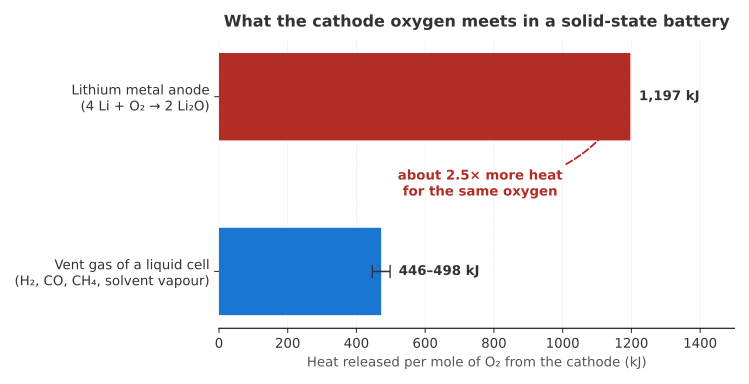
More heat per mole of oxygen than any vent gas gives. Lithium plus O₂ releases about 1,197 kJ per mole of O₂. The vent gases of a liquid cell give 446 to 498 kJ.
A Chinese Academy of Sciences team ran accelerating-rate calorimetry on oxide electrolytes against lithium metal and set those two figures side by side. Per mole of oxygen from a failing cathode, a lithium metal anode makes a hungrier sink than the solvent vapour ever did. Kinetics differ, since solids react slower than gases until something melts. Yet the enthalpy sits against the solid-state battery.
A 2025 review of sulfide cells in Advanced Energy Materials lands in the same place from the electrode side. Single electrodes in all-solid cells can release as much heat as in a liquid cell or more, with short-circuit heat leading the total. A good solid-state battery resists the start of an internal short through a stiff separator that never melts. It carries no smaller energy budget once the short exists.
Which solid electrolyte changes what?
Four families, four different hazard profiles. The table sums up the audit, and the sections that follow give the evidence.
| Family | Vapour fuel gone? | Against Li metal | Against a charged Ni-rich cathode | New gas hazard | How it breaks |
|---|---|---|---|---|---|
| Sulfide (Li₆PS₅Cl, Li₃PS₄, LGPS) | Yes | Argyrodite good, tin poor | Poor, ignites at 150 °C | H₂S, SO₂, sulfur vapour | Soft, K_IC near 0.2 MPa·m^½ |
| Oxide (LLZO, LATP, LAGP, LLTO) | Yes | LLZO quiet, LATP and LAGP violent | Moderate, O₂ still leaves | Little gas | Brittle, K_IC 1 to 2 MPa·m^½ |
| Polymer (PEO-LiTFSI) | No, the polymer burns | Moderate, runs at 60 to 80 °C | Poor wetting, more O₂ | Pyrolysis gas, HF | Soft, melts near 65 °C |
| Halide (Li₃InCl₆, Li₃YCl₆) | Yes | Poor, needs an interlayer | Good, suppresses O₂ | Cl₂, HCl | Brittle like sulfides |
What do sulfide electrolytes change?
Sulfides raise the runaway onset by about 100 K, then add a flammable solid and a toxic gas. They carry the most documented runaway chemistry of any family.
Toyota, Samsung SDI, Solid Power and CATL all back sulfides for their ionic conductivity. The family also reacts with almost everything.
Against the cathode. The key reaction pairs the oxygen from a charged layered oxide with the thiophosphate anion. A 2022 study in Chemistry of Materials saw an NCM811 and Li₆PS₅Cl cathode ignite at 150 °C inside an argon glovebox once the NCM sat above 4.4 V. Note the setup, though. No air, no liquid, no lithium metal, just the cathode mix. The released oxygen tore into the sulfide and left Li₃PO₄, metal sulfides, Li₂S and SO₂. Glassy sulfides react with NCM811 oxygen near 200 °C. Crystalline argyrodite and LGPS react with the cathode’s breakdown products near 300 °C.
At cell scale, a 2023 study on 3.8 Ah Li|Li₆PS₅Cl|NCM523 pouch cells found no runaway at 0% SOC. At 100% SOC, though, oxygen from the cathode hit the sulfide hard past 275.5 °C and drove runaway. Then the lithium reaction came, past 302 °C. Two points stand out. The onset sits about 100 K above a like-for-like liquid NMC cell, a real gain. Still, the cathode drives the event, so the state-of-charge rule you already use for NMC packs carries over intact.
The electrolyte itself burns. General Motors researchers reported in 2025 that β-Li₃PS₄ and Li₆PS₅Cl count as flammable solids. Both give off sulfur vapour in dry oxidizing air below 300 °C, and that vapour then auto-ignites. No liquid cell owns an O₂ and sulfur gas path like that.
Against lithium metal. Argyrodite behaves. The Li and Li₆PS₅Cl reaction near 178 °C runs weak and shuts itself down behind a LiCl skin. Tin-bearing sulfides do not. Calorimetry on Li₁₀SnP₂S₁₂ against lithium showed runaway even for a fresh interface, far worse after cycling, with a huge spike at the melt point of lithium. That melt point, 180.5 °C, recurs in every solid-state battery thermal study, and a later section returns to it.
Why does H₂S matter for a sulfide pack?
Because sulfide electrolytes hydrolyse on contact with moisture and give off hydrogen sulfide. The NIOSH IDLH for H₂S sits at 100 ppm. The nose goes numb near that same level, so the warning smell fails just when it counts.
Even a dry room at a −40 °C dew point fails to stop it. That room holds about 126 ppm of water, the standard for lithium-ion plants. There Li₇P₃S₁₁ gave off about eight times more H₂S than argyrodite over 16 h, with peaks of 5 to 16 ppm from 1 g of powder. Industry now calls for a −60 °C dew point in sulfide cell plants. For the fire engineer, though, the scenario that matters comes from the breached cell. A crushed or flooded sulfide pack in humid air turns into an H₂S source. So does one hit with a hose line. The off-gas literature for liquid cells never covers that gas, so it argues for H₂S sensing wherever sulfide packs sit in storage.
What do oxide electrolytes change?
Garnet LLZO holds the best thermal record of any electrolyte, while the phosphate NASICONs rank among the worst. Yet both crack under a growing lithium dendrite.
In the CAS calorimetry study, LLZO against lithium showed no clear heat release. LAGP and LATP against lithium, in contrast, reached self-heating rates near 32,000 °C/min and 11,000 °C/min. Onset ran at 262 °C for LAGP, 291 °C for LATP, 251 °C for LLTO and, finally, 293 °C for LLZO. The LAGP and lithium runaway got hot enough to melt stainless steel. The authors blame oxygen freed from the NASICON lattice itself. So “oxide” says nothing about safety on its own.
Why does a soft metal crack a hard ceramic?
Because lithium plates into a flaw, and a flaw of length fails once the local stress reaches the fracture limit.
According to Kalnaus and colleagues, the fracture toughness of oxide electrolytes sits near 1 to 2 MPa·m^½, and sulfides near 0.2 MPa·m^½. With near 1 MPa·m^½ and pores a few microns wide, falls well inside the stress that lithium plating generates. That explains why dendrites punch through LLZO at only 0.3 to 1 mA/cm², an order of magnitude below the practical target. The Oxford group’s 2023 paper in Nature split the failure into two stages. First, lithium fills pores under the surface until pressure cracks the ceramic. Then it drives a dry crack open from the rear like a wedge. A March 2026 follow-up found that dendrites advance at stresses far below the fracture stress, because corrosion rides along with the crack.
Why this matters for fire: a dendrite through a ceramic separator makes an internal short with no melting polymer to open the circuit. And it does so inside the densest cell on the market. That matches the scenario Sandia flags as no safer than lithium-ion. QuantumScape reported that a 24-layer Alpha-2 prototype survived nail penetration at Hazard Level 2 with a confirmed short. Heating to 300 °C gave Hazard Level 3, against a Hazard Level 6 fire at 184 °C for a liquid cell. Encouraging, yet still vendor data on a prototype that carries a liquid catholyte, so read it as such.
Which solid-state battery has a real fire record?
The polymer family, and the record cuts against the hype. Bolloré’s Blue Solutions has built lithium metal polymer cells for buses and car-sharing fleets for over a decade.
On 4 and 29 April 2022, two Bluebus 5SE buses caught fire in Paris. The first threw molten metal several metres. RATP pulled all 149 buses of the series, and they stayed off the road for two years. Each 12 m bus carried six packs and 441 kWh, sold as fully solid with no liquid at all. The French investigator BEA-TT published its final report in October 2024. It named the most likely direct cause as an intercell short from thermal runaway, traced to a Mylar insulation layer set in the wrong place during manufacture. A recall of the affected battery series then followed.
Three lessons follow. First, “no liquid electrolyte” stopped neither runaway, nor spread, nor a fully involved bus. Second, a manufacturing defect made an internal short. That marks the exact failure class a solid electrolyte should shrug off, and the one Sandia says it does not. Third, the polymer burns. PEO melts as it warms and burns with a blue flame. Most polymer electrolytes count as flammable. LMP cells also run at 60 to 80 °C because PEO conductivity collapses below its melt point near 65 °C. So the pack sits for life near the point where its separator softens. PEO also wets polycrystalline NCM811 poorly, which leaves bare cathode surface and more oxygen release under heat than a liquid gives.
For fire design, a PEO pack works as a lithium metal battery with a combustible separator. That marks no gain over lithium-ion for the growth phase of a fire.
What do halide electrolytes change?
Halides pair well with high-voltage cathodes and even suppress oxygen release, yet they bring chlorine along. No halide cell sits anywhere near production.
Chloride electrolytes such as Li₃InCl₆, Li₃YCl₆ and Li₂ZrCl₆ tolerate high-voltage cathodes without the sulfide and oxygen exotherm. With a half-charged NCM622 cathode, Li₃InCl₆ nudged the breakdown temperature up and suppressed oxygen release by oxidizing itself, with a little Cl₂ given off. That runs opposite to sulfides and oxides, which pull the cathode’s breakdown temperature down.
The trade-offs follow from the chemistry. Chloride oxidation, 2Cl⁻ → Cl₂ + 2e⁻, caps the voltage window near 4.3 V against Li/Li⁺. Lithium metal reduces halides, so they need a protective layer. Moisture hurts them too, since hydrated Li₃InCl₆ frees HCl on heating. A halide pack in runaway makes Cl₂ and HCl rather than H₂S. Treat this family as a horizon note, never yet as a design input.
Which hazards survive the switch to solid?
Four hazards persist in any solid-state battery that uses a layered-oxide cathode, a lithium metal anode, or both. None of them care what the electrolyte looks like.
Cathode oxygen release. Unchanged. A Ni-rich NMC cathode gives up oxygen from 150 to 200 °C, and the only open question asks what reacts with it. Cathode choice, whether LFP, LMFP or another polyanion, stays the biggest single lever on solid-state battery thermal stability. The same holds for liquid cells.
Lithium melts at 180.5 °C, then it moves. A lithium foil anode works as a solid firewall only until the cell reaches its melt point. Past that, it flows as a liquid reductant into whatever gap the separator failure opens. Sandia and Polytechnique Montréal showed in Joule in 2025 that lithium metal in contact with LiFePO₄ starts a thermite reaction. Calculated adiabatic temperatures reach 2,500 °C in the charged state. The reaction triggers on its own at 500 °C with poor contact, and at room temperature in inert gas once mixed. Lithium passivation limits the transport, so the burn runs long and re-ignition follows.
Read that twice. LFP, the cathode we recommend for thermal stability, acts as a thermite oxidizer for lithium metal. The authors also note that Ni, Co or Mn in place of iron raises the heat. Once molten lithium touches an oxide, the cell turns into a metal fire, with the suppression consequences covered elsewhere on this site. Water then acts as a reactant, and lithium burns even in nitrogen.
Internal short circuits. Dendrites, manufacturing defects and crush all make shorts. Sandia states it flatly. Once a short exists, the temperature rise can match a conventional lithium-ion failure, and the cell can light the materials around it. A solid-state battery earns its edge by making shorts harder to create, never by making them benign.
Mechanical abuse. Brittle ceramics fracture under crush or impact. Sulfides bend, yet they stay soft. A breached solid-state battery means a shorted cell with a bare lithium anode in air, and for sulfides an H₂S source once moisture arrives. The external-heating gain in every vendor video holds up, so never stretch it to crush.
What does “semi-solid” mean for the cars on sale now?
A hybrid cell with 5 to 20 wt% liquid electrolyte, under China’s new definition. Nearly every “solid-state” car sold so far runs one, including NIO’s 150 kWh swap pack, SAIC’s MG4, and the FAW and Dongfeng launches.
GB/T 43568-2026, on solid-state battery terminology and classification, took effect on 1 July 2026. It defines a liquid battery as more than 20 wt% liquid electrolyte and a hybrid cell as 5 to 20 wt%. An all-solid cell holds under 5 wt%, with no more than 0.5% mass loss after 6 hours of vacuum drying at 120 °C. The standard counts as recommended rather than mandatory, yet it stands as the only quantitative definition anywhere. ISO and IEC, meanwhile, have none. Trade reporting at the draft stage noted that every mass-produced “solid-state” battery from a Chinese maker in fact used a hybrid cell. All-solid mass production sits no sooner than about 2027.
Does a small liquid fraction keep most of the benefit?
No. The Sandia model covered this exact build. It found that a small amount of liquid raises heat release in specific failure modes, perhaps by a margin small enough that ease of manufacture wins. QuantumScape’s ceramic-separator cell uses a liquid catholyte, and the venting they report at 300 °C came from it.
Lin and colleagues (2024) heated commercial liquid and hybrid LFP cells to runaway. The hybrid cell warmed slower and came out safer at 100% SOC. Yet it made 1.5 times the gas volume per ampere-hour, while the liquid cell’s vent gas held more H₂ and hydrocarbons. A 2026 module-level study found that the hybrid LFP cell tolerated overcharge worse but heat better. The hybrid electrolyte also made no visible difference to how runaway heat moved through the module. A hybrid NCM622 cell under side heating peaked at 950 °C, squarely in liquid-NMC territory.
The design conclusion stays simple. A hybrid cell works as a lithium-ion cell with a modified electrolyte. Its spread behaviour, peak heat and vent-gas flammability sit close to the liquid baseline. So the propagation-test framework and gas-detection assumptions you already use apply unchanged. “Solid-state” on a spec sheet should trigger one question: what liquid mass fraction? Under the new Chinese standard, the vendor should now hold an answer.
What changes for the fire safety engineer?
Five things: a later trigger, unchanged spread, new toxic gases, a metal-fire suppression problem, and test standards that lag the cell. Suppose the all-solid timelines hold, with Toyota and Samsung SDI at small volume from 2027. CATL’s chairman puts true mass production no sooner than 2030. Here comes what should move in a design basis when those packs arrive.
Design fire. The heat-release profile of the first cell starts later, near 275 °C rather than 150 to 180 °C for a like NMC cell. Yet the peak sits no lower. The vent-gas share of early heat release should fall hard for inorganic electrolytes, and stay unchanged for polymers and hybrids. Neither shift lets you drop the near-step HRR treatment that battery events demand.
Propagation. Cell-to-cell spread runs on conduction and hot ejecta, not mainly on electrolyte vapour. The only field data on a “solid” pack, Bluebus, showed full spread. So design pack-level barriers on the assumption that spread occurs, unless module-level test data for that exact cell show otherwise.
Gas detection and toxicity. Sulfide packs bring H₂S, with an IDLH of 100 ppm and odour fatigue at that same level. They also bring SO₂ from both moisture and heat. Halide packs, in contrast, bring Cl₂ and HCl. Fixed H₂S sensing at a sulfide-pack store costs little and has a clear rationale. HF from LiPF₆ breakdown, the main toxic product of a liquid cell, should fall for true all-solid cells and persist for hybrids.
Suppression. A lithium metal cell past 180 °C holds molten alkali metal. Water on a breached, involved lithium metal pack sets up a metal-fire scenario. The thermite result also implies re-ignition after apparent knockdown. That marks a real break from lithium-ion, where copious water stands as the accepted tactic.
Standards. The abuse tests in UL 1642, UN 38.3, IEC 62660-3 and GB 38031-2025 apply to a solid-state battery as written. Yet several grew around liquid-cell failure signatures. QuantumScape’s own note that nail results mean nothing without a voltage dip to prove a short applies with more force to a stiff ceramic stack. Parts 2 to 4 of GB/T 43568, on solid-state-specific safety and durability tests, had not appeared as of July 2026. Until they do, “passes UL 1642” tells you less for a solid-state battery than for a liquid one.
What can the data not tell you yet?
Almost all solid-state battery runaway data come from powders, pellets and small pouch cells. Published module- or pack-scale spread tests on all-solid cells barely exist.
Everything above about spread rests on inference plus the single Bluebus field case. Test methods also lack a standard, whether for the delithiation route, the DSC pan pressure or the atmosphere. So treat every onset here as ±20 to 30 K. The family table also generalizes across compositions, and a coating or an interlayer can move a material from one row to another. Hybrid abuse data come almost wholly from Chinese commercial LFP and NCM622 cells with proprietary electrolytes. They show a trend, never a design value.
Key takeaways
A solid-state battery changes where the fire starts and how fast the early phase grows. Inorganic solid electrolytes push the runaway onset up by about 100 K and remove the solvent vapour that drives jet-fire behaviour. In the best pairings they also remove or delay one exothermic reaction pair. Those gains hold, and they will show up as fewer fires that start from external heat.
They leave the oxidizer alone, though. The same charged layered oxide releases the same oxygen at the same temperature. A short circuit still dumps the stored energy as heat, and the cell may hold half again as much energy per kilogram. A lithium metal anode melts at 180.5 °C, reacts with oxide cathodes as a thermite, and turns any breached, involved pack into a Class D problem. Depending on the family, H₂S, SO₂ or Cl₂ joins the toxic-gas list. And the only “solid” packs with field history, the Paris buses, burned the way lithium-ion packs burn, from a defect short.
So here comes the one-line answer to the question in the title. A solid-state battery will cut the frequency of some fire starts. It will barely cut the consequence of a fire once it starts, and it will change which gases and which tactics you plan for. For hybrid “semi-solid” cells, the only ones on sale, treat them as lithium-ion. Wait for module-level spread data and a liquid mass fraction under GB/T 43568-2026 before you change that view.
The hype says a non-flammable electrolyte makes a non-flammable battery. The electrochemistry says a battery needs no electrolyte to burn. It needs an oxidizer, a reductant, and a way for them to meet.
Cite this articleHow to cite
Dinh, D. C. (2026, September 2). Solid-State Battery Fire Risk: A Sober Look at What Changes. PyroRisk. https://pyrorisk.net/blog/solid-state-battery-fire-risk-a-sober-look/
Recent posts
Featured posts
Categories
Comments
Related posts

Battery Fire Safety
Off-Gas Detection: The Warning Before a Battery Fire
Off-gas detection reads the vapour a failing cell breathes out before flame. Here comes the window it buys, the sensors that see it, and the limits.

Battery Fire Safety
Thermal Runaway Propagation: How One Cell Takes a Pack
Thermal runaway propagation turns one failed cell into a lost pack. Here comes the heat budget that decides it, and the design that stops it.

Battery Fire Safety
How to Put Out a Lithium Battery Fire Without Smothering
A lithium battery fire shrugs off CO₂, halon and dry powder. Here comes the heat budget that explains why water, and only water, ends the event.