pyrorisk.net · Fire Science & Risk Battery Fire Safety
How to Put Out a Lithium Battery Fire Without Smothering
A lithium battery fire shrugs off CO₂, halon and dry powder. Here comes the heat budget that explains why water, and only water, ends the event.
Online: pyrorisk.net/blog/how-to-put-out-a-lithium-battery-fire/

A lithium battery fire breaks the first rule every fire course teaches. Cut off the air, and the flame dies. But not here. Crews knock the flame down with CO₂, watch it vanish, then watch it come back a minute later. Meanwhile the cell keeps cooking. The popular line blames self-made oxygen, yet that line carries only half the truth. So this post pulls the two halves apart, then shows why bulk cooling ends the event when nothing else does.
TL;DR
Why a lithium battery fire shrugs off smothering
- Charged NMC, NCA and LCO cathodes shed lattice oxygen from about 150 °C, and that oxygen feeds the reactions inside the can.
- Graphite and binder burning in that oxygen give off 393–422 kJ per mole of O₂, all of it where no agent can reach.
- The jet flame outside still burns in room air. Adding CO₂ drops vent-gas flame speed from 66 cm/s to 3 cm/s.
- So flame knockdown works, and it changes nothing. FAA tests show halon 1301 killing the flame yet failing to halt cell-to-cell spread.
What actually stops a lithium battery fire
- Bulk heat removal, and little else. Water carries about 2.6 MJ per kg from 20 °C to steam, far past any gas agent.
- Runaway heat spans 2.0–112.0 kJ per Wh of cell energy across 76 studies, so a 100 kWh pack can swallow thousands of litres.
- Water suits lithium-ion cells, which hold no metallic lithium. A Class D unit only wastes time and cools nothing.
- No product halts the cascade outright. A 2025 trial of five methods stretched the delay by up to 179% and stopped none of it.
Does a lithium battery really make its own oxygen?
Only in part. Charged layered-oxide cathodes do shed lattice oxygen when hot, and that oxygen drives the runaway from within. The flame you see outside still needs room air.
Both halves matter, because they point at different tools. First, the internal half rules out smothering as a cure. The external half explains why gas agents still darken the flame, and why that trick buys so little.
Which cathodes shed oxygen, and when?
Layered oxides shed it: NMC, NCA and LCO. Olivine LFP holds on to its oxygen, thanks to a strong covalent P–O bond.
For example, time-resolved XRD with mass spectrometry shows the sequence. Charged LiNixMnyCozO₂ walks from the layered structure to spinel, then to rock salt, and more nickel with less cobalt and manganese lowers the onset and raises the oxygen yield. So nickel-rich grades can start that walk near 150 °C. According to Jung and co-workers at the Technical University of Munich, NMC622 begins to release lattice oxygen above roughly 81% state of charge, the point where the delithiated lattice gives way.
That oxygen then meets graphite, binder and electrolyte a few nanometres away. The oxidation runs at 393–422 kJ per mole of O₂, which lands as heat inside a sealed can. Our post on LFP vs NMC walks through why the two chemistries part company right here.
Does the flame outside still need air?
Yes. The visible jet burns vented gas, and that gas obeys ordinary fuel-air rules.
First, look at what leaves the cell. One 5.5 Ah LFP cell vents about 3 L of gas at 54% hydrogen, 21.6% CO₂ and 6.1% methane. Sandia measured flammability limits and burning velocities for such mixtures with standard fuel-air methods, because nothing about them demands new physics. Dilute the room and the flame slows hard: CO₂ dilution cuts peak laminar flame speed from about 66 cm/s to 3 cm/s.
Still, a truly self-oxidising fire would ignore the room. This one does not. So the slogan “the battery supplies all its own oxygen” fails on the evidence, even though the operational advice built on it survives.
Why does smothering fail on a lithium battery fire?
Because smothering only touches the flame. The heat engine sits inside the cell, feeding on its own reactants, and it never notices the atmosphere you built.
The FAA Technical Center made this concrete, for instance. Halon 1301 at cargo-compartment design concentration “could suppress the electrolyte and burning packaging fires, but it had no effect on stopping the propagation of thermal runaway from cell to cell”. Read that twice. The agent did its job on the flame and left the cascade untouched.
Worse, the gas keeps coming while the flame stays dark. In cargo-compartment tests at 5% design concentration, halon showed minimal effect on battery gases, and the trapped mixture exploded hard enough to dislodge panels. One 727 test threw the cockpit door off its hinges. So a knocked-down flame with an intact runaway underneath describes a bomb, not a save.
The FAA now tells cabin crew to hit the flame with halon, then pour on as much water as they can find. A halon extinguisher alone will simply see the battery reignite.
What does the heat budget of a lithium battery fire look like?
Two numbers frame it: the heat a failing pack gives off, and the heat your agent can carry away. Everything else follows from that gap.
First, take the source term. A meta-analysis of 76 experimental studies puts total runaway heat at 2.0–112.0 kJ per Wh of nominal cell energy, with peak rates of 0.006–2.8 kW/Wh. Note the top of that band. A cell can give off many times the electrical energy it stored, since the cell holds fuel as well as charge. Our post on thermal runaway propagation tracks where that heat then goes.
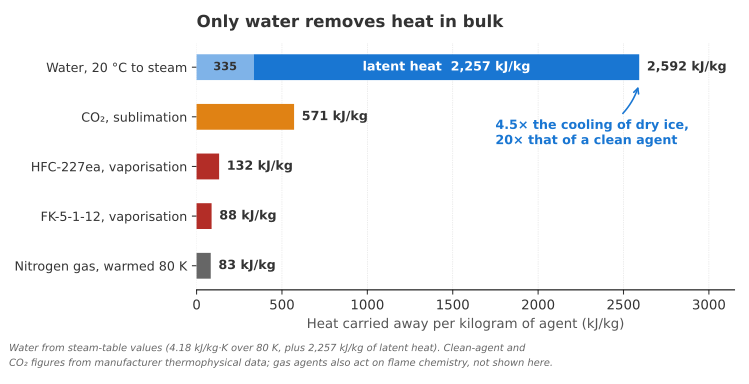
Next comes the sink term. Water climbs 80 K to boiling and then vaporises, so each kilogram carries:
The latent term dwarfs the rest, which explains water’s lead. Compare CO₂ at about 571 kJ/kg of sublimation heat, delivered as a gas that leaves the scene at once.
When does the cascade stop?
Once the cooling rate beats the delivered heating rate at the neighbouring cell. Written as a balance, the chain breaks when:
Here marks the trigger point, near 200–260 °C for many NMC cells. Nobody can rescue the cell already gone. Yet every neighbour stays winnable right up to the moment its own core crosses that line, which makes cooling the only lever with real leverage.
How much water does a pack really need?
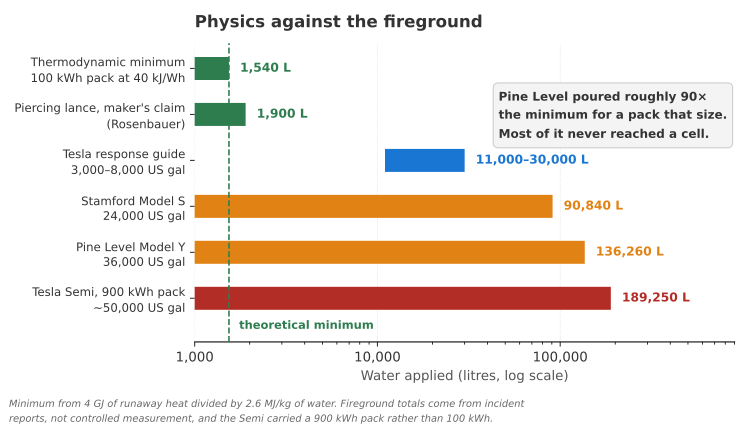
Far less in theory than on the fireground. A 100 kWh pack releasing 40 kJ/Wh liberates about 4 GJ, and 4 GJ divided by 2.6 MJ/kg comes to roughly 1,540 kg of water.
Yet field consumption runs an order of magnitude higher. Most of a hose stream misses the pack, runs off, or flashes to steam against sheet metal instead of cells. So the gap between 1,540 L and the five-figure gallon counts in the press measures delivery efficiency, not physics. Any tactic that puts water inside the pack collapses that gap.
Why does water beat every rival agent?
Because only water carries heat away in bulk. The FAA tested this directly by pouring ten agents onto a heated plate.
The result then read cleanly. “The aqueous agents exhibited the highest cooling effectiveness … The non-aqueous agents exhibited little cooling capacity and showed minimal increase in effectiveness with greater volumes”. More clean agent buys more flame chemistry, not more cooling. More water buys more cooling, every litre of it.
Which agents fail on a lithium battery fire?
Every agent that works on the flame alone. That list of failures against a lithium battery fire covers CO₂, inert gas, clean agents, halon, dry powder and aerosol generators.
Do clean agents stop propagation?
No. They knock the flame down well, then leave the heat exactly where it sat.
Chinese full-scale work on storage sites puts it plainly: HFC-227ea and similar systems can only isolate oxygen and do not dissipate the heat the batteries release. For instance, a related test pairing shows the split. C₆F₁₂O cleared the open flame, while the follow-on water mist dropped peak battery temperature by 75 °C. One agent handled optics, the other handled physics.
Does dry powder or a Class D unit help?
Barely, and sometimes it hurts. NIOSH mine-safety tests found dry chemicals quench the fire for a moment, then lose it again for lack of cooling.
Their comparison of suppression techniques then went further. Class D powder let the pack reignite earlier and burn harder than the untreated case. So the product marketed hardest for “lithium fires” scored worse than nothing at all in that rig.
Should you throw a fire blanket over it?
Use a blanket for containment, though never for extinguishment. It shields exposures and hides the light show, while the cascade rolls on underneath.
FSRI and the Fire Protection Research Foundation flag a real hazard here. Gas builds up under the fabric with an active battery still in runaway, which sets up an explosion risk rather than an end state. Blankets earn their place in a car park or a hangar. They do not end the event.
Does water make a lithium battery fire worse?
Water adds three hazards, and none of them outweighs its cooling. Crews manage them with PPE, gas monitoring and runoff capture.
Hydrogen. Water across live cells electrolyses, and hot aluminium strips oxygen from steam. Both routes add to a gas cloud that already runs past half hydrogen by volume.
Hydrogen fluoride. LiPF₆ salt hydrolyses to HF on contact with water. The event already emits plenty without help: Larsson and colleagues measured 20–200 mg of HF per Wh of nominal capacity, plus 15–22 mg/Wh of POF₃ in some tests. Notably, that same study looked at water mist and found no worsening of the fluoride load.
Runoff. Contaminated water carries heavy metals and, with some foams, PFAS. After the Moss Landing fire, researchers at San José State estimated roughly 25 tonnes of heavy metals across about half a square mile of wetland near Elkhorn Slough. The EPA calls the cleanup the largest lithium-ion job in its history.
Does the lithium react with the water?
Not in a lithium-ion cell. The lithium sits as ions inside the electrodes, with no metal to attack the water.
Thus the distinction separates two whole families. Lithium-metal primary cells and anode-free designs do hold reactive metal, and they do warrant Class D thinking. Rechargeable lithium-ion cells do not. As TÜV SÜD puts it, “water and foam work just fine” on a lithium-ion pack. Our primer on lithium-ion battery basics covers the chemistry behind that line.
Do you need a special lithium battery fire extinguisher?
No, at least not yet on the evidence. Every proven agent works through the water it carries, so the premium buys convenience rather than a new mechanism.
First, take the classification muddle. NFPA 10 lists Classes A, B, C, D and K, while EN 2 lists A, B, C, D and F. Neither set holds a lithium-ion class. ISO 3941:2026 added Class L in January 2026 for cells with no metallic lithium present. Read that as a label for the hazard, though, not as a test for hardware. Class L sits outside the EN 2 and EN 3 extinguisher rating scheme, so no certification changed with it, and NFPA has not adopted it in US codes. A proposed prEN 3-11 would test and mark units for small rechargeable cells, yet it remains in development.
So treat any product sold as “Class L certified” with suspicion. No equipment rating for Class L exists to certify against.
What do AVD and F-500 actually add?
A film and a surfactant, riding on water that does the real work. Both perform decently, and both attract marketing that outruns the data.
AVD mixes roughly 83% water with 17% exfoliated vermiculite, whose platelets form a film over the cell surface. Bench work supports the idea, with AVD outperforming plain water mist and clean agents on cooling in ASME journal testing, and a modified vermiculite dispersion knocking down a 173 Ah LFP cell fire without reignition. Vendor copy then claims the agent extinguishes fire burning inside the cell, which no independent work shows. Note also that the UL/ULC listing on at least one AVD extinguisher covers Class A fires.
Also, F-500 EA scored well. NIOSH found water mist with F-500 additive the most effective suppressant among those it tested on packs. Once again, water-borne cooling does the lifting.
The honest summary comes from a 2025 study of five suppression methods on an 8 kWh system. Water mist and encapsulator agents led the field, stretching propagation delay by 179% and 167%, and none of the tested methods prevented propagation entirely. Delivered cooling remains the variable that moves; the additive nudges it.
How do crews fight an EV lithium battery fire?
With volume, patience and access to the pack underside. Doctrine for an EV lithium battery fire has swung from “let it burn” toward sustained, aimed water.
Tesla’s Emergency Response Guide asks for 11,000–30,000 L (3,000–8,000 US gallons), jacking the car to reach the pack, and long monitoring afterwards. Reported fireground totals run wider still: 24,000 gallons at Stamford, 36,000 at Pine Level, and roughly 50,000 for the first Tesla Semi fire, whose 900 kWh pack reached about 1,000 °F and closed I-80 for some 15 hours. Those figures record what crews used, not what the physics demanded. Our post on EV fire rates puts the frequency side in proportion.
Pack-piercing lances attack the delivery problem head-on. Rosenbauer’s system drives a nozzle through the case from about 8 m away and claims full knockdown with as little as 1,900 L. The physics behind that claim holds up, since water inside the pack meets hot cells directly. Still, most published lance data come from the maker, so weigh the marketing accordingly.
When should a crew let it burn instead?
When the water supply cannot last the attack, and the vehicle threatens nothing nearby. A stalled offensive costs more than a planned defensive one.
Confirm battery involvement first, because many vehicle fires never reach the pack. Once it does, commit to the supply, aim at the pack, and watch the temperature trend on a thermal imager. Release the vehicle only after the pack cools and stays cool.
What changes at grid scale?
The explosion hazard takes over. At a storage site, trapped vent gas threatens crews long before flame does.
So APS McMicken remains the case study. On 19 April 2019 one cell pair went into runaway, the built-in Novec 1230 system failed to stop the spread, and gas accumulated for about three hours. Opening the door then admitted air to an explosive atmosphere, and the blast hospitalised eight firefighters and one police officer. Four of them suffered serious injuries. The cause stayed disputed afterwards, with LG Chem’s experts rejecting the internal-defect finding.
Thus codes now answer that pattern directly. NFPA 855 builds design around UL 9540A propagation data and demands explosion control under NFPA 68 or NFPA 69, typically ventilating below 25% of the lower explosive limit. Where sprinklers apply indoors, the baseline asks for 0.3 gpm/ft² (about 12 mm/min) over 2,500 ft², with a 500 gpm hose demand for 120 minutes. Check the edition your jurisdiction adopted, since the 2026 revision reworks the explosion-control path and adds a large-scale fire test.
One design rule for a grid-scale lithium battery fire follows from all of it. Never accept a clean-agent-only scheme as protection against propagation, and never write a door-entry procedure that assumes clean air.
Why does a lithium battery fire come back hours later?
Because damaged cells hold stranded energy and a hot core. Both can push a quiet pack back over its trigger point long after the flames stop.
The NTSB documented a Tesla in Fort Lauderdale that reignited twice after knockdown, once on the tow truck and once in the storage yard. Tesla’s own guide therefore asks crews to watch pack temperature for at least 24 hours and to park a damaged vehicle at least 15 m (50 ft) from anything worth saving. FSRI gives the same advice with different words: assume reignition, look for smoke, listen for hissing, and track temperature before release.
So every lithium battery fire plan needs thermal imaging and a quarantine distance as core steps, not as optional extras.
Which agent does what?
The tables below sort every lithium battery fire agent by mechanism rather than by marketing. Nearly all of them darken the flame, so the column that decides the outcome asks whether the agent removes heat.
Agents that remove heat
| Agent | Mechanism | Stops the cascade | Evidence |
|---|---|---|---|
| Water, direct or deluge | Bulk heat, ~2.6 MJ/kg | Yes, best available | FAA, FM Global, NIOSH |
| Water mist | Cooling plus O₂ dilution | Yes, given the delivery | Several peer-reviewed tests |
| Piercing lance | Water inside the pack | Yes, with far less water | Largely vendor-run |
| F-500 EA | Water plus encapsulation | Yes, through its water | NIOSH favourable |
| AVD, vermiculite | Water plus film barrier | Partly, through its water | Bench data, heavy marketing |
Agents that only touch the flame
| Agent | Mechanism | Stops the cascade | Evidence |
|---|---|---|---|
| CO₂ | Oxygen displacement | No cooling | Reignites |
| Clean agents | Flame chemistry | No bulk cooling | Failed at McMicken |
| Inert gas, IG-541/55 | Oxygen displacement | No | Reignites |
| Halon 1301/1211 | Flame chemistry | No | FAA: no effect on spread |
| Dry powder, Class D | Smother or crust | No, sometimes worse | NIOSH: earlier reignition |
| Fire blanket | Containment | No, adds blast risk | FSRI and FPRF warn on gas |
| Aerosol generator | Flame chemistry | No | Flame only |
How should you plan for a lithium battery fire?
Plan every lithium battery fire response around cooling, gas and time. Those three drive every good decision, from a phone on a desk to a 300 MW storage hall.
For single devices and small packs. Use water, or drop the cell into a bucket and leave it there. Skip the CO₂ unit and skip the Class D powder, since neither cools anything. Quarantine the device afterwards in a metal container away from anything that burns. Swelling, hissing or a rising temperature after apparent extinguishment means the cell still runs, so keep cooling.
For vehicle response. Confirm pack involvement, then commit to a supply that outlasts the fire. Aim at the pack from underneath or pierce it, monitor with a thermal imager, and hold the vehicle for at least 24 hours at 15 m from exposures. With no water available and no exposures at risk, controlled burn-down beats a half-finished attack.
For storage sites and plan review. Treat blast control as equal to fire control. Demand UL 9540A data, explosion control under NFPA 68 or 69, and the sprinkler baseline where it applies. Where the test shows unit-to-unit spread, widen the spacing and raise the water demand to match. Read the gas hazard as the life-safety driver it has become.
For buying specialty agents. Ask for independent third-party data against battery fires, not a Class A rating and not a vendor demo. Where the only advantage reduces to “it carries water”, let price and logistics decide.
Key takeaways
A lithium battery fire runs on a heat engine you cannot reach. Charged layered-oxide cathodes hand it oxygen from the inside, so cutting off the room changes the flame without touching the cascade. That single fact retires CO₂, halon, inert gas, clean agents and dry powder as cures, whatever their labels promise.
Overall, water wins for one dull reason. It carries about 2.6 MJ per kilogram to steam, and the neighbouring cell only needs to stay under roughly 250 °C. Get water onto hot cells, keep it there, and the arithmetic turns your way. Miss the pack and you simply pour a river into a car park.
So the field advice on a lithium battery fire comes down to four moves. Cool in bulk and keep cooling. Vent or monitor the gas before anyone opens a door. Watch the pack for a day with a thermal imager. And treat any “special” agent as water with a surcharge until somebody shows you independent data that says otherwise.
Cite this articleHow to cite
Dinh, D. C. (2026, August 22). How to Put Out a Lithium Battery Fire Without Smothering. PyroRisk. https://pyrorisk.net/blog/how-to-put-out-a-lithium-battery-fire/
Recent posts
Featured posts
Categories
Comments
Related posts

Battery Fire Safety
Off-Gas Detection: The Warning Before a Battery Fire
Off-gas detection reads the vapour a failing cell breathes out before flame. Here comes the window it buys, the sensors that see it, and the limits.

Battery Fire Safety
Thermal Runaway Propagation: How One Cell Takes a Pack
Thermal runaway propagation turns one failed cell into a lost pack. Here comes the heat budget that decides it, and the design that stops it.
Battery Fire Safety
Are EV Fires Really More Common Than Gas Car Fires?
Across U.S., Swedish, Australian, Norwegian and Polish data, EV fires happen 20 to 80 times less often than gas car fires per registered vehicle.