pyrorisk.net · Fire Science & Risk Fire Case Studies
Notre-Dame Fire: Why an 800-Year-Old Roof Burned in Hours
The 2019 Notre-Dame fire grew for half an hour in a 100 m oak attic before anyone called firefighters. See the fuel, the lead, the vaults and the rebuild.
Online: pyrorisk.net/blog/notre-dame-fire-why-an-800-year-old-roof-burned-in-hours/
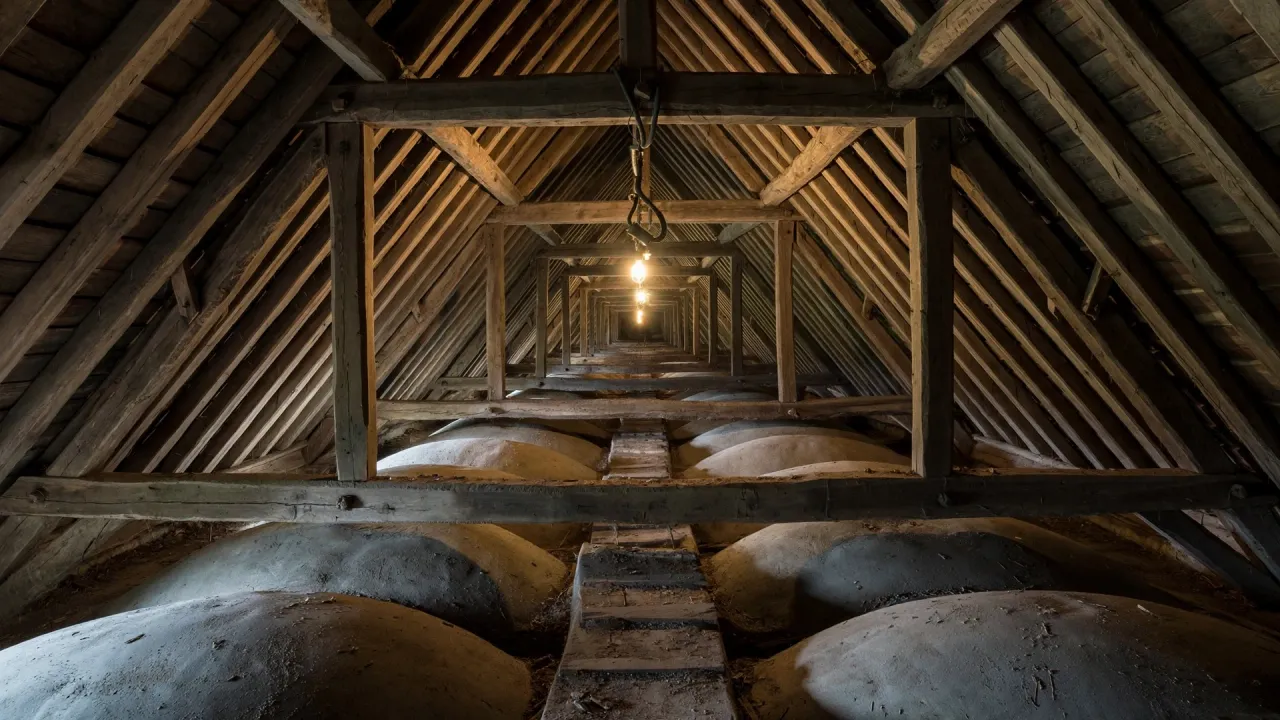
On 15 April 2019, at about 18:20, smoke detectors in the roof of Notre-Dame de Paris raised an alarm. Nobody called the fire brigade until about 18:51. By the time crews reached the roof, much of the medieval oak frame stood in flames. Then, at about 19:50, the spire fell through the vaults. This case study of the Notre-Dame fire asks why a roof that stood for 800 years burned in hours. The short answer: time mattered more than old oak. A long, undivided fuel load met a slow human response to a good sensor. Then a lead skin opened the fire to the sky.
TL;DR
The fire
- The detectors raised the alarm at about 18:20. But a guard checked the wrong attic, so the fire brigade got the call only at about 18:51.
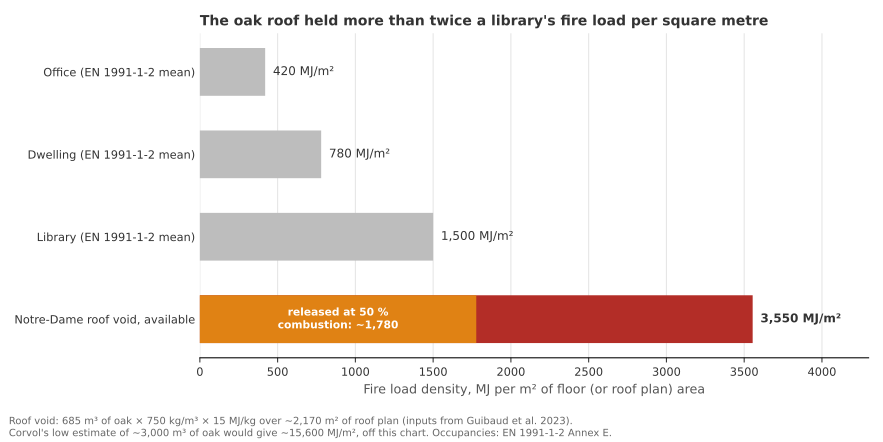
- The attic formed one oak void about 100 m long, with no fire walls and no sprinklers. On published inputs, it held about 3,550 MJ of fuel per m² of roof, over twice a library’s design value.
- The lead covering, part of 460 t on the roof and spire, melted and opened the roof. Below it, the stone vaults held, although parts of them reached temperatures that damage limestone for good.
The lessons
- Measure the whole time from alarm to water on the fire, not just how sensitive the detector is.
- Split long roof voids into compartments. The rebuilt Notre-Dame roof has three, plus automatic water mist and a far bigger water supply.
- Treat works periods as a separate, higher risk. Several major heritage fires since 1990 broke out during building or restoration works.
What happened at Notre-Dame on 15 April 2019?
A fire broke out in the roof frame near the crossing while the spire stood in scaffolding for restoration. It destroyed most of the roof and the spire, but stopped at the stone vaults and the west towers.
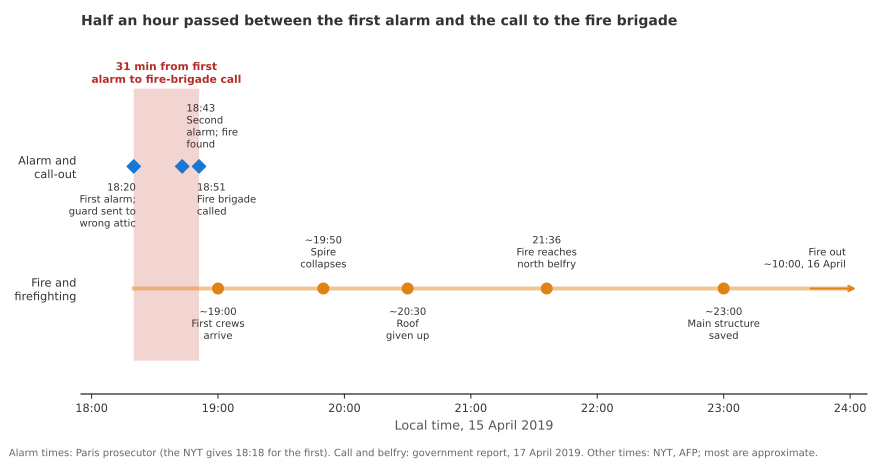
Mass had started in the cathedral when the first alarm sounded. The times below come from the Paris prosecutor, the government, the New York Times and fire brigade accounts. Several are approximate.
| Time | Event |
|---|---|
| 18:20 | First alarm; a guard checks the wrong attic |
| 18:43 | Second alarm; staff find the fire |
| 18:51 | Call to the fire brigade |
| ~19:00 | First crews arrive |
| 19:50 | The spire collapses |
| ~20:30 | Commanders give up the roof |
| 21:36 | Fire reaches the north belfry |
| ~23:00 | Main structure declared saved |
| ~10:00 | Whole fire out, next morning |
Nobody died, and only one firefighter and two police officers suffered light injuries. Accounts differ on when the fire came “under control”, from 22:30 to 03:30, because they define it differently.
Why did a working alarm lead to a half-hour delay?
The sensor worked, but the chain of people behind it did not. A coded location, a new employee, the wrong attic and a long climb cost about 30 minutes.
Notre-Dame had aspirating smoke detection, which draws air from the roof through pipes to a sensitive detector. The New York Times reconstruction (syndicated copy) says the system took dozens of experts six years to design. Yet it relied on a human check. After an alarm, a guard had to confirm the fire before anyone called the fire brigade.
That check failed. The employee watching the panel had started the job three days earlier and was working a double shift. The panel named the zone “Attic Nave Sacristy”, followed by a code, ZDA-110-3-15-1. So a guard went to the attic above the sacristy, a side building, not the main roof. He found nothing. At 18:43, a second alarm sent staff up the right stairs, roughly 300 steps. By then, the fire had grown far beyond any extinguisher. The security contractor, Elytis, said its employee had passed on the right location. Even so, fire safety expert Glenn Corbett told the Times that a “cascade of oversights and erroneous assumptions” undid the technology.
In fire-engineering terms, the response forms a chain: detect, locate, confirm, call, climb, attack. The detector did its part early, while the human links took about half an hour. Under the t-squared fire model, , even a “slow” fire, with kW/s², reaches about 9.5 MW in 30 minutes. That number only shows the scale. As the ASET vs RSET post argues, the slowest link sets the clock.
Why did Notre-Dame’s oak roof burn so fast?
Old oak burns no faster than new oak. Instead, the roof held a huge, unbroken load of slender, dry timber in one void, with no fire walls or sprinklers.
The medieval frame had a nickname: la forêt, the forest. Most of it dated from the 13th century. According to a structural study by Vannucci, the choir frame went up around 1225–1230 and the nave frame about 1230–1240. Some timbers came from an older roof of the 1160s. The transept and spire frames came later, from Viollet-le-Duc’s 19th-century restoration.
How many oaks went into the roof?
Estimates run from about 1,000 to 2,000 trees, because sources count different things. Some count standing trees, while others count the squared timber in place.
CNRS timber specialist Frédéric Épaud puts the Gothic frames at about 1,000 oaks, mostly young trees 25 to 30 cm across. A widely repeated figure says 1,300 oaks, and forest historian Andrée Corvol reaches about 2,000. Instead, Guibaud and co-authors, in the Journal of Cultural Heritage, counted the timber in place. They took 585 m³ of structural timber from the CNRS digital model of Notre-Dame and added about 100 m³ of battens. That volume drives the energy sums below.
What did the roof void look like to a fire?
A long triangular tunnel of wood. Guibaud’s team modelled a nave roof 100 m long and 14 m wide, crossed by a transept 48 m by 16 m, with a 55° pitch.
From the pitch and half-span, the inside height to the ridge comes out at roughly:
Vannucci gives the frame’s height as 9.75 m, so the estimate holds. The attic formed a continuous oak tunnel about 10 m high and 100 m long. Several features of that tunnel favour fast fire growth.
- No barriers. Nothing stopped hot gas from running along the ridge. The old attic had neither fire walls nor sprinklers.
- Thin, close members. Slender rafters expose a lot of surface for their mass. Also, facing surfaces radiate heat to each other, as in a wood crib.
- Dry wood. Medieval carpenters worked the oak green, but centuries indoors leave timber very dry. Nobody has published a measured moisture content for this roof.
- A chimney. The steep roof and spire drive a strong upward flow, like the stack effect in a stairwell.
- Hard access. The void sat about 30 m above the floor.
How much energy did the roof hold?
On Guibaud’s inputs, about 7.7 TJ of potential heat, or roughly 3,550 MJ per m² of roof. With half of it burned, the fire released about 3.9 TJ.
The paper’s inputs give a timber volume m³. They also use a density kg/m³ and a heat of combustion MJ/kg. So the potential energy follows:
The authors then assume a combustion efficiency , because the open fire burned incompletely and left char on the vaults:
Next, spread the potential energy over the roof plan, m². This sum counts the crossing twice, so it slightly understates the density:
That dwarfs design values. For example, EN 1991-1-2 gives mean fire loads of about 420 MJ/m² for offices, 780 MJ/m² for dwellings and 1,500 MJ/m² for libraries. So the roof carried over twice a library’s fire load per square metre, in a single void. The answer also depends heavily on the timber volume. The low end of Corvol’s 3,000 to 5,000 m³ would give TJ, over four times as much.
How big was the Notre-Dame fire?
Hundreds of megawatts. Spread the 3.9 TJ over a main burning phase of two to four hours, and the average heat release rate comes to about 270 to 540 MW.
Assume most of the roof burned between about 19:00 and 23:00. Then dividing the released energy by that time gives a crude average:
Peaks ran higher than this average. Still, the scale explains a lot. The heat release rate post puts a burning car at 1.5 to 8 MW. A room past flashover gives 10 MW or more. So the Notre-Dame roof released the heat of dozens of burning rooms, for hours.
Why didn’t the oak char slowly, as Eurocode 5 predicts?
It did not need to burn through. Eurocode charring rates assume a standard furnace fire. Roof trusses, however, fail at their joints and thin members long before the thickest beams char away.
For design, EN 1995-1-2 gives a notional charring rate of 0.55 mm/min for hardwood of at least 450 kg/m³, such as oak. That value includes corner rounding, as a Eurocode workshop summary of Table 3.1 shows. For a 250 mm square member exposed on four sides, the time to char through follows:
Nearly four hours looks inconsistent with a spire that fell about an hour after crews arrived. However, three reasons close the gap.
First, the Eurocode rates come from the ISO 834 standard fire used in fire resistance tests. A fully involved void, where hot members radiate to each other, can impose heavier heat fluxes and char wood faster. Second, a truss fails long before its members burn through. The joints, with their mortises, tenons and pegs, lose section first. Rafters squared from logs only 25 to 30 cm across ended up thinner than the 250 mm example. Third, thin boards burn faster still. The rebuild team uses a rule of thumb that 1 mm of batten buys about one minute. That rate runs roughly double the Eurocode value for massive oak.
Does 800-year-old oak char differently from new oak? Nobody knows yet. The closest work, a 2024 study in Fire, tested pine aged with UV light, not centuries-old oak. No one has published charring data for Notre-Dame’s own oak.
What did the lead roof do in the fire?
It melted and opened the roof. About 460 t of lead covered the roof and spire. Lead melts at about 327 °C, so the covering slumped once the battens under it burned.
According to a Ministry of Culture answer to parliament, the roof carried 210 t of lead and the spire 250 t. Guibaud’s team modelled a 5 mm lead sheet on battens about 30 mm thick. Since their model cannot melt metal, it treated the lead’s loss as a heat-absorbing reaction at 600 K. Vannucci gives thinner values for the 2019 roof: lead tiles 2.82 mm thick, which he models on 2 cm fir boards. A thinner skin would only have opened sooner.
Inside a closed roof, the fire could only burn as fast as air leaked in. But once the lead and battens gave way, the attic turned into an open fire with an unlimited air supply. Meanwhile, the lead also tinted the smoke yellow.
How much lead fell on Paris?
Probably about a tonne within 1 km, though estimates vary widely. A soil study put the deposit near 1,000 kg, while a study of Seine sediment found little effect on the river.
In GeoHealth, van Geen and co-authors analysed 100 soil samples within 1 km of the cathedral. They estimated about 1,000 kg of extra lead within that radius, with a 95 % interval of 0.5 to 1.5 t. That runs over six times INERIS’s estimate of about 150 kg for the plume between 1 and 50 km. Their model puts soil lead downwind, to the north-west, at about 430 mg/kg, against 240 mg/kg in other directions. France sets no legal limit for soil, but 29 of the 100 samples exceeded the 300 mg/kg level that health authorities recommend.
Some responses came months later. On 25 July 2019, two schools nearby closed after surface dust exceeded the 5,000 µg/m² reference value. On the prefect’s order, work on the cathedral then stopped until 19 August to tighten protection for workers. Meanwhile, the regional health agency urged blood-lead tests for children under 7 and pregnant women.
By contrast, a 2026 study of Seine sediments by Evrard and co-authors found a negligible impact on the river’s lead contamination. Even so, sediment near the cathedral held more lead in 2020. Both findings can hold at once, at different scales and through different pathways.
France chose to rebuild Notre-Dame in lead anyway. The ministry cited its look, its malleability and a durability greater than zinc or copper. Estimates of lead washing off the new roof in rain range from 7 to 11 kg a year to about 21 kg. For fire safety, the trade-off stays plain. A lead roof vents an attic fire quickly, and it guarantees a toxic plume if the roof ever burns again.
Why did the stone vaults survive?
Limestone does not burn, and most of the fire burned above the vaults. Heat reached them as radiation and from burning debris, at a net 3 to 6 kW/m² for one to two hours.
Yet the webs of the studied choir vault measure only 12 to 15 cm thick. They broke where heavy burning masses struck them: at the crossing, where the spire fell, and in parts of the nave and north transept. Elsewhere they held, and Guibaud’s team used the stone itself as a thermometer.
Limestone changes colour for good when heated. It turns pink at about 250–300 °C, as iron oxide-hydroxide turns to haematite. Next it goes grey at 400–500 °C. Above 600–700 °C it turns white, as calcite breaks down into lime:
Cores drilled from one intact choir vault let the team work backwards to the heat it received. The net heat flux reached 3 to 6 kW/m² and lasted one to two hours. In total, the stone took in 40 ± 10 MJ/m². That was enough to weaken the heated stone for good. Separately, laser scans from before and after the fire show the vault sagging by 4 cm in one place and rising by 2 cm in another.
The team also estimated the exposure from the fire side. They assumed 30 % of the released energy left as radiation, and that the vaults saw at most a fifth of it, a view factor of 0.2:
The paper’s mean of about 120 MJ/m² implies roughly 1,950 m² of vaults. That figure runs three times the stone-based value. So the authors suggest a plaster layer on top of the vaults blocked part of the heat. The radiant heat post explains the view factor. The flames themselves ran far hotter than the stone. Raman analysis of charcoal by Deldicque and Rouzaud points to temperatures above 1,200 °C at the crossing.
The rescue also left its own damage. Firefighting water soaked the masonry. Then, in July 2019, the government warned that the cathedral could still collapse. Workers later took down about 200 t of burned scaffolding, some 40,000 pieces, between June and November 2020.
How did firefighters save the towers?
By giving up the roof. Commanders accepted the loss of the roof frame. Then they sent a team into the north tower to stop the fire before the bell frame burned.
More than 400 firefighters reached the site within half an hour, and the government later put the total near 500. They used 15 large hose lines and six monitors, and two fireboats pumped water from the Seine. A remote-controlled robot called Colossus also joined the fight. However, crews kept it out of the attic, because its treads could damage the old structure.
The decisive fight came in the north tower. Near 20:30, the brigade’s commander, General Jean-Claude Gallet, told officials, “In 20 minutes, I’ll know if we’ve lost it.” One of them took that to mean Notre-Dame could collapse. At 21:36, fire reached the north belfry, the wooden frame that carries the bells. So about 20 firefighters climbed the towers, reached the bells and put out the flames there. Around 23:00, Gallet said the main structure had been saved. The New York Times later concluded that Notre-Dame came much closer to total loss than anyone knew at the time.
Why didn’t they drop water from aircraft?
French civil security officials ruled it out at once. They warned that a drop of water from the air could bring down the whole structure and damage nearby buildings.
From a fire-science view, though, the bigger problem lies in the energy balance. Water absorbs at most about 2.6 MJ per kg, if it warms to 100 °C and then fully boils. To match the average fire, crews needed a water flow of:
That works out to roughly 6,300 to 12,500 litres per minute, every drop of it turning to steam on the burning wood. Only water that reaches the fuel and boils does that work. Streams thrown from outside into a void 30 m up, under a falling lead roof, mostly miss. So the defensive choice followed from the physics: protect the towers, and let the roof go.
What caused the Notre-Dame fire?
Officially, nobody knows. Investigators kept two leads, an electrical fault or a badly stubbed-out cigarette. At the last official update, in late 2024, nobody faced charges.
Early on, prosecutors said nothing pointed to arson. On 26 June 2019, prosecutor Rémy Heitz closed the preliminary inquiry with two hypotheses: an electrical malfunction or a cigarette. Judges then opened an investigation against persons unknown. The charge covers involuntary damage by fire through a “manifestly deliberate” breach of a safety duty.
According to franceinfo, judicial sources placed the start at a horizontal timber, the wall plate of the choir. That beam sat at the south-east corner of the crossing. Workers on the site had admitted to police that they smoked there despite a ban. Judges and experts also inspected the electrical supply for the bells in the spire. By late 2024, the judge had ordered a 3D model of how the fire started, built from images taken that evening.
Rumours have filled the gap. In December 2024, a French TV channel claimed the case had closed or fallen under military secrecy, but fact-checkers showed both claims false. Since then, no reliable outlet has reported charges, a dismissal or a closure. In my assessment, the cause will probably stay undetermined, as it did at the Glasgow School of Art in 2018.
Why do heritage roofs keep burning?
The same conditions keep lining up: long timber voids without compartments, no automatic suppression, alarms that wait on people, building works and hard access.
| Fire | Year | During works? | What happened |
|---|---|---|---|
| York Minster | 1984 | No | Probable lightning; roofs later compartmented |
| Windsor Castle | 1992 | Yes | A spotlight lit a curtain during rewiring |
| La Fenice, Venice | 1996 | Yes | Two electricians on the crew set the fire |
| Glasgow School of Art | 2018 | Yes | Cause undetermined; ducts fed the fire |
| Børsen, Copenhagen | 2024 | Yes | Cause undetermined; the spire fell |
Notre-Dame had all five conditions. Its restoration brought scaffolding, electrics and people into a roof that lacked fire walls, sprinklers and an automatic call-out. After its fire, by contrast, York Minster compartmented all its roofs, a step Notre-Dame took only after 2019. The Grenfell Tower and Station nightclub case studies show the same pattern of layered defences whose gaps line up.
France responded with a national plan. Its “sécurité cathédrales” plan, launched in October 2019 with €2 million, covers the 87 cathedrals the state owns. Since 2023 it also adds fire detection during works, more patrols and remote monitoring. According to the culture ministry, the state spent €220 million on cathedrals from 2021, including €12 million for fire safety in 2023.
What does the rebuilt Notre-Dame do differently?
It keeps the oak and the lead but adds fire engineering: fire-rated trusses that split the attic into three, water mist, better detection, thicker battens and more water.
The cathedral reopened on 7 December 2024. Carpenters rebuilt the frames in oak, and they finished the nave and choir timbers by hand with a medieval broad-axe. The spire returned to its 96 m height under lead. According to the public body Rebâtir Notre-Dame de Paris, the new roof adds five layers of protection:
| Measure | What it does |
|---|---|
| Fire-rated trusses | Split the attic into three compartments |
| Water mist | Wets and cools the frame with little water damage |
| Aspirating detection and thermal cameras | Locate an ignition precisely |
| Battens 15 mm thicker | Delay the lead melting by about 15 minutes |
| Dry risers | Triple the water flow to 600 m³/h |
Each measure answers a 2019 failure. First, the compartments break up the 100 m tunnel. Next, the mist starts automatically, without waiting for a guard. In addition, the detection pins down the location, which fixes the sacristy confusion. Finally, the battens use the 1 mm per minute rule to keep the lead skin closed longer, so the fire stays short of air.
The dry risers deserve a closer look. A flow of 600 m³/h equals about 167 kg/s of water. If all of it boiled on the fuel, it could absorb:
That matches the scale of the 2019 average fire, but only in theory, since real hose streams waste most of their water. So the risers serve a fast attack on a small fire inside one compartment, not a repeat of 2019.
Some questions remain open. No public source gives the mist system’s droplet size, discharge density or duration. Nor has anyone shown, by test or validated model, that compartments still tens of metres long will hold against a fully developed oak fire. The design also depends on automatic systems working for decades, and on future works keeping the compartment walls intact.
What are the limits of this case study?
The New York Times investigation sits behind a paywall, so some details here come from syndicated copies. Sources also disagree by a few minutes on several times. The energy and heat release numbers inherit Guibaud’s assumptions: 50 % combustion efficiency, 15 MJ/kg and 750 kg/m³. They also rest on a timber volume at the low end of published estimates. The average heat release rate gives a crude bound, not a fire curve. Finally, the cause remains legally open. So neither hypothesis counts as established, and everyone involved keeps the presumption of innocence.
Key takeaways
The Notre-Dame fire burned for hours because it grew unseen for half an hour, in a place firefighters could hardly reach. The detectors worked. But the chain of people behind them, from a coded message to a climb of about 300 steps, did not.
The roof made the worst of that delay. One 100 m oak void, with no fire walls or sprinklers, held over twice a library’s fire load per square metre. Yet the thin stone vaults saved the building, and firefighters saved the towers by giving the roof up.
For heritage roofs, the lessons translate directly. Time the whole chain from alarm to water, not just the detector. Divide long voids into compartments. Treat restoration works as a separate fire risk with its own rules. Then plan for the toxic plume before it happens. As the ALARP post argues, a good system on paper does not make a safe building.
Cite this articleHow to cite
Dinh, D. C. (2026, October 16). Notre-Dame Fire: Why an 800-Year-Old Roof Burned in Hours. PyroRisk. https://pyrorisk.net/blog/notre-dame-fire-why-an-800-year-old-roof-burned-in-hours/
Recent posts
Featured posts
Categories
Comments
Related posts
Fire Case Studies
Grenfell Tower Fire: The Cladding Physics Behind 72 Deaths
The Grenfell Tower fire began as a kitchen fire. See how polyethylene cladding, a stay-put plan that outlived the building and gamed tests killed 72 people.
Fire Case Studies
Station Nightclub Fire: Why 100 People Had Only 90 Seconds
The Station nightclub fire killed 100 people in 2003. See how stage gerbs, acoustic foam and one narrow inner door left the crowd about 90 seconds to escape.
Fire Safety Engineering
2-Hour Fire Wall: What a Fire Resistance Rating Measures
A 2-hour fire resistance rating means a wall survived a 1918 furnace curve, not a real fire. Here is what the test proves, and where it falls short.