pyrorisk.net · Fire Science & Risk Fire in Daily Life
Turkey Fryer Fireball: The Physics of Water in Hot Oil
A turkey fryer holds five gallons of hot oil over an open flame. See why 100 g of ice makes 200 L of steam, how pots overflow, and how to fry safely.
Online: pyrorisk.net/blog/turkey-fryer-fireball-the-physics-of-water-in-hot-oil/
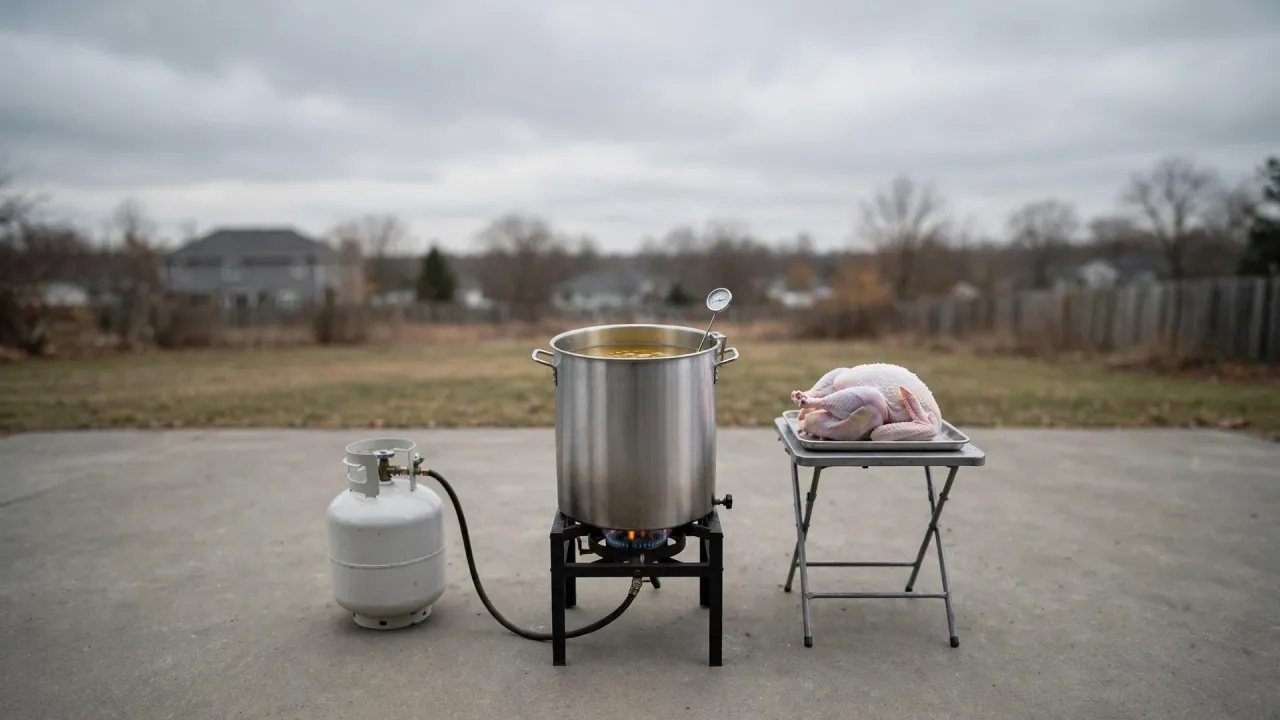
Every November, a turkey fryer somewhere turns into a column of flame. The recipe takes three things: about five gallons of oil near 180 °C, an open propane flame right below the pot, and a bird that still holds ice. Water meets hot oil and flashes to steam. Then the steam throws foaming oil over the rim, and the burner lights it. This post works through the physics with numbers, then checks what the fire records really say.
TL;DR
The physics
- A turkey fryer fire starts as a frothover, not a true boilover. Water flashes to steam under hot oil, the foam spills over the rim, and the burner below ignites it.
- Water grows about 1,600 times in volume as it boils at 100 °C, and about 2,000 times at 180 °C. So 100 g of ice makes about 200 L of steam, seven times the volume of a 30-quart pot.
- Even a dry bird can overflow an overfilled pot. In our example, 5 gallons of oil plus a 6 kg turkey leaves about 2 cm of spare height.
- Frying at 177 °C sits about 150 K below the oil’s flash point. Yet a 50,000 BTU/h burner with no thermostat can close that gap in roughly 15 minutes.
The risk and the fix
- Thanksgiving leads every other day for US home cooking fires, with 1,139 in 2024, about three times the daily average. CPSC knew of 217 turkey fryer fire or burn incidents from 2000 to 2022.
- UL decided in 2002 not to certify any turkey fryer, and NFPA strongly discourages the oil-filled kind.
- If you fry anyway, thaw and dry the bird, set the oil line with water, and turn the burner off while you lower it. Then stay 3 m from buildings, watch the thermometer, and never use water on the fire.
What makes a turkey fryer erupt?
Water flashes to steam under the hot oil, the foam overflows, and the burner below ignites it. So the water does the work, and the oil does the burning.
A typical outdoor turkey fryer pairs a 30-quart pot with a propane burner on a low stand. An older NFPA position statement describes “approximately 5 gallons of oil” heated to “350 degrees Fahrenheit or more”. Then the trouble runs in five steps.
- Water or ice enters oil at 160–190 °C.
- The water boils inside the oil, which foams and splatters.
- Foam plus the bird’s own volume lifts the oil over the rim.
- The oil runs down the pot onto the open flame directly below.
- The spray and the spilled pool ignite, and flames wrap the pot, the stand and whoever holds the hook.
UL’s 2002 warning follows this chain. An overfilled pot may spill when the bird goes in, and the oil then hits the burner. Likewise, UL said, partly frozen birds can cause a “spillover effect”.
Is a turkey fryer fire really a boilover?
Not in the strict sense. Fire science keeps the word boilover for burning crude oil tanks, while a frozen bird in hot oil causes a frothover instead.
| Event | Container on fire? | Where the water sits | Fryer case |
|---|---|---|---|
| Boilover | Yes, for hours | Layer at the tank bottom | None |
| Frothover | No | Under hot, thick oil | Wet or frozen bird |
| Slopover | Yes | Sprayed on the burning surface | Water on a burning turkey fryer |
Craig Shelley’s tank fire primer in Fire Engineering draws the same lines. A frothover happens when water boils under hot, viscous oil in a tank that has no fire. A slopover, by contrast, follows a water stream onto the hot surface of burning oil.
True boilover needs more. The LASTFIRE boilover study lists three conditions: a full-surface tank fire, water in the tank, and a dense hot zone that sinks through the fuel. That zone “occurs with crude oil but not with refined products such as gasoline or kerosene unless a range of such products is mixed in a tank”. A fryer pot meets none of these when the bird goes in, since nothing burns yet. So fire departments use “boil-over” loosely, and for the public that works fine. Engineers, though, would call a turkey fryer eruption a frothover-driven overflow followed by ignition. Our post on kitchen fire science covers the closest lab cousin, thin-layer boilover.
How much steam does a little ice make?
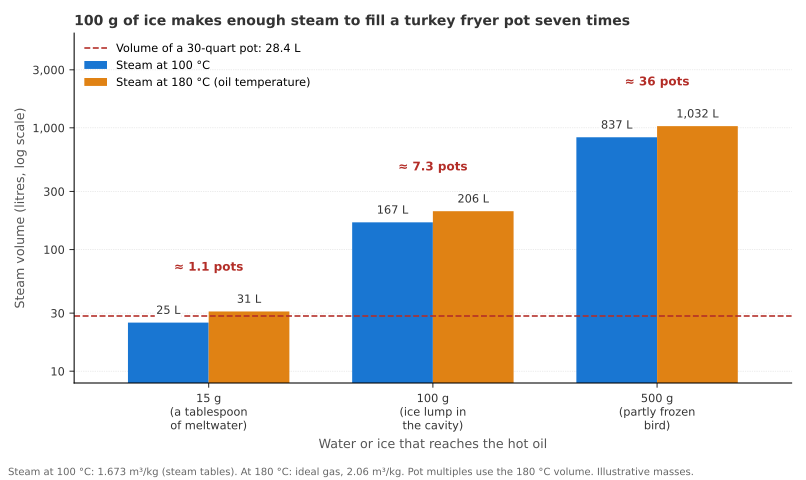
About 1,600 to 2,000 times the water’s own volume. So 100 g of ice makes roughly 200 L of steam, about seven times the volume of a 30-quart pot.
At atmospheric pressure, 1 kg of saturated steam at 100 °C fills 1.673 m³, according to NIST steam data. The ratio then depends on which liquid volume you divide by.
So the fire service’s “1,700:1”, which Shelley ties to 212 °F, and the engineer’s “about 1,600” both hold. But steam born in 180 °C oil comes out superheated, so it takes up more room still. The ideal-gas law gives its volume, with J kg⁻¹ K⁻¹.
That equals about 2,060 times the volume of cold liquid water. NIST’s own tables give 2.05 m³/kg at 180 °C, so the ideal-gas value holds within 1%. The table below applies both figures to a 30-quart (28.4 L) turkey fryer pot.
| Water or ice in the oil | Steam at 100 °C | Steam at 180 °C | Pot volumes |
|---|---|---|---|
| 15 g, a tablespoon | 25 L | 31 L | 1.1 |
| 100 g, an ice lump | 167 L | 206 L | 7.3 |
| 500 g, a partly frozen bird | 837 L | 1,032 L | 36 |
As a check, , and .
Why does water flash so violently in hot oil?
Because frying oil sits 60–90 K above water’s boiling point and wraps the water completely. So heat pours in fast, and steam forms faster than it can escape.
One fryer manual asks for 325–350 °F (160–175 °C) and warns never to pass 400 °F (200 °C). Water boils at 100 °C, so any drop that touches the oil overheats at once. Two things then make the turkey fryer case violent.
- Thick oil traps the steam. Bubbles cannot leave as fast as they form, so they build a foam. The steam, not the oil, sets the foam’s volume.
- The heat supply never runs short. Boiling goes on for as long as water remains, as the next section shows.
NIST researchers have filmed the effect. Manzello, Yang and Cleary (2003) dropped water into hot peanut oil for a Fire Safety Journal study. The droplet sank, broke up and “ultimately produced a vapor explosion”. That took about 2.1 s after impact at 200 °C and 1.17 s at 220 °C. They ran no test at 177 °C, though.
The delay points to superheat. A water drop under oil touches few nucleation sites, so it can heat past 100 °C and then flash all at once.
Can the oil supply that much heat?
Easily. The oil stores enough heat above 100 °C to boil off about 0.9 kg of ice, and boiling 100 g cools it by only about 9 K.
First, take 1 kg of ice from −18 °C to steam at 100 °C. The ice must warm, melt, warm again and then boil.
Next, size the oil charge. Five US gallons make 18.93 L, and at 0.92 kg/L that weighs about 17.4 kg. Assume a specific heat of kJ kg⁻¹ K⁻¹. NIST lists 2.045 for peanut oil at 35 °C, and Fasina and Colley (2008) found that the value rises with temperature. Then the heat that the oil can give up between 180 °C and 100 °C follows.
Boiling off 100 g of ice costs only about 305 kJ. That cools the whole charge by about K. So the oil acts as a near-endless heat store for the event. Contact area and mixing limit the steam rate, while energy does not.
Why is a frozen turkey the worst case?
Because a frozen bird keeps feeding water into the oil. Ice hides in the cavity and under the skin, and each layer thaws and flashes in turn.
The ice’s extra latent heat, 334 kJ/kg, slows nothing on a human time scale, so the bird just keeps making steam as it thaws. Gulfport fire chief Billy Kelley, whose crew staged the stunt on purpose, described it this way: “We put in a frozen turkey, and it immediately thaws out.” The water then makes the oil flare up, he added. NFPA’s tip sheet agrees that “a partially thawed turkey will cause the oil to splatter”. Rain and snow bring the same hazard, since they also drop water into hot oil.
Why can a dry bird still overflow the pot?
Because the bird pushes aside its own volume of oil. So an overfilled turkey fryer overflows with no water at all.
A turkey lowered into a pot of area raises the oil level by a simple ratio.
That explains the water test. The US Fire Administration tells cooks to test the oil level with water first, with the turkey in the pot. CPSC adds a number: fill “until the turkey is covered by about 1/2 inch of water”.
Yet the cold water test misses one effect. Oil swells as it heats. Canciam (2008) derived an expansion coefficient of 7.47 × 10⁻⁴ per °C for soybean oil from density data. Stretched over 160 K, that adds roughly 11–12% to the volume. So a line marked with cold water sits a few centimetres low once the oil gets hot.
Consider a worked case with our own round numbers. The pot measures 30 cm across, so m², or 7.07 dm². A 28.4 L pot of that width stands about 40 cm tall. The turkey weighs 6 kg at about 1.05 kg/L, so it displaces 5.7 L.
| Step | 5 gal oil (18.9 L) | 3 gal oil (11.4 L) |
|---|---|---|
| Cold oil depth | 26.8 cm | 16.1 cm |
| Thermal expansion, 11% | +3.0 cm | +1.8 cm |
| Turkey, dm | +8.1 cm | +8.1 cm |
| Hot, loaded level | 37.9 cm | 26.0 cm |
| Freeboard left for foam | about 2 cm | about 14 cm |
The arithmetic checks out: dm, L or 0.30 dm, and dm.
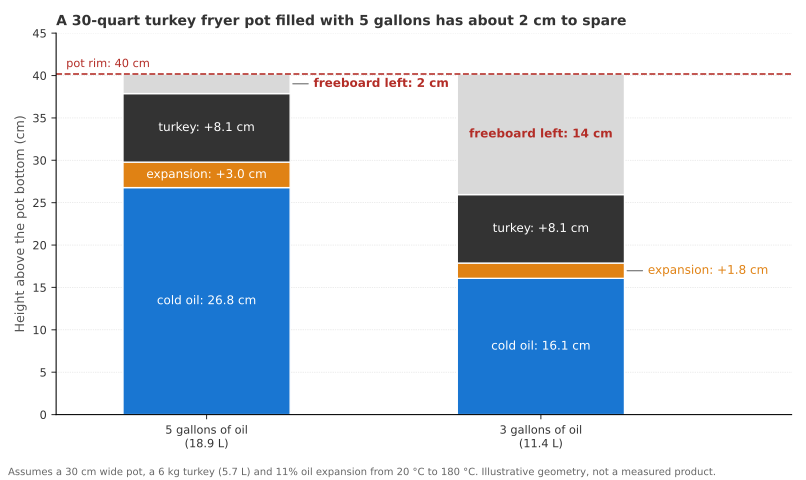
Filling a 30-quart turkey fryer pot with the full five gallons leaves almost no margin, even for a bone-dry bird. Then any steam foam goes straight over the rim. So do the water test with the bird itself, and leave headroom above the mark. For chip pans, the London Fire Brigade gives a blunter rule: “Never fill a pan more than one third full of fat or oil.”
How close is frying oil to catching fire?
About 150 K below its flash point at normal frying heat. So oil at the right temperature will not ignite in the pot by itself.
| Oil | Smoke point | Flash point | Fire point |
|---|---|---|---|
| Canola | 236 °C | 326 °C | 350 °C |
| Soybean | 240 °C | 330 °C | 360 °C |
| Peanut | 230 °C | 334 °C | 360 °C |
These values come from the Institute of Shortening and Edible Oils chart, which reports a single open-cup test per oil. Self-ignition, with no flame needed, takes more heat again, and the measured range runs wide. A University of Maryland student study heated 5 mL samples on a hot plate. It found 406 °C for soybean oil, 424 °C for canola and 435 °C for olive oil. Larger pans ignite sooner, though. At Canada’s National Research Council, 42 L of fryer oil self-ignited at 368 °C. Canola oil in a large industrial cooker did so at 351–361 °C, with smoke from about 250 °C.
- Treat 350 °C as the danger line for a large pot left on full heat.
- Burned oil re-ignites more easily. Its self-ignition point can drop after a fire, so knocked-down flames return unless the oil cools.
How fast can a turkey fryer overheat?
In roughly 15 minutes at full fire, by our estimate. A turkey fryer burner with no thermostat keeps heating the oil until someone turns the gas down.
Retail kits commonly rate the burner at 50,000 BTU/h, and some at 55,000. The lower figure converts to about 14.7 kW.
Assume that 40% of that reaches the oil, since wind and the bare pot waste the rest. Heating 17.4 kg of oil from 20 °C to 177 °C then takes this long.
That makes 15–16 minutes. Now leave the gas on full. The climb from 177 °C to a flash point near 330 °C needs a similar amount of heat.
So about a quarter-hour of neglect takes a turkey fryer from cooking heat to flash point. Growing heat losses stretch that time somewhat, yet the estimate fits the record. In November 2003, CPSC reported that most incidents happened “while the oil was being heated, prior to adding the turkey”. UL flagged the same gap: with no thermostat, a unit can overheat its oil to the point of combustion.
Some makers now add a timer instead. For example, the Camp Chef manual describes one that shuts off the gas after 15 minutes unless the cook resets it.
Why does spilled oil turn into a fireball?
Because the spill arrives hot, spread thin, and right on top of a flame. A cold pool of cooking oil resists a match, but a hot spray over a burner does not.
- Surface area. Fine droplets heat almost at once, so a spray burns like a vapour cloud.
- Pre-heated fuel. Spilled oil at 180 °C needs only about 150 K more to reach its flash point, instead of 300 K.
- A constant pilot. The burner sits directly under the pot, so ignition follows almost for certain.
Bill Gustin’s tactics guide in Fire Engineering warns that the short hose “can burn through, adding propane to the fire”. Flames on the cylinder can also cause a tank explosion, a BLEVE, “in a few minutes”.
How big is the fireball?
Nobody has measured it properly. Staged demonstrations show flames of roughly 3 to 4.5 m, and an energy estimate points to megawatts.
We found no instrumented heat release rate for a turkey fryer overflow, only demonstrations. For example, a 2025 KSL-TV test at a Utah fire training centre lowered an unthawed 24 lb turkey into a fryer rated for 16 lb, “sparking flames as high as 15 feet”. CPSC staged a similar burn in Maryland in 2016 that produced “a huge fireball”.
The energy budget explains why. Vegetable oil releases about 37 MJ/kg when it burns, close to the 37.8 MJ/kg lower heating value that Engineering ToolBox lists.
If one spilled litre burned in 2–5 s, it would release 7–17 MW. Treat that as an upper bound. Heskestad’s flame height formula, from our post on heat release rate, gives a cross-check. A flame 3–4.5 m tall on a 0.5 m base matches roughly 1–2 MW. So a spilled litre more likely burns over 15–35 s, or less oil burns in the first flash. Either way, a “10-foot fireball” fits the physics. For scale, NIST’s stovetop tests burned only about 185 g of oil and still peaked near 100 kW.
Why is water the worst way to fight a turkey fryer fire?
Because water on burning oil causes a slopover. The same 1,600 to 2,000-fold expansion now happens inside burning oil, and it throws flaming droplets outward.
As the UK’s Fire Industry Association puts it, a water jet on burning cooking oil “will create an expulsion of the burning oil as the water is quickly converted into steam”.
- Cut the fuel. Close the cylinder valve, but only if you can reach it safely.
- Smother small fires. For a pan, USFA advises keeping a lid or baking sheet nearby. A five-gallon turkey fryer in full flame rarely allows that, so back away and call the fire department.
- Use a wet chemical extinguisher if you own one: Class K in the US, Class F in Europe. Its mildly alkaline potassium salt solution, with a pH near 8.5, cools the oil and turns hot fat into soap. As NFPA explains, it “forms a foam blanket to prevent reignition”.
Cooling matters because hot oil re-ignites. An all-purpose ABC powder can knock the flames down, yet it neither cools the oil nor forms that blanket.
How often do turkey fryer fires happen?
Rarely, by the reported numbers. CPSC logged about ten turkey fryer incidents a year, while Thanksgiving cooking fires of all kinds run above a thousand.
| Measure | Value | Source |
|---|---|---|
| Thanksgiving home cooking fires, 2024 | 1,139 | NFPA |
| Cooking share of Thanksgiving home fires | 80% | NFPA |
| Thanksgiving residential fires per year, 2017–2019 | 2,300 | USFA |
| Turkey fryer incidents, 2000–2022 | 217 | CPSC |
| Injuries in those incidents | 83 | CPSC |
| Property loss in those incidents | $9.5 million | CPSC |
NFPA’s Thanksgiving page puts the 2024 count at “321 percent of the daily average”. For 2020–2024, cooking caused 80% of Thanksgiving home fires and 35% of the civilian injuries. USFA’s data snapshot adds 5 deaths, 25 injuries and $26 million in losses a year. The fryer counts come from a CPSC release of November 2022, and its later releases give no new totals.
- Fryers make up a small slice. Thanksgiving runs at two to four times a normal day for fires, depending on the source, but most of those start on a stove.
- CPSC undercounts. It logs only the incidents that reach it, and it says more may have occurred.
- A viral statistic misleads. The claim of “5 deaths, 60 injuries and 900 homes destroyed” a year garbles an old NFPA report on all deep fryers. NFPA’s current tables list 730 fires, 4 deaths and 31 injuries a year for all deep fryers in 2017–2021.
CPSC’s own fryer counts, by contrast, listed no fatal injuries through 2017. So the hazard rates as rare but severe.
Do standards make a turkey fryer safe?
Only in part. UL withholds its mark, NFPA discourages oil fryers, and the gas appliance standard relies on a thermometer and warning labels.
- UL. In June 2002, UL “decided not to certify any turkey fryers with our trusted UL Mark”. Its concerns included tip-over, spillover onto the burner, partly frozen birds, missing thermostats and hot handles. A 2010 release repeats that “UL does not certify any turkey fryers”, and we found no later change.
- NFPA. Its older position statement called the fryers “not suitable for acceptably safe use by even a well-informed and careful consumer”. Today, NFPA still “strongly discourages the use of turkey fryers that use cooking oil”.
- CSA/ANSI Z21.89. This gas appliance standard requires every fryer to ship with a thermometer. A fryer not approved for turkeys must carry the words “This appliance is not for frying turkeys.” The 2017 revision tightened the thermometer rules and limited boilers to heating water.
So a turkey fryer can carry a valid Z21.89 mark while UL withholds its own mark and NFPA calls oil fryers unsafe. The mark shows that the gas train and the build meet a standard. However, it cannot stop a user from overfilling the pot or lowering a frozen bird.
What does the Tacoa boilover teach a backyard cook?
That hot oil and water kill by throwing liquid, and that “this oil cannot do that” makes a dangerous belief.
On 19 December 1982, a fuel oil tank exploded and burned at the Tacoa power plant near Caracas. About six hours later, a boilover threw blazing oil over responders and onlookers. About 150 people died, including 40 uniformed firefighters, according to the IChemE account.
- Experts assumed boilover could not happen. NFPA and the American Petroleum Institute had long held that No. 6 fuel oil, a refined product, “was not subject to boilover”. Yet the Tacoa fuel held a wide enough range of hydrocarbons to form a hot zone. Cooks make a similar bet on a turkey fryer.
- The thrown liquid did the killing. Crowds had gathered at a fire that looked stable. At home scale, the thrown oil burns the person who holds the hook.
How do you fry a turkey safely?
Buy a fried bird or use an oil-less fryer. If you fry in oil anyway, control the water, the oil level, the flame and the distance.
What should you do before lighting the burner?
Thaw and dry the bird, measure the oil with water, and pick a safe spot outdoors.
- Thaw fully, then dry. USDA allows 24 hours in the fridge per 4–5 lb. So a 13.2 lb bird needs to days. Check the cavity for ice by hand.
- Set the oil line with the water test, using your own bird. We suggest 10 cm of clear rim above the hot, loaded level.
- Site the turkey fryer like a fire hazard. Keep it 10 ft (3 m) from the home and not under roof eaves, as USFA advises. UL adds: never on wooden decks or in garages. Leave 2 ft between the cylinder and the burner.
- Check the weather. Stop in rain or snow, and never move the turkey fryer indoors.
What should you do while the oil is hot?
Control the flame, watch the thermometer, and keep people back until the oil cools.
- Turn the burner off before the bird goes in or comes out, as Seattle Fire advises. Lower it slowly, and relight only once the foam settles.
- Watch the thermometer. Fry at 160–175 °C, and shut the gas if the oil passes 200 °C or smokes. Frying takes about 3 minutes per pound, so a 13 lb bird needs 40 minutes of standing watch.
- Keep people back. USFA asks for a 3 ft zone free of children and pets. Leave the pot alone until the oil cools below 45 °C, which can take hours.
- Plan the fight. Keep a Class K extinguisher close. New Jersey’s fire marshal accepts an all-purpose unit, but expect re-ignition with one. Shut the gas, and never use water. If flames reach the hose, the cylinder or a building, retreat and call 911 or 112.
What are the limits of this evidence?
Read the worked examples as estimates of scale, not as test results.
- No one has instrumented a turkey fryer fireball. Flame heights come from staged demos.
- Our constants carry assumptions. These include the oil’s specific heat, the 40% burner efficiency, the pot size and the turkey’s density.
- Some sources date back years. UL’s and NFPA’s fullest statements survive only in web archives, and CPSC’s last fryer count dates from 2022.
Key takeaways
A turkey fryer fire starts with water, not with oil. Water expands 1,600 to 2,000 times as it flashes to steam, so 100 g of ice can foam a 30-quart pot over its rim. An overfilled pot needs no ice at all, because the bird’s own volume and the oil’s thermal expansion use up the freeboard.
The oil then burns because the burner sits right below the spill. Normal frying stays about 150 K under the flash point. Yet a burner with no thermostat can erase that margin in about 15 minutes.
Reported incidents stay rare, at roughly ten a year in CPSC’s files, but the worst ones burn people and homes. So UL declined to certify any turkey fryer, and NFPA strongly discourages oil-filled models. If you fry anyway, thaw and dry the bird, measure the oil with water, kill the flame while you lower, and keep water away from the fire.
Cite this articleHow to cite
Dinh, D. C. (2026, October 1). Turkey Fryer Fireball: The Physics of Water in Hot Oil. PyroRisk. https://pyrorisk.net/blog/turkey-fryer-fireball-the-physics-of-water-in-hot-oil/
Recent posts
Featured posts
Categories
Comments
Related posts
Fire in Daily Life
The Science of a Kitchen Fire: Why Water Makes It Worse
A kitchen fire starts when cooking oil creeps up to its 368 °C autoignition point. Here's the physics of why water makes a burning pan catastrophically worse.
Fire in Daily Life
Overloaded Power Strip: How a Daisy Chain Starts a Wall Fire
A power strip fire rarely starts in the cord. It starts at a worn contact that no breaker can see. Learn the physics of daisy chains and how to stay safe.
Fire in Daily Life
Space Heater Season: Why 3 Feet and Off at Night Save Lives
A space heater starts a small share of US home heating fires but causes most of the deaths. Radiant heat, tip-over physics and sleep explain why.