pyrorisk.net · Fire Science & Risk Fire in Daily Life
Overloaded Power Strip: How a Daisy Chain Starts a Wall Fire
A power strip fire rarely starts in the cord. It starts at a worn contact that no breaker can see. Learn the physics of daisy chains and how to stay safe.
Online: pyrorisk.net/blog/overloaded-power-strip-how-a-daisy-chain-starts-a-wall-fire/
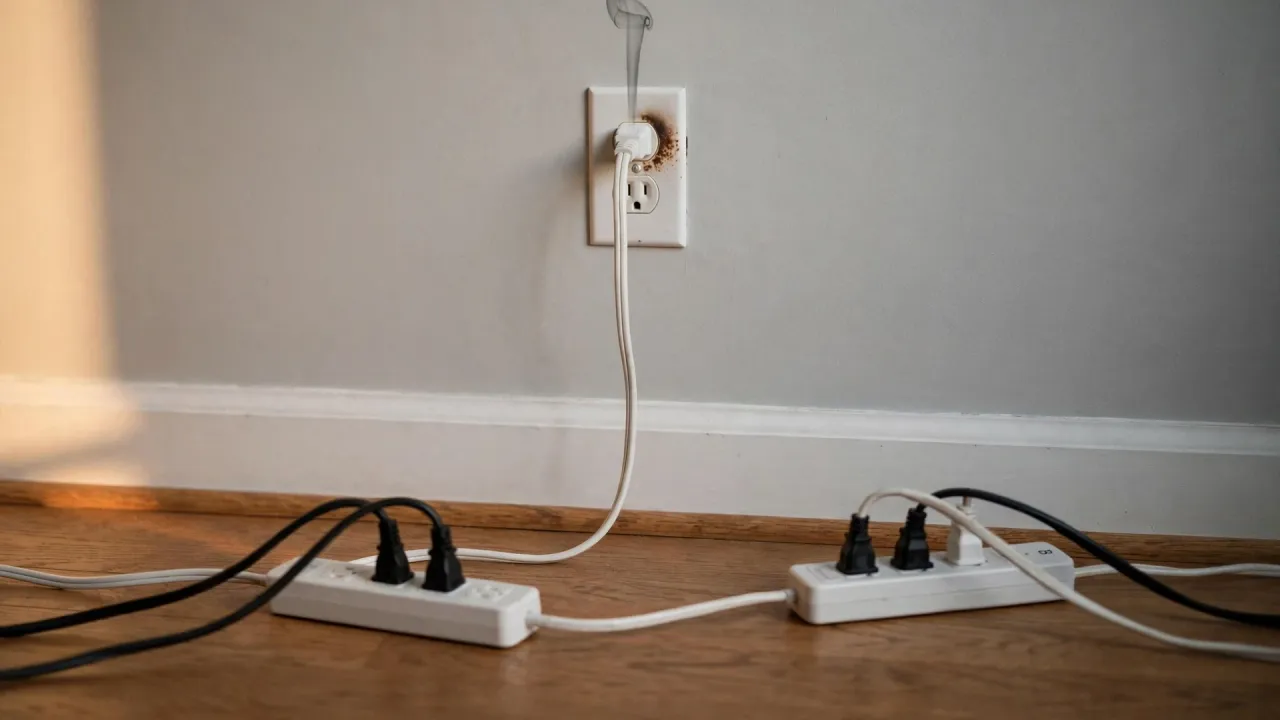
A power strip fire rarely starts where people expect. The cord seldom melts. Instead, the trouble starts at a connection: a tired outlet spring, a loose screw terminal or a worn plug blade. A tenth of an ohm there turns a normal load into about 25 W of heat inside a plastic box. Daisy chains make it worse, because every load in the chain passes through one wall outlet. And the breaker cannot see any of it. This post works through the physics, then checks the codes and fire records.
TL;DR
The physics
- A power strip fire usually starts at a hot contact, not in the cord. At 16 A, a worn 0.1 Ω contact gives off about 26 W, close to the 28–50 W that ignited furnishings and studs in limited tests.
- Glowing contacts have kept going at just 0.3 A and draw no extra current, so no breaker trips.
- Each strip in a daisy chain adds two more contacts in series, and the wall outlet carries the whole load.
- A US breaker need not trip below 135% of its rating. A European breaker may carry 113% for an hour.
The risk and the fix
- In 2015–2019, US homes averaged 32,620 fires a year involving wiring, outlets, cords and lights, with 430 deaths.
- A surge protector adds no current capacity, and old ones can catch fire themselves.
- Plug heat and motor loads straight into the wall. Use one power strip per outlet, never chain them, and keep long-running loads under 80% of the rating.
How does a power strip start a fire?
Mostly through a bad connection. Current squared times resistance makes heat, and a worn contact packs that heat into a few cubic centimetres of plastic.
Joule’s law sets the heat that any conductor makes.
Heat grows with the square of the current. So double the load, and the same resistance makes four times the heat. An appliance’s power is , so for a given wattage the current is . That is why a 2 kW heater draws 16.7 A on a 120 V North American circuit but only 8.7 A on a 230 V European one.
A wire’s resistance depends on its resistivity , length and cross-section .
The table applies it to common sizes, using our own arithmetic for solid copper. Stranded cord runs slightly higher, and copper gains about 0.4% resistance per kelvin as it warms.
| Conductor | Typical use | Per metre, one wire |
|---|---|---|
| 1.0 mm² | Light EU cord | 17 mΩ |
| 16 AWG | US strip cord | 13 mΩ |
| 2.5 mm² | 20 A circuit | 6.9 mΩ |
Current flows out on the live wire and back on the neutral, so the loop has twice the resistance of one wire. A 1.8 m (6 ft) 16 AWG power strip cord at 15 A therefore gives off about W. However, that heat spreads along the whole cord, and a cord in free air sheds it easily. Cord ratings, and PVC insulation classes of 60 to 90 °C, assume exactly that.
Why is the cord itself rarely the ignition source?
Because overload alone takes very large currents to ignite a cord. Lab tests needed three to seven times the rated current.
Vytenis Babrauskas’s review of electrical ignition reports that overload tests needed 3–7 times the rated load to ignite cable. A 2023 Fire Technology study drove 130–240 A through thick PVC-insulated wire, and ignition still needed an arc as the melting core parted. A 15 A or 16 A circuit cannot keep that up for long. So the real paths to ignition run elsewhere: poor connections, cords that cannot shed heat, a last surviving strand, and arcs across charred PVC.
Why does a worn contact get so hot?
Because two metal faces touch only at tiny high points. Current crowds through them, so one contact can add more resistance than metres of wire, all in one spot.
Even a tight plug blade touches its socket spring at only a few “a-spots”. The current squeezes through them, and any oxide film adds more resistance. A new, tight contact adds a few milliohms. In contrast, a worn spring, a loose screw terminal, a push-in “backstab” joint or a corroded blade can add tens or hundreds. All of that heat then lands in about a cubic centimetre of plastic.
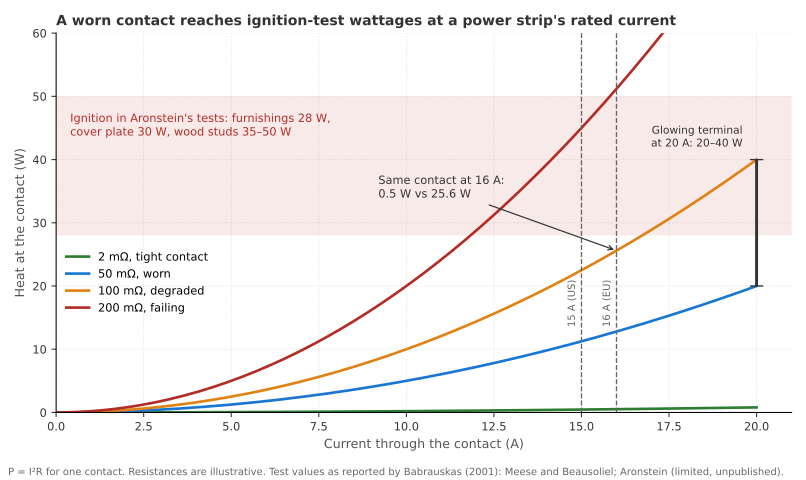
| Contact resistance | 10 A | 13 A | 16 A |
|---|---|---|---|
| 2 mΩ, tight | 0.2 W | 0.34 W | 0.5 W |
| 50 mΩ, worn | 5 W | 8.5 W | 12.8 W |
| 100 mΩ, degraded | 10 W | 16.9 W | 25.6 W |
| 200 mΩ, failing | 20 W | 33.8 W | 51.2 W |
For scale, a small soldering iron uses about 25–30 W. So a 100 mΩ contact at 16 A acts like a soldering iron buried in a plug. The numbers also match measurements. In a 1977 study at the US National Bureau of Standards, Meese and Beausoliel saw a glowing outlet terminal give off 20–40 W at 20 A, against 0.08–0.2 W for a good joint. Yet it dropped only about 1–2 V, too little for anyone to notice the lights dim.
Why does a bad connection keep getting worse?
Because heat loosens the joint, and a looser joint makes more heat. Copper oxide then grows a glowing bridge that passes 1,200 °C.
A poor connection works as a positive-feedback loop. Heat drives oxidation and creep, creep loosens the joint, and the loose joint heats more. Between copper parts, a bridge of copper oxide (Cu₂O) grows, and a thin glowing filament forms inside it. Sletbak and co-workers measured that filament at 1,200–1,300 °C, which Babrauskas notes sits close to the melting point of Cu₂O. Even 10 mm away, they recorded 200–350 °C at only 1 A.
Later work went higher. After John Shea of Eaton set out the physics of glowing contacts in 2006, a 2022 study watched peak contact temperatures climb to 1,400–1,600 °C over time.
Why doesn’t the breaker trip on a glowing contact?
Because a breaker measures current, and a glowing contact adds none. It acts as a small heater in series with a normal load.
Meese and Beausoliel held a visible glow at just 0.3 A for at least five minutes, and one joint glowed on and off for 129 hours at 15 A. They also found steel terminal screws far more likely to glow than brass ones. Later, Hagimoto and colleagues found that 0.3–2 A could sustain a glow in 1 mm wires. A breaker, though, has nothing to detect.
What does daisy-chaining a power strip add?
Three hazards at once: more contacts in series, all the current through one wall outlet, and spare sockets that invite more load.
In a chain of strips, each load’s current passes through every plug-and-socket joint on its way to the wall. Each joint adds two contacts, live and neutral, so the series resistance builds up.
The heat at joint is , where is the total current of everything downstream. Therefore the joints nearest the wall carry the most current, and the wall outlet carries it all. However many sockets the chain offers, that one outlet stays the worst-loaded contact in the room. UK charity Electrical Safety First makes the same point: plugging one extension lead into another “could cause the plug in the wall socket to overheat”.
The extra length also adds voltage drop, . Two 1.8 m strips plus a 3 m 16 AWG extension cord make a loop of about . So 18 A loses about 3 V before counting any contact, and motors such as fridges then draw more current.
Meanwhile, spare sockets invite more load. French rules under NF C 15-100 allow at most 8 sockets on a 1.5 mm² circuit at 16 A, and 12 on a 2.5 mm² circuit at 20 A. A power strip quietly gets around that cap, and a chain multiplies the bypass.
When does a breaker actually trip?
Later than most people think. A US breaker need not trip below 135% of its rating, and a European one may carry 113% for an hour.
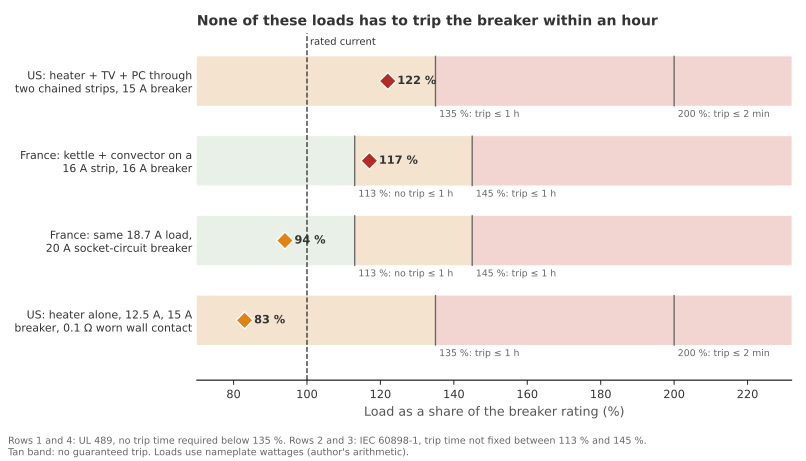
A breaker protects the wall wiring behind it, not the power strip and not a contact. Under IEC 60898-1, a 16 A breaker must not trip within an hour at 1.13 times its rating, or 18.1 A. It must trip within an hour at 1.45 times, or 23.2 A. Under UL 489, a 15 A US breaker must trip within one hour at 135% and within two minutes at 200%. Below 135%, UL 489 sets no trip time at all.
What happens in a typical US home office chain?
The breaker likely holds, the cord runs warm, and a worn wall contact gives off about 33 W. Our worked case uses a 120 V, 15 A circuit and two chained strips.
| Load | Power | Current at 120 V |
|---|---|---|
| Space heater | 1,500 W | 12.5 A |
| TV and games console | 400 W | 3.3 A |
| Desktop PC and monitor | 300 W | 2.5 A |
| Total at the wall | 2,200 W | 18.3 A |
- The load runs at 122% of the 15 A strip and breaker. UC Riverside’s safety office caps a strip at 12 A, and sends anything over 5 A or 600 W straight to the wall.
- The breaker need not trip below 135%, or 20.3 A. Strip protectors vary too: one comparison of two “15 A” units found trip points of 135% and 150%.
- The cord runs warm, at W per metre. That is fine in free air but not under a rug.
- A worn wall contact makes real heat. At 0.1 Ω, W tops the 28–30 W that ignited furnishings and cover plates in Aronstein’s tests. Even the heater alone, at 12.5 A, makes about 16 W there.
What changes on 230 V in Europe and the UK?
Lower current for the same power helps the cord. But a larger breaker can hide a strip overload completely, and only the UK’s plug fuse protects the lead.
Take a French multiprise marked 16 A and 3,680 W, with a 1.0 mm² cord.
| Load | Power | Current at 230 V |
|---|---|---|
| Kettle | 2,200 W | 9.6 A |
| Convector heater | 2,000 W | 8.7 A |
| TV and box | 100 W | 0.4 A |
| Total | 4,300 W | 18.7 A |
That makes 117% of the strip’s rating. On a 16 A breaker, 18.7 A sits just above the 18.1 A no-trip line, so it may run for a long time. On a 20 A circuit, the no-trip line rises to 22.6 A, and the overload turns legitimately invisible. That breaker guards the 2.5 mm² wall cable, not the 1.0 mm² cord, which gives off W per metre. A 0.1 Ω contact adds 35 W.
The UK adds a layer. Each BS 1363 plug carries a fuse, usually 13 A, that protects the lead where a 32 A ring circuit breaker cannot. Most leads carry a 13 A rating, about 3 kW at 230 V. So a 3 kW kettle plus a 900 W toaster draws 17.0 A, about 130% of the fuse. Yet a fuse also responds to heat, so it does not blow at once at 130%, and it ignores a hot contact at the wall socket.
Why do coiled cords and rugs make a power strip dangerous?
Because a cord rated for its load still overheats when its heat cannot escape. Coils, rugs, bedding and dust all trap it.
Babrauskas lists “excessive thermal insulation” as an ignition mode. In one Japanese test, simply coiling a cord three times and covering it with a cloth caused ignition, though the cord carried no more than its rated current. Electrical Safety First likewise says to unwind cable reels fully, since many carry only 10 A or less. Shea’s 2011 study of house circuit fires also named bundled extension cords under rugs. NFPA found that wire or cable insulation was the first item to ignite in 32% of home electrical distribution and lighting fires.
A power strip pushed behind a sofa, buried in bedding or coated in lint faces the same problem. Our post on dryer lint fires covers how heat builds up in a fluffy, insulating bed.
How does hot PVC turn into an arc?
PVC chars into a conductor. Once a carbon path forms between the blades, current flows through the char and arcs, even at modest loads.
PVC makes up most cords and strip housings, and it breaks down into an electrical path. Above roughly 200 °C it gives off hydrogen chloride and chars, and PVC char conducts like a semiconductor. Nagata and Yokoi found that PVC heated to only 160 °C ignited when they applied 100 V across 1 mm of it. Babrauskas also calls PVC “one of the less-satisfactory polymers with regards to arc tracking”. Our post on pyrolysis explains how heat breaks polymers apart.
Japanese lab work by Ashizawa and Omata traced the plug failure chain. Heat from a poor connection degrades the PVC, which gives off hydrogen chloride, and its chalk filler soaks up moisture. Tiny sparks then etch carbon tracks, which arc and ignite.
Plug fires do not need huge loads, either. Mitsuhashi showed that a cord with one surviving strand ignites only in a window of 10–20 A. Below it, the strand stays under about 100 °C. Above it, the strand fuses before the insulation heats up. That window sits squarely in a loaded power strip’s working range.
Can dust alone start a plug fire?
Yes, through tracking. Dust and damp on a plug that stays in for years can carbonise the plastic between the pins with no overload at all.
Japan’s safety agency NITE has reconstructed the sequence. First, dust settles in the gap between plug and outlet and absorbs moisture. Then it conducts between the blades and carbonises the resin surface. Finally, the track breaks down into a short circuit that ignites. NITE recorded 250 fire accidents involving wiring devices from 2016 to 2021. Of 96 accidents caused by how people used or installed the devices, tracking caused 29 and overloading only 6.
Do arc-fault breakers catch these faults?
Sometimes. An arc-fault device listens for the electrical noise of arcing, which an ordinary breaker ignores, but it cannot sense a contact that only glows.
A series arc, in a broken wire or failing contact, sits in line with the load. It lowers the circuit current, so an overcurrent device “cannot be expected to respond”, in Babrauskas’s words. A parallel arc, from live to neutral through char, can draw more. Yet Hagimoto’s waveforms typically peaked at no more than about 50 A, with rare 250 A spikes, and such brief pulses can slip past a breaker for a long time.
Arc-fault devices fill this gap: AFCIs in North America and AFDDs to BS EN 62606 elsewhere. In the UK, BS 7671 has required AFDDs since 2022 on socket circuits up to 32 A in high-rise residential buildings, shared houses (HMOs), purpose-built student housing and care homes. Amendment 4 of 2026 keeps the rule.
How does a power strip fire get inside the wall?
Through the wall outlet. It carries the whole chain’s current, and heat from its contacts can ignite the box, the studs or the insulation around it.
“Wall fire” covers three routes.
-
The wall outlet itself. In 1978 Ontario Hydro tests that Babrauskas summarises, aluminium-wired outlets with poor connections sat in a mock stud bay with cellulose insulation. They carried 15 A through their terminals to wiring further down the circuit. With back-wired outlets, the wood panelling and cellulose ignited after four cycles, once even after the fuse had blown. Screw-terminal outlets only scorched, and a gypsum and fibreglass wall did not ignite in 42 cycles.
-
What a glowing contact can ignite. Aronstein’s limited, unpublished tests ignited furnishings against an outlet face at 28 W, thermoset cover plates at 30 W and wood studs at 35–50 W. The studs first smouldered, then flamed once the fire broke through.
-
Slow heating of wood over years. This route remains contested. From case incidents, Babrauskas argues that wood heated for months can ignite at hot-object temperatures as low as 77 °C. In contrast, Cuzzillo and Pagni concluded that “‘pyrophoric carbon’ appears not to exist”. Swann, Hartman and Beyler found that long preheating did not lower plywood’s minimum heat flux for ignition, though it did shorten ignition times. So treat any claim that a warm outlet box will “eventually” ignite a stud as a hypothesis.
Aronstein’s wattages match the 100–200 mΩ rows of the contact table. Our post on smouldering vs flaming fires covers the switch to flame.
Why is a fire inside the wall so deadly?
Because it starts out of sight and out of reach of smoke alarms. Fires that start at night cause more than half of these deaths.
NFPA places 8% of US home electrical distribution and lighting fires in a wall assembly or concealed space. The same report finds that fires between midnight and 8 a.m. make up 23% of these fires but 52% of the deaths. A smouldering wall cavity also makes smoke rich in carbon monoxide, as our post on smoke inhalation explains. Once flames reach the room, the race between ASET and RSET decides who gets out.
Is a surge protector safer than a power strip?
No. A surge protector clamps brief voltage spikes, but it adds no current capacity, and a worn-out one can overheat and burn.
Inside, metal-oxide varistors (MOVs) do the work. When the voltage spikes, an MOV conducts and shunts the surge, often for less than 100 µs. Each surge, however, wears it down, until it conducts on normal mains peaks and runs away thermally. A sustained overvoltage, such as a lost neutral, gets there fastest. According to Littelfuse, unprotected MOVs then “will heat up, out-gas and may catch fire”. So UL 1449 added abnormal overvoltage tests in 1996, and thermally protected MOVs now disconnect when hot.
Old units show the risk. In 2013, Schneider Electric recalled about 15 million APC SurgeArrest units made before 2003. It had received 700 reports of overheating and melting, 55 property damage claims and 13 injuries.
People often confuse four kinds of protection.
| Device | Responds to | Protects |
|---|---|---|
| Breaker or fuse | Sustained overcurrent | The wiring it suits |
| Surge protector | Microsecond voltage spikes | Electronics |
| AFCI or AFDD | The noise of arcing | Against missed arcs |
| GFCI or RCD | Current leaking to earth | People, from shock |
Apart from an arc-fault device, which may catch an arc if one develops, none of them responds to a 30 W glowing contact.
What do the codes say about daisy-chaining power strips?
Don’t do it. US fire codes, OSHA and UL’s listing all require a power strip to plug directly into a wall outlet, and UK and French guidance agree.
- UL listing and OSHA. UL’s listing conditions, quoted in a 2002 OSHA letter, say strips must plug directly into a permanent outlet and “are not to be series-connected to other RPTs or connected to extension cords”. OSHA adds that strips are not designed for space heaters, fridges or microwaves.
- US fire codes. NFPA 1 §11.1.4 requires strips listed to UL 1363 and plugged directly into a permanent outlet. The International Fire Code’s §603.5 also demands a direct connection, though approved meeting rooms may briefly chain up to five.
- UK. Electrical Safety First says one lead per socket, never chained. In May 2022, a Bexleyheath house fire involved “multiple extension leads plugged in together leading back to a single socket”, blamed on an overloaded lead.
- France. Insurer Luko by Allianz Direct warns that branchements en cascade, chained multiprises, raise the fire risk.
How many fires do power strips cause?
Nobody counts them separately. US data fold power strips into cords, plugs and outlets, within about 32,620 home electrical fires a year.
| Measure | Value | Data years |
|---|---|---|
| US home electrical distribution and lighting fires | 32,620 a year | 2015–2019 |
| Civilian deaths in those fires | 430 a year | 2015–2019 |
| Direct property damage | $1.3 billion a year | 2015–2019 |
| Cords and plugs, share of fires | 12% | 2002–2005 |
| Cords and plugs, share of deaths | 39% | 2002–2005 |
The first three rows come from NFPA’s 2022 report, and the shares from an earlier NFPA analysis. So cords and plugs start few of these fires but kill out of proportion. In that 2008 analysis, extension cords alone came to 2,110 fires and 96 deaths a year. Many sites instead quote 3,300 home fires a year from extension cords, but that comes from a CPSC fact sheet with figures from before 2000.
- Causes can be wrong. Babrauskas cites claims that investigators misjudge a significant share of “electrical” fires.
- Countries differ. The UK, for example, counted 13,537 accidental electrical dwelling fires in 2024/25, under its own definitions.
How do you use a power strip safely?
Plug heat and motor loads into the wall, use one power strip per outlet, add up the watts, and replace anything warm, loose or scorched.
- Plug heat and motor loads straight into a wall outlet, one per outlet: heaters, kettles, toasters, air fryers, microwaves, hair dryers, fridges and portable air conditioners. Our space heater post explains why.
- Use one power strip per wall outlet. Never chain strips or feed one from an extension cord.
- Add up the watts. Keep long-running loads under 80% of the rating: about 1,440 W for a 15 A US strip, 2,940 W for a 16 A EU strip and 2,400 W for a 13 A UK lead.
- Buy certified strips with overcurrent protection: UL 1363 in North America, the NF mark in France, and BS 1363 or BS 5733 with a fused plug in the UK.
- Keep cords in the open, never under rugs or bedding, and fully unwind cable reels.
Then look after what you have.
- Replace a surge protector after a nearby lightning strike or major surge, or when its indicator shows end of life.
- Unplug and dust plugs that stay in for months, to break the tracking cycle.
- Add outlets if you use strips every day, and ask an electrician about arc-fault protection.
- Fit working smoke alarms near every loaded power strip. Our post on smoke alarm types explains which kind catches smouldering fires early.
What warning signs mean you should unplug now?
Heat, smell, scorch marks or a loose fit. Each one points to the contact damage that leads to glowing joints.
UK fire services list scorch marks, hot plugs and sockets, fuses that often blow, breakers that trip for no obvious reason, and flickering lights. Electrical Safety First adds burning smells. Also watch for a plug that falls out of a slack outlet, and for buzzing or crackling. A slack fit, in particular, shows the worn spring behind a high-resistance contact. If you notice any of these, unplug the power strip and have the wall outlet replaced.
What are the limits of this evidence?
Read the contact numbers as illustrations, not measurements.
- Contact resistance varies. Glowing joints cycle between high and low resistance, so one 0.1 Ω value simplifies.
- The ignition data are thin. Most tests are old and small, and many used aluminium wiring. Babrauskas called systematic research “inordinately scarce”.
Key takeaways
A power strip fire usually starts at a connection, not in the cord. Heat follows , so a worn 0.1 Ω contact turns a normal 16 A load into about 26 W in a thumb-sized space. Tests have ignited furnishings and studs at 28–50 W. Yet a glowing joint draws no extra current, so no breaker sees it.
Daisy chains stack the odds: each strip adds two contacts in series, and the wall outlet carries the whole load. Breakers also leave overloads room, since UL 489 sets no trip time below 135%. A surge protector changes none of this.
So plug heat and motor loads straight into the wall, use one power strip per outlet, and stay under 80% of the rating. Then treat warmth, scorch marks, a burning smell or a slack plug as reasons to unplug.
Cite this articleHow to cite
Dinh, D. C. (2026, October 3). Overloaded Power Strip: How a Daisy Chain Starts a Wall Fire. PyroRisk. https://pyrorisk.net/blog/overloaded-power-strip-how-a-daisy-chain-starts-a-wall-fire/
Recent posts
Featured posts
Categories
Comments
Related posts
Fire in Daily Life
Space Heater Season: Why 3 Feet and Off at Night Save Lives
A space heater starts a small share of US home heating fires but causes most of the deaths. Radiant heat, tip-over physics and sleep explain why.
Fire in Daily Life
Turkey Fryer Fireball: The Physics of Water in Hot Oil
A turkey fryer holds five gallons of hot oil over an open flame. See why 100 g of ice makes 200 L of steam, how pots overflow, and how to fry safely.
Fire in Daily Life
Chimney Fire Science: Why Creosote Turns Flues Into Fuel
A chimney fire can hit 1090 °C and crack a clay flue liner in minutes. Here is the creosote science behind it, and why an annual sweep stops it.