pyrorisk.net · Fire Science & Risk Fire Safety Engineering
Ionization or Photoelectric Smoke Alarm? Why Experts Split
Ionization alarms beat a photoelectric smoke alarm by seconds in flaming fires, then lose by 30 minutes in smoldering ones. Here is why experts still split.
Online: pyrorisk.net/blog/ionization-vs-photoelectric-smoke-alarm-why-experts-split/
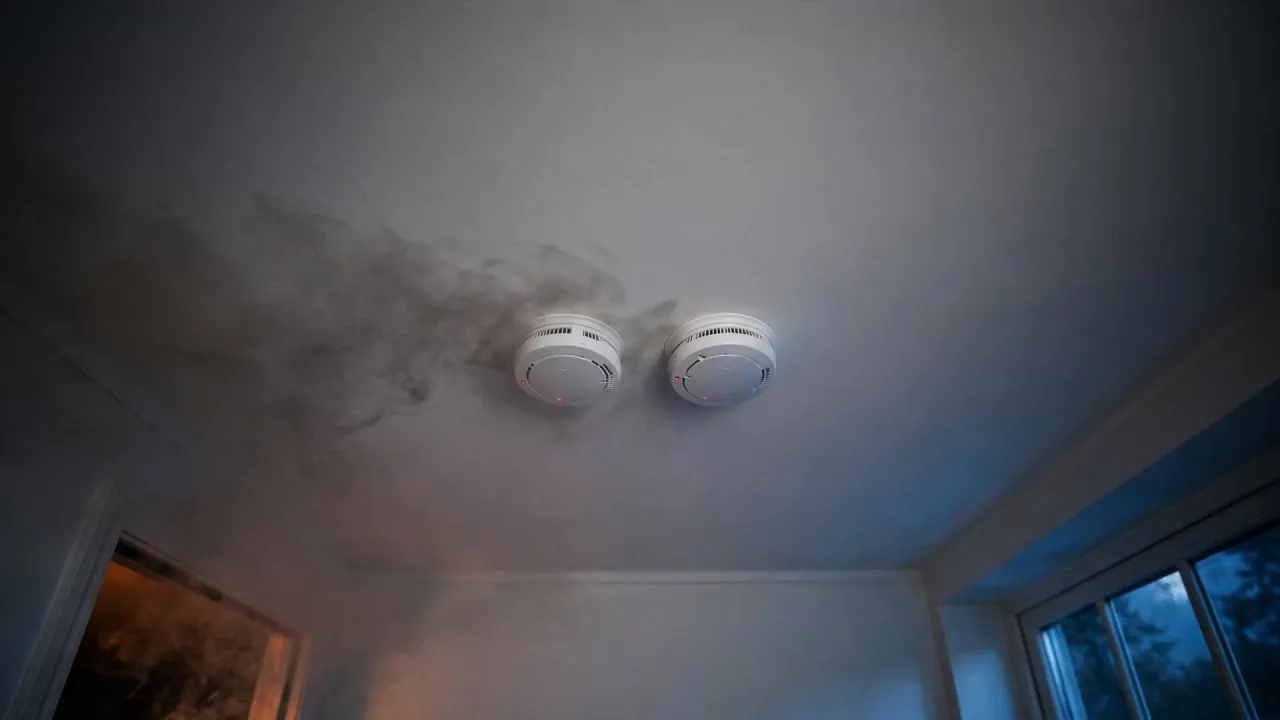
Every smoke alarm uses one of two tricks to notice smoke. An ionization alarm watches a tiny electric current, while a photoelectric smoke alarm watches for scattered light. Fire services have argued for decades about which trick works better. Yet the physics settled long ago: in side-by-side tests, ionization alarms win flaming fires by tens of seconds. Photoelectric alarms, by contrast, win smoldering fires by tens of minutes. So the real fight concerns how to weigh those numbers, and how to count alarms people rip down after burning toast.
TL;DR
The physics and the test data
- Ionization (ion) alarms react best to the tiny soot of flaming fires. A photoelectric smoke alarm reacts best to the larger smoke particles of smoldering fires.
- In NIST’s benchmark tests, ion alarms sounded first in flaming fires, at 47 seconds against 94. In smoldering fires, photoelectric alarms led by about 30 minutes.
- Dual-sensor alarms close most of the flaming gap, but they can inherit the ion sensor’s kitchen false alarms.
The field record and the law
- In two field trials, people disabled ion alarms about four times as often, mostly because of cooking.
- Since 30 June 2024, US alarms must pass UL 217 8th edition or later, with new smoldering foam and hamburger tests.
- France bans ion alarms in homes on radiation grounds, so French homes already use optical alarms.
How does an ionization smoke alarm sense smoke?
It measures a tiny current through ionized air. Smoke particles soak up the ions, so the current drops, and the alarm sounds once the drop crosses a set threshold.
Inside sits a small americium-241 source. Its alpha particles knock electrons off air molecules between two plates, so a steady current flows. Smoke particles then grab those ions and slow them down. Because capture depends on both the count and the size of particles, the signal tracks their product. UL’s Smoke Characterization Project confirmed this in the lab.
Here gives the number of particles per unit volume and their mean diameter. Test labs use a reference sensor called a measuring ionization chamber, or MIC. Both UL 217 and EN 14604 report its reading as a unitless value . It compares the current in clean air, , with the current in smoky air, .
Clean air gives . As smoke thickens, falls and climbs.
How much radioactive material does one contain?
Very little. According to the US Nuclear Regulatory Commission, most units sold today hold one microcurie or less of americium-241, about 37 kBq.
The NRC’s backgrounder describes the source, and the US exemption in 10 CFR 30.15 caps it at 1 µCi per unit. Still, the source brings licensing and disposal rules.
How does a photoelectric smoke alarm see smoke?
It shines light where its sensor cannot see it directly. Smoke particles scatter some of that light onto a photodiode, and the alarm sounds when enough light arrives.
A home photoelectric smoke alarm sets an LED, usually infrared, and a photodiode at an angle inside a dark maze. Clean air sends almost no light to the sensor, but smoke scatters light in all directions. UL found that the scattered signal grows with particle count, but with the square of particle size. Obscuration, the dimming of a straight beam, grows with the cube.
Here stands for the scattered signal and for optical density per unit path. So a light-scattering sensor rewards big particles far more than an ion chamber does.
Why does particle size decide the race?
Because flaming and smoldering fires make very different smoke. Flames make swarms of tiny soot particles, while smoldering makes fewer, larger tar droplets.
Flames produce huge numbers of soot clumps, well below 0.3 µm across. They push the ion signal, , up fast. Yet they add little to the scattering term, . Smoldering, by contrast, releases droplets above 0.3 µm, with mass-median sizes of 1–3 µm in NIST smolder tests. These scatter light well but barely register in an ion chamber.
The gap runs large. Mulholland and Ohlemiller found that smoke from smoldering cellulose insulation needed seven times the concentration of punk-stick smoke, a standard test source, to trip an ion detector. UL also found that flaming foam made the smallest particles of any material it tested. Smoke also ages as it travels, so small particles clump into bigger ones before they reach a ceiling. Our post on smoldering vs flaming fires covers the chemistry behind it.
| Feature | Ion | Photoelectric |
|---|---|---|
| Sensor | Am-241 source, ion chamber | IR LED and photodiode |
| Signal grows with | ||
| Best at | fast flaming fires | smoldering fires |
| Weak at | smoldering sofas, aged smoke | some clean or very black flaming smoke |
| Cooking false alarms | frequent | fewer, not zero |
How do alarm standards measure smoke density?
Through the dimming of light over a known path. Engineers write it with the Beer–Lambert law, then turn it into optical density or percent obscuration.
A beam of intensity loses light as it crosses a path of length through smoke with extinction coefficient . Three common measures follow.
US practice quotes percent obscuration per unit length instead, in %/m or %/ft.
For light smoke, 1 %/ft roughly equals 3.3 %/m. The exact conversion treats both values as fractions, since one metre spans 3.281 feet.
So the UL 217 sensitivity window of 1.6–12.5 %/m matches about 0.5–4 %/ft. Europe’s EN 14604 instead uses in dB/m for the optical channel and for the ion chamber. Its room fire tests end at dB/m or .
What did NIST’s side-by-side tests find?
Both types usually gave people time to escape. Yet each lagged badly on the fire type it handles worst, and NIST TN 1455 remains the benchmark study.
Bukowski and colleagues fitted alarms of each type side by side in a manufactured home and a two-storey house. Then they lit flaming, smoldering and cooking fires. Their report found that either type “consistently provide[s] time for occupants to escape from most residential fires.” It added that “in some cases the escape time provided can be short.”
NIST also found that escape margins had shrunk. In flaming tests, conditions turned deadly after about 3 minutes on average. The 1970s Indiana Dunes tests had allowed 17 minutes. NIST blamed faster-burning modern furniture, plus stricter criteria for survivable conditions. Our post on t-squared fire growth explains why modern fires grow so fast.
| Fire type | Photo alarm (s) | Ion alarm (s) | Untenable (s) |
|---|---|---|---|
| Smoldering | 2219 ± 1061 | 4010 ± 1120 | 4316 ± 1256 |
| Flaming | 94 ± 33 | 47 ± 36 | 217 ± 67 |
| Cooking | 738 ± 103 | 681 ± 475 | 1477 ± 249 |
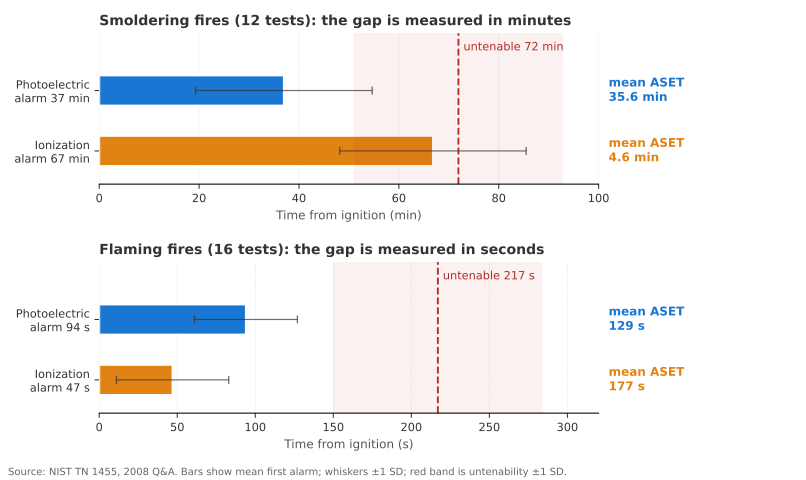
The chart shows why both camps quote the same study. In smoldering fires, the average ion alarm sounded just 5 minutes before conditions turned deadly. The average photoelectric smoke alarm left about 36 minutes. In flaming fires, however, ion alarms left 177 seconds and photo alarms 129. NIST averaged these margins test by test, so they differ slightly from the gaps between the means.
How often did the escape margin run out?
More often than the headline suggests. At the longest assumed escape time, ion alarms failed 9 of 12 smoldering tests. The photoelectric smoke alarm, in turn, failed 11 of 16 flaming tests.
NIST’s 2008 clarification compared the available safe egress time (ASET) with a required time (RSET) of 10 to 140 seconds. For the 12 smoldering tests, ASET fell short in 1–5 tests with photo alarms, but in 2–9 with ion alarms. For the 16 flaming tests, it fell short in 1–11 with photo alarms and 0–5 with ion alarms. So each type fails often on the fire it detects worst. Our post on ASET vs RSET explains the inequality behind these counts.
Why does NIST treat seconds and minutes alike?
Because it judged margins against danger, not raw detection speed. NIST argued that a 30-minute lead in a slow fire may matter no more than a 30-second lead in a fast one.
In NIST’s words, the margin from “a 30 minute earlier warning in a slow growing smoldering fire” may be no “more significant than a 30 s earlier warning for a fast growing flaming fire.” Photoelectric advocates reject that view. NIST also granted that ion alarms may leave too little time for people with limited mobility in a smoldering fire. Likewise, a photoelectric smoke alarm may leave too little time in a flaming furniture fire.
Do dual-sensor alarms close the gap?
Mostly, yes. In a NIST follow-up on the same data, dual photo-ion alarms matched a photoelectric smoke alarm on smoldering fires and beat it by 29–38 seconds on flaming fires.
Thomas Cleary’s analysis found that the ion sensor added only 3–4 seconds on smoldering fires. The flaming gain depended on how sensitive the maker set the ion channel. However, that same setting also drove kitchen false alarms. So a dual alarm buys back the flaming deficit, but it risks the ion alarm’s worst habit.
Do UL and European tests agree?
Yes, on direction. UL’s 2007 burns of modern furniture repeated NIST’s pattern, and the UK’s BRE later put the same question to European test fires.
Fabian and Gandhi burned modern synthetic and natural materials in the UL 217 test room for a UL and Fire Protection Research Foundation project. Their summary reads: “The ionization alarm responded quicker to flaming fires; the photoelectric responded quicker to non-flaming fires.” In one flaming foam test, the photoelectric smoke alarm never sounded at all. Meanwhile, photo alarms led every non-flaming test except one toaster fire. The work later shaped the new UL 217 test fires.
In Europe, a 2014 BRE study by Chagger ran 29 test fires with fuels such as MDF, PVC cable and sunflower oil. The BRE report asked whether ion detectors “perform poorly in certain types of smouldering fires” and whether optical ones miss some flaming fires. In short, Europe asked the same question.
Why do nuisance alarms matter more than lab speed?
Because a disabled alarm detects nothing. Field trials show people disconnect ion alarms several times more often than photo alarms, mostly after cooking.
Lab speed means little once the battery sits on the kitchen counter. Three studies anchor this point.
- Rural Alaska, 2000. Fazzini, Perkins and Grossman found that ion homes had more than 8 times the rate of false alarms after 6 months. In all, 92% of ion homes had at least one false alarm, against 11% of photo homes.
- Seattle, 2008. In a randomized trial of 757 homes, 20% of ion alarms and 5% of photo alarms had stopped working at 9 months.
- CPSC pilot, 2010. Lee and Pineda found that, at 1.5 m from a stove, 8.7% of cooking events tripped ion alarms, 11.3% dual alarms and 3.0% photo alarms.
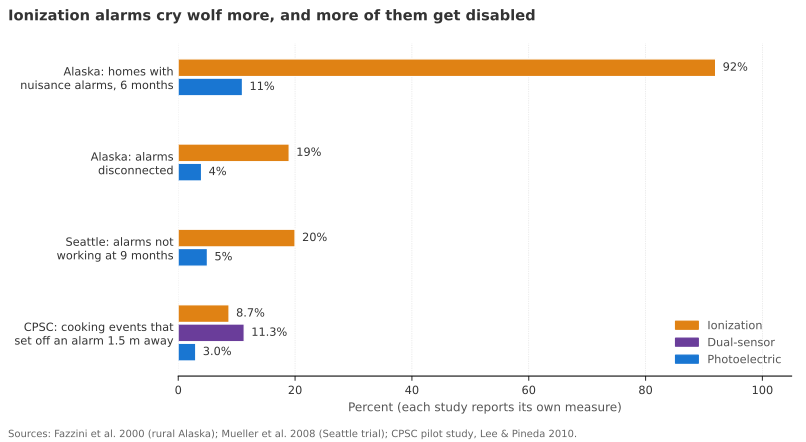
Each study measured something different, so compare bars within a group only. In Alaska, 19% of ion alarms ended up disconnected, while the photoelectric smoke alarm fared far better, at 4%. The Seattle risk ratio for a dead or missing ion alarm reached 2.7 at 15 months. At 6 m from the stove, though, every type in the CPSC study fell to about 1%.
Newer alarms have not solved the problem yet. In NIST mock-kitchen tests, alarms that passed UL 217 8th edition “were not clearly superior” to older designs across a range of cooking. NIST added that the single hamburger test “may not be sufficient” to represent real cooking. Our post on kitchen fire science covers why cooking sets off so many alarms.
What changed with UL 217 8th edition?
Since 30 June 2024, US alarms must pass three extra tests: flaming foam, smoldering foam and a broiling-hamburger test. Simple ion-only designs struggle to pass all three.
UL’s standards panel voted in 2015 to add the tests. One burns polyurethane foam with open flame, and another lets the same foam smolder. In the cooking test, meanwhile, the alarm must stay silent while two frozen burgers broil. NIST and UL Standards & Engagement both give 30 June 2024 as the date the new editions took effect.
The rule does not force anyone to replace an installed alarm. However, it squeezes simple designs from both sides. Ion-only units struggle with smoldering foam, while ion-heavy designs struggle with the burger.
How close to a kitchen can a smoke alarm go?
At least 3 m (10 ft) from a fixed cooking appliance under NFPA 72, unless listed for that spot. A photoelectric smoke alarm may sit as close as 1.8 m where the layout leaves no choice.
Since its 2010 edition, NFPA 72 has barred smoke alarms within 3.0 m of a fixed cooking appliance. Between 3.0 and 6.1 m, an alarm needs a silence button or photoelectric sensing. The International Residential Code restates the rule by type.
| Alarm type | Minimum distance from cooking |
|---|---|
| Ion | 6.1 m (20 ft) |
| Ion with silence switch | 3.0 m (10 ft) |
| Photoelectric | 1.8 m (6 ft) |
Why do US fire experts disagree?
Because they weigh the same evidence differently. NFPA stays neutral and recommends combination alarms, while the firefighters’ union backs a photoelectric smoke alarm or a UL 217 8th-edition device.
The NFPA’s guidance says that “ionization alarms are more responsive to flaming fires, and photoelectric alarms are more responsive to smoldering fires.” It recommends combination alarms, and now multi-criteria ones too. The US Fire Administration advises both types or a dual-sensor alarm. Yet the fire service splits three ways.
- IAFC. In 2008, the chiefs’ fire and life safety section backed dual-sensor alarms after the UL study.
- IAFF. The firefighters’ union backed photo-only alarms in 2008. Its fire prevention page lists a 2020 resolution that widens this to alarms passing UL 217 8th edition.
- World Fire Safety Foundation. This group campaigns hardest for photo-only alarms. Treat its material as advocacy.
Which US states restrict ion alarms?
Massachusetts, Vermont and Maine, among others. Each limits ion alarms near kitchens and bathrooms, where steam and cooking cause most false alarms.
In Massachusetts, an older home offered for sale needs photoelectric alarms within 20 feet of a kitchen or of a bathroom with a tub or shower. Vermont’s 2008 law demanded photoelectric-only alarms and even excluded combination units. Since 2025, its statute also accepts “UL 217 compliant smoke alarms.” Maine’s law requires a photoelectric smoke alarm within 20 feet of a kitchen or bathroom, while it still allows ion alarms inside bedrooms.
What have the courts said?
The record runs both ways. Death cases have produced large verdicts, while a 2026 California class action over the “smoke alarm” label failed.
Juries in single cases, such as Gordon v. BRK Brands in 1999, have returned large verdicts. In 2023, however, Pons v. Walter Kidde Portable Equipment claimed that ion-only devices cannot honestly carry the name “smoke alarm”. On 6 April 2026, the federal court granted the makers summary judgment. It held that approval by California’s State Fire Marshal gives the label a safe harbor. The plaintiffs have appealed to the Ninth Circuit, and the same lawyer has filed a related suit in Washington.
Why did Europe settle the debate differently?
Radiation law settled it, not fire science. Rules on radioactive consumer goods pushed ion alarms off most EU shelves, and France banned them from homes outright.
EU home alarms carry CE marking against EN 14604. The standard uses four test fires: TF2 smouldering wood, TF3 glowing cotton, TF4 flaming foam and TF5 flaming heptane. Unlike UL 217, it has no cooking test. In principle it stays neutral on technology, so an ion alarm could pass.
Radiation rules drew the real line. Directive 2013/59/Euratom requires states to justify every practice that uses ionising radiation, consumer goods included. Its effect on smoke alarms stays national, though. In 2000, a European Parliament question claimed that Germany and France banned americium detectors while the Netherlands sold them in DIY shops. The Commission replied that most states, including those two, licensed them instead for their technical benefits. So the EU map remains a patchwork, even though ion alarms have become rare in EU shops.
Why can’t French homes use ion alarms?
Because French health law forbids adding radioactive material to consumer and building products. So every legal French home alarm uses optical sensing.
The loi Morange of 9 March 2010 required every home to have at least one détecteur avertisseur autonome de fumée, or DAAF, by 8 March 2015. An order of 5 February 2013 then set the rules: CE marking to NF EN 14604, at least 85 dB(A) at 3 m, and a spot near the bedrooms, high up and away from steam. Service-Public says plainly that the law bans ion detectors because they are radioactive. ANIL traces the ban to article R. 1333-2 of the public health code.
What happened to France’s 7 million ion detectors?
France ordered them out of commercial buildings over ten years. The plan covered some 7 million detectors on about 300,000 sites, with a deadline of 5 December 2021.
Outside homes, ion detectors long ruled commercial fire systems. Yet ASN judged them no longer justified, since optical detectors now detect fires about as well. A 2011 order and two ASN decisions set up the removal. By ASN’s own 2022 report, however, nearly one million still hung on ceilings after the deadline.
How do Scotland and Queensland handle kitchens?
By changing the sensor, not by dulling it. Scotland puts a heat alarm in the kitchen, and Queensland requires photo-only alarms throughout the home.
Since 1 February 2022, every home in Scotland must have linked alarms, with a heat alarm in the kitchen. Queensland’s law goes further. Since 2017, it has required photoelectric alarms that do “not also contain an ionisation sensor”, so dual units fail too. Every home must comply by 1 January 2027.
Do you probably have the wrong smoke alarm?
Only if you live in the US and bought a cheap alarm before mid-2024. In France and most of the EU, you almost certainly own an optical alarm already.
Ion alarms have ruled US homes since the 1970s. You may read that 90% of US homes have only ion alarms. That figure comes from the Pons complaint, which gives no source, so treat it as a claim. Ion units also long sold as the cheapest option, at about half the price of a photoelectric smoke alarm in 2000, according to an editorial beside the Alaska study. So a cheap US alarm bought before mid-2024 may well use ion sensing only, a poor choice for a bedroom hallway.
In France, by contrast, nobody can legally fit an ion DAAF. So the French risks look different: a fake import without real EN 14604 testing, an old alarm, an alarm in the kitchen, or one alarm for a multi-storey home.
Do smoldering fires really cause most deaths?
Not directly, and that nuance matters. Night fires cause nearly half of US home fire deaths, yet very few deaths come from fires that never burst into flame.
NFPA’s latest Home Structure Fires report finds that fires between 11 p.m. and 7 a.m. made up 19% of home fires but caused 48% of deaths. Upholstered furniture burned first in just 1% of fires but in 14% of deaths. Sleeping people and smoldering sofas or bedding form the core photoelectric argument.
The other side deserves equal airtime. A 2006 white paper from a public-private fire safety council, with NFPA analysts among its authors, puts deaths from fires that never flame at “at most 3%.” A smoldering fire that flares up will trip an ion alarm in the end. So the real question asks how much early warning disappears. NIST’s margins answer that most of it can: 276 seconds for ion alarms against 2,136 for photo alarms. Our post on smoke inhalation explains why those minutes decide who survives.
Where do the experts genuinely disagree?
On weighting, not on physics. Both camps accept the test data, yet they value seconds in fast fires and minutes in slow fires differently.
| Question | Neutral or ion camp | Photoelectric camp |
|---|---|---|
| Flaming fires | a 30–50 s lead matters when danger comes at 217 s | photo alarms still left 129 s |
| Smoldering fires | a slow fire leaves margin after a late alarm | ion margins of 276 ± 331 s sometimes hit zero |
| Fatal fires | at most 3% of deaths involve fires that never flame | half of deaths happen at night |
| Nuisance alarms | siting rules and hush buttons fix them | trials show 2.7–4 times more disabling |
| Best answer | dual-sensor or both types | photo only |
Our reading follows the field data. Once you count disabled alarms, the photoelectric smoke alarm wins for bedrooms and spots near kitchens. Where you can afford two sensors, an ion channel adds a real but modest flaming gain. That gain only pays off if it does not trigger nuisance alarms.
Which smoke alarm should you install?
Where you have a choice, fit a photoelectric smoke alarm near bedrooms and a heat alarm in the kitchen. Then link every alarm together.
- US homes: replace ion-only alarms near bedrooms or kitchens. Fit a photoelectric smoke alarm or a UL 217 8th-edition device instead. Ion units carry a radioactive-material notice on the back.
- US homes wanting more: add a second sensor far from the kitchen. Pair a photoelectric smoke alarm in each bedroom with a dual or ion alarm in the living room.
- French and EU homes: check the label. Look for CE and NF EN 14604 marking. Fit one alarm per level, plus one near the bedrooms.
- Kitchens everywhere: use a heat alarm. Keep every smoke alarm at least 3 m from the stove.
- Engineers: quote NIST’s margins, not its headline. Cite the ASET spreads and the counts of ASET below RSET from TN 1455.
Two findings would change this advice. One is a real-home test in which a UL 217 8th-edition ion design matches photoelectric speed on smoldering foam. The other is field data showing people disable dual alarms as often as ion-only ones.
What are the limits of this evidence?
Read the numbers as strong evidence of direction, not as precise forecasts for your home.
- Test fires differ from house fires. Models of one type can vary as much as the two types do.
- Old data describe old alarms. TN 1455 and the 2007 UL study tested alarms from before 2024.
- Nuisance samples stay small. Alaska covered four villages and the CPSC pilot nine homes.
- Sensor type sits beside other factors. Linked alarms, loud enough sounders and alarm age matter just as much.
Key takeaways
The physics never changed. Ion chambers track particle count times size, so they catch the fine soot of flaming fires first. A photoelectric smoke alarm tracks scattering area, so it catches the coarse smoke of smoldering fires first. NIST put numbers on the gap: about 47 seconds of ion lead in flaming fires, against roughly 30 minutes of photoelectric lead in smoldering ones.
The field record tips the balance. Ion alarms trip on cooking far more often, and people disconnect them about four times as often. Meanwhile, UL 217 8th edition now tests both smoldering foam and burger smoke, so new US alarms must handle both.
Geography decides whether you own the wrong one. An American with a cheap, older ion-only alarm near the bedrooms should replace it with a photoelectric smoke alarm. A French home already has an optical alarm by law, so check its label, age and position instead. Everywhere, put a heat alarm in the kitchen, link the rest, and replace every alarm at 10 years.
Cite this articleHow to cite
Dinh, D. C. (2026, September 25). Ionization or Photoelectric Smoke Alarm? Why Experts Split. PyroRisk. https://pyrorisk.net/blog/ionization-vs-photoelectric-smoke-alarm-why-experts-split/
Recent posts
Featured posts
Categories
Comments
Related posts
Fire Safety Engineering
2-Hour Fire Wall: What a Fire Resistance Rating Measures
A 2-hour fire resistance rating means a wall survived a 1918 furnace curve, not a real fire. Here is what the test proves, and where it falls short.

Fire Safety Engineering
ASET vs RSET: The Inequality Behind Every Evacuation Plan
ASET vs RSET decides whether a building passes. Here come the timeline, the tenability limits, the equations, and the one term that swings the answer most.
Fire Safety Engineering
Critical Temperature: Why Steel Softens and Concrete Spalls
The 550 °C critical temperature of steel comes from a load ratio, not from metallurgy. Here is the real physics, and why hot concrete explodes.