pyrorisk.net · Fire Science & Risk Fire Case Studies
Station Nightclub Fire: Why 100 People Had Only 90 Seconds
The Station nightclub fire killed 100 people in 2003. See how stage gerbs, acoustic foam and one narrow inner door left the crowd about 90 seconds to escape.
Online: pyrorisk.net/blog/station-nightclub-fire-why-100-people-had-only-90-seconds/
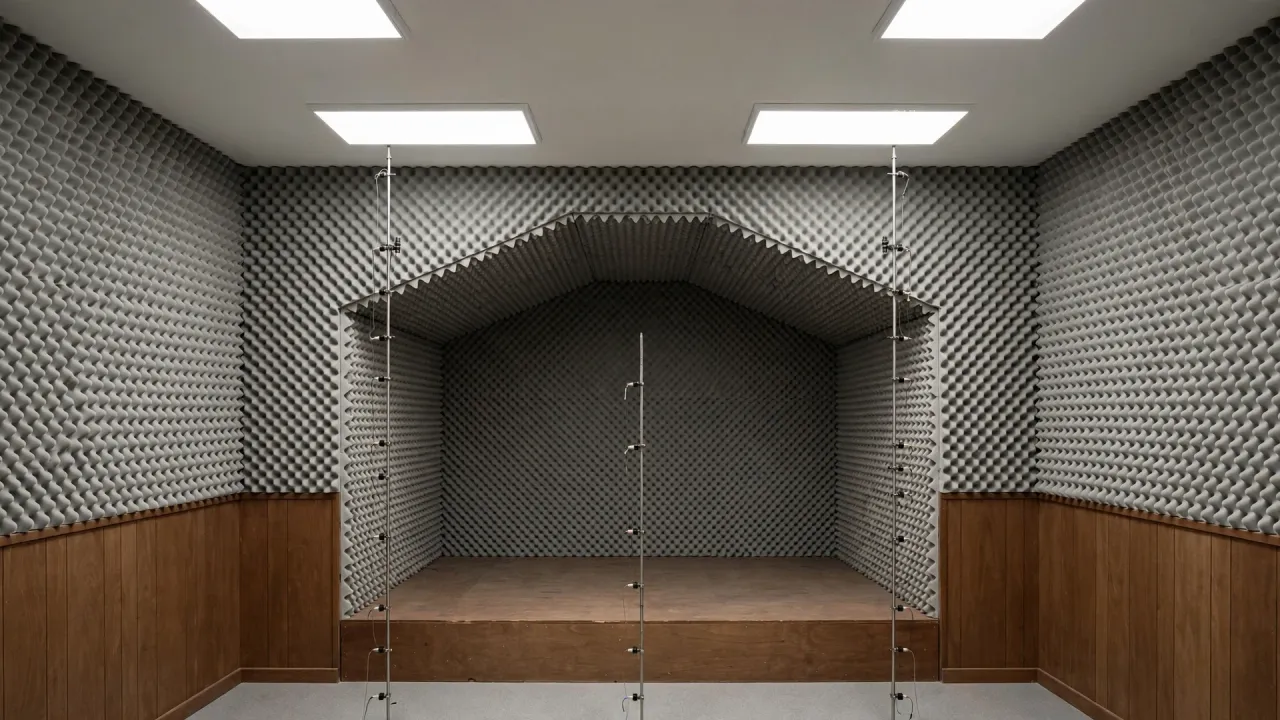
On 20 February 2003, a tour manager lit four stage fireworks behind the band Great White at the Station nightclub in West Warwick, Rhode Island. Their sparks reached grey acoustic foam on the walls around the drummer. Within about 90 seconds, the air at head height across the main room could kill. In the end, 100 people died. This case study follows the Station nightclub fire through the evidence of NIST’s investigation. It explains why the foam burned so fast, why most of the crowd headed for one door, and why the arithmetic of escape never had a chance.
TL;DR
The fire
- Four stage gerbs lit non-fire-retarded polyurethane foam in about 10 seconds, and the foam then lit the wood paneling behind it.
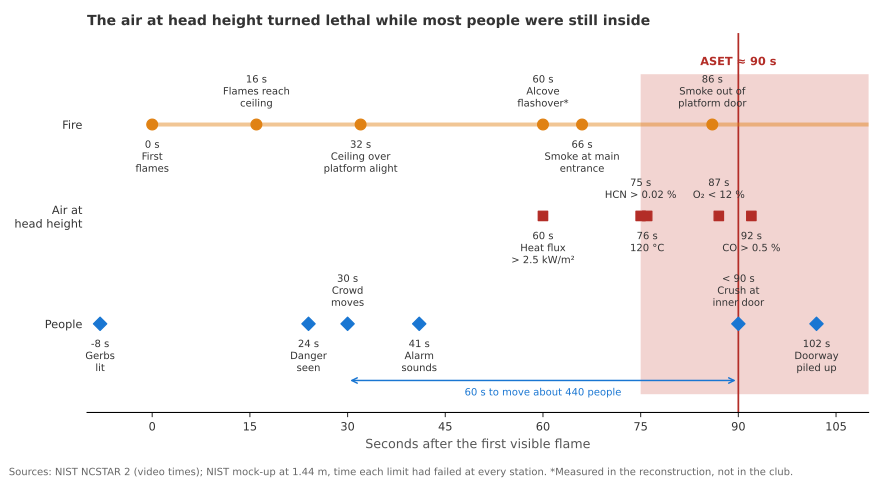
- In NIST’s full-size mock-up, the alcove flashed over at about 60 s, and every head-height limit failed between 60 and 92 s.
- NIST’s computer model put the peak heat release rate near 54 MW, a growth rate dozens of times faster than an ultrafast design fire.
The failures
- The club had four exits, yet about two-thirds of the crowd tried the main entrance, where one 0.9 m inner door choked the flow.
- Even at ideal flow, about 440 people needed some three and a half minutes to get out, while the room gave them about 90 seconds.
- A sprinklered mock-up stayed survivable for the whole test. Sprinkler and crowd-manager rules followed within months, but NIST’s 90-second evacuation cap never became code.
What happened at the Station nightclub on 20 February 2003?
As the band took the stage, four gerbs lit the foam around the drummer’s alcove. Fire ran across the ceiling within about 30 seconds, and the main exit jammed within about 100.
The Station nightclub was a single-storey wood-frame building of about 412 m², built around 1946 and altered many times since. According to NIST’s investigation report, NCSTAR 2, it had a heat-detection fire alarm with sounders and strobes, but no sprinklers. The 2003 model codes required sprinklers in a new club of this kind, yet not in an existing one. NIST built its timeline from a TV news camera’s footage, accurate to within about 2 s. Time zero is the first visible flame:
| Time (s) | What the record shows |
|---|---|
| −8 | Four gerbs fire |
| 0 | First flames on the wall |
| 16 | Flames reach the ceiling |
| 24 | First patrons see the danger |
| 30 | Band stops; crowd starts to leave |
| 41 | Fire alarm sounds |
| 66 | Smoke at the main entrance |
| 102 | Main doorway piled with people |
Ninety-six people died at the scene, three more within days and one 70 days later, for a final toll of 100. NIST counted more than 200 injured.
How many people were inside the Station nightclub?
More than the licence allowed. News tallies gave NIST between 440 and 458 people, against a licensed limit of 404 and about 420 under a model-code calculation.
Later counts rose further, and researchers have modelled 460 to 465 people. The licence itself has a history. According to the Boston Globe, the town’s fire inspector raised the legal capacity from 258 to 317 and then to 404, starting in 1999. So the crowd exceeded even the raised licence, and the licence exceeded what the model code would give.
How fast did the Station nightclub fire grow?
Faster than any design fire. The foam lit in about 10 seconds, the alcove flashed over in about a minute, and NIST’s model put the heat output near 54 MW within about 90 seconds.
NIST matched the effect to a stage gerb called the Silver 15×15. Two fired straight up at the alcove’s centreline, and two fired at 45° to either side. In NIST’s materials tests, each gerb burned for 14.5 to 16 s. Most sparks travelled less than 2.74 m, but some flew beyond 4.6 m. Against a foam-lined wall, the gerb lit the non-fire-retarded foam in about 10 s. However, it did not ignite gypsum board, wood paneling or fire-retarded foam during the whole discharge.
What did the cone calorimeter show about the foam?
The foam ignited in seconds and burned hard. Under a radiant heat flux of 35 kW/m², it lit in 6 s; the wood paneling took 41 s.
NIST tested each lining in the cone calorimeter, with the bumpy face of the foam toward the heater:
| Material | Flux (kW/m²) | Ignition (s) | Peak HRR (kW/m²) |
|---|---|---|---|
| PU foam, non-FR | 20 | 14 | 450 |
| PU foam, non-FR | 35 | 6 | 586 |
| PU foam, non-FR | 60 | 3 | 1,154 |
| PU foam, FR | 35 | 13 | 453 |
| Wood paneling | 35 | 41 | 437 |
The ceiling tile did not ignite at 35 kW/m². NIST also measured a piloted ignition temperature of 370 ± 5 °C for the non-fire-retarded foam. It gave an effective thermal inertia of , a very low value, because light foam heats up at the surface almost at once. The classic ignition formula for a thick solid shows what that means:
Here is the time to ignition, is the rise from room temperature to ignition, and is the incident heat flux. The result matches the measured 6 s. NIST derived the thermal inertia from the same data, so the match only checks the arithmetic. Still, the formula shows the key point: ignition time falls with the square of the heat flux. Double the flux, and the foam lights four times sooner.
What did NIST’s full-size reconstruction measure?
Lethal air at head height within about 90 seconds. In the unsprinklered mock-up, every tenability limit at 1.44 m failed between 60 and 92 s after ignition.
NIST rebuilt about a fifth of the club, around the platform, as a room of 10.78 m by 7.0 m with a 3.8 m ceiling. Foam went over wood paneling, as in the club. According to Madrzykowski, Bryner and Kerber, the limits at 1.44 m had failed at every measuring point by these times:
- Heat flux passed 2.5 kW/m² at about 60 s.
- Hydrogen cyanide passed 0.02 % by 75 s.
- Air temperature passed 120 °C at all three stations by 76 s.
- Oxygen fell below 12 % by 87 s.
- Carbon monoxide passed 0.5 % by 92 s.
Each of these alone can incapacitate within minutes. Together they leave almost no margin, as our post on smoke inhalation explains. A later analysis by Galea and co-workers reports a measured ceiling peak of 695 °C and carbon monoxide near 3.5 % at 100 s.
Was it really flashover at 100 seconds?
Not quite. The alcove flashed over at about 60 s in the mock-up. The 90 to 100 second mark is when head-height air turned lethal and the main exit stopped working.
Steve Kerber, a member of NIST’s team, has said that “the drummer’s alcove reached flashover within 60 seconds”. NIST’s model of the whole club found the dance floor untenable even 0.6 m above the floor within 90 s. By then, the crush at the main entrance had already formed. Then, at 102 s, the news video shows people piled in the doorway. So “100 seconds to flashover” compresses several events into one. Galea’s team also argues that both fire models run about 15 s ahead of reality. A photograph at 86 s shows fire still inside, while both models already show flames outside the platform door.
How does the growth compare with a t-squared design fire?
It dwarfs it. An ultrafast design fire reaches about 1.5 MW at 90 s, while NIST’s model put the Station nightclub near 54 MW by then.
Design fires grow as , and the t-squared fire post covers the four standard classes. The fastest, ultrafast, uses kW/s². NIST’s model reached about 54 MW roughly 90 s after ignition, and a crude fit to that point gives:
This fit is rough, because the fire grew slowly at first. In NIST’s model, the output then jumped from about 2 MW to 54 MW in under 50 s once the alcove was fully involved. Even so, the point stands. No standard design fire would give a sensible ASET for a foam-lined room with a spark source. For why the rate matters more than the total, see the post on heat release rate.
Was the foam on the walls legal?
No. NIST found that exposed foam plastic as a wall finish already broke the model codes. Moreover, the standard test for wall finishes had a blind spot for foams that melt and drip.
At the Station nightclub, grey “egg-crate” polyurethane foam covered the platform walls, the alcove and parts of the upper rear wall. In places, it sat over rigid polystyrene insulation with no thermal barrier. Yet NIST never obtained foam from the scene. As a result, it could not tell whether the installed foam was fire-retarded, so it tested purchased samples instead. Its non-fire-retarded foam behaved like the foam in the video.
The foam acted as the bridge. According to NIST, the wood structure and paneling held over 95 % of the fuel load. The test data also carry a warning. Under an external heat flux, both the fire-retarded and the plain foam ignited and burned. In other words, the retardant bought resistance to a small spark, not to a developed fire.
NIST also criticised the test behind the rules. ASTM E84 runs a sample along the ceiling of a horizontal tunnel, so melting plastics can drip away and post a falsely low flame-spread index. Neither corner geometry nor heat release enters the result. Therefore NIST asked for clearer triggers for the NFPA 286 room-corner test. Our posts on ASTM E84 vs ISO 9705 and reaction to fire vs fire resistance explain that gap.
Why did most people head for one door?
Because they came in that way. The club had four exits, yet about two-thirds of the crowd tried the main entrance, where a single 0.9 m inner door throttled the flow.
The main entrance led through a short corridor to an outer pair of doors. Just inside, however, stood one 0.9 m interior door, and everyone leaving that way had to pass through it. NIST’s own code check rated the whole main exit for only 180 people because of that door. NIST did not count the kitchen door as accessible to patrons. The platform door, next to the fire, had two doors in series, and the inner one swung inward. That left three exits meant for patrons, plus the windows:
| Exit | Layout | Survivors out |
|---|---|---|
| Main entrance | One 0.9 m inner door, then double doors | 90 |
| Bar side door | Single door | 46 |
| Platform door | Two doors in series | 20 |
| Kitchen door | Single door | 12 |
| Windows | Bar room and sunroom | 79 |
The survivor counts come from a Providence Journal list of 247 people who got out on their own, as summarised by Firehouse.
NIST concluded that 56 to 66 % of occupants tried the main entrance. Windows accounted for about a third of documented escapes. According to the NIST report, the single inner door, merging streams of people and worsening conditions likely triggered the crush. Many people then became stuck, lying in the outer double doors.
Did people at the Station nightclub panic?
The evidence says no. Studies of survivor interviews found that people moved with friends and partners, behaviour that followed normal social rules rather than herd panic.
The crowd also moved early. Patrons saw the danger at about 24 s, and most began to leave at about 30 s, before the alarm at 41 s. Many people lost the first seconds because they read the flames as part of the show. After that, they did what people usually do in an unfamiliar building and headed for the way they came in.
Sociologists Aguirre, Torres, Gill and Hotchkiss studied 179 groups from that night. They found that group-level factors predicted how many in each group died or suffered injuries. A 2017 agent-based model built on their data found that only 10 % of attendees came alone. When the model let every agent ignore social ties, predicted deaths fell from 105 to 45. So designers should model groups, not just individuals.
What does ASET vs RSET say about the Station nightclub?
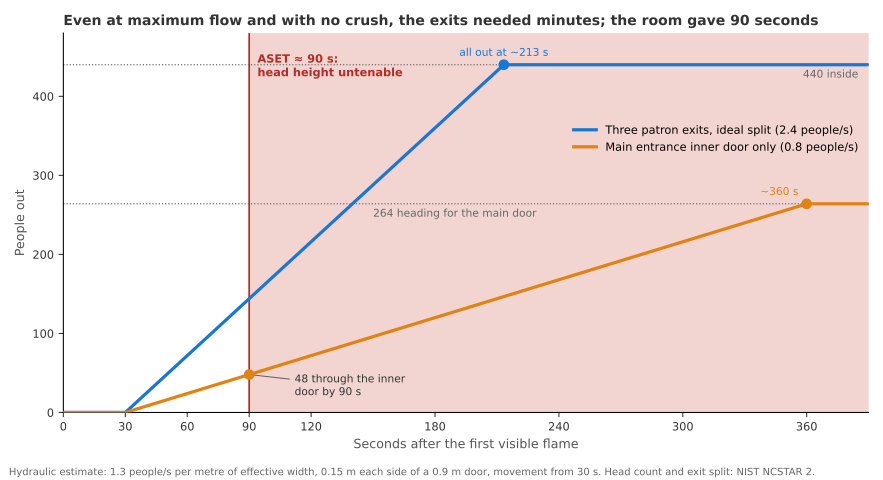
RSET was several times ASET. Even at ideal flow, about 264 people needed some 330 s to pass the single inner door, while the room stayed survivable for about 90 s.
The ASET vs RSET post covers the framework. NIST found conditions untenable within about 1.5 minutes for anyone still standing, so Galea’s team took ASET as about 90 s. A building is safe when the available safe egress time beats the required one:
Recognition and pre-movement took about 30 s, which left roughly 60 s to move. The SFPE hydraulic model, summarised in a 2009 NIST paper by Gwynne and co-authors, caps flow through a door at about people per second per metre of effective width. It also takes 0.15 m off each side of a doorway as a boundary layer. For the 0.9 m inner door:
Now suppose 60 % of 440 occupants, or 264 people, use that door:
Now take the best case instead, with 440 people perfectly balanced across the three patron exits at about 2.4 people per second. That still needs about 180 s of flow, so s, more than double the ASET. In the 60 s available, the inner door could pass at most about 50 people. These figures also assume no crush, no smoke and no lost exit. Hence NIST’s call for a 90-second maximum evacuation time in clubs like the Station nightclub.
Why do coupled fire and crowd models matter here?
Because smoke slows people down. When Galea’s team fed the fire’s heat and gases into their evacuation model, far more people stayed trapped than in a run that ignored them.
At 95 s, the coupled run had 168 people still inside, against 137 in the uncoupled one. By 105 s, the gap had grown to 134 against 57. In addition, the timing of the fire dominated everything. With NIST’s fire timeline, the coupled model predicted about 180 deaths. After a 15 s correction, it predicted 84, close to the real toll. By contrast, NIST’s early hydraulic runs assumed 404 people, with 90 % using the front door. They gave 4 minutes 30 seconds for full evacuation and no doorway pile-up at all. A model without a crush mechanism can reproduce flow, but not the failure that killed people.
What would have saved lives at the Station nightclub?
Sprinklers, most clearly. In NIST’s sprinklered mock-up, three of five heads opened within about 30 seconds, and conditions at head height stayed survivable for the whole test.
NIST used NFPA 13 quick-response heads, and no tenability limit failed during the test. NIST’s summary says survivable conditions lasted for more than five minutes. Its full-club model with sprinklers then capped the fire at about 220 kW, and the fire went out about 114 s after ignition. One of those first three heads sat inside the alcove itself. The post on sprinkler design mistakes shows how recesses like this get missed.
The second counterfactual is the wall itself. In NIST’s tests, the gerb lit neither fire-retarded foam nor bare wood paneling. NIST’s summary finding was that strict adherence to the 2003 model codes “would go a long way to preventing similar tragedies in the future”. In my reading of the evidence, sprinklers or a compliant finish would each have removed the fast fire, and with it most of the deaths. Wider exits alone would not have.
How did every layer of protection fail at once?
Five separate barriers stood between a stage effect and a mass-casualty fire. On 20 February 2003, each one had a gap.
Safety engineers often picture this as slices of Swiss cheese whose holes line up. At the Station nightclub, the slices were these:
- Ignition control. A tour manager lit indoor pyrotechnics without a permit.
- Wall finish. Foam on the walls broke the code, yet inspections in the years before the fire did not cite it.
- Crowd size. The licence had risen to 404, and the crowd exceeded even that.
- Suppression. The building had no sprinklers, because the rules exempted existing buildings.
- Exit geometry. One interior door throttled the main entrance.
Each layer looks reasonable alone, but together they made the outcome close to certain. Our event tree vs fault tree post shows how analysts put numbers on chains like this. NIST’s first recommendation aimed at the second and third layers: adopt a model code and enforce it with qualified inspectors. However, NIST’s work ran alongside the criminal and civil cases, which limited its access to physical evidence and witnesses.
What changed after the Station nightclub fire?
Within months, NFPA’s codes required sprinklers and crowd managers in most nightclubs, and NFPA 101 later told new clubs to size the main entrance for two-thirds of the crowd. NIST’s 90-second evacuation cap never became code.
NIST’s report on the Station nightclub made ten recommendations. The core ones were sprinklers in all new nightclubs and in existing ones with more than 100 occupants, and a ban on non-fire-retarded foam finishes. Others covered indoor pyrotechnics and exit sizing:
- No pyrotechnics without sprinklers. Ban indoor pyrotechnics in clubs without sprinklers, and keep anything that can burn at least twice the device’s designed projection away.
- Time and exit limits. Cap evacuation at 1.5 minutes, size exits as if one exit, including the main one, is lost, and size the main entrance for two-thirds of the crowd.
- Finding the exits. Give evacuation directions before every event, and add exit signs and lighting near the floor.
Codes moved fast. In July 2003, NFPA approved interim amendments to NFPA 101 and NFPA 5000, according to the NFPA case study on nightclub fires. They required sprinklers in new nightclubs and in existing ones over 100 occupants, and they added provisions for trained crowd managers. The 2006 editions made those rules permanent, with one crowd manager per 250 people at larger events. They also set the two-thirds main-entrance rule for new clubs, which the International Code Council rejected for its own codes. Meanwhile, the 2006 International Building Code cut the sprinkler threshold for nightclubs and other Group A-2 venues from 300 occupants to 100.
Rhode Island passed its own Comprehensive Fire Safety Act in July 2003. It adopted NFPA 1 and NFPA 101 and removed the old exemptions for existing buildings. Every assembly venue for more than 300 people needed sprinklers by July 2005, and nightclubs posted for 150 or more by July 2006. The act also banned pyrotechnics in venues for up to 300 people and required an exit announcement before each act or set.
Uptake stayed partial. A 2014 draft impact study by John Hall of NFPA, done for NIST, found that NFPA 101 matched the sprinkler advice by 2006. Apart from the main-entrance rule, though, the other exit changes did not appear in the code. In my view, the 90-second cap and the “lose one exit” rule are the most important lessons still missing.
What happened in the courts?
The tour manager pleaded guilty to 100 counts of involuntary manslaughter. The club’s two owners pleaded no contest, and civil claims settled for a total of $176 million.
Daniel Biechele received four years to serve in May 2006 and won parole in March 2008. Owner Michael Derderian received four years to serve, while his brother Jeffrey received a suspended sentence and community service. The settlements drew on many parties, including the state and the parent company of the TV station whose cameraman filmed the fire. A memorial park opened on the Station nightclub site in May 2017.
Why do nightclub fires keep happening?
The same three ingredients keep returning: indoor pyrotechnics, foam or plastic on the ceiling, and a crowd that heads for the way it came in.
| Fire | Year | Deaths | Ignition and fuel |
|---|---|---|---|
| Station nightclub, USA | 2003 | 100 | Gerbs, PU foam |
| Cromañón, Argentina | 2004 | 194 | Flare, ceiling netting |
| Lame Horse, Russia | 2009 | 156 | Fireworks, plastic ceiling |
| Kiss, Brazil | 2013 | 242 | Flare, PU foam |
| Colectiv, Romania | 2015 | 64 | Pyrotechnics, PU foam |
| Pulse, North Macedonia | 2025 | 63 | Pyrotechnics, ceiling foam |
| Le Constellation, Switzerland | 2026 | 41 | Sparklers, ceiling foam |
According to Le News, pyrotechnics featured in 73 % of the 15 deadliest nightclub fires since 2000, and acoustic foam in 47 %. A 2026 room-corner test of the Kiss foam reached 2,465 kW at 167 s.
Both of the newest fires remain open cases. The Crans-Montana fire on 1 January 2026 killed 41 people and injured 115. According to RTS, prosecutors are investigating 17 people, including the two owners and several local officials. They have not yet indicted anyone. The commune admitted that no periodic inspection had taken place since 2019. In North Macedonia, the trial over the Kočani fire opened in November 2025, with 35 people and three companies as defendants. Each of these rare fires kills many people at once, which is why they weigh heavily on an F-N curve. The Grenfell Tower case study shows the same pattern on a façade: a combustible layer that nobody tested as built.
What are the limits of this case study?
NIST never had physical evidence from the Station nightclub. All of its material data come from purchased foams, and it could not say whether the installed foam was fire-retarded.
Its full-club model also needed calibrated inputs, including a heat flux of 1,500 kW/m² imposed at the ignition points for the first 35 s. So the model’s heat release and tenability maps are best estimates, not measurements. The video timeline is the most reliable record, but it covers only what one camera saw. Head counts and exit counts differ between datasets. The hydraulic sum and the t-squared fit above are deliberately simple illustrations. Finally, the 2025 and 2026 fires remain under investigation, and everyone named in them keeps the presumption of innocence.
Key takeaways
The Station nightclub fire turned a 15-second stage effect into 100 deaths because the wall finish set the clock. Non-fire-retarded foam lit in about 10 seconds and passed the fire to the wood paneling. Within about 90 seconds, the air at head height could kill.
The exits never stood a chance against that clock. Most of the crowd headed for the door they came in by, and one 0.9 m inner door throttled it. Even ideal flow needed minutes. Meanwhile, coupled models show that a 15-second shift in fire growth can more than double the predicted deaths.
For designers, the lessons are direct. Keep foam plastics off the walls of assembly spaces, sprinkler every club, and check exits as if the main entrance is lost. Then model groups and smoke-slowed walking together, not a crowd of strangers moving on a spreadsheet. As the ALARP post argues, compliance on paper is not the same as safety.
Cite this articleHow to cite
Dinh, D. C. (2026, October 10). Station Nightclub Fire: Why 100 People Had Only 90 Seconds. PyroRisk. https://pyrorisk.net/blog/station-nightclub-fire-why-100-people-had-only-90-seconds/
Recent posts
Featured posts
Categories
Comments
Related posts
Fire Case Studies
Grenfell Tower Fire: The Cladding Physics Behind 72 Deaths
The Grenfell Tower fire began as a kitchen fire. See how polyethylene cladding, a stay-put plan that outlived the building and gamed tests killed 72 people.
Fire Case Studies
Notre-Dame Fire: Why an 800-Year-Old Roof Burned in Hours
The 2019 Notre-Dame fire grew for half an hour in a 100 m oak attic before anyone called firefighters. See the fuel, the lead, the vaults and the rebuild.

Fire Safety Engineering
ASET vs RSET: The Inequality Behind Every Evacuation Plan
ASET vs RSET decides whether a building passes. Here come the timeline, the tenability limits, the equations, and the one term that swings the answer most.