pyrorisk.net · Fire Science & Risk Fire Testing
Reaction to Fire vs Fire Resistance: What Each Test Proves
Reaction to fire ranks how a product feeds a growing fire. Fire resistance times how long an assembly holds. Mixing up the two has killed people.
Online: pyrorisk.net/blog/reaction-to-fire-vs-fire-resistance/

Two phrases rule fire specs, and people swap them almost daily. Reaction to fire ranks how much a product feeds a growing fire. Fire resistance times how long a wall, floor or door holds once that fire rages. So one phrase rates a material. The other rates a built element. Neither one stands in for the other, and the gap between them runs through several of the deadliest fires on record.
TL;DR
What each one measures
- Reaction to fire covers ignition, flame spread, heat and smoke. It belongs to a product: a lining, an insulation board, a cable, a finish.
- Fire resistance covers load, integrity and heat transfer under a standard fire. It belongs to an assembly: a wall, a floor, a door, a damper, a seal.
- Europe splits them across two texts. EN 13501-1 gives Euroclasses, while EN 13501-2 gives R, E and I with a time in minutes.
- The USA splits them the same way. ASTM E84 gives a flame spread index, while ASTM E119 gives an hourly rating.
- The two exposures share nothing. A corner burner gives roughly 40 kW/m² for 10 minutes. A furnace climbs past 945 °C at 60 minutes.
Where the confusion turns fatal
- Grenfell Tower killed 72 people on 14 June 2017. A surface class drove a facade choice that no surface class can settle.
- The Station nightclub killed 100 people on 20 February 2003. Wall foam flashed the alcove over in 60 seconds, so ratings on the structure changed nothing.
- Rosepark care home killed 14 people on 31 January 2004. Fire doors sat open, so the compartment leaked while the linings behaved.
- Battery rooms defeat both frameworks at once. That gap explains why UL 9540A data and blast venting now fill it.
What separates reaction to fire from fire resistance?
One rates a material, while the other rates a built element. Reaction to fire asks whether a product burns, and how fast flame runs across it. Fire resistance asks how long an assembly holds.
EN 13501-1 puts it well. Reaction to fire covers how a product adds to a fire by its own decay. Read that wording closely. The product itself supplies fuel, and the class ranks how freely it does so. Ignition, flame spread, heat, smoke and burning drips all feed one short string.
Fire resistance works from the other end. Here a fully grown fire attacks an element, and the lab times how long that element keeps working. Three duties carry the weight. The element must stay standing. It must block flame and hot gas. Finally, it must limit heat on the cold face. So the answer arrives in minutes rather than as a letter.
Which question does each test answer?
Each framework answers one question, and neither answer implies the other. A short table splits them cleanly.
| Dimension | Reaction to fire | Fire resistance |
|---|---|---|
| Object tested | Product, material, lining | Element or assembly |
| Question asked | Does it burn, how fast? | How long does it hold? |
| Scale | Bench and mid-scale | Full-scale furnace |
| Result | A class or an index | Minutes, with R, E, I |
| Fire stage | Growth, before flashover | After flashover |
A wall that holds for 60 minutes tells you nothing about its lining. That lining can still carry flame across a room in 90 seconds. Meanwhile a lining that barely burns tells you nothing about the wall behind it. Both points sound obvious on paper. Yet specs blur them every week.
Where does each one govern the fire timeline?
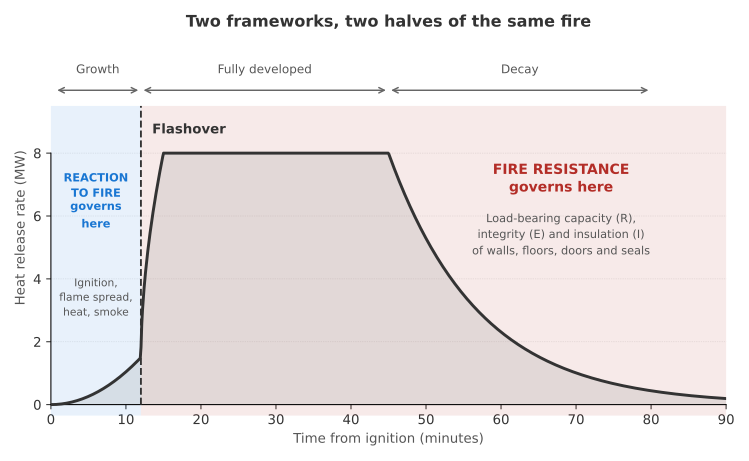
Reaction to fire governs early growth. Fire resistance governs everything after flashover. So the two own different halves of one fire.
Picture a room fire in order. First a small flame meets a surface. That surface either resists it or feeds it. Then flame spreads, heat builds, and the growth curve steepens. Reaction to fire decides whether the room reaches flashover at all, and how soon.
After flashover the fuel package matters less. Now the room burns fully, heat runs past 900 °C, and the building itself takes the load. Fire resistance decides whether the fire stays in one room. It also decides whether the structure lasts long enough for people to leave.
How does Europe divide the two?
Europe divides them across two parts of one standard family. EN 13501-1 handles reaction to fire. Meanwhile EN 13501-2 handles fire resistance.
The Euroclass system sorts products into A1, A2, B, C, D, E and F. Smoke classes s1 to s3 then sit beside the letter, along with drip classes d0 to d2. Five methods feed that scheme. They include a 750 °C furnace, a bomb calorimeter, and a corner test with a 30 kW burner. Floors run their own ladder with the “fl” suffix. Pipe lagging runs another with “L”.
EN 13501-2 lives in a different world. Its data comes from the EN 1363, EN 1364, EN 1365 and EN 1366 series, plus EN 1634-1 for doors. Each of those methods puts a real assembly in a furnace.
What do R, E and I actually mean?
Three letters name three duties, and each one fails on its own. R covers load, E covers integrity, and I covers heat transfer.
- R, from résistance, means the element still carries its load.
- E, from étanchéité, means no flame or hot gas gets through.
- I, from isolation, means the cold face stays cool enough.
- W caps radiation, while M adds impact.
- C covers self-closing gear, and S covers smoke leakage.
Rated periods run 15, 20, 30, 45, 60, 90, 120, 180 and 240 minutes. Join the letters to a period and the code reads exactly. So R 60 marks a column that stays up for 60 minutes, with no integrity claim at all. Then EI 60 marks a fire wall that carries no load. REI 60 marks a load-bearing compartment wall. Doors add one wrinkle. EI1 and EI2 differ in where the lab reads heat near the frame, and EI1 sets the harder bar.
What does the standard fire curve look like?
One equation drives almost every fire resistance test on earth. The ISO 834 cellulosic curve fixes furnace heat against time:
Feed a few times into it and the severity shows up at once:
| Time | Furnace temperature |
|---|---|
| 30 min | ≈ 842 °C |
| 60 min | ≈ 945 °C |
| 120 min | ≈ 1049 °C |
Oil and tunnel work needs a harsher attack. So EN 1363-2 adds the hydrocarbon curve:
That curve reaches roughly 1100 °C and then flattens. It also arrives fast. A pool fire skips the slow climb of a wood-fuelled room.
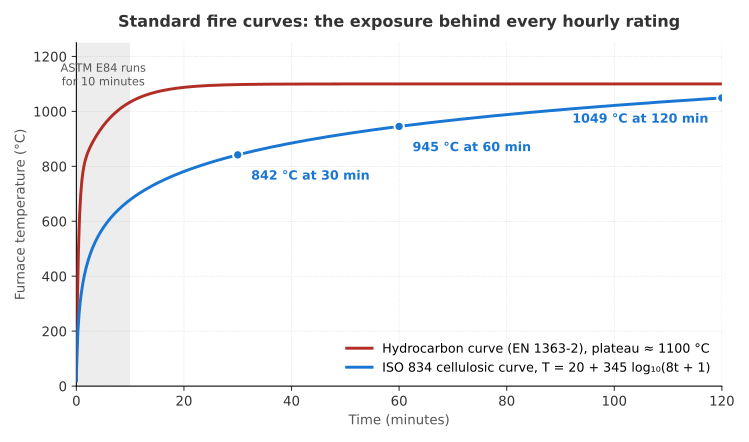
Note what both curves leave out. Neither one shows a real fire. Both ignore fuel load, air supply and decay. They act as a shared yardstick instead. Two walls run on the same curve compare fairly, and that fairness carries the whole regime.
How does a lab judge integrity and insulation?
Three checks decide integrity, and two heat limits decide insulation. Both sets lean on simple kit rather than on models.
Integrity fails on any of three signs. First, steady flame shows on the cold face. Second, a dried cotton pad of 30 × 30 × 20 mm lights when held over a crack. Third, gap gauges get through. A 6 mm gauge must not enter and then run 150 mm. A 25 mm gauge must not enter at all.
Insulation fails on heat alone. The mean rise across the cold face must stay at or below 140 K. Meanwhile no single point may pass 180 K. Those limits guard people and goods on the far side, since 180 K above room heat will scorch a hand. Load failure, meanwhile, follows limits on sag and on rate of sag.
How does the USA divide the two?
The USA draws the same line with other kit. ASTM E84 covers surface burning, while ASTM E119 covers fire endurance.
ASTM E84, also sold as UL 723, runs the Steiner tunnel. A sample 24 in wide and 24 ft long sits in the ceiling of a 25 ft tunnel. Two burners give about 89 kW for 10 minutes. Two numbers then come out. The Flame Spread Index scales against fibre-cement board at 0 and red oak at 100. Smoke rides the same scale as the Smoke Developed Index.
Three classes follow from that index, and all three cap smoke at 450:
| Class | Flame Spread Index | Smoke Developed Index |
|---|---|---|
| A | 0 to 25 | ≤ 450 |
| B | 26 to 75 | ≤ 450 |
| C | 76 to 200 | ≤ 450 |
Bench methods fill in around the tunnel. The cone calorimeter under ASTM E1354 runs at 25 to 50 kW/m². ASTM D1929 gives self-ignition heat, while ASTM D635 gives burn rate for plastics. UL 94 grades small plastic parts. Room-scale options exist too, such as NFPA 286, whose corner burner steps from 40 kW to 160 kW.
What does ASTM E119 demand?
ASTM E119 demands four things at once, and one failure ends the test. The method dates from 1918. UL 263 and NFPA 251 mirror it.
- Heat transfer stays capped. The cold face may rise 250 °F on average, or 325 °F at one point.
- No flame gets through, and no cotton waste lights on the far side.
- The assembly carries its load throughout.
- Walls and partitions then face a hose stream test on a twin sample.
That last item shocks people. A twin wall takes half the fire exposure, capped at one hour. Then a fire-hose jet hits it. So the wall must survive heat shock and impact together, which mimics real firefighting.
Restraint shifts the answer as well. A restrained assembly fights its own growth at the supports, and it usually earns a longer rating. The IBC then assumes the loose case unless a designer proves otherwise. So the safer number rules by default.
What do F and T ratings mean for firestops?
Firestops carry two fire resistance ratings, and specs often quote only the first. ASTM E814 and UL 1479 define both.
The F rating gives the time that the seal blocks flame, hose stream included. The T rating gives the time before the cold side rises 325 °F, measured on the pipe or cable as well as on the seal. That split matters when a hot pipe comes out beside stored goods.
Note the maths behind the number, since codes print it in an odd way. The written value reads “325 °F (163 °C)”. Yet a rise of 325 °F converts to something else:
That figure takes its shape from ASTM E119, which allows 250 °F on average plus a 75 °F margin at one point. UL 1479 then adds L and W ratings for air leakage and water.
Can you convert one rating into another?
No. The two families measure different things, so no route runs between them in either direction.
The trap sits one level deeper, though. People also try to convert within the reaction-to-fire family, and that fails too. ASTM E84 and the corner test differ in slope, exposure, length and output. The tunnel lays a sample flat in a ceiling. The corner test stands two wings upright. ASTM E84 says so itself. It gives only comparative results, under the exact conditions named in the method.
Vendor charts still make the rounds. They pair Euroclass B with Class A, or bare mass timber with Class C and roughly D-s2,d0. Every honest source adds a warning, and no regulator treats such a map as binding. So when a project crosses borders, buy the missing test.
Does “non-combustible” mean the same thing everywhere?
No. Each region defines it through different kit, and the definitions clash at the edges.
The USA uses ASTM E136 or ASTM E2652. A sample enters a vertical tube furnace at 750 °C. It passes when flaming stops within about 30 seconds and furnace heat rises no more than 30 °C. NFPA then adds a middle tier called limited-combustible, set by a potential heat below 3500 Btu/lb under NFPA 259.
Europe reaches for Euroclass A1 and A2 instead, tested by EN ISO 1182 and EN ISO 1716. These tiers refuse to line up. ASTM E136 runs harsh enough to call mineral wool with a binder combustible. Meanwhile A2-s1,d0 allows a small, tightly capped organic share. So one board can pass in one market and fail in the other, with nobody at fault.
Why does a fire resistance rating belong to one tested assembly?
Because the rating covers a whole build-up, not a material. Studs, boards, screws, insulation, joints and seals all shape the result. Change any of them and the claim lapses.
This “tested as-built” problem explains the listed design. ASTM E119 results publish as named designs rather than as material data. Specifically, a listed design fixes every part and every spacing. Swap the screws, thin the board, or add an unrated hole, and the test no longer covers what stands on site.
Site work breaks that chain daily. A contractor drills a cable route through a rated wall and seals it with ordinary foam. Next an electrician sets two socket boxes back to back. Someone hangs a heavier leaf in a rated frame. None of these steps looks dramatic. Yet each one wipes out the only proof the wall ever had.
Which fires show the difference most clearly?
Three fires draw the line better than any textbook. Two failed on one side each. The third failed because people mixed the sides up.
| Fire | Date | Deaths | Failure type |
|---|---|---|---|
| Beverly Hills Supper Club | 28 May 1977 | 165 | Interior finish, egress |
| MGM Grand, Las Vegas | 21 Nov 1980 | 85 | Finishes, smoke spread |
| The Station nightclub | 20 Feb 2003 | 100 | Reaction to fire |
| Rosepark care home | 31 Jan 2004 | 14 | Fire resistance |
| Lakanal House | 3 Jul 2009 | 6 | Compartment breach |
| Lacrosse, Melbourne | 25 Nov 2014 | 0 | Facade, wrong test |
| Plasco, Tehran | 19 Jan 2017 | 22 | Structural endurance |
| Grenfell Tower | 14 Jun 2017 | 72 | Facade, wrong class |
The Station nightclub: a pure reaction-to-fire failure
Pyrotechnics lit plain polyurethane foam on the walls and ceiling. No amount of fire resistance in the building could have changed that ending.
According to the NIST report, smoke reached the exit doors in a little over one minute. Flames broke through part of the roof in under five minutes. Later work at UL’s Fire Safety Research Institute put flashover in the drummer’s alcove within 60 seconds. By 90 seconds the smoke had banked down near the floor.
NIST also tested the foam itself. A plain sample lit within 10 seconds of flame from a pyrotechnic. A treated sample did not light at all. So one material choice set the whole timeline. Exit width mattered hugely here. Yet no rated wall or floor could buy back the time that the lining had already spent.
Rosepark care home: a pure fire resistance failure
Fire started in a cupboard that should have had fire doors, kept shut. Good linings would have saved nobody. Closed doors would have saved almost everyone.
Heat and smoke ran from that cupboard into the corridor, then into open bedrooms. Ten residents therefore died within about 11 minutes. The Fatal Accident Inquiry, ruled by Sheriff Principal Brian Lockhart on 20 April 2011, called fire safety at the home systematically and seriously defective. Work published in Fire and Materials traced the smoke path in detail.
Notice the mechanism here. A compartment leans on doors that people actually close, on frames that fit, and on seals that someone checks. In short, a fire resistance rating describes a lab set-up. So the site must rebuild that set-up every single day.
Grenfell Tower: a category error with 72 deaths
A kitchen fire reached new rainscreen cladding and climbed the tower. The whole strategy leaned on fire resistance inside the flats. An outside reaction-to-fire failure then beat it.
The Phase 1 report named the panels first. Their polyethylene cores drove the fast spread, because those cores acted as fuel. PIR and phenolic foam behind the panels added to the climb. Then the Phase 2 report landed on 4 September 2024. It found systematic dishonesty among makers, who rigged test routes, misstated data and misled the market.
Three category errors sit at the heart of that story:
- A certificate called the panel Euroclass B, “equivalent to Class 0”. Both terms rate a surface. Yet the claim drove a choice about a vented outer wall.
- One insulation reached the market as the first PIR board to pass BS 8414. That test used non-combustible boards at key spots, which the sales pitch never mentioned.
- BS 8414 judges a system against BR 135 limits. It issues neither a class nor a rating, so quoting it as either one misleads the reader.
Later testing settled the physics. Systems with polyethylene cores failed BS 8414 with plastic insulation and with mineral fibre alike. So the panel ruled the outcome, not the insulation. A “stay put” plan built on compartments never allowed for fire at every window at once.
Which tests belong to neither camp?
Several key tests sit between the two families. They judge whole systems against fire spread, so they give neither a surface class nor a fire resistance rating.
- NFPA 285 burns a two-storey wall with a window opening. It watches flame spread over the face, inside cores, over the inner face, and sideways. Codes trigger it for burnable parts in outer walls above 40 ft, and no E84 class replaces it.
- BS 8414 burns a full facade rig and judges it against BR 135.
- ASTM E2307 uses a mid-scale, multi-storey rig for perimeter barriers. It follows the E119 curve after the first 30 minutes.
- UL 9540A measures runaway spread in battery systems, and it reports data rather than a verdict.
ASTM E84 also fails in one specific way, which makes these options necessary. Foam and thermoplastics melt, drip and fall to the tunnel floor. That escape breaks the flame front and flatters the result. So codes demand large-scale proof for foam insulation. A Class A index also never lifts the separate need for a 15-minute thermal barrier over bare foam.
Why do both frameworks fail for battery rooms?
Because a battery fire attacks in a way neither one models. Thermal runaway dumps heat as a near step function. Vent gas then adds a blast risk that no heat rating covers.
Start with the reaction-to-fire side. FIGRA and the Flame Spread Index both ask how fast flame grows across a surface. A lithium-ion cell in runaway ignores that question, because it vents a jet of hot, flammable gas. So a Euroclass on the wall lining adds little to the safety case.
Now take the fire resistance side. An EI 120 room holds back heat for two hours. Yet vent gas that ignites makes pressure instead. A blast can wreck a heat-rated wall in milliseconds, long before any heat limit even applies. That gas also carries carbon monoxide and hydrogen, so the smoke hazard rides in with the pressure wave.
Three needs therefore replace the usual two. First, UL 9540A yields data on spread, gas make-up and blast risk at cell, module, unit and site level. Second, NFPA 855 feeds that data into a hazard mitigation analysis. Third, NFPA 68 or NFPA 69 handles blast venting or explosion prevention as its own trade.
Collapse deserves the same care. At the Plasco building in Tehran on 19 January 2017, fire burned for about 3.5 hours. A 16-storey steel frame then fell, killing 22 people, 16 of them firefighters. Published work blames the collapse on ceiling trusses that failed once fire took floors 10 to 14, plus a frame with too little continuity and redundancy. No surface class on the contents would have changed that ending.
How should you specify both correctly?
State which question you answer, every time, on every line. Six habits then close most of the gap.
- Cite reaction-to-fire classes in full. Write B-s1,d0, never “Class B”. For US work, give both index numbers rather than “Class A compliant”.
- Cite fire resistance classes in full. Give REI, EI or E, the period in minutes, and any W, M, C or S suffix.
- Refuse translated classes. Nobody may turn a Euroclass into an ASTM E84 class, or “Class 0” into anything modern.
- Distrust bare E84 numbers for foam. Demand NFPA 286 or FM 4880, plus the thermal barrier that the code wants anyway.
- Demand system proof for outer walls. Above the height trigger, require NFPA 285 or BS 8414 on the exact build-up, part for part.
- Guard the tested assembly on site. Control field changes, specify F and T ratings, and treat every fire door as carrying two classes at once.
One product often needs both frameworks together. A fire door carries a fire resistance class such as EI2 30-S, and its veneer carries a surface class. Steel protection works the same way. An intumescent coating earns its keep by holding steel below its critical heat, yet the coating still needs a surface class of its own. Specifiers often declare one and forget the other.
Cavity barriers show the link most sharply. A correctly rated barrier can still fail, because burnable insulation carries fire around it through the cavity. So the reaction to fire of one part quietly decides whether the fire resistance of another part means anything at all.
Key takeaways
Reaction to fire and fire resistance answer two questions with two sets of kit. One ranks how much a product feeds a growing fire, using a corner burner, a tunnel or a cone. The other times how long an assembly holds under a standard curve, using a furnace, a load frame and a hose stream. Europe writes the split as EN 13501-1 against EN 13501-2. The USA writes it as ASTM E84 against ASTM E119. The two structures match almost exactly, which tells you the split reflects physics rather than red tape.
Two failure modes keep coming back. Sometimes a spec carries the right class in the wrong domain, as at Grenfell Tower, where surface classes drove a facade choice that only a system test could settle. Sometimes a sound rating never survives contact with the building, as at Rosepark, where fire doors stood open. Both failures look like paperwork until people die.
So the working rule stays simple. Name the question before you name the number. Then check that the proof covers the thing you mean to build. For linings and finishes, cite the full reaction-to-fire class. Walls, floors, doors and seals instead need the full fire resistance class. Anything larger than one part needs a system test, because neither framework will ever cover the other’s ground.
Cite this articleHow to cite
Dinh, D. C. (2026, August 5). Reaction to Fire vs Fire Resistance: What Each Test Proves. PyroRisk. https://pyrorisk.net/blog/reaction-to-fire-vs-fire-resistance/
Recent posts
Featured posts
Categories
Comments
Related posts
Fire Testing
Cone Calorimeter 101: HRR, THR, and MARHE Explained
What a cone calorimeter measures — peak heat release rate, total heat release, and MARHE — plus the oxygen-consumption math behind every number.
Fire Testing
ASTM E84 vs ISO 9705: Why Fire Tests Disagree on Walls
How the ASTM E84 Steiner Tunnel and the ISO 9705 room corner test can rate the same wall lining Class A and a flashover hazard, and which to trust.

Fire Testing
Euroclass A to F: How Europe Rates Reaction to Fire
A Euroclass such as B-s1,d0 comes from the SBI test. Here is what each letter measures, and why a component class never proves a facade will hold.