pyrorisk.net · Fire Science & Risk Fire Testing
UL 94 V-0 Decoded: What the Plastic Fire Rating Means
A UL 94 V-0 mark means a plastic bar self-extinguishes under a 50 W flame. Here is what the test measures, and the four things it never promises.
Online: pyrorisk.net/blog/ul-94-v-0-what-the-rating-really-means/

Open a plug top or a laptop charger and you often find two characters moulded into the shell: V-0. That mark comes from UL 94, the flammability standard electronics engineers quote constantly and read rarely. The rating still carries real information. It tells you how a plastic behaves next to a small flame. Yet it promises far less than most specifications assume. So this post covers the methods, the chemistry behind a V-0 grade, and the four questions the rating cannot answer.
TL;DR
- UL 94 ranks how a standard plastic bar reacts to a 50 W flame. Nothing more.
- The ladder runs HB < V-2 < V-1 < V-0 < 5VB < 5VA. 5VA sits at the top.
- Every rating belongs to one thickness and one colour. So “V-0” alone means nothing.
- V-1 and V-2 share identical time limits. Only flaming drips separate them.
- Morgan and Bundy (2007) found no link between V rating and time to ignition. Total heat release showed no link either.
- UL 94 measures no smoke. It measures no toxic gas.
- Runaway ejecta from lithium-ion cells reach 243 to 1258 °C. A 50 W screen misses that hazard.
- UL therefore wrote a separate standard, UL 2596, for battery enclosures.
- Specify class, thickness and colour together. Take all three off the Yellow Card.
What does UL 94 actually measure?
UL 94 measures one narrow thing. The question runs like this: does a standard plastic bar stop burning once a small flame leaves it? The method also records whether the bar drips, and whether those drips ignite cotton below.
Underwriters Laboratories first published the standard in September 1972. The title stayed deliberately modest: Tests for Flammability of Plastic Materials for Parts in Devices and Appliances. Then the 7th edition landed on 28 February 2023. ANSI approval followed on 2 July 2026, and that revision added a Flame Stabilization Time measurement. The US Department of Defense also adopted the standard, back on 16 September 1988.
Read the scope and the standard undercuts its own reputation. First, the methods use “standard size specimens”. They respond to “a small open flame or radiant heat source under controlled laboratory conditions”. Then they serve only “as a preliminary indication” of acceptability. Preliminary. UL says so in its own text.
UL 94 harmonises with several international methods. IEC 60695-11-10 covers the 50 W flame, and IEC 60695-11-20 covers the 500 W flame. ISO 9772 handles foams, while ISO 9773 handles thin flexible sheet. The methods match broadly. Still, conditioning, flame calibration and classification codes differ. So a result under one scheme never transfers automatically to another.
A second family of UL standards covers electrical ignition sources, such as hot wires and arcs. Those sources start most real enclosure fires. UL 746A handles short-term properties, UL 746B handles long-term thermal ageing, and UL 746C covers electrical equipment. Together they produce the hot-wire, arc and tracking numbers that share a Yellow Card with the UL 94 class.
Product standards then pull the class into law. Under IEC 62368-1, a plastic fire enclosure around a battery must reach at least V-1. Most approval bodies also want every combustible plastic inside that enclosure at V-2 or better. UL 2580 covers electric-vehicle batteries, UL 1973 covers stationary storage, and UL 9540 covers whole systems. All three also reference material flammability, among many other requirements.
How do the UL 94 test methods work?
Every UL 94 method follows one ritual. Condition the specimens, apply a calibrated flame for a fixed time, then time what happens after the flame goes away.
Conditioning deserves more attention than it gets. One set of five bars sits for 48 hours at 23 °C and 50% relative humidity. A second set bakes for 168 hours in a 70 °C circulating-air oven, then cools in a desiccator. That aged set matters. Flame retardants and plasticisers migrate or evaporate over a product’s life, so a grade that passes fresh and fails aged flatters a ten-year product badly.
One further rule shapes everything. All five specimens in a set must comply. So a single failure sends the lab back to a fresh set of five, and every one of those must pass too.
HB — the horizontal burn
HB sits at the bottom of the ladder, because it rewards slow burning rather than self-extinguishment.
The lab clamps a 125 mm × 13 mm bar horizontally and marks it at 25 mm and 100 mm. A 20 mm blue flame then touches the free end at about 45°. Timing runs over the 75 mm gauge length:
A bar 3 to 13 mm thick passes at v ≤ 40 mm/min. Meanwhile a thinner bar, under 3 mm, passes at v ≤ 75 mm/min. Alternatively the flame front dies before the 100 mm mark, which also passes. But note what HB permits. A material can burn along its whole length, steadily, and still carry the rating.
V-0, V-1 and V-2 — the 20 mm vertical burn
The V tests turn the bar upright. That change also makes life much harder for the plastic. Flame now preheats the material above it, and molten polymer can fall away.
The lab suspends a 125 mm × 13 mm bar vertically. Dry surgical cotton sits 300 mm below, ready to catch any drips. A 20 mm blue flame, roughly 50 W, touches the lower edge for 10 seconds and withdraws. First the technician times the afterflame, t₁. Then the flame returns for a second 10 seconds. That gives afterflame t₂ and afterglow t₃. Five bars, ten applications.
| Criterion | V-0 | V-1 | V-2 |
|---|---|---|---|
| Afterflame per bar (t₁ or t₂) | ≤ 10 s | ≤ 30 s | ≤ 30 s |
| Total afterflame, 5 bars | ≤ 50 s | ≤ 250 s | ≤ 250 s |
| Afterflame + afterglow (t₂+t₃) | ≤ 30 s | ≤ 60 s | ≤ 60 s |
| Burning to the clamp | No | No | No |
| Drips ignite cotton | No | No | Allowed |
The total-afterflame rule for V-0 reads as one sum over ten flame applications:
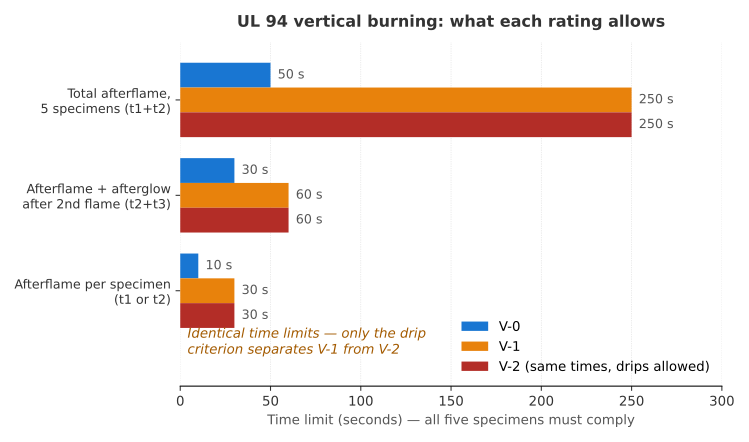
Look hard at the last two columns. V-1 and V-2 still share every time limit. The only difference lies in dripping. V-2 tolerates flaming drips that ignite the cotton, and V-1 does not. So drip control, rather than char formation, often decides which mark a compound earns.
5VA and 5VB — the 500 W flame
The 5V tests raise the ignition source by roughly a factor of five. They also add a second specimen shape.
Here the burner produces a 125 mm flame with a 40 mm inner blue cone, near 500 W. Then it touches the specimen five times for 5 seconds, with 5-second gaps. Labs run bars at 125 mm × 13 mm and flat plaques at 150 mm × 150 mm. After the fifth application, afterflame plus afterglow must stop within 60 seconds. Also, no drip may ignite the cotton.
Then comes the decisive part. On the plaque, 5VA permits no burn-through at all, while 5VB permits a hole. 5VA therefore tops the UL 94 ladder. Product standards therefore demand it for enclosures of fixed or permanently connected equipment.
VTM and HF — films and foams
Thin films and foams get their own methods, because both would misbehave in the standard V rig.
For films, the lab wraps a 200 mm × 50 mm specimen around a 12.7 mm mandrel. Tape holds it, the mandrel slides out, and the resulting tube goes into the rig vertically. Time limits mirror V-0, V-1 and V-2, so the classes read VTM-0, VTM-1 and VTM-2. But a VTM rating never equals a V rating. Geometry and flame exposure differ, so VTM-0 ≠ V-0, however similar the labels look.
Cellular and foamed materials run HBF, HF-1 and HF-2. HF-1 asks for afterflame under 2 seconds, afterglow under 30 seconds, and no flaming drips. Meanwhile HF-2 relaxes the drip rule. HBF, the base grade, caps burning rate at 40 mm/min over a 100 mm span.
Why does thickness change a UL 94 rating?
Thickness changes the rating for two reasons. First, a thin wall heats through faster. Second, it conducts less heat away from the flame. So the same compound often drops a class when the wall gets thinner.
Yet this point causes more specification errors than any other. “V-0 at 1.5 mm” and “V-0 at 0.75 mm” describe genuinely different achievements. A resin can hold V-0 at 3.0 mm and slip to V-2 at 0.8 mm. Below that it may carry no rating at all. Thin sections run out of material to char with, and they reach pyrolysis temperature sooner.
Colour matters too, for the same physics at smaller scale. Pigments and their carriers change melt viscosity, char structure and drip behaviour. So a rating attaches to a specific colour and loading, never to the resin family. Grade and even lot can enter the picture as well.
A UL Yellow Card records exactly this. For each colour it lists a flame class against a minimum thickness. Read that strictly. The rating holds at the tested thickness and anything greater, but never below it. Say a design review shaves a wall from 1.5 mm to 1.2 mm to save cycle time. The carded rating no longer covers that part.
How does a plastic reach V-0?
Most plastics reach V-0 through additives. A handful of high-temperature polymers get there through their own backbone chemistry instead.
Start with the baselines, which vary enormously:
- ABS and polypropylene typically rate HB. Both burn readily and drip, so unfilled grades never self-extinguish reliably.
- Polycarbonate resists ignition better, and general-purpose grades often reach V-2. Flame-retarded grades and PC/ABS blends climb to V-0 or 5VA. LEXAN 9034 rates HB, for example, while the FR grade LEXAN 9604 holds V-0 from about 0.9 mm.
- PEEK, PEI, PPS and polyimide rate V-0 inherently at usable thicknesses. Aromatic, char-forming backbones resist combustion without any halogenated additive. PVC behaves similarly, thanks to its chlorine content.
Everything else needs chemistry. Four families dominate, and each works by a different mechanism:
| FR family | Example | Mechanism | Loading |
|---|---|---|---|
| Brominated + synergist | Brominated PS with Sb₂O₃ | Gas phase | 10–12% Br, 1.5–6% Sb₂O₃ |
| Phosphorus | RDP, BDP, phosphinate | Char promotion | 12–17 wt% in PA |
| Metal hydrate | ATH, magnesium hydroxide | Water release | 50–60 wt% |
| Nitrogen | Melamine cyanurate | Intumescent char | Varies |
Treat those loadings as order-of-magnitude figures. They come from patent and vendor literature, and they shift with polymer, filler and processing.
Two details reward attention. First, the antimony synergist earns its keep. Reaching V-0 in ABS or HIPS without it pushes bromine content towards 22%, and total additive load past 30%. Second, a fraction of a percent of PTFE often converts a V-2 compound into V-0. That additive does one job: it stops the drips. Remember the criteria table. Dripping alone separates those two classes, so the cheapest route to a better mark rarely involves slowing the burn.
What did regulators do to brominated retardants?
Regulators squeezed the brominated families out of electronics step by step. Industry answered by moving towards phosphorus, nitrogen and mineral systems.
The sequence runs roughly like this. Penta- and Octa-BDE left the EU market in August 2004. DecaBDE followed on 1 July 2008 in electrical and electronic equipment. A European Court of Justice ruling had reinstated the RoHS restriction first. RoHS now caps PBBs and PBDEs at 0.1%, or 1000 ppm, in any homogeneous material. The EU POPs Regulation lists PBDEs and HBCD, and a revision entering force on 17 November 2025 tightened those entries further. REACH restricts decaBDE in articles below 0.1% by weight. Ecodesign rules exclude halogenated retardants from electronic-display enclosures.
For a designer the consequence looks simple. Halogen-free formulations now dominate new work. They generally need higher loadings, or a different base resin, to hit the same class.
What does UL 94 fail to predict?
UL 94 fails to predict heat release, fire load, smoke, toxicity and full-scale behaviour. Every one of those sits outside what a 50 W flame on a small bar can reveal.
Frame the test honestly and the limits follow from the physics. A small flame touches the specimen briefly, then leaves. The question asks whether burning continues without that flame. Real fires impose sustained radiant flux instead, on materials that never get the chance to self-extinguish.
Why does cone calorimetry disagree?
Cone calorimetry disagrees because it applies continuous radiant heat instead of a brief flame. So it measures fire behaviour rather than ignition resistance.
The reference study comes from the NIST Building and Fire Research Laboratory. Morgan and Bundy (2007) ran 18 commercial thermoplastics. The set covered PC, ABS, PC/ABS, HIPS, PP and PVC, spanning V-0 down to no rating at all. Their result deserves careful quoting:
- Peak and average heat release rate showed some correlation with V rating. HRR at 60 seconds behaved similarly.
- Time to ignition showed none. Total heat release showed none either.
- No precise correlation emerged, thanks to differing retardant mechanisms and polymer fuel energies.
The physical reason sits in the rigs themselves. A cone calorimeter irradiates a horizontal sample at 25 to 75 kW/m². That flux removes the drip-away escape route that helps a V-2 material pass. UL 94 instead watches a vertical bar in poor ventilation after the flame goes. The same NIST programme found that V-1-or-better materials resisted a candle-sized source well. Yet materials sharing a V rating behaved differently in full-scale fire. So a V-0 part can still release plenty of heat once a developed fire takes hold.
The limiting oxygen index offers no rescue either. LOI ranks the minimum oxygen fraction that sustains candle-like burning, and higher scores look better. Yet its correlation with UL 94 wanders. A flame-retarded polycarbonate can post an LOI near 32.8% and still fail V-0. Both remain small-scale screens of different physics.
What about smoke and toxicity?
UL 94 says nothing whatsoever about smoke or toxic gas. Most fire deaths come from exactly those two.
Worse, the chemistry that buys a V-0 mark can make the smoke nastier. Feuchter and colleagues (2023) added brominated retardant plus antimony trioxide to HDPE and PP. Hydrogen bromide yields reached 56 and 72 mg per gram of polymer. Smoke toxicity indices rose sharply as a result. Halogen-free phosphorus, nitrogen and mineral systems produced less smoke, and no halogen acids.
David Purser’s under-ventilated combustion work points the same way. Yields of carbon monoxide, hydrogen cyanide and organic irritants climb steeply as a fire turns under-ventilated. That regime dominates real smoke exposure in enclosures. UL 94 never probes it.
Where else has small-scale testing misled?
Small-scale tests mislead whenever engineers read a material screen as a system prediction. Fire science has also learned that lesson repeatedly.
Europe built the Single Burning Item test specifically to reflect the ISO 9705 room-corner scenario. That reference fire uses a 100 kW burner stepping to 300 kW. Even so, the calibration gives about 95% FIGRA correlation for wall and ceiling linings, and documented gaps for sandwich panels. American practice hits the same wall, as the quarrel between ASTM E84 and room-corner results shows. Finally, Grenfell Tower stands as the extreme case of inferring system performance from component data.
A live policy argument sits alongside the technical one. Industry bodies argue, for example, that retardants in enclosures buy escape time against small ignition sources. Against that, Shaw and colleagues concluded in Reviews on Environmental Health that flammability rules “can cause greater adverse environmental and health impacts than fire safety benefits”. Proposals for an external candle-ignition standard then failed five times, in 2008, 2012, 2013, 2014 and 2015. On 20 September 2017 the US Consumer Product Safety Commission voted 3–2 the other way. It asked manufacturers to drop organohalogen retardants from four product categories, including plastic casings around electronics. Nobody has settled that dispute yet.
Why is V-0 the wrong test for a battery enclosure?
V-0 addresses the wrong hazard for a battery. Thermal runaway produces a sustained jet of flaming gas and molten particles, so a brief 50 W flame reveals nothing about it.
Look at the measured numbers from lithium-ion cells in runaway. They span a wide range by chemistry, format and state of charge, though. Even the low end dwarfs anything UL 94 contemplates.
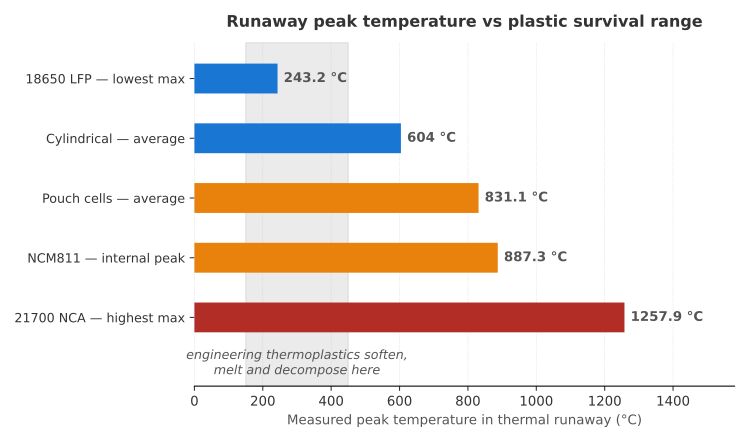
The underlying studies tell a consistent story. Ten pouch cells averaged a maximum of 831.1 °C, with onset near 215.6 °C. A review of cell testing reported 1257.9 °C for a 21700 NCA cell. The same review reported 243.2 °C for an 18650 LFP cell, a spread that mirrors the chemistry gap between LFP and NMC. Nail-penetration work on NCM811 recorded 887.3 °C internally at 100% state of charge, running up to 256.3 °C hotter than the surface.
Scale up and the picture turns violent. For instance, federal-lab tests at BAM Berlin recorded jet flames up to 5 m long. Fragments flew beyond 30 m, and module mass loss reached 82%. Ejecta also arrive as high-velocity streams of flaming gas and molten particles. Meanwhile industry testing reports jets that erode solid aluminium.
So UL drew the obvious conclusion and wrote a dedicated standard. UL 2596, the Battery Enclosure Thermal Runaway evaluation, exists for one reason. A cell in runaway produces “a jet-like flame” and “ejects particle material that could erode its protective enclosure”, while pressure builds inside. Enclosures therefore face heat, pressure and particle loading together. Pack-level propagation data comes from UL 9540A instead.
None of this makes the UL 94 class useless in a battery product. It remains a valid input, because IEC 62368-1 also addresses ordinary electrical-fault hazards. But it never bounds the runaway hazard. A specification that treats V-0 as the answer to thermal runaway has confused two different problems.
How should you specify a UL 94 rating?
Specify a UL 94 rating as three linked facts: class, thickness and colour. Then back all three with a current Yellow Card that you have actually opened.
But a Yellow Card carries more than the flame class. Alongside it sit the electrical and thermal numbers from UL 746A and UL 746B:
- RTI, the Relative Thermal Index, gives the maximum continuous-use temperature at which a critical property stays above half its original value. It splits into electrical, mechanical-with-impact and mechanical-strength values, so match the right one to the part’s job.
- HWI, hot-wire ignition, and HAI, high-current arc ignition, rank resistance to electrical sources. Those sources start most real enclosure fires.
- CTI, the comparative tracking index, ranks surface tracking under contamination. All three report as PLC values, where a lower number means better performance.
Four errors recur often enough to name:
- Specifying “V-0” with no thickness. Always write “V-0 at X mm”, then check X against your thinnest wall, boss and rib.
- Assuming the rating travels across colours or grades. It does not. A black grade’s card says nothing about the white one.
- Assuming the moulded part inherits the datasheet class. Wall thickness, regrind fraction, weld lines and processing all shift real behaviour, including behaviour near a flame. So test the part where the risk sits.
- Confusing a material class with an enclosure requirement. The class feeds compliance. Then the product standard defines what the enclosure must achieve.
Two habits close the remaining gaps. Ask for the oven-aged conditioning result, not just the fresh one, whenever the product must last ten years. Then commission cone-calorimeter data whenever the part carries a meaningful fuel load. Never infer heat release from a flame class that never measured it.
Key takeaways
UL 94 does its actual job well. Hold a small flame to a standard bar, take it away, and watch what happens. That question has a clean answer, and half a century of product safety practice rests on it. The criteria also run in seconds and millimetres. The ladder from HB to 5VA ranks sensibly, and the international harmonisation works.
Trouble starts when people read the rating as something larger. V-0 does not mean “will not burn”. It does not cap heat release, bound smoke, limit toxic yield, or predict flashover behaviour. Morgan and Bundy tested that assumption directly, though. They found no correlation for time to ignition, and none for total heat release. A rating tied to one thickness and one colour simply cannot carry that weight.
Three rules follow for a working engineer. Match the class to the part’s position in the product and the governing standard, rather than writing V-0 across a whole bill of materials. Buy real fire data — cone calorimetry, smoke density, toxic gas yields — whenever the consequence justifies it. And for anything holding lithium-ion cells, treat UL 94 as necessary but nowhere near sufficient. Design against the jet, the pressure and the ejecta that a 50 W flame will never simulate.
Overall, the rating tells the truth. It simply answers a smaller question than the one most people ask it.
Cite this articleHow to cite
Dinh, D. C. (2026, July 29). UL 94 V-0 Decoded: What the Plastic Fire Rating Means. PyroRisk. https://pyrorisk.net/blog/ul-94-v-0-what-the-rating-really-means/
Recent posts
Featured posts
Categories
Comments
Related posts

Fire Testing
Euroclass A to F: How Europe Rates Reaction to Fire
A Euroclass such as B-s1,d0 comes from the SBI test. Here is what each letter measures, and why a component class never proves a facade will hold.
Fire Testing
ASTM E84 vs ISO 9705: Why Fire Tests Disagree on Walls
How the ASTM E84 Steiner Tunnel and the ISO 9705 room corner test can rate the same wall lining Class A and a flashover hazard, and which to trust.
Fire Testing
Cone Calorimeter 101: HRR, THR, and MARHE Explained
What a cone calorimeter measures — peak heat release rate, total heat release, and MARHE — plus the oxygen-consumption math behind every number.