pyrorisk.net · Fire Science & Risk Fire Testing
ASTM E84 vs ISO 9705: Why Fire Tests Disagree on Walls
How the ASTM E84 Steiner Tunnel and the ISO 9705 room corner test can rate the same wall lining Class A and a flashover hazard, and which to trust.
Online: pyrorisk.net/blog/astm-e84-vs-iso-9705-when-fire-tests-disagree/
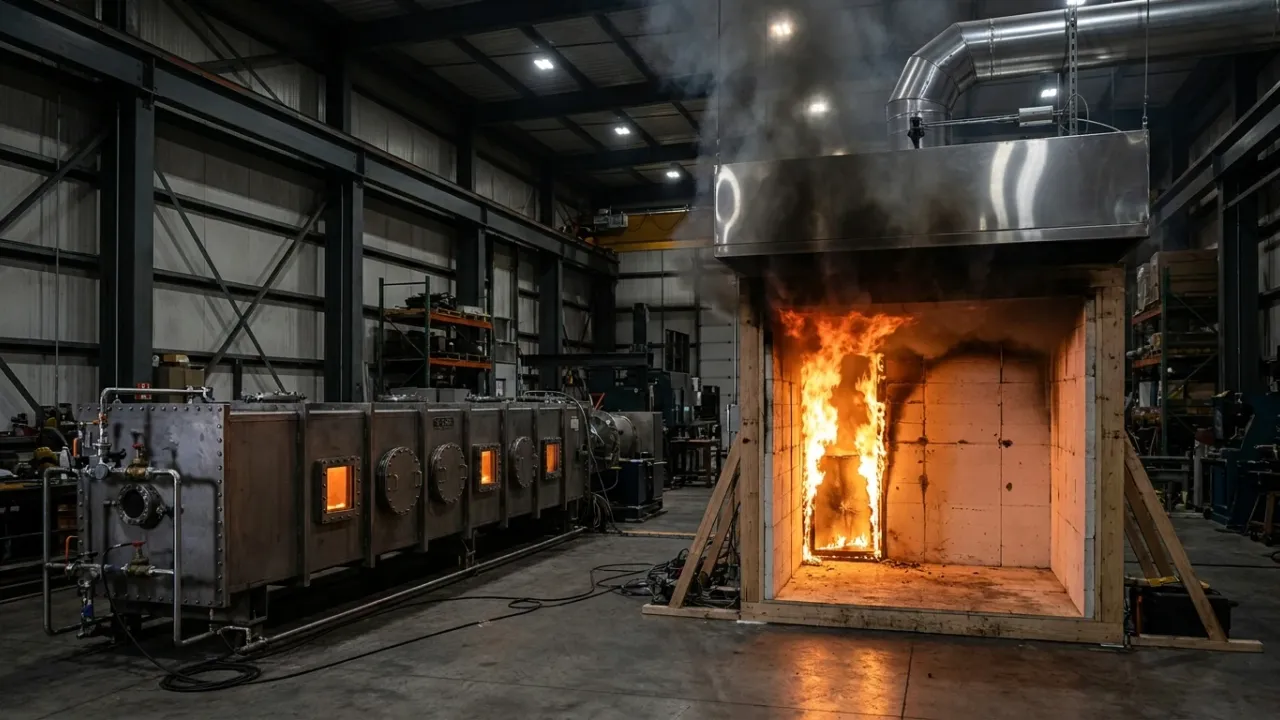
Two labs test the same wall lining. One runs ASTM E84 and reports a Flame Spread Index of 20. That number buys a Class A rating, the best a material can earn. The other lab lines a room with the same product and lights a corner burner. Then it watches the room flash over in under four minutes. Neither lab made a mistake. Both tests ran to standard, and both numbers stand. So the gap between them deserves a proper explanation. This post covers where it comes from, how wide it gets, and which number to trust for each material class.
TL;DR
- ASTM E84 burns a ceiling-mounted strip for 10 minutes and reports an index, not a fire outcome.
- ISO 9705 lines a 3.6 m × 2.4 m × 2.4 m room and measures heat release rate directly.
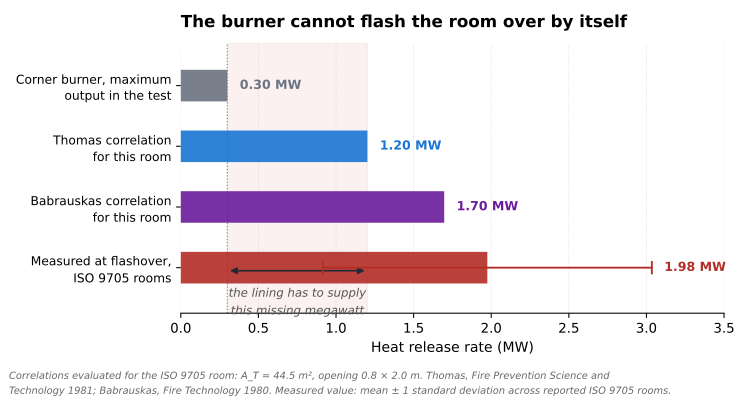
- Flashover there needs roughly 1.2 to 2.0 MW, yet the corner burner supplies only 300 kW.
- Foam plastics can earn Class A under ASTM E84 and still flash a room over in minutes.
- Molten plastic drips off the tunnel ceiling and escapes the flame, while a corner keeps it burning.
- Corner geometry roughly quadruples the effective fire, so its flame runs about 74% taller.
- Codes therefore route foams, textiles, and composites to room corner tests such as NFPA 286.
- Trust the tunnel for stable products, and demand room data for everything else.
What does ASTM E84 actually measure?
ASTM E84 measures how far flame creeps along a ceiling-mounted sample during a 10 minute forced-draft exposure. Albert Steiner of Underwriters Laboratories built the method in the 1940s, and his era had reason to worry. Cocoanut Grove in 1942, then the LaSalle and Winecoff hotels in 1946, killed hundreds through fast flame spread over interior finishes. UL published the first version as UL 723 around 1950, and ASTM adopted E84 in 1961. Alexander Morgan’s 2023 review in the Journal of Fire Sciences remains the sharpest modern audit of the method.
The apparatus explains most of the results. A refractory-lined duct runs 25 ft (7.6 m) long, 450 mm wide, and 300 mm deep. The specimen covers 24 ft of that length and forms the roof, face-down. Two gas burners at one end push a 5,000 BTU/min flame, about 88 kW, against the underside. Meanwhile a steady draft of 240 ft/min, or 1.2 m/s, drags the flame front and its smoke toward the exhaust. Gas therefore crosses the whole tunnel in roughly six seconds.
Note the design intent behind that layout. Horizontal mounting, a ceiling specimen, and a forced draft together reproduce wind-aided flame spread. They do it across a large sample, close to 4 m² of it, inside a repeatable box. So the choice bought reproducibility. It also built in the blind spot this post keeps returning to.
How does ASTM E84 turn a flame front into an index?
The test integrates flame-tip position over time, then maps the resulting area onto a scale anchored by red oak. Operators log the flame tip through observation ports as the burn runs. Recession never counts, since the standard treats the front as though it never retreats. The area under that distance-time curve, written in feet-minutes, becomes the Flame Spread Index:
Work the numbers backwards and the classes gain meaning. A Class A ceiling of 25 allows up to about 48.5 ft·min. Red oak, the calibration fuel, sits near 146 ft·min. Committees picked red oak because it burned uniformly across the country and repeated well, which quietly admits how hard reproducibility proved.
Smoke earns its own index from a photocell in the exhaust duct. The Smoke Developed Index compares the area under the light-obscuration curve with red oak’s:
The two indices carry no correlation whatsoever. A material can creep along slowly and still blind a corridor. So building codes cap the SDI at 450 and bin the FSI into three classes.
| Class | Flame Spread Index |
|---|---|
| A (I) | 0–25 |
| B (II) | 26–75 |
| C (III) | 76–200 |
What does ASTM E84 admit it cannot do?
Quite a lot, and Section 4.3 of the standard lists most of it plainly. The method measures no heat transmission through the surface. It reports no heat release rate, the variable that governs fire hazard. It applies one fixed heat flux and never varies it. A single tunnel run also cannot classify a material as noncombustible. Above all, the standard excludes “the effect of aggravated flame spread behavior of an assembly resulting from the proximity of combustible walls and ceilings”. A corner produces exactly that effect.
Then comes the melting caveat, which does the real damage. Some materials melt, drip, or delaminate enough to break up the flame front. Those materials, in the standard’s own words, earn low indices “that do not relate directly to indices obtained by testing materials that remain in place”. Thermoplastics soften near 165 °F (74 °C) and flow before 200 °F (93 °C).
Picture what follows in a ceiling-mounted specimen. The softened sample falls to the tunnel floor, well clear of the burner flame, so the flame front stalls with nothing left to climb. The instrument then records almost no spread and prints a low index. In effect, the sample scored well by leaving.
What does ISO 9705 do differently?
ISO 9705 builds a real room, lines it with the product, and burns it. The room runs 3.6 m long, 2.4 m wide, and 2.4 m high, with a single 0.8 m × 2.0 m doorway. Test material covers the walls and ceiling, while the doorway wall stays bare. A propane sand-box burner sits in a rear corner and follows a fixed programme: 100 kW for 10 minutes, then 300 kW for 10 more. An instrumented hood captures everything leaving the door.
Calorimetry does the rest. ISO 9705-1:2016 derives heat release rate from the oxygen the fire consumes:
Huggett’s constant carries the whole method. Nearly every common fuel releases about 13.1 MJ of heat per kilogram of oxygen consumed, within roughly 5%. So a lab can weigh a fire’s power without knowing what burns. Our cone calorimeter primer works through the same trick at bench scale.
The outputs read like a fire report rather than a rating. Labs get a heat release curve, a time to flashover, the total heat released, a smoke production rate, and floor-level heat flux. The standard also fences its own scope. It evaluates no fire resistance. It also excludes sandwich panel systems, pipe insulation, and façades, which go to ISO 13784, ISO 20632, and ISO 13785.
Why does 1 MW mark the flashover line?
Compartment geometry sets that threshold, and this particular room needs somewhere between 1.2 and 2.0 MW. Thomas’s correlation estimates the heat release rate required for flashover from surface area and ventilation:
Here covers the internal bounding surface minus the opening, while gives the ventilation factor. Run the ISO 9705 numbers through it. The room’s surfaces total 46.1 m², so lands at 44.5 m². Its doorway contributes a ventilation factor of 2.26. Those two terms then add to about 1.20 MW. Babrauskas’s ventilation-only form, , returns 1.70 MW instead. Measured room data cluster near 1,975 kW, with a standard deviation around 1,060 kW.
Now compare those figures with the burner. Even at full output the burner delivers 300 kW, roughly a quarter of the lowest estimate. Everything else has to come out of the lining. So time to flashover measures exactly one thing: how fast the product on the walls turns itself into fuel.
Labs declare flashover when several signs coincide. Typical markers: heat release near 1 MW, a floor heat flux of 20 kW/m², upper-layer gas above 600 °C, flame out of the doorway, or a paper target igniting on the floor. Our post on flashover in 60 seconds follows the same transition in a living room.
How do jurisdictions score a room corner result?
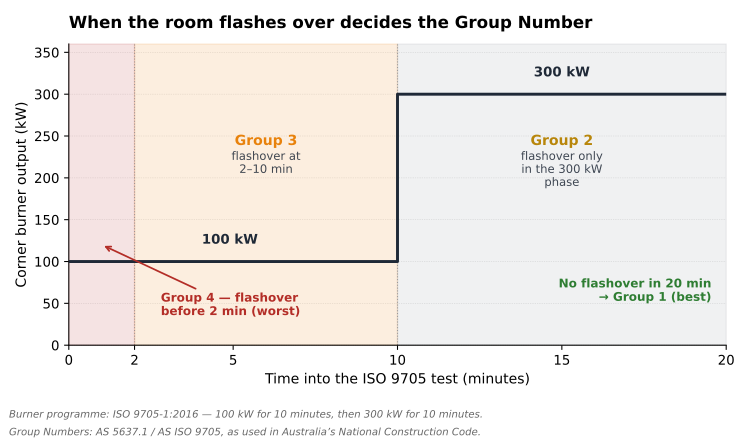
Jurisdictions convert time to flashover into a rating, because ISO 9705 classifies nothing by itself. Australia leads here. Its National Construction Code assigns a Group Number straight from the clock, through AS 5637.1 and AS ISO 9705:
- Group 1: never reaches flashover, even under 300 kW.
- Group 2: flashes over during the 300 kW phase, but not under 100 kW.
- Group 3: flashes over between 2 and 10 minutes under 100 kW.
- Group 4: flashes over within 2 minutes under 100 kW.
Lower means better. Note what that scale carries and no tunnel index can: a time axis.
What did Europe build instead of the tunnel?
Europe built the Single Burning Item test, an intermediate-scale corner test validated against ISO 9705. Full-scale rooms cost too much for routine classification, so EN 13823 shrinks the geometry while keeping the corner. Two specimen wings, 0.5 m × 1.5 m and 1.0 m × 1.5 m, meet on a trolley under an instrumented hood. A 30 kW propane burner, standing in for a burning wastepaper basket, fires at the base of that corner for about 20 minutes.
The duct instruments produce two headline numbers. First, the Fire Growth Rate index tracks how quickly power climbs:
In that expression gives the running average heat release rate in kW, while marks burner application at 300 s. FIGRA therefore comes out in watts per second. Second, total heat release over the first 600 s of exposure:
EN 13501-1 then bins products from A1 down to F on those two numbers.
| Euroclass | FIGRA limit | THR600s limit |
|---|---|---|
| A2 / B | ≤ 120 W/s | ≤ 7.5 MJ |
| C | ≤ 250 W/s | ≤ 15 MJ |
| D | ≤ 750 W/s | — |
| E | small-flame test only | — |
| F | no performance determined | — |
Smoke sub-classes s1 to s3 and flaming-droplet sub-classes d0 to d2 get appended, so a top-performing lining reads B-s1,d0. Near-inert mineral products skip the SBI altogether.
Validation matters more than the limits. During the EUREFIC programme and the SBI round robins, reference products ran in both the SBI and the full room. Room results clustered by time to flashover, and those clusters set the class boundaries directly. FIGRA from the two scales then agreed to roughly 95% for wall and ceiling linings.
Note the exception, though. For metal-faced sandwich panels with combustible cores, that correlation weakens badly. Hence ISO 9705-1:2016 pushes panel systems out of its own scope and toward ISO 13784 instead. No single test covers every product family.
Why do ASTM E84 and ISO 9705 disagree?
Geometry drives the gap, and three mechanisms do nearly all of the damage.
First, the corner itself. A corner restricts air entrainment from two sides, so the flame runs taller and hotter against the surface. Fire engineers often approximate a corner fire by mirroring it, which multiplies the effective heat release rate by four. Feed that into Heskestad’s flame height correlation:
Flame height scales as , and . So the same burning surface stretches its flame roughly 74% higher purely by sitting in a corner. Mowrer and Williamson published the practical version of that result: a corner fire can flash a room over with about half the heat release a room-centre fire needs. ASTM E84 explicitly excludes the effect.
Second, radiative feedback. A real compartment grows a hot smoke layer that radiates back down onto every surface, and that loop produces flashover. The tunnel has no compartment, no layer, and no loop. The SBI captures part of the loop, which explains why Europe treats it as a surrogate rather than a reference.
Third, dimensional stability. A vertical corner specimen keeps its melt in the fire, either clinging to the wall or pooling and burning at the base. The ceiling-mounted tunnel specimen simply sheds it. Delaminating composites cheat the same way, because a separating face layer stalls the front without ending the hazard.
Why do foam plastics break the tunnel?
Foam plastics can earn Class A in ASTM E84 and still flash a real room over in minutes. Expanded polystyrene, extruded polystyrene, polyurethane, and polyisocyanurate all soften early and burn hard. Flame retardants can hold the tunnel index at or below 25 while doing very little about the megawatts.
The fire community settled this decades ago. According to Factory Mutual guidance from the 1970s, ASTM E84 flame spread ratings deserve no weight at all for foamed plastics. Underwriters Laboratories documented the same anomaly in its own subject report on cellular plastics. Babrauskas, White, and Urbas then confirmed the unreliability again in Fire and Materials in 1997.
Then the codes moved. Since 1976, US model codes have required foam plastics to sit behind a thermal barrier regardless of flame spread rating, now through IBC Chapter 26 and IRC R316. The usual barrier means 12.7 mm (½ in) of gypsum board meeting the temperature-rise criteria of NFPA 275. Exposed or thicker foam qualifies only through a room-scale burn: NFPA 286, the legacy UBC 26-3, UL 1715, or FM 4880.
Read that requirement as a verdict. A code that demands a physical barrier on top of a Class A rating has already told you what the rating means here.
Where do ASTM E84 and ISO 9705 agree?
Both tests agree reasonably well on dimensionally stable products, and wood makes the cleanest example. Wood stays where you put it. The USDA Forest Products Laboratory and NRCC ran an international round robin on wood products through the 100/300 kW room programme. Untreated wood flashed the room over between roughly 3 and 15 minutes, in an order that tracked tunnel indices well. Fire-retardant-treated plywood lasted longest of all.
One detail from that work deserves attention. Lining the ceiling rather than the walls consistently shortened time to flashover. Geometry sensitivity therefore shows up as a measurable effect, not a theoretical worry. The tunnel’s own ceiling mount looks rather less innocent in that light.
How do the codes handle the disagreement?
Codes route the suspect material classes away from the tunnel and toward corner tests. NFPA 286 provides the US room corner method. Its room measures 8 ft × 12 ft × 8 ft, lined with 5/8-in Type X gypsum, and its corner burner runs 40 kW for 5 minutes, then 160 kW for 10. Under the IBC and IFC, a product passes when four criteria all hold:
- Flame never reaches the ceiling during the 40 kW exposure.
- Flame never reaches the outer extremity of the sample during the 160 kW exposure, and flashover never occurs.
- Peak heat release rate stays at or below 800 kW.
- Total smoke released stays at or below 1,000 m².
IBC Chapter 8 then accepts NFPA 286 as an alternative wherever Class A applies. So the code treats a room corner pass as at least equal to a tunnel Class A, and for suspect materials rather better.
Textile and expanded vinyl wall coverings leave the tunnel entirely. NFPA 265, the Method B corner test, applies 40 kW for 5 minutes and then 150 kW for 10, with a similar set of pass criteria. UL 1715 covers barriers over combustibles, though it uses a wood crib rather than a metered burner, which makes its exposure less repeatable. NFPA 286 arrived in the 1990s precisely because it reports flashover, peak heat release, and smoke together.
Which fire test should you trust?
Trust the full-scale room corner test, and treat ASTM E84 as a screening index for stable materials only. That ranking follows from design intent rather than preference. ISO 9705 serves as the reference scenario, the SBI and NFPA 286 serve as validated intermediate surrogates, and the tunnel gives a cheap comparative ranking. Four stages cover most decisions:
- Classify the material honestly. Does it melt, drip, delaminate, or intumesce? Does it belong to the foam plastics or fibre-reinforced composites? If yes, skip to stage 3.
- Use ASTM E84 for stable products, but verify the report. Check the mounting, the orientation, and the SDI. No melting or dripping should appear in the notes. Plenum work tightens further, to FSI ≤ 25 and SDI ≤ 50.
- Require room corner data for suspect classes. That means ISO 9705, NFPA 286, or NFPA 265 for textiles. In Europe, ask for a Euroclass to EN 13501-1 with its s and d sub-classes.
- Screen with the cone calorimeter first. ISO 5660-1 data at 25 to 50 kW/m² predicts room corner heat release through validated models. Those models handle smoke poorly, so measure smoke directly.
When should an ASTM E84 number stop convincing you?
Four triggers should move a product from tunnel data to a room corner requirement:
- The material loses dimensional stability below about 200 °C. Anything that softens, flows, or delaminates escapes the tunnel flame and flatters its own index.
- Predicted time to flashover falls inside the 300 kW phase or earlier. In Australian terms, that means Group 2 or worse.
- Cone data show a high peak heat release per unit area at 50 kW/m² alongside a short time to ignition. Fast growth beats a good index every time, as our post on t-squared fire growth explains.
- The product is a sandwich panel with a combustible core. Intermediate-scale correlation fails there, so go to ISO 9705 or ISO 13784.
The bottom line
The two methods answer different questions, and both answer honestly. ASTM E84 asks how far a flame creeps along a ceiling strip in a draft, then replies with an index. ISO 9705 asks whether a lining takes a room to flashover, then replies in megawatts and minutes. For stable materials the two answers roughly agree, and the tunnel’s low cost makes it a sensible default. For anything that melts, drips, or delaminates, the tunnel goes blind while the room corner exposes the hazard.
So ask the right question first. Does this material belong to a class the tunnel cannot see? If yes, no ASTM E84 number will save you, and the codes reached that conclusion decades ago. The engineering task is to reach it before the fire does.
Cite this articleHow to cite
Dinh, D. C. (2026, July 10). ASTM E84 vs ISO 9705: Why Fire Tests Disagree on Walls (Updated July 24, 2026). PyroRisk. https://pyrorisk.net/blog/astm-e84-vs-iso-9705-when-fire-tests-disagree/
Recent posts
Featured posts
Categories
Comments
Related posts
Fire Testing
Heat Release Rate: Why HRR Is the King of Fire Science
Why heat release rate is the single most important number in fire science: how labs measure it, what it predicts, and why it outranks smoke toxicity.
Fire Testing
Cone Calorimeter 101: HRR, THR, and MARHE Explained
What a cone calorimeter measures — peak heat release rate, total heat release, and MARHE — plus the oxygen-consumption math behind every number.

Fire Testing
Euroclass A to F: How Europe Rates Reaction to Fire
A Euroclass such as B-s1,d0 comes from the SBI test. Here is what each letter measures, and why a component class never proves a facade will hold.