pyrorisk.net · Fire Science & Risk Fire in Daily Life
Christmas Tree Fire: Flashover in 60 Seconds Explained
A dry Christmas tree fire can hit 7 megawatts and flash a whole room in under a minute. Here is the NIST science, second by second, and why water stops it.
Online: pyrorisk.net/blog/christmas-tree-fire-flashover-in-60-seconds/
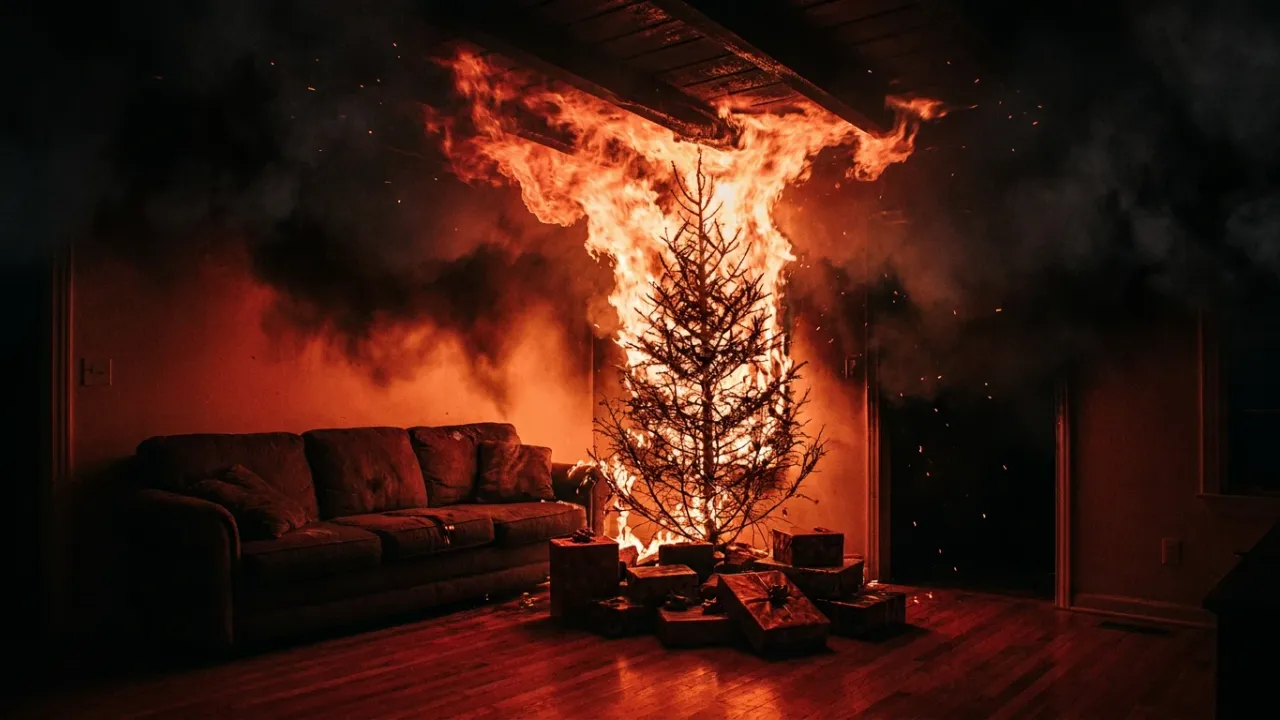
Every December the same clip resurfaces. Two Christmas trees stand side by side. A flame touches the first, and a few needles flare, then sputter out. The same flame touches the second, and a column of fire reaches the ceiling. Forty seconds later the room is gone. A Christmas tree fire like that fills a living room in under a minute. The footage is not a stunt or a sped-up edit. It comes from controlled tests at the National Institute of Standards and Technology (NIST), measured with research-grade calorimetry. The only real difference between the two trees is water.
TL;DR
- A Christmas tree fire is one of the most powerful fuel packages a home can hold.
- In a NIST test, a dry Douglas fir hit 7,362 kW just 31 seconds after ignition.
- Its watered twin would not ignite at all, even after three tries.
- The radiant heat then triggers flashover, when every surface lights at once.
- Fresh needles hold more than their own weight in water, which blocks ignition.
- So the fix is simple: keep the stand full, and retire the tree once it dries.
The numbers, up front
In NIST’s Technical Note 2131, a dry 2.1 m Douglas fir ignited on the first try. It then reached a peak heat release rate of 7,362 kW, more than 7 megawatts, just 31 seconds after ignition. The matched, watered twin could not be sustainably lit at all. The team even moved the ignition source and doubled the matchbooks across three attempts.
To put 7 MW in perspective, a burning wastebasket runs near 50 kW. A burning upholstered chair peaks around 270 kW. So a Christmas tree fire is roughly 25 to 150 times more powerful than those, and it gets there in half a minute.
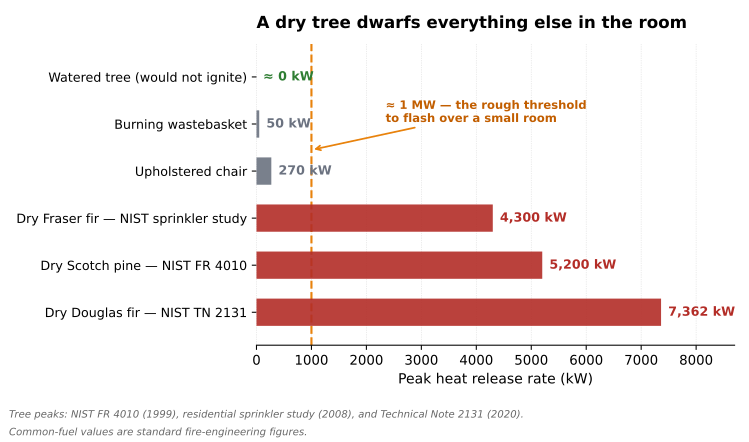
Three NIST tests, so the numbers stop confusing you
Different videos quote different Christmas tree fire figures, because several studies exist. So it helps to separate them.
- Scotch pine tests, Report FR 4010 (1999). Eight dried pines peaked at roughly 1.6 to 5.2 MW. A fresh tree kept in water would not light, even with a propane torch. This is the source of the classic “room flashes over in about 40 seconds” footage.
- Residential sprinkler study (2008). Dry Fraser firs peaked at 3.2 to 4.3 MW. An unsprinklered furnished room blew past 6 MW and flashed over. Meanwhile an identical sprinklered room stayed near 1.8 MW and never flashed over.
- Technical Note 2131 (2020). The modern watered-versus-dry video. The dry tree hit 7,362 kW at 31 s, and the watered one gave essentially nothing.
One distinction matters. The 7,362 kW figure is a bare tree under a calorimeter hood. The “40 to 60 second flashover” comes from the furnished-room demos. Both numbers are real, yet they measure different things.
What flashover actually means
Flashover is the moment a fire stops being a fire in a room and becomes a room on fire. Almost every exposed surface ignites at once. Fire engineers mark it with two thresholds: an upper-layer gas temperature near 500 to 600 °C, and a floor-level radiant heat flux around 20 kW/m².
The mechanism is a radiation feedback loop, and it runs in four steps.
- First, the burning tree’s plume rises and spreads hot, soot-laden smoke across the ceiling.
- That black layer radiates well. As it thickens and heats, it beams heat back down onto everything below.
- Then the radiant heat drives pyrolysis, the thermal breakdown of solids into flammable gases, across the whole room at once.
- Finally, once floor flux hits about 20 kW/m² and surfaces reach ignition temperature, all those gases light nearly together.
Here is the counter-intuitive part. Just before flashover, the sofa ignites from radiant heat before any flame touches it. That is why a Christmas tree fire seems to light the whole room at the same instant.
Why a dry Christmas tree fire spreads so fast
A Christmas tree breaks almost every rule of fire-safe design. First, look at the fuel itself.
- Surface area. A tree is thousands of thin needles, each huge in surface area for its mass. Fine fuels heat through and ignite almost instantly. NIST researcher Isaac Leventon uses a book as the analogy: closed, it barely burns; fanned open, it goes up fast.
- Low moisture. A fresh needle holds more than its own dry weight in water. So that water has to boil off first, which soaks up huge amounts of heat. A dried needle, under 10% moisture, skips that step.
Then look at the chemistry and the shape.
- Volatile resins. Conifer needles carry terpenes such as α-pinene and limonene. α-Pinene flashes near 33 °C and packs about 45 MJ/kg, roughly double the dry wood itself. These resins act as a built-in fire starter.
- Geometry. The tree is a vertical, well-aired lattice. Air flows through it, so flames climb it like a chimney and reach the ceiling in seconds.
Frame by frame: the dry tree
Combine the measured data with the footage, and a Christmas tree fire in a living room reads like this.
- 0 s, ignition. A small source lights dry needles low in the tree. It might be a candle, a match, or an electrical short in a light string.
- 0 to 7 s, flame spread. Resin-rich needles flash. Flame races up and out through the lattice and reaches the ceiling within seconds.
- 7 to 15 s, full involvement. Black smoke streaks across the ceiling. Fresh air near the floor feeds the base, and heat release climbs toward megawatt scale.
- 20 to 31 s, peak burn. The tree hits peak heat release rate. The ceiling layer is now a fierce radiant heater.
Then the rest of the room takes over.
- About 30 s, preheat. Sofa, table, carpet, and gifts begin to pyrolyze under that radiant heat, before flame ever touches them.
- 40 to 60 s, flashover. Floor flux passes 20 kW/m², the gas layer hits 500 to 600 °C, and every surface ignites. The room is now lethal.
The watered tree, in the same setup, gives a few seconds of local needle flame and then dies. Mostly smoke, no room fire.
The one variable that decides everything
Moisture is the single most important factor in a natural tree’s fire risk. Everything turns on it.
First, consider the gap. Freshly cut trees carry needle moisture of 120 to 160%. The dry trees in the NIST videos sat under 10%. Research cited by the USDA Forest Service found trees ignite readily once foliar moisture drops below about 50%.
Then consider how fast it falls. A cut tree drinks like a cut flower, often a gallon on the first day. But if the stand runs dry, sap seals the cut, and the tree can no longer rehydrate. From there, drying accelerates. The London Fire Brigade puts the relatively safe window at about two weeks.
Water also beats chemistry. Penn State Extension and USDA research are blunt: plain water in an adequate stand is the best preservative. Additives and most consumer fire retardants do little. And never spray hairspray on a tree, because it makes the needles more flammable, not less.
How worried should you actually be?
Christmas tree fires are rare but disproportionately deadly. According to the NFPA, US fire departments saw an average of 143 home fires a year that started with a tree from 2020 to 2024. Those fires caused about 7 deaths, 13 injuries, and $15 million in damage each year. Candles, by contrast, start about 5,900 home fires a year, roughly 40 times as many.
Yet per fire, a Christmas tree fire is far more lethal. Seven deaths in 143 fires works out to about one death per 20 tree fires. For home fires overall, NFPA’s figures give about one death per 126. So a tree fire is roughly six times deadlier. The tree counts are small, though, so that ratio shifts from one NFPA report to the next. Electrical or lighting equipment plays a part in about 40% of tree fires, and a heat source too close to the tree causes nearly one in four. The hazard also loads into late season: more than a third of tree fires strike in January, once the tree has dried out.
A note for the artificial-tree crowd. They are not automatically safe either. UL warns that a pre-lit artificial tree can be as much of a hazard as a dry natural one, and PVC trees can melt and release toxic hydrogen chloride.
The takeaways that matter
- Choose fresh. Look for green, pliable needles that resist a gentle pull, plus sticky sap at the cut.
- Cut and hydrate. Make a fresh 5 cm cut before standing it, use a stand that holds at least a gallon, and top it up daily.
- Keep it back. Stand the tree at least 1 m from any heat source, including fireplaces, heaters, radiators, and candles.
Finally, plan for the days you forget all of the above.
- Use listed LED lights. They run far cooler than incandescents, so they cut both ignition risk and energy use. Never leave them on overnight.
- Retire it promptly. Once a tree dries, it cannot be rehydrated, so get it out before January through a recycling program.
- Layer your defenses. Working smoke alarms buy the seconds a fast fire steals. NIST also showed a single sprinkler held a dry-tree room to 1.8 MW and prevented flashover entirely.
The lab result is hard to argue with. Same spark, same room, same furniture. The only difference between a non-event and a lethal flashover was a stand full of water. So keep yours topped up, and the demo never runs in your house.
Cite this articleHow to cite
Dinh, D. C. (2026, June 19). Christmas Tree Fire: Flashover in 60 Seconds Explained (Updated October 1, 2026). PyroRisk. https://pyrorisk.net/blog/christmas-tree-fire-flashover-in-60-seconds/
Recent posts
Featured posts
Categories
Comments
Related posts
Fire in Daily Life
Chimney Fire Science: Why Creosote Turns Flues Into Fuel
A chimney fire can hit 1090 °C and crack a clay flue liner in minutes. Here is the creosote science behind it, and why an annual sweep stops it.
Fire in Daily Life
Dryer Fire Science: The Physics of Why Lint Ignites
A dryer fire almost always starts with lint. Here is the surface-area physics that turns soft fluff into fast fuel, plus the simple habit that prevents it.
Fire in Daily Life
The Science of a Kitchen Fire: Why Water Makes It Worse
A kitchen fire starts when cooking oil creeps up to its 368 °C autoignition point. Here's the physics of why water makes a burning pan catastrophically worse.