pyrorisk.net · Fire Science & Risk Fire in Daily Life
Chimney Fire Science: Why Creosote Turns Flues Into Fuel
A chimney fire can hit 1090 °C and crack a clay flue liner in minutes. Here is the creosote science behind it, and why an annual sweep stops it.
Online: pyrorisk.net/blog/chimney-fire-science-why-creosote-turns-flues-into-fuel/
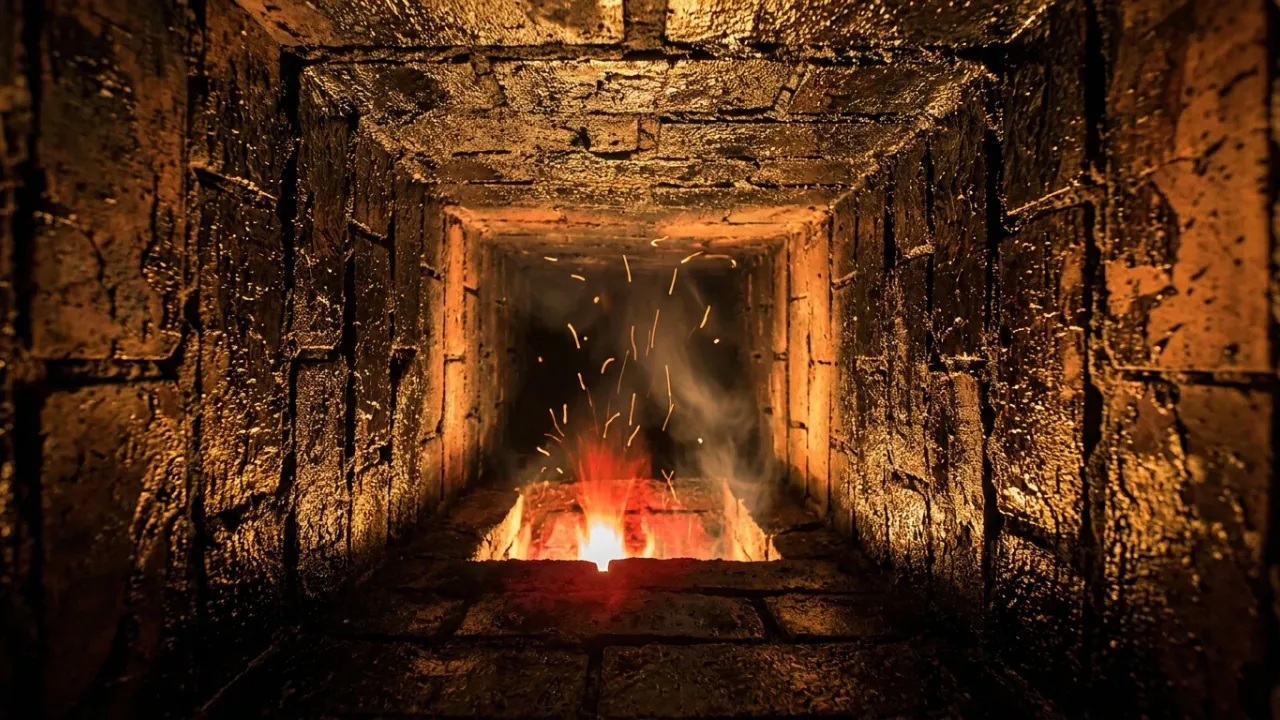
A fire in the hearth keeps you warm. A chimney fire burns the house around it. The culprit, a thin tar layer called creosote, coats the flue and waits for one hot spark. Once lit, a chimney fire can push a clay liner toward 1090 °C (2000 °F). The duct built to carry smoke away then turns into the furnace itself. This post walks through the tar chemistry, the cracked liners, and the testing standards. It ends with the cheap habit that stops the whole chain.
TL;DR
- Creosote, the tar that smoke deposits on a cool flue wall, feeds every chimney fire.
- Once lit, the blaze can spike to roughly 1090 °C, far beyond a flue’s normal duty.
- As little as 3 to 6 mm of buildup can feed a damaging chimney fire.
- Thermal shock can crack a clay liner in minutes, so flame reaches the framing.
- Most chimney fires smoulder quietly, yet they still wreck the flue.
- According to NFPA data, “failure to clean” leads the causes of US home heating fires.
- The fix stays cheap: inspect every year, and sweep past 3 mm of soot or any glaze.
Where does creosote come from?
Creosote comes from incomplete combustion: smoke full of unburned tar meets a cool flue wall. The tar then condenses there, layer after layer. Every wood fire makes some; bad habits make far more.
Wood never burns as a solid. Heat first breaks it into flammable gases and tar droplets, and those vapours feed the visible flame. Our pyrolysis primer covers that process in depth. Complete combustion turns the vapours into carbon dioxide and water. Starve the fire of air or heat, though, and much of the tar escapes up the flue as a fog. The Chimney Safety Institute of America (CSIA) lists the cargo plainly. Expect smoke, water vapour, gases, unburned wood particles, hydrocarbons, tar fog, and assorted minerals.
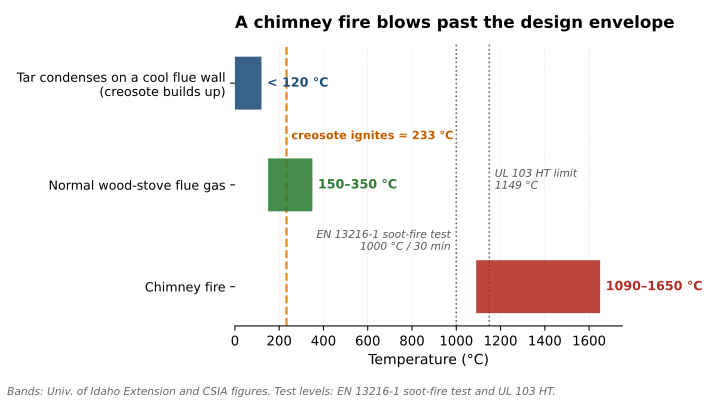
Then the smoke meets a cold surface. Like breath fogging a mirror, the tar condenses on any wall below roughly 120 °C. The University of Idaho Extension puts hard numbers on the thresholds. Below about 65 °C, the deposit turns thick, sticky, and tar-like.
Chemists know the residue as a blend of phenols, organic acids, and polycyclic aromatic hydrocarbons. Those ring molecules carry a coal-like energy density. The watery, acidic fraction — wood vinegar — evaporates away, but the heavy tars stay put. Sweeps just call the mix creosote.
Cold walls act as creosote factories. An exterior masonry chimney dumps heat into the winter air along its whole height. As a result, the inner wall drops below the tar’s dew point for much of its length. The same flue can therefore sit clean at its base and filthy at its top. Keep the wall hot, and the tar stays airborne and leaves. Let the wall go cold, however, and the tar plates out — the makings of a future chimney fire.
The three degrees of creosote
Sweeps grade the deposit in three degrees, and each stage stores more energy than the last.
- First degree: light, flaky soot from hot, well-aired fires. A simple brush removes it.
- Second degree: hard, shiny black flakes full of hardened tar, which usually demand a rotary tool.
- Third degree: a glaze that runs down the flue, hardens, and recoats itself into a thick layer. One sweep-training course calls it “extremely concentrated fuel.”
Two levers drive the progression. First, temperature: wet wood, smouldering fires, and cold chimneys all chill the smoke, so more tar settles out. Second, residence time: restricted air and oversized flues let the smoke linger against the wall. Unseasoned wood hurts twice, because the fire wastes its energy boiling off water instead of heating the flue. So keep firewood below 20% moisture, and the chemistry starts on your side.
Third-degree glaze grows under the worst habits. Think damped-down overnight burns, wet logs, and airtight houses that starve the fire of make-up air. It also drives the most destructive chimney fires.
How hot does a chimney fire get?
A chimney fire can reach roughly 1090 °C (2000 °F). Normal flue gas, by contrast, runs at only 150 to 350 °C, and the same Idaho bulletin cites peaks up to 1650 °C. That heat can melt mortar, crack tiles, and collapse liners.
The fuel explains the fury. Creosote sits in the flue as stored chemical energy. The closely related coal-tar creosote packs about 29 MJ/kg — close to a good coal — per NOAA’s chemical database. In other words, a neglected flue wears a lining of coal-grade fuel.
A quick estimate shows the scale. The stored energy follows from the layer’s mass and its heat of combustion :
Take a 6 m flue with a 20 cm square duct, which offers about 4.8 m² of inner wall. Coat it with 6 mm of creosote at a density near 1100 kg/m³. The layer then holds roughly 30 kg of fuel. At 29 MJ/kg, the wall carries around 900 MJ. So a full sack of coal’s worth of energy sits parked inside a duct that passes through your attic.
Ignition takes surprisingly little. Dry creosote can light near 233 °C, a figure fire-safety guides quote widely. Nobody, however, has traced it to a primary measurement. One hot, fast fire — a load of cardboard, a resinous flare-up — can push flue gas past that line. Then the reaction feeds itself: burning tar heats the next patch, which vaporises and burns in turn. A study for the Wood Heating Alliance tied creosote to 92% of reported chimney fires. It also flagged just 3 to 6 mm of buildup as a genuine hazard.
Why does the clay liner crack?
The liner cracks from thermal shock: the fire heats the tile’s inner face far faster than heat can soak through. The hot face then expands against a cold, rigid back until the ceramic fails.
Ceramics handle steady heat well, yet they hate steep gradients. Clay conducts heat slowly. So during a chimney fire, the inner face slams toward 1000 °C while the outer face lags far behind. The mismatch sets up tensile stress, and a classic relation captures its scale. With elastic modulus , thermal-expansion coefficient , Poisson’s ratio , and a temperature difference across the tile:
Plug in rough clay-tile values: GPa, per kelvin, and . A 280 °C face-to-face difference then yields a stress near 29 MPa. Fired clay breaks in tension at only a few MPa. The tile never stood a chance, which matches field lore. Sweeps treat a roughly 280 °C (500 °F) inside-to-outside gap as the practical fracture point.
The failure arrives with an audible pop, like a cold drinking glass dropped into hot water. A cracked tile changes everything, because the flue no longer contains the flame. Hot gas can then reach the mortar, the brick, and the timber framing behind them. CSIA puts it bluntly: one chimney fire may spare a home, but a second can burn it down.
What do the soot-fire tests require?
Chimney standards on two continents test products at roughly 1000 to 1150 °C. That band reflects what a real chimney fire actually does.
In Europe, EN 1443 encodes a chimney’s soot-fire resistance in a single letter: G for resistant, O for not. To earn its G, a product must survive the EN 13216-1 test: 1000 °C of flue gas for 30 minutes. It must stay gas-tight afterwards, per the British Flue & Chimney Manufacturers’ Association. Nearby combustibles may warm no more than 100 °C above ambient during the test. Products rated O may serve gas and oil appliances only, never wood.
North America runs the same logic through UL 103. Its high-temperature HT variant tests factory-built metal chimneys at up to 1149 °C (2100 °F). Continuous duty sits near 540 °C. Two independent standards bodies converged on nearly the same number, and neither picked it by accident. Even so, CSIA cautions that a listed chimney can still suffer damage in a real event. A damaged chimney then needs replacement, not another season of use.
The fires nobody notices
Most chimney fires never roar. CSIA stresses that the majority go undetected, since a slow, oxygen-starved smoulder makes little noise. Yet a quiet chimney fire can wreck the liner just as thoroughly as the version with the freight-train roar. Our post on smoldering versus flaming explains why quiet fires deserve more fear, not less.
The slow path scares fire scientists most. Wood framing near a hot chimney bakes a little with every season. Over years, the heat converts it into a reactive char — “pyrophoric carbon” — that grabs oxygen and self-heats. Fresh lumber needs about 250 °C to ignite. However, fire scientist Vytenis Babrauskas documents structure fires traced to heat sources as low as 77 °C. Those cases involve months or years of exposure. The Idaho bulletin states the trend plainly. New framing ignites near 250 °C, yet wood heated season after season gives up at far lower temperatures. Each chimney fire, and even routine over-firing, pushes the framing further down that curve.
So learn the forensic signs of a past event. CSIA’s checklist includes:
- Puffy or “honeycombed” creosote that has expanded and foamed — proof the deposit once burned.
- Warped metal dampers or connector pipes.
- Cracked or collapsed flue tiles, or creosote flakes on the roof and ground.
- A discoloured or distorted rain cap, or smoke leaking through mortar joints.
Any one of these signs calls for a camera inspection before the next fire.
How common are chimney fires?
US fire departments respond to an estimated 25,000 chimney fires a year, according to figures CSIA has long cited. The blazes cause about $125 million in property loss, plus roughly 10 deaths.
The wider heating picture backs this up. NFPA counts an annual average of 37,365 US home heating-equipment fires for 2020 to 2024. The tally equals 11% of all reported home fires. Those fires kill about 417 people and injure 1,260 more each year, alongside $1.2 billion in property damage. The leading factor stays mundane: failure to clean, chiefly creosote in solid-fuel chimneys. Fireplaces or chimneys figure in roughly 3 in 10 home heating fires.
Two more patterns stand out. First, seasonality: about 46% of these fires strike between December and February, when flues run hardest and coldest. Second, the deadly ones escape the flue. Per the US Fire Administration, confined flue fires stay common. Yet the non-confined fires that reach the structure cause nearly all the deaths.
The hazard also tracks fuel habits, not geography. England logged 2,019 chimney fires in 2024–25, per UK government statistics. The count sits far below the roughly 10,000 a year of the mid-2000s, because solid-fuel use declined. The physics never changed; the fuel did.
What does the annual sweep actually fix?
A sweep removes the fuel before it can burn. NFPA 211 requires an inspection at least once a year. Cleaning follows once soot passes 3 mm or any glaze appears.
The standard also defines three inspection levels, worth knowing before you book one.
- Level 1 — the routine annual baseline: a visual check of the accessible chimney, flue, and appliance connections.
- Level 2 — adds a full camera scan of the flue interior. Mandatory after any suspected chimney fire, after a change of appliance or fuel, and at a property sale.
- Level 3 — opens walls or removes components when inspectors suspect serious hidden damage.
Mechanically, first-degree soot yields to a brush, while hardened second-degree deposits need rotary tools. Glazed third-degree creosote resists both. So sweeps may add chemical modifiers that dry and embrittle the glaze first. Every credible source, though, treats them as an aid to sweeping, never a substitute.
One limit deserves emphasis. A sweep removes fuel, but it cannot fix a cracked liner, a warped damper, or a breached mortar joint. Only a camera can prove the tiles survived. Cracks often hide under fresh soot until the next fire reopens them. Many countries also treat sweeping as a legal duty. Germany’s licensed district sweeps, the Schornsteinfeger, must visit one to three times a year, with fines for refusal.
Timing helps too. Book the sweep in late summer or early autumn, before the heating rush fills every diary. A clean flue also drafts better, so the fire lights more easily and burns cleaner from day one.
How do you prevent creosote buildup?
You prevent creosote buildup by keeping the flue wall hot and the wood dry. The tar then leaves the chimney as vapour instead of condensing. Every rule of thumb follows from that 120 °C threshold.
- Burn seasoned wood below 20% moisture, so the fire heats the flue instead of boiling water.
- Favour small, hot, bright fires, because a damped-down overnight smoulder builds glaze fastest.
- Insulate or line a cold flue, since a warm inner wall keeps tar airborne and also shields nearby framing.
- Light fires from the top of the stack, which trims the smoky cold-start pulse.
- Give the fire enough make-up air, because an airtight house can starve the burn into a smoulder.
- Fit a flue thermometer about 45 cm above the stove, then hold it roughly between 120 and 250 °C.
That band protects you at both ends. Below it, water and tar condense on the wall; far above it, you risk lighting whatever deposit already exists. No deposit, no chimney fire. For the wider chemistry of why flames need hot, gas-phase fuel, see what is fire.
What should you do during a chimney fire?
Get everyone out and call the fire service, then cut the air supply if you can do so safely.
You may hear a low roar like a freight train or sharp cracking sounds. Sparks may also rain from the chimney top. Treat the event as a structure fire, because firefighters carry thermal-imaging cameras that find hidden heat inside walls and attics. Meanwhile, closing the stove inlets and the damper starves the burning tar of oxygen. No safer move exists for a homeowner. Purpose-made suppressant flares can buy time, but they do not replace the fire service.
Above all, never pour water down the flue. Water flashing to steam expands roughly 1,600-fold. The burst can crack the liner or blow burning debris back into the room. The sudden chill also drives the same thermal shock that wrecks tiles during a chimney fire. A quiet chimney proves nothing either, since the structure can smoulder for hours. Afterwards, book a Level 2 camera inspection before you light anything again.
The honest takeaway
A chimney fire compresses a whole fire-science course into a few terrifying minutes. Incomplete combustion paints the flue with coal-grade fuel. A spark near 233 °C sets it off, and the flue soars toward 1090 °C. Thermal shock then cracks the ceramic, so flame reaches timber that years of gentle baking have already primed. Yet one cheap habit breaks every link in that chain. Sweep the chimney every year, keep the deposit under 3 mm, and the soot-fire test never runs in your house.
Cite this articleHow to cite
Dinh, D. C. (2026, June 12). Chimney Fire Science: Why Creosote Turns Flues Into Fuel (Updated July 24, 2026). PyroRisk. https://pyrorisk.net/blog/chimney-fire-science-why-creosote-turns-flues-into-fuel/
Recent posts
Featured posts
Categories
Comments
Related posts
Fire in Daily Life
Dryer Fire Science: The Physics of Why Lint Ignites
A dryer fire almost always starts with lint. Here is the surface-area physics that turns soft fluff into fast fuel, plus the simple habit that prevents it.
Fire in Daily Life
Christmas Tree Fire: Flashover in 60 Seconds Explained
A dry Christmas tree fire can hit 7 megawatts and flash a whole room in under a minute. Here is the NIST science, second by second, and why water stops it.
Fire in Daily Life
The Science of a Kitchen Fire: Why Water Makes It Worse
A kitchen fire starts when cooking oil creeps up to its 368 °C autoignition point. Here's the physics of why water makes a burning pan catastrophically worse.