pyrorisk.net · Fire Science & Risk Fire Fundamentals
Smoke Inhalation: Why the Upper Layer Kills You First
Smoke inhalation kills more fire victims than flame does. Here is the toxic upper layer, the CO and HCN dose, and the FED clock that times your escape.
Online: pyrorisk.net/blog/smoke-inhalation-why-the-upper-layer-kills/
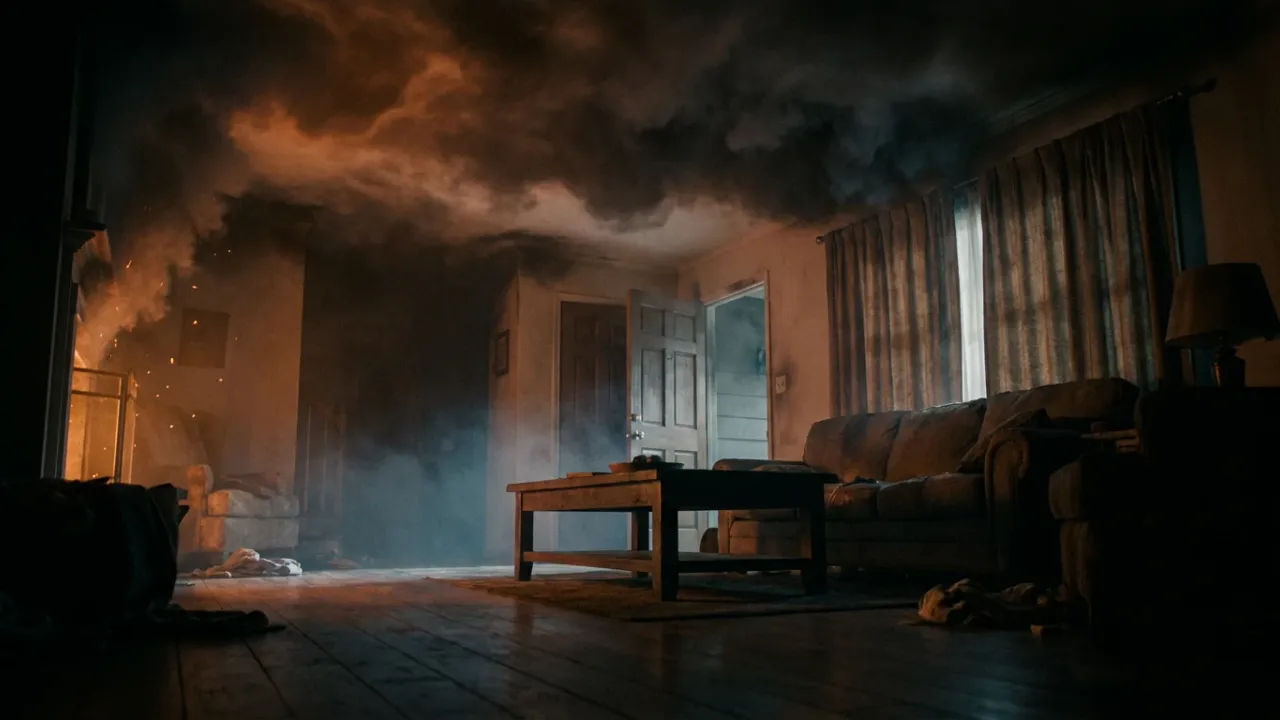
Picture a house fire, and you probably picture flames. Yet in most fatal fires, the flames never touch the victim. Smoke inhalation does the killing instead. It often strikes one room away, minutes ahead of the fire itself. A hot, poisonous cloud gathers at the ceiling, thickens, and then sinks. Both UK government fire data and US Fire Administration records point the same way. So this post pulls that cloud apart. We will cover the gases, the physics of the layer, the dose equations, and your escape window.
TL;DR
- Smoke inhalation, not burns, kills most people who die in fires.
- In England, “overcome by gas or smoke” led all causes at 34% of fire deaths.
- Carbon monoxide and hydrogen cyanide, the “toxic twins”, do most of the harm.
- The poison pools in a hot upper layer at the ceiling, then sinks.
- Engineers score the danger as a Fractional Effective Dose, and 1.0 means collapse.
- A starved, post-flashover fire raises toxic yields roughly 10 to 50 times.
- Modern furnishings flashed a test room over in 3 minutes 30 seconds.
- The same room with old-style contents took 29 minutes 30 seconds.
- Working smoke alarms cut the risk of dying in a home fire by about 60%.
How often does smoke inhalation kill instead of burns?
Toxic gas leads every other cause of fire death. Yet the exact share depends on how a country codes each case. Two national datasets tell the story from different angles.
England codes the cause of death directly. For the year to March 2025, “overcome by gas or smoke” ranked as the most common cause. It accounted for 34% of fire deaths, or 93 people. The year before gave 31%, or 77 deaths. That category has topped the list in almost every year since 2009.
American data merge the categories differently. According to the US Fire Administration, home fires from 2017 to 2019 killed 49% of their victims through burns and smoke together. Smoke inhalation alone accounted for another 35%. Burns alone accounted for just 6%. So smoke played a part in roughly 84% of the deaths with a stated cause.
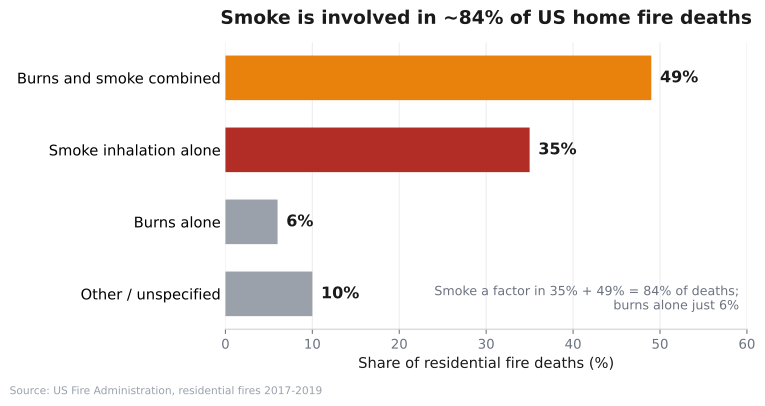
Both framings deserve honesty. The popular “three out of four” rounds the combined figure, where smoke contributes alongside burns. The narrow “smoke alone” coding sits nearer a third. Neither number contradicts the other. Both describe the same grim pattern.
Why did that pattern harden? Your furniture changed. Since the 1950s, makers swapped wood, cotton, and wool for polyurethane foam, nylon, polyester, and PVC. Stec and Hull put the result bluntly in their review of fire toxicity. Fire effluent now drives most fire deaths, and a growing share of injuries.
What does carbon monoxide do to your blood?
Carbon monoxide takes the seats that oxygen needs. So it drives most smoke inhalation deaths. The molecule grabs haemoglobin roughly 200 to 250 times more tightly than oxygen does. The US National Academies trace that ratio to a 1985 review. Each captured site forms carboxyhaemoglobin, written COHb.
The theft runs deeper than simple crowding. Carbon monoxide also warps the oxygen-release curve. So whatever oxygen still rides on your blood clings on instead of feeding tissue. It then jams cytochrome c oxidase inside the mitochondria. Healthy non-smokers carry under 3% COHb, while smokers run 10 to 15%.
Clinicians read the damage on a rough ladder:
- 10%: mild headache, or nothing at all
- 20%: throbbing headache, dizziness, nausea
- 30%: bad headache, poor judgement, blurred vision
- 40%: fainting and confusion
- 50%: drowsiness, seizures, coma
- 60%+: heart and lung failure, then death
David Purser’s tenability work adds a cruel wrinkle. Escape ability holds up fairly well to about 30% COHb in an active person. A resting person may reach 40%. Then the poison lands all at once, and collapse follows within seconds. Studies of unburned fire victims found COHb between 48% and 82%, averaging near 63%.
You can watch that clock run. Purser’s uptake equation gives the loading rate:
Here gives the level in ppm. gives the breathing rate in litres per minute, and the time in minutes. Now take 5,000 ppm, an ordinary level in a closed room after flashover. An escaping adult breathes about 25 L/min. The blood then loads at roughly 5.6 points per minute. So it crosses 30% in about five minutes.
NIOSH sets the immediately dangerous level at 1,200 ppm. Half an hour there yields only 10 to 13% COHb. The post-flashover room runs an order of magnitude worse, which is why smoke inhalation moves so fast indoors.
Why is hydrogen cyanide the faster twin?
Hydrogen cyanide poisons the cell itself. It does so about 25 times more effectively than carbon monoxide. Firefighters pair the two gases as the “toxic twins” for good reason. Together they turn smoke inhalation from a slow poisoning into a fast one.
The cyanide ion binds the iron inside cytochrome c oxidase. That halts the electron transport chain, so aerobic energy production simply stops. Doctors call the result histotoxic hypoxia. Your cells suffocate while oxygen still surrounds them. Cyanide also spreads through every tissue, whereas carbon monoxide mostly stays in the blood. Worse, a first pulse of it makes you breathe hard. So you draw the whole toxic mixture in faster.
Purser’s thresholds, drawn from animal and human data, run steep:
- Below 80 ppm: minor effects across an hour
- 80 to 180 ppm: heavy breathing, then collapse inside 30 minutes
- Above 180 ppm: gasping at once, with collapse in a few minutes
NIOSH sets the immediately dangerous level at just 50 ppm. That figure runs 24 times stricter than the one for carbon monoxide. Older human data suggest 110 to 135 ppm may kill within an hour. The 30-minute rat LC50 lands near 165 to 177 ppm.
ISO 13571 turns those thresholds into a running dose:
Run that sum at 150 ppm and it climbs by 0.148 per minute. So it reaches 1.0 in under seven minutes. Push the room to 200 ppm, and the same sum arrives in about two minutes.
Where does the gas come from? Any material with nitrogen in the chain. Think polyurethane foam in mattresses and sofas, plus nylon carpet, acrylic fabric, wool, and silk. The twins also work together. In rat studies of mixed exposure, time to collapse fell from 5 minutes to 2.6 minutes.
How do carbon dioxide and thin air finish the job?
Carbon dioxide barely poisons you at fire levels. Yet it still helps kill you, because it makes you breathe harder. Rising blood CO₂ lifts your minute volume, so every other toxicant enters faster. Purser’s model treats that as a multiplier:
At 5% carbon dioxide the factor reaches about 2.7. In plain terms, you inhale nearly three times the poison per minute. Purser caps the product near 70 L/min, since no set of lungs pumps faster.
Meanwhile the fire eats the oxygen you have left. Tenability slides as the fraction drops, and a separate term tracks it:
At 12% oxygen this term ticks slowly. It needs nearly half an hour to reach 1.0. At 10% it needs only about six minutes. Below roughly 9% people lose consciousness, and near 6% they die. Thin air adds to the asphyxiant burden, though the breathing multiplier leaves it alone.
What do the irritant gases do to your escape?
Irritants attack your eyes and airway. So they wreck your escape long before they threaten your life. Burning plastics release hydrogen chloride from PVC, plus acrolein, formaldehyde, nitrogen oxides, hydrogen fluoride, and sulphur dioxide.
The effect lands at once. Eyes stream, the throat burns, and breath-holding starts. Panic and confusion follow in a corridor you have walked a thousand times. At higher doses these gases injure the deep lung, and they can kill days later. ISO 13571 lists knock-out levels near 30 ppm for acrolein and 250 ppm for formaldehyde. It gives 1,000 ppm for hydrogen chloride, 250 ppm for nitrogen dioxide, 500 ppm for hydrogen fluoride, and 150 ppm for sulphur dioxide.
Treat those numbers as contested. The American Chemistry Council argues that the irritant model runs too strict. Laboratory workers, after all, tolerate brief acrolein exposures and keep working. Soot deserves its own warning too. The particles blind you, and they carry poisons deep into your lungs. Also, irritants explain why smoke inhalation victims so often stop within reach of an exit.
How do fire engineers measure the dose?
Engineers add concentration over time and call the total a Fractional Effective Dose. Poison works by dose, not by concentration alone. So the running sum matters more than any instant reading:
Each gas then contributes its own fraction, and the fractions add:
When the total hits 1.0, about half of a general population can no longer save themselves. ISO 13571 also offers 0.3 as a stricter design mark. That lower bar covers the most vulnerable 11%: the elderly, the very young, and the ill. In effect, the FED puts a number on smoke inhalation, and a clock on your escape.
Irritants need different bookkeeping, since they act on concentration rather than stored dose. Engineers therefore track a Fractional Effective Concentration:
Two versions of this method circulate. The Purser method in the SFPE Handbook covers a wider gas set, including nitrogen oxides. The simplified ISO form counts only carbon monoxide and cyanide as asphyxiants. Side-by-side tests show the two can diverge sharply. Both remain guidelines with honest uncertainty. ISO even warns that surviving your escape does not guarantee surviving the aftermath.
How does the upper layer form?
Hot gas floats. So every compartment fire builds a ceiling-high store of its own exhaust, and the sequence never varies. A buoyant plume rises above the burning object and drags in cool room air. It strikes the ceiling, then spreads outward as a thin ceiling jet. Once that jet reaches the walls, it banks downward and deepens into a hot upper layer.
The result splits the room in two. A scorching, blinding layer sits above, and cooler, clearer air sits below. Fire engineers call the boundary the smoke interface. That split governs every smoke inhalation case in a building. Our primer on what fire actually is covers the plume in more depth.
Entrainment explains why the layer grows so fast. Heskestad’s correlation gives the mass flow up the plume:
Take a burning sofa at 500 kW, an ordinary heat release rate. Roughly 70% of that power rises with the gas. At 2 m above the fire, the plume then carries about 2.2 kg/s. Almost all of that mass came from the room, not the sofa. At a layer density near 0.6 kg/m³, the flow works out to some 3.7 m³/s. That fills the top half of a 4 m × 5 m × 2.4 m living room in under ten seconds.
Why does the upper layer make smoke inhalation lethal?
Everything a fire produces rises, so heat, soot, and poison gather in one place. The upper layer therefore holds the highest heat and the densest smoke in the building. It also holds the steepest levels of carbon monoxide and cyanide.
Then it descends. As the fire grows, the interface drops toward the floor, and the breathable band shrinks. Compartment studies find that carbon monoxide can pass its tenability limit before the layer reaches head height. So a room can look survivable from a crawl while the air above your shoulders already carries a lethal dose.
The layer also radiates downward. Once it grows hot and deep, it acts as a ceiling-wide heater that dries and preheats everything below. Our post on radiant heat describes the same mechanism between buildings. Smoke inhalation therefore rarely acts alone, since heat and blindness arrive with it.
What happens when the fire runs out of air?
Toxic yields jump. Incomplete burning turns fuel into poison instead of carbon dioxide. Fire scientists index that state with the equivalence ratio:
Below 1.0 the fire runs fuel-lean and fairly clean. Above 1.0 it runs fuel-rich, and the chemistry sours. Carbon monoxide yields climb from about 0.01 g/g in a lean flame to 0.05 g/g at the balance point. Fuel-rich flames reach roughly 0.2 g/g. Purser’s survey of post-flashover fires averages 0.24 ± 0.09 g/g. Across materials, the yield of poison and smoke rises by a factor of 10 to 50 as ventilation fails.
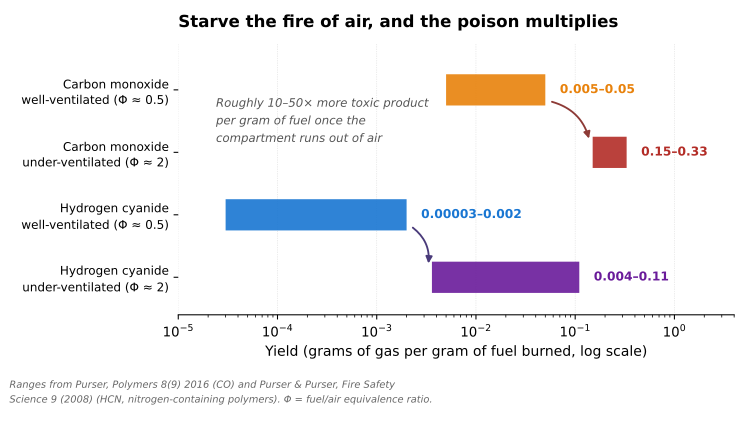
Cyanide tracks the fuel’s nitrogen content. Purser and Purser measured yields near 0.00003 g/g for nitrogen polymers burning cleanly. The same materials, starved of air, reached 0.11 g/g. Polyacrylonitrile, roughly 23% nitrogen by weight, gives about 0.078 g/g at Φ = 2. Hot pyrolysis of polyurethane foam can turn up to 70% of the foam’s nitrogen into cyanide. PVC misbehaves in its own way. It makes plenty of carbon monoxide even with air to spare, because the hydrogen chloride it sheds poisons the flame chemistry.
Flashover marks the hinge point. When the upper layer radiates past roughly 600 °C, every exposed surface lights nearly at once. The room then burns fully developed and air-starved. That means maximum poison per gram of fuel, and a plume of it pushing into the rest of the house. Smoke inhalation risk peaks here, several rooms from the flames.
Why do modern rooms flash over so fast?
Plastic furnishings release heat far faster than wood, cotton, and wool ever did. So the whole sequence compresses. UL’s Fire Safety Research Institute burned two identical living rooms side by side to prove it.
The synthetic room reached flashover in 3 minutes 30 seconds. Its legacy-furnished twin took 29 minutes 30 seconds. Across three sets of UL experiments, the natural rooms took at least 700% longer. FSRI draws a blunt conclusion from its 2012 test series. Occupants of a modern home get roughly three minutes to escape. A 1970s house gave something like 17 minutes. That comparison belongs to UL and FSRI, not to the NFPA, despite the way it circulates online.
Our post on t-squared fire growth explains the curve behind those numbers. Faster growth does more than shorten the countdown, though. It also drives the room into its air-starved state sooner. So the fire spends more of its short life making the maximum amount of poison.
Why does “get low and go” still work?
Clean air survives below the interface. So the floor protects your lungs and your eyes at the same time. That single fact explains the oldest advice in fire safety.
Vision matters as much as breathing. Engineers relate visibility to the smoke’s extinction coefficient :
Optical density per metre sets , while the constant takes a value near 3 for reflecting signs and 8 for lit ones. NIST’s alarm research uses an optical density of 0.25 m⁻¹ as a cautious limit. That gives an extinction coefficient of 0.58 m⁻¹, and a visibility of roughly 5 m. Double the density, and your sight collapses to about 2.6 m. So the exit sign at the end of a hallway simply vanishes.
So crawl, keep your head low, and count doorways with your hand. The floor still ranks as your best defence against smoke inhalation. Below the interface you gain breathable air, cooler gas, and the last of your eyesight. Those three things buy the minutes your dose equation needs.
What does a working smoke alarm buy you?
A smoke alarm buys time, the one term in the dose equation you still control. Every part of the FED sum multiplies by . So minutes of warning translate straight into lethal dose avoided.
The statistics agree with the algebra. According to the NFPA, working smoke alarms cut the risk of dying in a home fire by about 60%. Roughly three out of five home fire deaths happen where the alarm was missing or dead. English data mirror that pattern. No alarm sounded in 31% of dwelling fire deaths in the year to March 2025.
Warning matters most for people far from the fire. Smoke inhalation can floor a sleeping occupant two rooms away, long before flashover. The layer travels through doorways and corridors while the fire room still looks ordinary. Our post on smouldering fires covers the slow version of that trap. There, hours of quiet carbon monoxide come before any flame at all.
What do firefighters face after the flames drop?
Crews face the same twins, plus a long tail of carcinogens during overhaul. Modern fires often reach flashover before the first engine arrives. That leaves a ventilation-limited room waiting for air. Open the wrong door or window, and the fire surges as oxygen reaches all that unburned fuel.
Overhaul carries the quieter risk. Carbon monoxide and cyanide linger in a knocked-down room. Yet the visible drama has ended, so masks come off early. Stec and Hull link the high cancer rates across the fire service to exactly this exposure. Smoke inhalation on the job therefore argues for breathing apparatus through overhaul, not just during the knockdown.
What actually protects you?
Early warning, a rehearsed route, and a closed door do nearly all the useful work. None of it costs much. Still, each habit below cuts your smoke inhalation dose, because all of them target the same term: the time that dose spends stacking up.
- Fit and test smoke alarms on every level. Interconnect them, so a basement fire wakes the top floor.
- Practise two ways out of every room. Three minutes leaves no time to improvise.
- Get low and go. Stay below the interface, and never go back inside.
- Close doors behind you, and sleep with bedroom doors shut. A closed door holds back the layer.
- Cut the fuel load where you can. Fewer plastics in a bedroom means a slower fire and less cyanide.
The honest takeaway
Fire kills mostly by chemistry, not by flame. A modern room flashes over in minutes and then runs short of air. It converts your furniture into carbon monoxide, cyanide, and irritants at ten to fifty times the clean-burning rate. All of it collects overhead, and then it sinks. Your survival hangs on one race: the running total must reach 1.0 later than you reach the door. So keep the alarms working, keep the doors closed, and keep your head below the layer. Those three dull habits decide almost every case where smoke inhalation would otherwise finish the job.
Cite this articleHow to cite
Dinh, D. C. (2026, June 26). Smoke Inhalation: Why the Upper Layer Kills You First (Updated July 24, 2026). PyroRisk. https://pyrorisk.net/blog/smoke-inhalation-why-the-upper-layer-kills/
Recent posts
Featured posts
Categories
Comments
Related posts
Fire Fundamentals
Smoldering vs Flaming: The Fire That Kills You in Sleep
A smoldering fire shows no flame and little heat, yet it loads a house with carbon monoxide for hours while you sleep. Here is the chemistry that kills.
Fire Fundamentals
How Hot Is Fire? Adiabatic Flame Temperature vs Reality
Fire has no single temperature. The adiabatic flame temperature sets a 1,950 °C ceiling, yet real fires burn at 800–1,200 °C. Here is why.
Fire in Daily Life
Christmas Tree Fire: Flashover in 60 Seconds Explained
A dry Christmas tree fire can hit 7 megawatts and flash a whole room in under a minute. Here is the NIST science, second by second, and why water stops it.