pyrorisk.net · Fire Science & Risk Fire in Daily Life
Dryer Fire Science: The Physics of Why Lint Ignites
A dryer fire almost always starts with lint. Here is the surface-area physics that turns soft fluff into fast fuel, plus the simple habit that prevents it.
Online: pyrorisk.net/blog/why-your-dryer-is-a-fire-hazard-the-physics-of-lint/
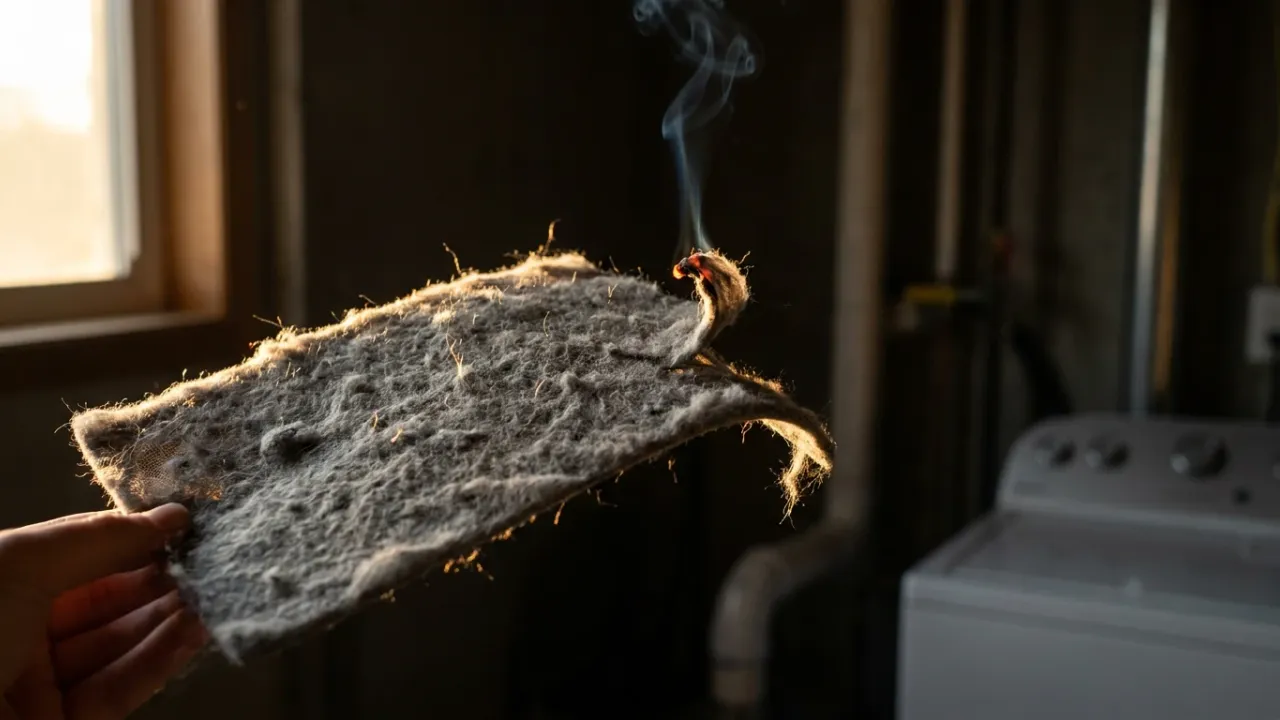
A clothes dryer looks like the most boring machine in the house. Yet it starts more home fires than almost any other appliance. Nearly every dryer fire traces back to the same soft, grey culprit: lint. This post digs into the physics of surface area, thermal mass, ignition temperature, and airflow. The goal: show why a handful of fluff behaves like serious fuel, and which cheap habits break the chain.
TL;DR
- A dryer fire almost always starts with lint and trapped heat, not with a rare fault.
- According to the NFPA, dryers and washers cause about 15,970 US home fires a year, and dryers drive 92% of them.
- The leading cause sounds absurd: nobody cleaned the lint. That failure sits behind 33% of cases and half of the deaths.
- Fine fibers ignite far more easily than solid cloth, because they pack a huge surface into almost no mass.
- One kilogram of solid fuel offers 0.048 m² of surface; as 50-micron particles, about 120 m².
- A clogged screen or duct traps heat, so internal surfaces climb toward lint’s ignition range of roughly 210 to 290 °C.
- The defence costs nothing: clean the screen every load, clear the duct every year, and never leave oily fabrics in a warm pile.
How many home fires do dryers cause?
Dryers and washers cause about 15,970 reported US home fires a year, according to the National Fire Protection Association. Dryers alone drive 92% of them. Each year, these fires kill 13 people, injure 440 more, and destroy $238 million in property.
One cause towers over the rest. The NFPA names “failure to clean” as the leading factor, behind a full 33% of the fires. Those same cases account for half of the deaths. Mechanical failure follows at 28%, then electrical failure at 17%. A heat source placed too close to combustibles adds 5%.
The first item to catch tells its own story. Dust, fiber, or lint ignited first in 27% of cases, with clothing close behind at 26%. Moreover, 83% of these fires began in the laundry area, per the US Fire Administration. Electric dryers accounted for 78% of the machines involved, roughly in line with their share of homes. Still, one forensic firm reports electric models cause fires at 2.5 times the rate of gas units. Hotter elements explain the gap.
Why the headline numbers disagree
Dryer fire counts differ by agency, so the headlines seem to clash. The NFPA counts dryers and washers together and scales up fires with unknown equipment, landing near 15,970. Meanwhile, the USFA tracks a narrower set — dryer-only fires in residential buildings — and lands near 2,900. A third figure, about 15,500, comes from the CPSC. The gap reflects method, not a real dispute, and every count points at the same culprit.
The same story abroad
The pattern crosses borders. UK Home Office figures logged 884 tumble-dryer fires in 2021/22. Also, Electrical Safety First counted 1,140 accidental electrical fires from white goods across England in 2024 — about three a day. Tumble dryers sit behind 51% of one insurance group’s white-goods fire claims. The neglect runs just as deep. By the same charity’s research, only one person in twelve cleans the lint filter even once a year. One in twenty never cleans it at all.
London’s firefighters tell the same story. The London Fire Brigade attends nearly one white-goods fire a day. Its 2025 log lists 258 of them, with washing machines (92) and tumble dryers (86) on top.
What is dryer lint made of?
Dryer lint consists of the fine broken fibers that tumbling clothes shed — mostly cotton cellulose, plus polyester and wool. Moving air then carries the fluff onto the screen and into the duct. Every load adds another layer, so the deposit grows week by week.
Chemically, cotton lint matches the shirt it came from. Nothing exotic hides inside. When heated, cellulose breaks down into flammable gases and tar, the process our pyrolysis primer covers in depth. So why does the fluff ignite in seconds when the shirt itself would only char? The answer lies in shape, not chemistry.
Why does fine lint ignite so easily?
Fine lint ignites easily because combustion happens only at a fuel’s surface, and fine fibers expose an enormous surface area. At the same time, each fiber holds almost no thermal mass, so a tiny dose of heat lights it.
The rule takes one line. With fuel mass , density , and particle size :
Shrink , and the area soars. A single one-kilogram sphere of density 1 g/cm³ measures about 12.4 cm across, with just 0.048 m² of surface. Grind the same kilogram into 50-micron particles, however, and the surface grows to roughly 120 m². That equals about 1,300 square feet — a 2,500-fold jump from the very same mass.
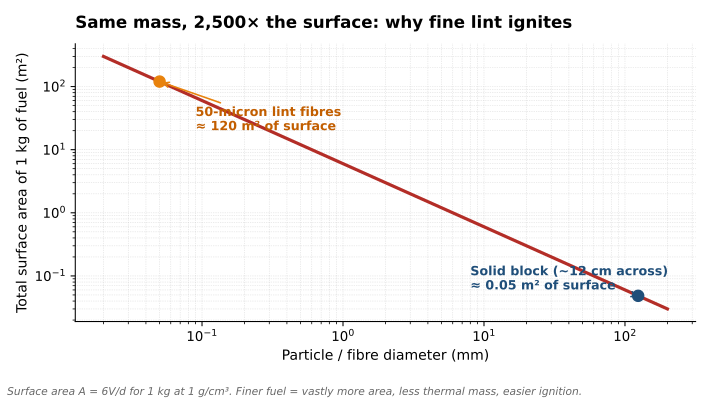
Surface explains only half the danger. The other half hides in the energy budget. The energy to light a fiber scales with its mass :
A lint fiber weighs mere micrograms. Here means specific heat, and the temperature climb to ignition. Because shrinks toward nothing, so does . Also, a thin fiber has no bulk behind it to drain heat away by conduction. Thus a weak spark, a glowing ember, or a hot metal surface can light it. The same source would fail against a solid plank.
Flour, sawdust, and grain dust explode inside silos for exactly this reason. NIST research on smoldering adds the final piece: high surface-to-volume ratios favor smoldering. An open, porous fuel bed also lets oxygen reach every fiber. In short, lint behaves like a slow-motion combustible-dust hazard sitting inside a hot appliance.
How hot must lint get to ignite?
Cotton lint pyrolyzes above roughly 250 °C and ignites between about 210 and 290 °C, depending on the test. No single number covers every case, because results swing with the method. The honest picture looks like this:
| Threshold | Typical range | Notes |
|---|---|---|
| Pyrolysis onset | above ~250 °C | Main decomposition at 300–400 °C |
| Piloted ignition | ~210–266 °C | Flame or spark present |
| Hot-surface ignition | ~290 °C minimum | NIST measurements on cellulosic fuels |
| Fast ignition | ~550 °C | Ignites within seconds in NIST tests |
One popular number deserves a warning. Fire-service articles repeat an autoignition figure of 407 °C for cotton, yet the value resists tracing to any primary study. Vytenis Babrauskas, the leading authority on ignition science, cautions that published values swing widely with test protocol. So treat any single-figure claim with suspicion, including that one.
Now place a dryer against that table. On high heat, the air moving through the drum runs at roughly 49 to 71 °C — nowhere near ignition. However, the electric heating element itself runs at about 120 to 200 °C, squarely inside lint’s ignition range. As long as air keeps flowing, the heat sweeps out of the machine with the moisture. The margin of safety lives entirely in the airflow.
How does a dryer fire actually start?
A dryer fire starts when restricted airflow traps heat until an internal surface, or the element, reaches lint’s ignition range. The machine supplies every side of the fire triangle on its own.
- Fuel — lint on the screen, in the heater box, on the motor, and along the duct.
- Heat — the element or gas burner, plus every degree the trapped air cannot carry away.
- Oxygen — the same airflow that dries your clothes feeds any flame.
For the basics of that triangle, see what is fire. The failure then unfolds as a chain, and each link gives a warning.
- First, lint clogs the screen or the duct, and airflow drops.
- Clothes take longer to dry — the earliest sign most people ignore.
- Because the exhaust carries away less heat, the heater box climbs until the high-limit thermostat trips.
- Repeated tripping ages the safety hardware; a bypassed or failed cutoff removes the last barrier.
- Finally, internal surfaces reach lint’s ignition range, or a stray clump touches the element and lights.
The USFA describes the endgame plainly. Once enough heat exists to ignite the lint while the safety devices sit compromised, fire ensues. Every step before that point remains visible to an attentive owner.
The fire you never see start
A dryer fire does not always announce itself with flames. Lint, like other porous cellulosic fuels, can smolder — burn slowly and flamelessly through the fuel bed for hours. Fire researchers call smoldering the most persistent form of combustion, common in porous fuels that char on heating. Then, with a fresh gulp of air, a hidden smolder can erupt into open flame — sometimes after the cycle ends. Our post on smoldering versus flaming explains why that transition kills.
Self-heating raises the stakes further. Fabrics carrying cooking-oil residue oxidize on their own, and a warm, folded pile traps the heat that reaction makes. In a 1991 study for the CPSC, Whirlpool engineers tested towels holding 20% vegetable-oil residue. The towels could ignite on their own after a wash, a dry, and a quiet stack on the shelf. The NFPA counts about 14,070 spontaneous-combustion fires a year across all settings.
Real losses back the warning. One laundromat fire from oily towels caused $600,000 in damage. A 1994 commercial laundry fire in Findlay, Ohio — traced to linseed-oil residue in clean, warm garments — topped $5 million. So the practical rules follow directly. Never leave a hot load piled in the drum or the basket overnight. Never machine-dry oil-soaked fabrics at all; wash them repeatedly and air-dry instead. The same self-heating chemistry starts fires in the kitchen too.
When lint reached the heating element
The United Kingdom ran the world’s largest accidental experiment on this physics. In November 2015, Whirlpool flagged about 5.3 million tumble dryers sold in the UK between 2004 and 2015. The affected brands included Hotpoint, Indesit, Creda, Swan, and Proline. The defect sounded almost trivial: fluff could slip past the filter and touch the exposed heating element. A 2018 parliamentary report tied that flaw to at least 750 fires and called the response woefully inadequate. In 2019, the government ordered a recall of roughly 500,000 still-unmodified machines.
One fire made the danger concrete. In August 2016, an Indesit dryer ignited on the seventh floor of Shepherd’s Court, an 18-storey tower in west London. The London Fire Brigade sent 120 firefighters and moved out around 100 families. Investigators found a worn, out-of-round drum opening that likely let lint reach the element. The flames then climbed the building’s cladding — a grim preview of a coming national tragedy.
Every case repeats one lesson. Keep the fuel away from the heat, and the dryer fire never starts.
Do safety standards catch this?
Partly: modern dryer standards demand fire-containment tests and a mandatory cool-down period, yet no standard can clean the duct behind your wall. In the US, electric dryers follow UL 2158, whose latest edition took effect in April 2024. Gas dryers answer to ANSI Z21.5.1 instead. In Europe, IEC 60335-2-11 covers vented, condenser, and heat-pump machines. These documents exist because the failure mode repeats worldwide.
Yet a standard only shapes the machine itself. It cannot reach the duct behind your drywall, and it cannot empty a screen. The hardware assumes airflow; the airflow depends on you.
Why the duct matters as much as the screen
Duct lint creates a double hazard. The same deposit acts as fuel and as the airflow restriction that overheats the machine. Each ridge of a flexible foil duct traps fibers, and each trapped fiber slows the air. Slower air then drops still more fibers. So the trap tightens itself, and dryer fire risk climbs with every load.
Think of the duct as a pipe the blower must push against. Every elbow, ridge, and lint bed adds resistance, which engineers call static pressure. Past a limit, the blower cannot move enough air, so heat and moisture stay inside. One restriction thus slows drying, wastes energy, and raises the fire risk all at once.
US building codes treat the duct with respect. The residential code, IRC M1502, caps the exhaust run at 35 feet. It also demands smooth, rigid metal duct of at least 4 inches across. Every bend costs airflow. So the code charges 5 feet of length per 90° elbow, and 2.5 feet per 45°. Flexible transition hose may span only 8 feet, and only if listed to UL 2158A. Also, the duct must end outdoors with a backdraft damper and never with a screen. A screen clogs with lint almost by design.
Two extra rules close the gaps. If the manufacturer’s manual demands a shorter run than the code allows, the stricter number wins. And if your duct still wears the plastic accordion style, replace it this week, because every dryer manual forbids it.
How do you prevent a dryer fire?
You prevent a dryer fire with three habits: screen cleaned every load, duct cleared every year, and no oily fabrics. Each habit removes fuel before heat can find it.
The screen comes first, because it guards the airflow. Yet no mesh catches everything, so fine fibers always drift downstream and settle in the duct. Annual duct cleaning — more often for heavy use or long runs — removes the fuel bed the screen missed. UL notes the right interval depends on usage, duct geometry, and the age of the machine.
Split the duct work sensibly, too. You can vacuum the screen housing and the reachable duct yourself. However, a professional can clear concealed runs and the exterior cap. A good technician also spots installation defects along the way.
Between cleanings, watch for the warning signs of a choked vent.
- Clothes take noticeably longer to dry, or come out hotter than usual.
- A burning smell appears during the cycle.
- The laundry room turns hot and humid while the machine runs.
- Lint gathers behind or around the dryer.
- The outside vent flap stays shut while the dryer blows.
Any one of these signs means stop, unplug, and inspect. So does a duct run near the 35-foot limit with several elbows. In that case, fit a UL 705-listed booster fan or reroute the duct. Finally, UK owners of those recalled 2004–2015 brands should check the register before the next load.
Buying new? Heat-pump dryers run cooler and skip the external duct, which removes the classic dryer fire pathway. Take the safer label with care, though. The claim comes mostly from manufacturers, and hard comparative fire data stays scarce. Their filters and heat exchangers still need regular cleaning.
The honest takeaway
The physics hands lint every advantage. Enormous surface, negligible mass, and an ignition threshold the element can reach whenever airflow fails. Yet the same physics hands you the counter. A dryer fire needs fuel, heat, and oxygen in one place, and you control the fuel completely.
So clean the screen every load. Clear the duct every year. Watch the drying time, because a slow dryer whispers its warning before anything burns. No other hazard in your home costs so little to remove. A dryer fire remains, one handful of grey fluff at a time, almost entirely preventable.
Cite this articleHow to cite
Dinh, D. C. (2026, June 5). Dryer Fire Science: The Physics of Why Lint Ignites (Updated July 24, 2026). PyroRisk. https://pyrorisk.net/blog/why-your-dryer-is-a-fire-hazard-the-physics-of-lint/
Recent posts
Featured posts
Categories
Comments
Related posts
Fire in Daily Life
Chimney Fire Science: Why Creosote Turns Flues Into Fuel
A chimney fire can hit 1090 °C and crack a clay flue liner in minutes. Here is the creosote science behind it, and why an annual sweep stops it.
Fire in Daily Life
Christmas Tree Fire: Flashover in 60 Seconds Explained
A dry Christmas tree fire can hit 7 megawatts and flash a whole room in under a minute. Here is the NIST science, second by second, and why water stops it.
Fire in Daily Life
The Science of a Kitchen Fire: Why Water Makes It Worse
A kitchen fire starts when cooking oil creeps up to its 368 °C autoignition point. Here's the physics of why water makes a burning pan catastrophically worse.