How Hot Is Fire? Adiabatic Flame Temperature vs Reality
Fire has no single temperature. The adiabatic flame temperature sets a 1,950 °C ceiling, yet real fires burn at 800–1,200 °C. Here is why.
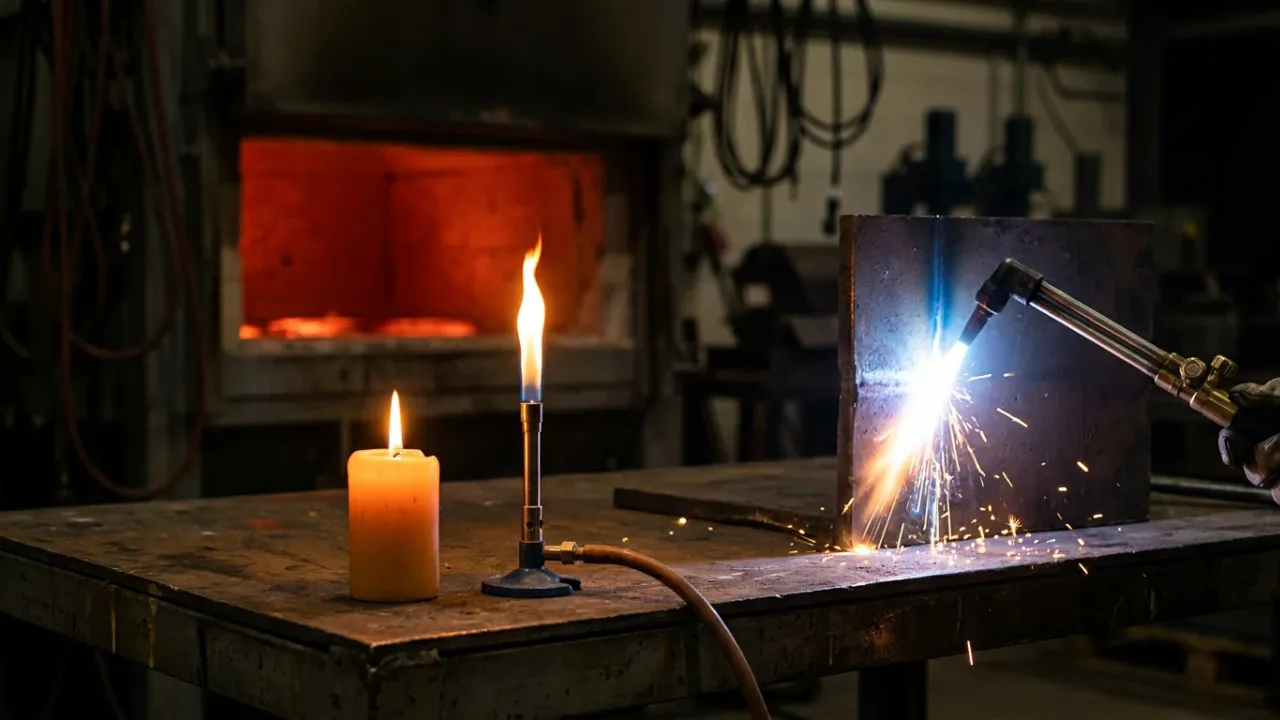
Ask a fire scientist how hot fire burns, and you get a question back: which fire, and where? A flame holds no single temperature the way a block of copper does. The flame temperature swings by more than 1,000 °C across a few centimeters of gas. It also flickers on a scale of milliseconds. Still, thermodynamics hands us one hard anchor. The adiabatic flame temperature sets a ceiling near 1,950 °C for most fuels in air. Yet real fires never come close. In short, the fires that threaten buildings sit at 800–1,200 °C. This post derives that ceiling from the first law. Then it tracks the four leaks that drain every real fire far below it.
TL;DR
- Fire has no single temperature. The ceiling in air sits near 1,950 °C.
- The ceiling has a name: the adiabatic flame temperature. Call it the AFT.
- One rule sets it. Enthalpy in equals enthalpy out, with nothing lost.
- No accidental fire reaches the AFT. Four leaks pull every real flame down.
- Nitrogen ballast leads that list. Excess air, soot radiation, and unburned fuel follow.
- Hot products also split apart. Dissociation alone costs about 100 K.
- Real flames hold just below 900 °C. The visible tip marks about 320 °C.
- Room fires settle at 800–1,200 °C after flashover. Air supply caps the burning rate.
- An oxy-acetylene torch hits 3,500 °C. Pure oxygen removes the ballast.
- Steel loses 40% of its strength by 550 °C. So safety hinges on time and insulation.
What is the adiabatic flame temperature?
The adiabatic flame temperature marks the hottest state a fuel can reach. Specifically, it assumes complete burning, zero heat loss, and no dilution beyond the needed air. Picture a fixed mass of fuel and air in a perfectly insulated vessel at 25 °C and 1 atm. Light it. Nothing escapes. So the product gases must swallow every joule the reaction gives up.
The first law then collapses into one line of bookkeeping. Total enthalpy in equals total enthalpy out:
Now split each species into two pieces. The enthalpy of formation carries the chemical energy locked in its bonds. The sensible enthalpy then counts the heat needed to warm that species from the reference state upward. It equals the integral of the specific heat . The full balance reads:
The reactants enter at , so their sensible term drops out. What remains says something simple. Because nothing escapes, the chemical energy goes entirely into heating the product gases. And marks the point where that heating stops.
Solving for takes iteration, because climbs with temperature. Every gas also soaks up more heat per degree as it warms. So a first guess always overshoots. Engineers run Newton-Raphson on the balance above. For the full equilibrium answer, they minimize Gibbs energy instead. Either way, methane in air lands near 2,226 K, or about 1,953 °C.
Does the vessel shape change the answer?
A rigid vessel gives a higher number than an open flame. The gap runs near 90 K. In a sealed bomb at constant volume, no energy goes into pushing back the atmosphere. So the balance runs on internal energy rather than enthalpy. More of the released energy then lands as temperature.
For methane, Babrauskas gives roughly 2,326 K at constant volume against 2,236 K at constant pressure. Free-burning fires, however, vent to the room. So they follow the constant-pressure value. Meanwhile, the constant-volume figure belongs to closed-vessel deflagrations and engine cylinders. Quote the wrong one and your flame temperature drifts by 90 K before the physics even starts.
Why do most fuels top out near 1,950 °C?
Most organic fuels release heat in proportion to the oxygen they burn. Each unit of heat therefore drags along the same load of nitrogen ballast. So wood, plastics, gasoline, and natural gas crowd into one narrow band of flame temperature.
| Fuel | AFT in air (K) | AFT in air (°C) | AFT in oxygen |
|---|---|---|---|
| Methane | ~2,226 K | ~1,953 °C | ~3,050 K |
| Propane | ~2,267 K | ~1,994 °C | ~2,526 K |
| Hydrogen | ~2,380 K | ~2,107 °C | ~3,074 K |
| Ethylene | ~2,375 K | ~2,102 °C | — |
| Acetylene | ~2,607 K | ~2,334 °C | ~3,773 K |
| n-Heptane | ~2,469 K | ~2,196 °C | — |
| Wood volatiles | ~1,900–2,000 K | ~1,600–1,750 °C | — |
Values for propane and hydrogen come from a US Department of Energy compilation. Likewise, the oxygen column follows equilibrium runs.
Hydrogen and acetylene break out of the band. Both pack unusually high energy into each mole of product gas. So the ballast argument loses its grip on them. For everything else the bookkeeping evens out. More heat demands more oxygen. Then more oxygen brings more nitrogen along for the ride.
That clustering explains a common surprise. People expect gasoline to burn far hotter than wood, since gasoline holds roughly twice the energy per kilogram. But the extra energy arrives with extra air. And the extra air arrives with extra nitrogen. So the ceiling barely moves.
What does dissociation cost?
Dissociation shaves roughly 100 K off the naive ceiling. Because hot products tear themselves apart, they park energy in broken bonds. Above about 1,800 K, the tidy story of complete burning to carbon dioxide and water simply fails. The products run backwards:
Radicals such as H, O, OH, and NO show up alongside them. Each reaction above absorbs energy in the direction written. The flame therefore parks part of its heat in chemistry instead of temperature. So a thermometer never sees that share.
For example, the size of that tax shows up cleanly in computation. A NASA CEA and GRI-Mech comparison gives 2,326 K for single-step complete burning of methane. The full equilibrium case gives 2,224 K. That 100 K difference is dissociation, priced exactly.
Dissociation also explains a neat quirk of the mixture curve. The peak flame temperature arrives slightly on the fuel-rich side, near an equivalence ratio of 1.05. Dissociation bites harder on the lean side, where spare oxygen drives the splitting reactions forward. So a small excess of fuel suppresses the tax. Gas turbine designers meet the same peak near 1.05 to 1.1.
Why is an oxy-acetylene torch so much hotter?
Pure oxygen removes the nitrogen ballast. The same chemical energy then heats far less gas. Air carries about 3.76 moles of nitrogen for every mole of oxygen. Nitrogen takes almost no part in the chemistry, and it releases nothing. Even so, every one of those molecules rides up to the final flame temperature. Each one demands its share of heat on the way.
Strip the nitrogen out and the temperature rise roughly doubles. An acetylene-oxygen flame reaches about 3,773 K, or 3,500 °C. In air the same fuel manages roughly 2,330 °C. Propane in oxygen reaches about 2,526 K. That gap explains why only oxy-fuel torches cut steel. It also explains why industry buys hundreds of millions of tonnes of oxygen a year.
Thermal ballast therefore ranks as the biggest single lever on flame temperature. It also hands us a comforting piece of physics. Accidental fires always breathe air. So they can never climb into torch territory on their own.
Why do real flames fall short of the ceiling?
Real fires burn as diffusion flames, and they pull in far more air than the chemistry needs. The fuel vapor and the air start out separate. They must mix before anything burns. Burning then happens on a thin surface where the mixture hits stoichiometric. Meanwhile the buoyant plume keeps entraining fresh air along its whole height.
All that surplus air behaves exactly like nitrogen ballast. It is dead weight the flame has to heat. So a wood or hydrocarbon flame with a 1,950 °C ceiling reads hundreds of degrees lower on a thermocouple. Entrainment, not chemistry, writes that difference.
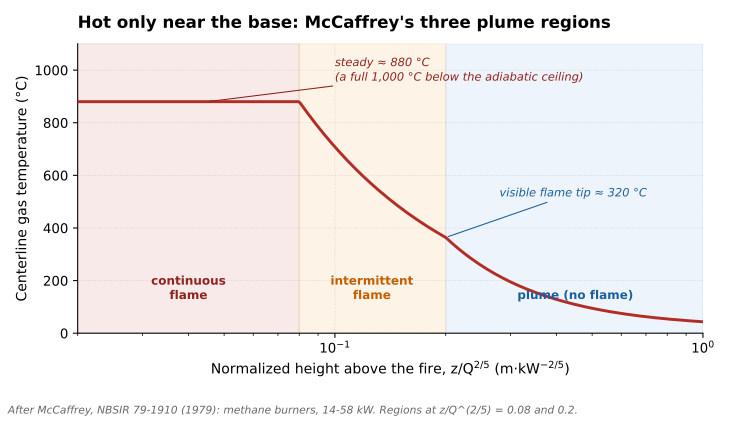
According to McCaffrey’s 1979 measurements at the US National Bureau of Standards, the centerline of a plume splits into three regions. He burned methane at 14 to 58 kW. Then he correlated everything against a normalized height:
Here gives height, the heat release rate, and a region exponent. That single exponent switch reproduces four decades of plume data.
| Region | (m·kW⁻²ᐟ⁵) | Behavior | Temperature | |
|---|---|---|---|---|
| Continuous flame | < 0.08 | 1/2 | Steady, always burning | Just below 900 °C |
| Intermittent flame | 0.08–0.2 | 0 | Flickering, pulsing | 900 °C down to ~320 °C |
| Plume | > 0.2 | −1/3 | Hot gas, no flame | Below 320 °C, falling |
Note the headline number. The steady flame region holds just below 900 °C throughout. The visible flame tip marks roughly 320 °C. French replications at Poitiers reported values you cannot tell apart. So the working flame temperature of an ordinary fire runs 1,000 °C under its own ceiling.
Size closes the gap a little. Small flames under a meter show that familiar 900 °C. Large pools climb to 1,100–1,200 °C, since a thick flame swallows less excess air per unit of fuel. Even the best-measured peaks in big pool fires stop near 1,260 °C. That still leaves 700 K on the table.
How much heat does soot radiate away?
Soot radiates 15% to 60% of a flame’s heat output straight out of the reaction zone. That loss is real energy, not dilution. A luminous flame glows because soot inside it runs hot enough to shine. Every photon leaving carries energy the gas no longer holds. So the flame temperature drops.
Fire scientists track the lost share as the radiant fraction, . It depends almost entirely on how much soot a fuel makes.
| Fuel | Radiant fraction | Character |
|---|---|---|
| Methane | ~0.14–0.21 | Weakly sooting |
| Propane | ~0.30 | Moderately sooting |
| Ethylene | ~0.32–0.35 | Sooty |
| 1,3-butadiene | ~0.43 | Very sooty |
| Acetylene | ~0.45–0.49 | Heavily sooting |
| Polystyrene | ~0.59 | Aromatic, very sooty |
Markstein and de Ris measured climbing from 0.181 for methane to 0.429 for 1,3-butadiene. Those values track the fuel’s laminar smoke-point flame length almost linearly. Across eight pool-fire fuels from 0.6 to 120 kW, the fraction ran from 0.16 to 0.35.
Soot then plays a double game. It makes the flame an efficient radiator, which cools the gas. But in fires beyond a few meters across, the same soot forms a cold, dark shroud. That shroud blocks light from deeper inside. NIST found near 0.30–0.40 up to roughly 4 m, falling as diameter grows. So radiation cools the flame, then throttles itself at scale.
The engineering split matters here. A hydrogen flame radiates little, burns hot, and stays nearly invisible. A polymer flame runs cooler locally. Yet it throws 30–40% of its power at everything nearby as radiant heat.
What else drains the heat?
Two more leaks pull real flames below the ideal, and both grow worse as a fire develops. First, combustion efficiency never reaches 1.0. Real flames leak carbon monoxide, soot, and unburned fuel out of the top. So part of the chemical energy never converts to heat at all. That efficiency drops further as a fire turns fuel-rich or ventilation-controlled. Almost every serious room fire ends up there.
Second, no real fire runs adiabatic. Heat pours out to walls, ceilings, cold surfaces, and the fuel bed itself. Some of that loss returns as useful work. Radiation back to the fuel drives the pyrolysis that keeps the fire fed. The rest simply leaves. Local extinction adds a little more, since flame stretch briefly snuffs patches of the reaction zone.
Stack the four leaks in order and the arithmetic works out. Nitrogen ballast holds the ceiling near 1,950 °C. Dissociation takes 100 K. Excess air takes several hundred more. Radiation and unburned fuel take the rest. What survives reads about 900 °C on a thermocouple.
What sets the temperature of a room fire?
Ventilation, not flame chemistry, sets the temperature of a fully developed room fire. Once flames fill a room, the useful physics shifts from the reaction zone to a whole-room balance. Heat flows in from burning. Heat also leaks out through walls and openings. And fresh air squeezes in through whatever gaps exist.
Before flashover, the McCaffrey-Quintiere-Harkleroad correlation predicts the hot layer well. Its authors fitted a room energy balance to more than a hundred tests:
Strip the algebra and two things drive everything. The gas temperature rise climbs with the heat release rate to the two-thirds power. It falls with the ventilation factor , the opening area times the root of opening height. Wall heat loss then trims the result through the conductance . The original fit covered rises from 20 °C to 600 °C, which spans the whole pre-flashover range.
Flashover arrives when the upper layer passes roughly 500–600 °C. A floor heat flux of 15–20 kW/m² also marks that moment. Radiation from that layer ignites everything below at once. The room then converts from a fire in a room to a room on fire.
After flashover, the fire usually turns ventilation-controlled. By then it holds far more fuel vapor than the incoming air can burn. So the opening, not the fuel, caps the burning rate. Fully developed rooms then settle into the familiar 800–1,200 °C band. Research on the top of that band shows something elegant. The ultimate room temperature depends only on the heat of combustion, the combustion efficiency, and the gas specific heat. Thus air flow rate and room shape drop out entirely. So the 1,200 °C limit reflects dilution and efficiency, never the flame itself.
Standard fire curves are rules, not physics
Structural fire testing runs on idealized time-temperature curves. People quote their outputs as a flame temperature far too often. The cellulosic ISO 834 curve, mirrored by EN 1363-1 and paralleled by ASTM E119, follows one formula:
Here comes out in °C, and runs in minutes. Evaluate it and the curve reaches 842 °C at 30 minutes. It passes 945 °C at 60 minutes, then 1,049 °C at 120 minutes. For tunnels and petrochemical plants, the hydrocarbon curve climbs to 1,050 °C within 5 minutes. Then it levels off at 1,100 °C. The French modified version pushes that ceiling to 1,300 °C.
Neither curve ever cools, which no real fire obeys. These curves rank severity inside a furnace. So a furnace controller chases them by burning more or less gas. They describe no actual flame anywhere, and they never claimed to. Eurocode parametric curves and travelling-fire models aim closer to physics. Yet the nominal curves remain the regulatory backbone, exactly as standard test methods diverge elsewhere in fire testing.
Still, those conventions matter enormously. Steel responds only to the temperature it actually reaches. By 550 °C, hot-rolled structural steel keeps only about 60% of its yield strength and 45% of its stiffness. But room fires clear that threshold with ease. So the design question never asks whether a fire gets hot enough to matter. It asks how long the structure holds out.
So how hot is fire?
Fire spans a ladder from about 700 °C in a smoldering ember to 3,500 °C in an oxy-fuel torch. Yet most building fires sit between 800 and 1,200 °C. A few anchors make the whole flame temperature scale easy to carry in your head.
- Oxy-acetylene torch: about 3,500 °C. Pure oxygen puts it on top.
- Adiabatic ceiling in air: about 1,950 °C. No accidental fire reaches it.
- Candle: about 1,400 °C in the outer mantle. The dark core sits near 800 °C.
- Large pool fires: 1,100–1,260 °C. Thick flames entrain less air per unit of fuel.
- Room fires: about 900 °C in steady flames. Flashover pushes them to 1,100–1,200 °C.
- Smoldering cigarette: about 700–950 °C. Almost no oxygen reaches that zone.
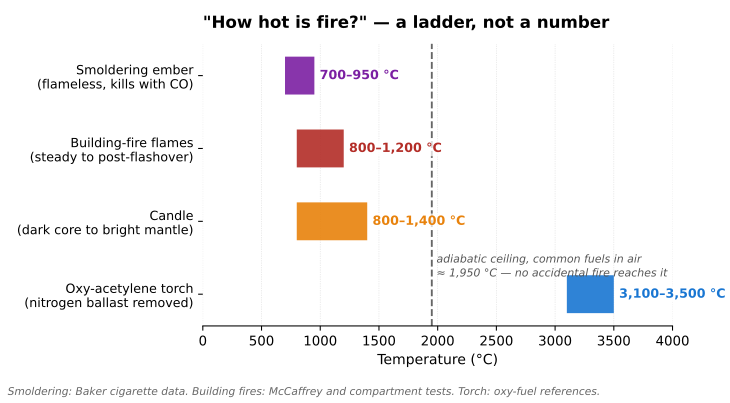
Notice the trade running down that ladder. Each step down swaps temperature for a different hazard. For instance, the torch cuts steel in seconds. The room fire collapses buildings over an hour. And the quiet ember, coolest of them all, kills sleepers with carbon monoxide.
What this means for design
Four practical rules follow from the physics above. Each rule also guards against a mistake I see regularly.
-
Use the AFT only as a sanity ceiling. Ask whether a scenario could ever pass some temperature, then move on. Never feed the adiabatic flame temperature into a heat transfer or structural calculation. It over-predicts real gas temperatures by 700–1,000 K.
-
Match the tool to the fire phase. Near an open flame, use McCaffrey or Heskestad plume correlations. Before flashover, use the MQH correlation above. After flashover, switch to a parametric curve from Eurocode EN 1991-1-2. Where regulation demands it, use the nominal ISO 834 curve instead.
-
Treat the radiant fraction as fuel-specific. Take 0.15–0.2 for light gases. Take 0.3–0.4 for sooty hydrocarbons and polymers. Never extrapolate a small-scale value to a big pool, since smoke blockage drives back down as diameter grows.
-
Design for the steel, not the flame. Room fires routinely pass 800 °C. So the critical steel temperature always arrives eventually. Protection therefore means insulation and time, never hope.
Three thresholds change that advice. In an oxygen-enriched space, the ceiling roughly doubles the temperature rise. The usual 800–1,200 °C intuition then fails, and oxy-fuel values apply instead. In a large or well-ventilated room, the fire stays fuel-controlled and local. So travelling-fire methods beat a uniform post-flashover curve there. And for tunnels or heavy sooting fuels, swap the cellulosic curve for a hydrocarbon or RWS curve first.
The next time someone quotes a single number for the temperature of fire, give the honest answer instead. Fire owns a whole ladder, from a 700 °C ember to a 3,500 °C torch. Thermodynamics sets the flame temperature ceiling near 1,950 °C. Then nitrogen, entrainment, soot, and starving air supplies pull every real flame far beneath it.
Cite this article
Dinh, D. C. (2026, July 17). How Hot Is Fire? Adiabatic Flame Temperature vs Reality (Updated July 24, 2026). PyroRisk. https://pyrorisk.net/blog/how-hot-is-fire-adiabatic-flame-temperature-vs-reality/
Recent posts
Featured posts
Categories
Comments
Related posts
The Science of Fire: What You Think You Know Is Wrong
Explore the science of fire — from radical chain reactions and flame anatomy to flashover physics and why modern homes burn 7x faster than 1950s ones.
Smoke Inhalation: Why the Upper Layer Kills You First
Smoke inhalation kills more fire victims than flame does. Here is the toxic upper layer, the CO and HCN dose, and the FED clock that times your escape.
The t-Squared Fire: How Fire Growth Rate Shapes Escape Time
Slow, medium, fast, ultrafast: how the t-squared curve turns fire growth into numbers, and why modern fuels outrun its four classes.