pyrorisk.net · Fire Science & Risk Fire Fundamentals
Radiant Heat: Why Fire Jumps the Gap Between Buildings
Convection burns up; radiation burns across. How radiant heat, the T⁴ law, and view factors decide whether fire ignites the house next door.
Online: pyrorisk.net/blog/radiant-heat-why-fire-jumps-the-gap-between-buildings/
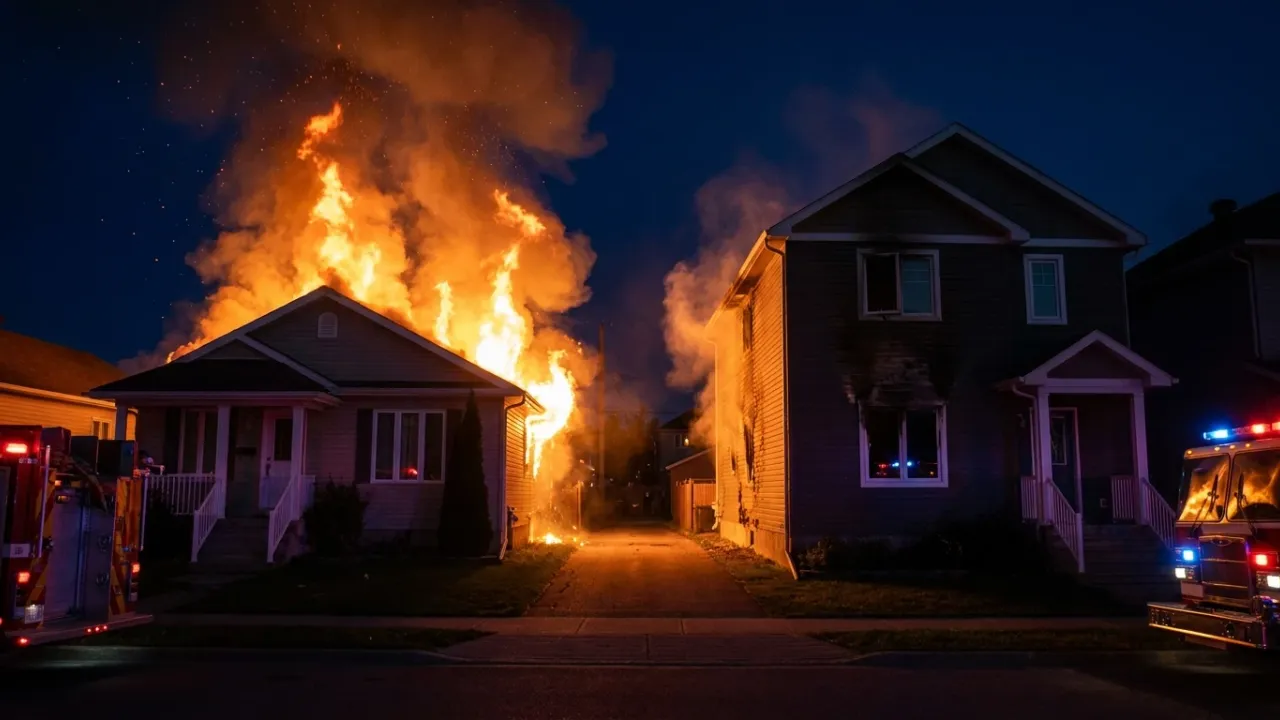
A burning house can ignite its neighbour without a single flame crossing the gap. Radiant heat does that work. Convection carries hot gases up into the sky. But radiation travels in straight lines: sideways, across gaps, through windows. So a fully involved building acts like a giant heater aimed at its street. This post follows that energy from flame to neighbouring wall, equation by equation. Along the way, it shows why fire codes measure safety in kW/m².
TL;DR
- Convection burns up; radiation burns across. Radiant energy moves line-of-sight in every direction.
- Emission follows the Stefan–Boltzmann law, E = εσT⁴. Double the absolute temperature, and output grows 16-fold.
- Above about 400 °C, radiation overtakes convection, according to Zhang and Usmani. So hot rooms radiate far more than they convect.
- A burning room fires 84–168 kW/m² out of its openings. Wood ignites near 12.6 kW/m² with a pilot flame close by.
- The inverse-square law only holds beyond about 2.5 fire diameters. Closer in, view factors and the solid-flame model rule.
- Embers start most fires at the wildland edge. Yet radiant heat drives the house-to-house spread that follows.
- The 2018 Camp Fire left a clear mark. Homes over 18 m from a destroyed neighbour survived far more often.
What makes radiant heat different?
Radiant heat needs no contact and no moving air. It travels as electromagnetic waves, like light, along any clear line of sight. Flames, embers, and hot smoke layers all emit it. So distance and geometry, not wind, decide how much energy arrives.
Convection behaves differently. Buoyancy pushes hot gases upward, so most of that energy leaves through the plume. A wall a few metres away therefore gets almost nothing by convection. Yet it can bake in the radiant field until it smokes, chars, and ignites.
Why does radiation beat convection above 400 °C?
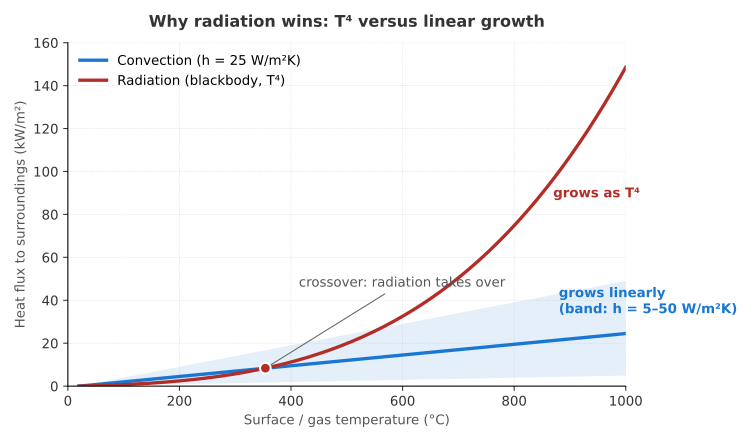
Because emitted power rises with the fourth power of absolute temperature, while convective transfer only rises in a straight line. The Stefan–Boltzmann law sets the pace:
Here σ = 5.670×10⁻⁸ W/m²K⁴, and the emissivity ε runs from 0 to 1. Double the absolute temperature, and the output grows 16-fold.
Convection instead follows q = h·ΔT, roughly linear in the temperature gap. The two curves therefore cross. According to Zhang and Usmani in Fire Safety Journal, the crossover sits near 400 °C for common convective coefficients of 5–50 W/m²K. Below it, convection moves more heat. Beyond it, radiation pulls away fast. A post-flashover room at 830–1,040 °C burns far past the line.
Flame emissivity follows its own law. For a flame of thickness D and absorption coefficient κ, engineers write:
So once a flame grows a few metres thick, ε_f climbs toward 1. The fire then radiates almost like a perfect blackbody at its own temperature.
How much radiant heat does a burning building emit?
A burning room pushes roughly 84 kW/m² of radiant heat out of its windows at about 830 °C. At 1,040 °C, typical of high fire loads, the figure doubles to 168 kW/m². Those two values anchor the UK method in BRE’s BR 187. The method treats each opening in the facade as a glowing radiator. Homes and offices take the lower figure, while warehouses take the higher one.
Measured peak emissive powers put other fuels on the same ladder:
- LNG pool fires reach about 220 kW/m² on land. On water, Sandia’s tests measured up to 286 kW/m².
- LPG burns near 160 kW/m², and gasoline near 130 kW/m². The luminous band around gasoline fires spans 50–100 kW/m².
- Thick black smoke emits only about 20 kW/m². Where flame breaks through, flashes near 120 kW/m² appear.
Smoke changes the story at scale. As pool fires grow, soot wraps the bright flame zone, and the effective output of heavy hydrocarbons falls toward 40 kW/m². So NIST’s NISTIR 6546 warns against the old bare-radiator assumption, which can overstate flux tenfold.
Air takes a toll too. Water vapour and CO₂ absorb infrared energy, so the transmissivity τ falls with path length and humidity. Wayne’s correlation gives τ ≈ 0.79 for a 20 m path at 15 °C in one worked example. Across a gap of a few metres, though, the loss stays small. Designers therefore set τ = 1 and stay conservative.
What decides how much heat lands next door?
Geometry decides it, through a number called the view factor. That factor measures the share of leaving radiation that actually strikes the target. Formally, it comes from a double integral over both surfaces:
Reciprocity links the two directions: A₁F₁₂ = A₂F₂₁. Nobody grinds through that integral for a real facade, however. Fire engineers instead reach for one closed form — a small element facing the corner of a parallel rectangle:
Here A = a/c and B = b/c, with a and b the rectangle sides and c the gap. For the point opposite a window’s centre, split the window into four sub-rectangles under that point. Then evaluate the corner factor of each and sum the four. Received flux equals emitted power times view factor, and that single product drives BR 187, NFPA 80A, and Eurocode EN 1991-1-2 Annex G.
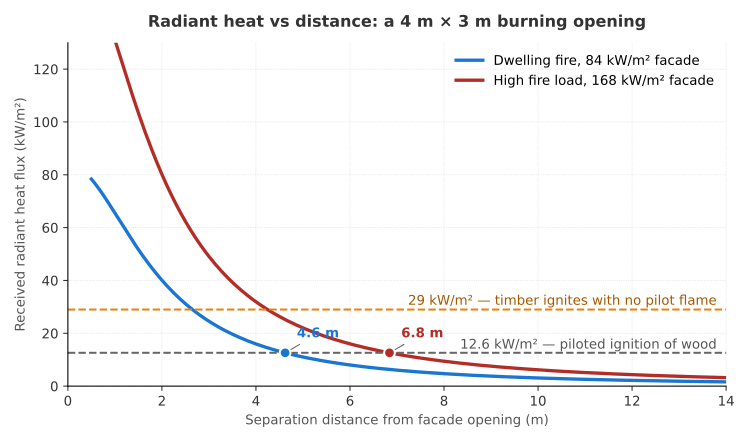
The curves above model a 4 m × 3 m opening — about one blazing living-room facade. Close in, the factor nears 1, so the wall receives nearly the full emitted flux. At 84 kW/m², the flux dips below the wood threshold past 4.6 m. Double the emissive power, though, and the safe gap stretches to almost 7 m.
Try the numbers on a smaller case: a 2 m × 1.5 m window with a receiver 5 m away, opposite its centre. Each quadrant then measures 1 m × 0.75 m, so A = 0.2 and B = 0.15. The four corner factors sum to about 0.037, and 84 kW/m² times 0.037 gives roughly 3 kW/m² — far below the 12.6 kW/m² limit. Shrink the gap to 2 m at 168 kW/m², however, and the received flux tops 30 kW/m², past every ignition threshold. Emissive power and separation dominate everything else.
When does the inverse-square law fail?
The inverse-square law fails within about 2.5 fire diameters — exactly where houses ignite each other. The point-source model squeezes the whole fire into a dot:
Here χ_r names the radiative fraction, Q̇ the heat release rate, S the distance, and φ the angle to the target. Flux falls with the square of distance. But χ_r spans roughly 0.15–0.45, and it shifts with fuel, pool size, and smoke. So treat it as a range, never a constant.
Far away, the shortcut works well. Hamins found it accurate within 13% at five to sixteen pool radii. Up close, it breaks, because the target no longer sees a point. It sees a wall of flame filling its view. For example, Modak measured errors above 25% within one pool radius. Received flux can even peak partway out, instead of rising all the way to the flame. Standard guidance therefore draws the line at 2.5 fire diameters.
House-to-house gaps of 2–10 m sit deep inside that near field. So engineers switch to the solid-flame model:
The flame becomes a real radiating surface with emissive power E_f, seen through view factor F. For long or tilted flames, weighted multi-point models by Hankinson and Lowesmith spread several sources along the flame axis. Either way, anyone quoting inverse-square numbers at a 3 m boundary holds the wrong tool.
How much radiant heat ignites the house next door?
About 12.6 kW/m² of radiant heat can ignite wood when a pilot flame or ember waits nearby. Near 29 kW/m², timber lights up with no pilot at all. Several other thresholds sit between those limits.
| Received flux | What happens |
|---|---|
| 1.4 kW/m² | Safety limit for people in US HUD siting guidance |
| 9–13 kW/m² | Small panes crack; piloted wood ignition after ~10 minutes |
| 20–30 kW/m² | Plain double glazing falls out; floor-level flux near flashover |
| 29 kW/m² | Wood ignites without any pilot flame |
| 40 kW/m² | Top Australian bushfire level below Flame Zone |
The famous 12.6 kW/m² criterion traces to piloted ignition of dry wood after a 10-minute exposure, per the UK’s BD 2887 review. Full-scale tests sometimes need 15–18 kW/m², so the number leans conservative. At the other extreme, one review of timber ignition reports 4.3 kW/m² after very long exposures. The familiar 12 ± 2 kW/m² therefore reflects test windows of 10–20 minutes, not a law of nature.
Exposure time matters because solids warm slowly. For a thermally thick solid, the classic ignition-time correlation reads:
Ignition time grows with the thermal inertia kρc and falls with the square of net flux. Halve the flux, and the wait quadruples. Measured ignition temperatures run from about 280 °C for some plastics up to 620 °C for fire-retarded plywood, with most materials between 350 and 450 °C. Handle published kρc values with care, though, since different test rigs disagree by factors of several.
Thin fuels play by a different rule. For a thermally thin sheet, ignition time rises only linearly with inverse flux, and it scales with thickness. The label depends on heating, not just geometry, because the same board can act thick early on and thin later, once heat soaks through. Curtains and paper therefore flash long before the fence boards behind them.
A subtlety hides near the threshold. As the wall warms, it throws energy back out as εσT⁴ of its own, and those losses can balance the input just below the pyrolysis point. So a target barely above the critical flux may never ignite at all, and regulators wisely tie their limits to a set exposure time.
Glazing complicates matters further, because windows often fail before walls. For instance, small single panes have cracked near 9.3 kW/m². Once the glass drops, radiation streams onto curtains and furniture, and the room can race toward flashover.
What does radiation do inside the burning room?
Radiant heat from the hot smoke layer drives flashover — the moment nearly every exposed surface in a room ignites at once. Two markers flag the transition: floor-level flux near 20 kW/m², after Waterman’s compartment tests, and an upper smoke layer at 500–600 °C. Above those values, pyrolysis gases from every couch and shelf light near-simultaneously. Kennedy adds a caution, though: the numbers serve as indicators, not definitions, since some fires meet them without flashing over.
Radiation also runs ahead of the flames inside the room. The hot layer can light a chair across the compartment before any flame arrives, a process called remote ignition.
After flashover, flames project from the windows and radiate at the building opposite. BR 187’s reviewers found those external flames add only 12–18% to the received radiation. That small margin justifies the simpler window-only radiator behind the code method.
What do real fires show about separation distance?
Embers start most fires in the wildland-urban interface, but radiant heat drives the house-to-house spread that follows. In NIST’s study of the 2007 Witch and Guejito fires, firebrands lit at least 60% of the destroyed homes. In the Grass Valley Fire, firebrands alone took 199 homes on the first day, and burning houses then lit their neighbours. Yet once one home burns fully, the street faces a radiator problem, not an ember shower.
Experiments measure that problem directly. NIST test burns placed two structures just 1.8 m apart. The plain one ignited within 5 minutes — 80 seconds after fire broke out of the source — while a fire-hardened twin survived. Meanwhile, a validated FDS study of shed fires found 3 m a safe separation for that source.
Field data agree. The 2018 Camp Fire destroyed 18,804 structures. Researchers in Fire Ecology then found an 18 m survival threshold: distance to the nearest destroyed structure predicted survival best. Construction age mattered too, since homes built before 1997 survived at 11.5% versus 38.5% for newer ones. In Lahaina in 2023, damaged buildings stood 6.5 m on average from the fire that exposed them. Undamaged ones stood 18.1 m away, and 84% of spread ran below a threshold gap.
Cities learned this lesson centuries ago. The Great Fire of London pushed separation into law, and Japanese earthquake fires taught the same. Modern experiments simply put numbers on the old instinct.
How do fire codes use radiant heat?
Nearly every separation rule caps received radiant heat, then works the geometry backwards into a distance. Britain’s BR 187 wraps a facade’s openings in a notional rectangle, mirrors it at the site boundary, and holds received flux to 12.6 kW/m². Australia’s AS 3959 even names its bushfire levels after flux: BAL-12.5, BAL-19, BAL-29, and BAL-40, with Flame Zone above. In the US, NFPA 80A grades exposures as light, moderate, or severe, then draws separations from the same radiator maths. The IBC keeps prescriptive tables of openings versus distance, and HUD accepts 31.5 kW/m² for buildings but only 1.4 kW/m² for people.
Performance-based codes hand the same physics to the engineer. New Zealand’s C/VM2 and Sweden’s rules set received-radiation criteria directly, with Swedish limits spanning 10–80 kW/m² by boundary distance. Eurocode EN 1991-1-2 Annex G supplies the view-factor method behind them all.
Notice how the levels track ignition physics. BAL-29 sits right at the no-pilot threshold of timber. So the lower levels chase embers, while the upper levels armour the wall itself. Speed matters too, since a fast design fire hits its radiating peak long before crews arrive.
How should engineers handle radiant heat?
Match the model to the range, respect the provenance of every threshold, and treat glazing as the weak link. Five habits cover most of it.
- Pick the right model. Use the point source only beyond 2.5 fire diameters. Inside that range, run the solid-flame model with view factors.
- Know your thresholds. State plainly that 12.6 kW/m² means piloted wood at 10 minutes. If margins run thin, sensitivity-test against 15–18 kW/m².
- Guard the glass. An intact wall below 12.6 kW/m² means little if the windows fail first. So specify tempered or fire-rated panes near the limit.
- Split embers from radiant heat. Screens and clean ground zones fight firebrands, while separation and cladding fight radiation. Conflagrations exploit both paths.
- Watch the moving edge. Standards keep evolving through BR 187’s second edition, the 2024 Eurocode annexes, and NIST’s ongoing separation experiments. Early data from the January 2025 Los Angeles fires remains provisional.
Radiation rewards respect for geometry. A burning building cannot chase its neighbour, yet its T⁴ glow crosses any gap with a clear sight line. So measure the gap, run the view-factor sums, and never trust the inverse-square shortcut up close. The house next door depends on it.
Cite this articleHow to cite
Dinh, D. C. (2026, July 24). Radiant Heat: Why Fire Jumps the Gap Between Buildings. PyroRisk. https://pyrorisk.net/blog/radiant-heat-why-fire-jumps-the-gap-between-buildings/
Recent posts
Featured posts
Categories
Comments
Related posts
Fire Fundamentals
How Hot Is Fire? Adiabatic Flame Temperature vs Reality
Fire has no single temperature. The adiabatic flame temperature sets a 1,950 °C ceiling, yet real fires burn at 800–1,200 °C. Here is why.
Fire Fundamentals
Smoke Inhalation: Why the Upper Layer Kills You First
Smoke inhalation kills more fire victims than flame does. Here is the toxic upper layer, the CO and HCN dose, and the FED clock that times your escape.
Fire Fundamentals
Smoldering vs Flaming: The Fire That Kills You in Sleep
A smoldering fire shows no flame and little heat, yet it loads a house with carbon monoxide for hours while you sleep. Here is the chemistry that kills.