pyrorisk.net · Fire Science & Risk Battery Fire Safety
Off-Gas Detection: The Warning Before a Battery Fire
Off-gas detection reads the vapour a failing cell breathes out before flame. Here comes the window it buys, the sensors that see it, and the limits.
Online: pyrorisk.net/blog/off-gas-detection-the-warning-before-a-battery-fire/

A lithium-ion cell rarely leaps straight to flame. It swells first. Then it cracks a vent and breathes out a cloud of solvent vapour and light gas. Off-gas detection reads that breath. Catch it early and you win minutes. Those minutes buy time to kill the charger, clear the room, or purge the box. Miss it and the same cloud pools, meets fresh air, and blows a door across the yard. This post covers what leaves the cell, how long the window runs, which sensors see it, and where off-gas detection breaks down.
TL;DR
What off-gas detection buys you
- A sick cell vents solvent vapour long before flame. Dimethyl carbonate and ethyl methyl carbonate lead that cloud, which can run up to 60% solvent by volume.
- FM Global clocked 5 to 20 minutes from first off-gas to runaway under slow heat and mild overcharge.
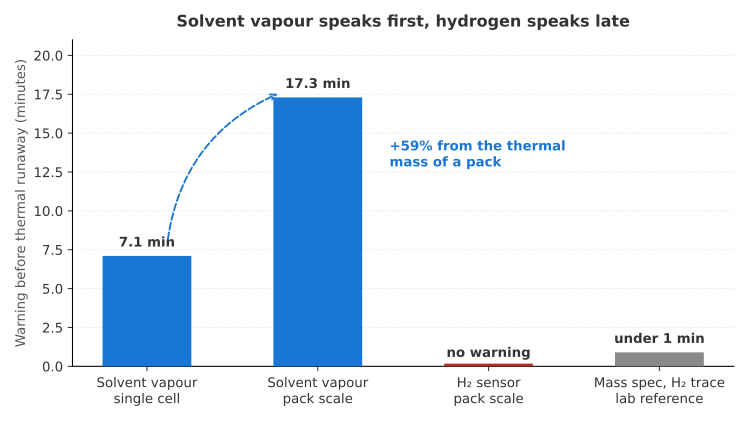
- Sandia clocked 7.1 minutes for one cell, then 17.3 minutes for a pack. Sheer metal mass more than doubles the warning.
- Stop the abuse once the alarm sounds and the cell may never run away at all.
Where off-gas detection stops working
- Crush, an internal short and hard overcharge leave seconds, not minutes. Any number quoted with no abuse mode named deserves no trust.
- Dilution beats the probe. Gas that floods a sensor inside a module may never trip one across the hall.
- H₂ shows up late. In Sandia’s pack test the H₂ probe gave no warning at all.
- Codes now fix the trip points: 25% of the lower flammable limit in US work, 10% LEL for H₂ under FM Global rules, and a 5-minute warning for cars.
What does off-gas detection mean?
Off-gas detection means sensing the gas a cell gives off before it burns. The alarm keys on chemistry, never on smoke or heat.
Failure runs in order. Heat first, then pressure, then a split vent, then a cloud, and only later a flame. Smoke and heat alarms wait at the end of that queue. Off-gas detection waits near the front, so it wins the time the later layers cannot.
What leaves the vent first?
Solvent, in vapour form. Dimethyl carbonate and ethyl methyl carbonate lead the cloud, with light gas behind them.
According to Fernandes and co-workers, quoted in the 2024 review by Bugryniec and colleagues, a cell that vents without flame can throw a cloud where solvent takes up to 60% of the volume. Boiling point sets the order. DMC boils near 90 °C, so it shows up at the first vent. EC boils near 244 °C, so it waits for full runaway. A 2025 flame-speed study tracked that split gas by gas.
Why does the smell arrive before the flame?
Because solvent needs only warmth to leave the cell. Flame needs a spark, and a mix inside its narrow burn band.
That sweet, sharp, ether-like smell comes from the carbonate esters. Crews often read it as harmless, and that reading kills people. A white haze plus a solvent smell marks a fuel-air mix, so treat the room as a bomb that lacks only a spark.
What happens inside a cell before it vents?
A ladder of reactions climbs the heat scale, and each rung adds gas. Pressure builds until a disc or a score line gives way.
Labs differ a little on the bands, and cell types shift them too. The order, though, holds everywhere.
Which heat bands mark each rung?
Near 80 °C for the first breakdown, 130 °C for the separator, and 160 °C for the point of no return.
| Stage | Band | What it makes |
|---|---|---|
| SEI breakdown | 80–130 °C | First heat, first gas |
| Salt breakdown | 100–120 °C | PF₅ and F species |
| Lithium reaction | 90–230 °C | C₂H₄, C₂H₆, C₃H₆ |
| First vent | 120–220 °C | DMC, EMC, CO₂, H₂ |
| Separator melt | 130–190 °C | Short path opens |
| Runaway, second vent | above 160 °C | CO, CH₄, soot, flame |
| Cathode breakdown | 200–300 °C | Oxygen from the oxide |
A coated separator holds near 190–200 °C rather than folding at the 130 °C melt point of bare film. That one upgrade widens the gap between the first vent and the second. So it widens the window that off-gas detection works in.
At what pressure does the vent open?
Near 1.0–1.4 MPa for the interrupt disc, and near 2.0–2.3 MPa for the burst vent, in a plain 18650.
Li, Crompton and Ostanek measured both discs. One cap tripped at 1.058 MPa, another at 1.293 MPa. Burst vents went at 2.308 MPa and 2.202 MPa. Both points drop at 100 °C, since hot steel yields sooner. A warm cell thus vents earlier than a cold one, which helps the probe and harms nobody.
Once the disc parts, the release runs fast. One 18650 in full runaway can throw some 0.27 mol of gas, or about 6 L at room heat. An MDPI rig logged 7.28 bar of overpressure inside 35 ms, though that number rests on one study.
Does cell type change the cloud?
Yes, and it flips the ranking twice. NMC gives more gas per amp-hour, yet LFP gives a nastier mix per litre.
| Cell type | Gas per Ah | Mix |
|---|---|---|
| LFP, full charge | 0.4–1.4 L/Ah | Near 40% H₂, 15% CO₂ |
| LCO, NMC, LMO | 1.28–21 L/Ah | H₂ share falls in runaway |
| NMC, first vent | — | Near 84% H₂ |
| NMC, full runaway | — | Near 40% H₂, plus CO |
A 2025 study of LFP cells from 3 Ah to 230 Ah put yield near 0.7 L/Ah under a heater, 0.11–0.68 L/Ah for overcharge, and 0.3–0.5 L/Ah for a nail. H₂ rules the LFP mix, so that gas burns at a lower limit than the NMC blend. LFP thus catches fire less often, yet blows up more readily. Our post on LFP against NMC walks through the rest of the trade.
How much warning does off-gas detection give?
Between seconds and tens of minutes. Abuse mode sets the answer, so any single figure with no abuse mode named will mislead you.
Three bodies have now timed the window. Their numbers line up once you sort the tests by how hard the cell gets pushed.
What did FM Global measure?
Five to twenty minutes, under chamber heat and mild overcharge.
Sujit Purushothaman’s team at FM Global cooked and overcharged cells while a gas probe watched. The gap from first off-gas to runaway ran, in their words, from about 5 to 20 minutes. One result beats the clock, though. When the team cut the abuse after the alarm, the cells never ran away at all. So off-gas detection can stop the event, not merely announce it.
FM drew the line honestly. Crush damage, hard overcharge and fast heating may leave no useful window, and their guidance says so outright.
What did Sandia clock?
7.1 minutes for a single cell, rising to 17.3 minutes for a pack.
Torres-Castro and colleagues at Sandia pitted fast impedance, solvent vapour and H₂ against each other. The gas probe gave those two figures, which the paper reports as a 59% difference between cell and pack. Heat drains away faster in a big block of metal, so the march to runaway slows and the alarm gains ground.
One finding upsets a common belief. The H₂ probe gave no warning at all in the pack test, and the mass spec caught H₂ under 1 minute before runaway. H₂ thus arrives too late to lead.
Why does a pack buy more time than a cell?
Because the metal next door drinks the heat. One loose cell has nowhere to dump its energy, while a cell in a pack must warm a big sink first.
The same mass cuts both ways, though. It stretches the warning window, then stores the heat that drives runaway from cell to cell once the first cell finally goes. Longer warning, bigger event.
When does the window shut?
Under crush, an internal short, or hard overcharge. Those modes run from vent to flame in seconds.
| Abuse mode | Warning | Verdict |
|---|---|---|
| Slow heat | 5–20 minutes | Strong first layer |
| Mild overcharge | 5–20 minutes | Strong, often stops it |
| Pack heat abuse | up to 17 minutes | Strong, probe inside |
| Hard overcharge | seconds to 2 minutes | Weak, needs the BMS |
| Internal short | seconds | Little to none |
| Crush or nail | seconds | None |
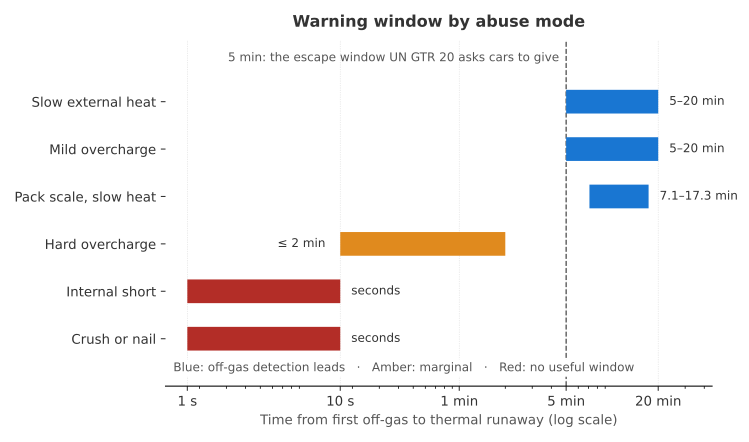
Read that table before you write a spec. Grid storage and fixed packs fail mostly at the top of it, so off-gas detection earns its place there. Cars and e-bikes fail across the whole range, so a car pack needs a strong case, a sharp BMS and gas probes together.
Why does dilution beat a good sensor?
Because a probe reads how thick the gas gets, never how much came out. Vent gas that floods a probe inside a module may never trip one in a big airy hall.
Model the room as one well-mixed volume. Take a vent gas flow that carries a mole fraction of the target gas, a room volume , and a fan flow . The level at the probe then climbs as:
Three lessons drop straight out of that line. A steady value scales with , so hard purging lowers every reading. The time constant sets how slowly the room fills, so a big hall answers late. Both terms punish a probe far from the cell, which sets up the next point.
Where should the sensor sit?
Inside the module, or as close to the cells as the design allows.
DNV’s ship battery work put it plainly: mount the probe as near the cells as you can, and inside the module if you can. Their tests found that LEL probes and voltage checks gave no early warning at all. A solvent vapour probe, by contrast, answered within seconds of the first off-gas. Same event, same room, opposite result, split by a metre of duct.
Layout follows each gas. H₂ gathers at the top of a sealed box, so H₂ probes belong high. CO and other toxic gas matter at head height, so those probes belong in the breathing zone. Solvent probes belong wherever the vent path first runs.
Which sensors do the work?
No single type wins outright. Each one trades speed against choosiness, drift and cost, so real jobs stack two or three.
| Sensor | Reads | Plus | Minus |
|---|---|---|---|
| Metal oxide | Solvent vapour | Fast, keen | Drifts with damp and heat |
| PID lamp | Carbonate vapour | Early, broad | Fouls, not choosy |
| Electrochemical | CO and H₂ | Cheap, proven | Late gas, ages out |
| Catalytic bead | Fuel gas | Rugged | Far too slow |
| NDIR | CO₂ and CO | Long life | CO₂ has many sources |
| Optical, TDLAS | Many gases | Rack scale | Costly, still new |
| Air sampling | Smoke bits | Very keen | Reads dust, not gas |
| FTIR, mass spec | The lot | Lab ground truth | Never a field probe |
Which sensor sees the earliest signal?
The solvent vapour family. Metal oxide and PID units answer to DMC and EMC, the very species that leave the cell first.
Those units come with a tax. A peer-reviewed sensor study showed every common metal oxide response shifting with damp and heat, enough to force a maths fix. Floor cleaner, fresh paint and new kit off-gas too, and each one can trip the alarm. A serious job thus pairs a fast solvent probe with a slower check channel, then votes across both before anyone leaves the building.
Does an H₂ sensor come first?
Rarely. H₂ builds hard during runaway, yet it lags the solvent vapour that marks the quiet first vent.
Keep the H₂ probe all the same. Codes ask for it, it anchors the blast sums, and it backs up the solvent alarm once that alarm has fired.
Why does the vent gas blow up so readily?
Because H₂ and CO rule the mix, and both burn across a wide band. A Rutgers thesis put the lower limit of a model battery vent gas at 7.88 vol% and the upper limit at 37.14 vol%, against 4.95% and 76.52% for pure H₂.
For a blend, the lower limit follows Le Chatelier’s rule, with as the share of each fuel:
That rule explains the LFP trap. Push the H₂ share up and the blend limit slides toward the H₂ limit, so a smaller leak turns deadly. Worse, a 2025 study saw real LFP vent gas light below its own computed limit. Treat a trip point as a design input, then, never as a promise.
What do the codes ask of off-gas detection?
Two trip points carry the weight: 25% of the lower flammable limit in US codes, and 10% LEL for H₂ under FM Global rules. Car rules work on time instead.
| Rule | Where | What it asks |
|---|---|---|
| NFPA 855 | US | Vent the blast, or hold gas below 25% LFL |
| IFC 1207 | US | Gas probes and fans, always on |
| UL 9540A | World | Vent gas mix, volume and rate |
| FM DS 5-33 | Insurers | H₂ alarm at 10% LEL |
| IEC 60079-29 | World | Probe duty, siting and upkeep |
| UN GTR 20 | World | 5-minute warning to the driver |
| GB 38031-2025 | China | No fire, no blast, 120 minutes |
What does NFPA 855 ask for?
Blast control, met either by vent panels under NFPA 68 or by prevention under NFPA 69. The prevention road means holding the gas below 25% of the lower flammable limit.
NFPA’s own fact sheet frames the standard around siting, spacing and a hazard study. The 2026 edition turns the screw again, since vent panels alone no longer suffice and live fans now carry the load. The gas figure behind those sums comes from UL 9540A, whose cell test measures vent gas mix, volume and rate.
What does FM Global add?
A tighter trigger. FM DS 5-33 asks for an approved H₂ probe that alarms at 10% LEL, then cuts power and starts the exhaust fans.
That margin of 2.5 times over the code figure reflects an insurer’s taste, not a legal floor. FM Approvals also passed its first purpose-built off-gas detector in 2025, which moves the kit out of the pilot column and onto a spec sheet.
What do the car rules ask?
Time, not gas level. UN GTR 20 and UNECE R100 both want a warning to the driver at least 5 minutes before the hazard reaches the cabin.
China went much further. GB 38031-2025, out in March 2025, wants no fire and no blast for 120 minutes after a forced runaway, with the pack skin at or below 60 °C and no smoke that harms the people on board. New type approvals meet it from 1 July 2026, and models on sale from 1 July 2027. The 5-minute alarm lives on inside that rule, so off-gas detection now sits on the compliance path for every pack sold into the largest car market on earth.
Which incidents prove the case?
Two sites carry the argument. One lacked gas probes, and the other outgrew its whole strategy.
APS McMicken, 19 April 2019
A 2 MW battery in Surprise, Arizona held 10,584 NMC cells. One cell faulted, and the fault walked through a rack. Smoke probes worked. Clean agent dumped. Neither one halted the cascade, and the box carried no gas probes at all, so off-gas simply piled up for hours.
Some three hours later a hazmat captain opened the door. Fresh air met the trapped cloud, the cloud blew, and the blast threw one firefighter about 70 feet. Four crew went to hospital. The DNV GL report filed with Arizona regulators noted that the blast risk from cell off-gas had counted as a known hazard since 2012. It then called for fans, barriers and crew drills built around off-gas detection. McMicken stays the plain proof that no flame does not mean no hazard.
Moss Landing, 16 January 2025
Fire wrecked much of the 300 MW Vistra array in California. Some 1,200 people left their homes, and the EPA reports the loss of a large share of about 100,000 cells. No final cause has come out yet, so treat every early theory with care.
The site still teaches one lesson. A layout that meets a code on paper can still fail at that scale, in a dense indoor hall, and two earlier heat events in 2021 and 2022 had already flagged the room.
Homes, e-bikes and small packs
Cheap packs rarely carry probes, so the home case rests on habit rather than kit. New York City’s toll of 268 battery incidents and 18 deaths in 2023 tells the tale of a warning that reached nobody.
Physics does not shrink with the pack, though. A swollen e-bike battery, a hiss, or that sweet solvent smell in a hallway all mark the same window. Move the pack outside if you can reach it safely, then call the fire service. Never carry a venting pack through a stairwell. Our guide on putting out a lithium battery fire covers what comes next.
Where does off-gas detection fail?
Four honest limits belong in every spec.
-
Fast faults defeat it. An internal short or a crush runs from vent to flame in seconds. FM Global rules those modes out of its own warning claim.
-
Dilution scales against you. A big airy hall may never reach 25% LFL at a wall probe, even while a module burns. Siting thus beats sensor quality.
-
Drift and age eat the margin. Metal oxide units wander, cells inside probes expire, and an old probe answers slower than its rated time. Bump tests and calibration belong in the running budget.
-
An alarm with no drill saves nobody. Someone must settle, well ahead of time, whether the crew vents to thin the cloud or seals the box to starve the fire. Venting cuts the blast risk yet feeds the flames, so the right call depends on the box, and it must exist in writing before day one.
How should you deploy off-gas detection?
Match the layer to the fault you actually face, then site the probes where the gas goes first.
-
Design for your main abuse mode. Fixed storage fails mostly through slow heat and overcharge, so off-gas detection leads there. Crash-prone packs need a strong case and a sharp BMS first, with gas probes in support.
-
Put the probe inside the module. A probe on the cells answers in seconds. A probe on the wall answers in minutes, if at all.
-
Stack two types and vote. Pair a fast solvent probe with a slower check channel. Skip the lone catalytic bead, which reports far too late.
-
Wire the alarm to an act. Cut power, split the string and start the fans on their own. A window of 7 minutes helps nobody when the drill takes 20.
-
Budget for upkeep. Set calibration spans, bump test on a clock, and swap probes on age rather than on failure.
-
Quote the abuse mode with every number. Write “5 to 20 minutes under slow heat and mild overcharge” in the spec. Never write “minutes of warning” on its own.
Two shifts would rewrite this advice. Cells with a truly higher onset point, whether solid state or sodium, would stretch every window. A shared test method for warning time, agreed across labs, would finally let a buyer weigh one probe against another.
Key takeaways
Off-gas detection works because failure runs in order. Solvent vapour leaves a warm cell long before flame, so a probe tuned to DMC and EMC speaks first while smoke and heat alarms wait their turn. FM Global measured 5 to 20 minutes of that lead under slow heat and mild overcharge, and Sandia measured 17.3 minutes at pack scale.
The window belongs to the abuse mode, though, never to the kit. Crush and internal shorts leave seconds, H₂ shows up too late to lead, and a probe across the hall reads a cloud that dilution has already erased. So the craft sits in the siting, the stacking and the drill, far more than in the sensor data sheet.
Codes have caught up on both sides of the world. North America fixes 25% LFL, insurers push down to 10% LEL, and China now wants 120 minutes with no fire. All three roads meet at one idea. The gas hands you a warning, so build the system that hears it and acts before anyone opens the door.
Cite this articleHow to cite
Dinh, D. C. (2026, August 29). Off-Gas Detection: The Warning Before a Battery Fire. PyroRisk. https://pyrorisk.net/blog/off-gas-detection-the-warning-before-a-battery-fire/
Recent posts
Featured posts
Categories
Comments
Related posts

Battery Fire Safety
Thermal Runaway Propagation: How One Cell Takes a Pack
Thermal runaway propagation turns one failed cell into a lost pack. Here comes the heat budget that decides it, and the design that stops it.

Battery Fire Safety
How to Put Out a Lithium Battery Fire Without Smothering
A lithium battery fire shrugs off CO₂, halon and dry powder. Here comes the heat budget that explains why water, and only water, ends the event.

Battery Fire Safety
Solid-State Battery Fire Risk: A Sober Look at What Changes
A solid-state battery drops the flammable solvent, not the oxidizer or the lithium. Here comes what changes in thermal runaway, and what stays put.