NYC's 2023 Battery Fires: 268 Incidents, 18 Deaths
In one year, New York logged 268 lithium-ion battery fires and 18 deaths from e-bikes and e-scooters — and rewrote micromobility safety law.
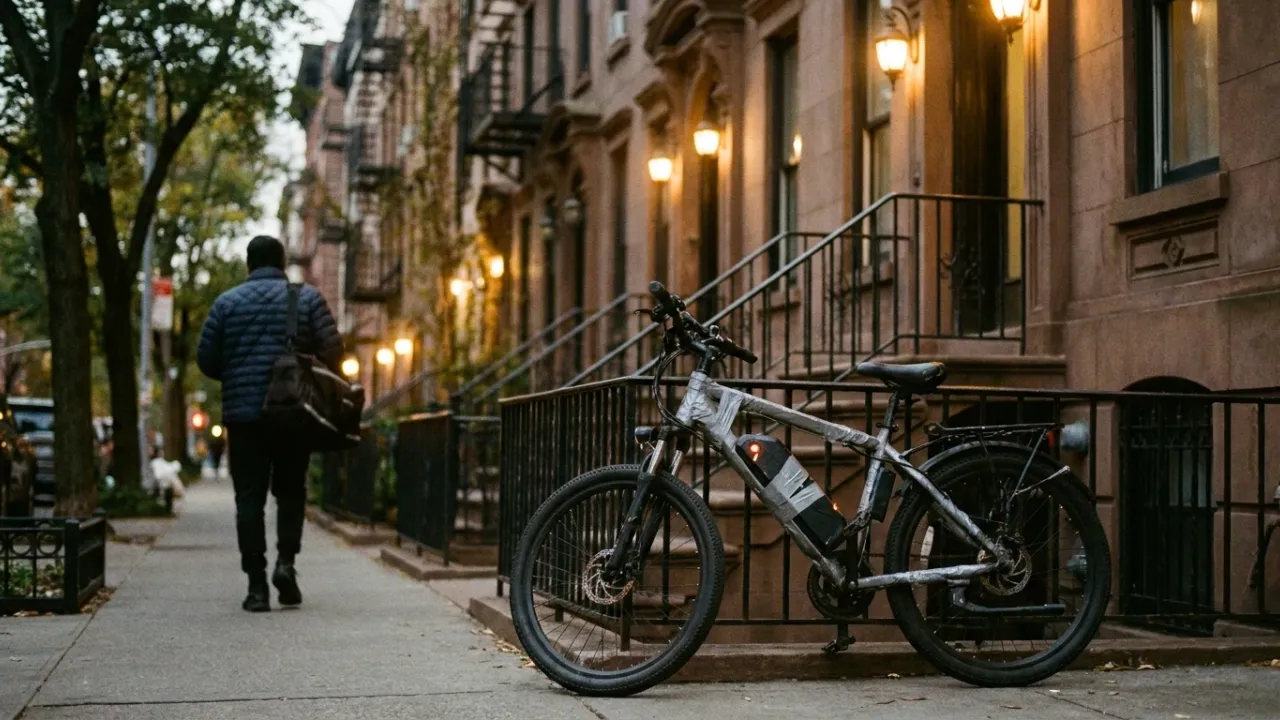
In one calendar year, New York City turned into a real-world test bench for the fire risks of lithium-ion micromobility. By the end of 2023, the FDNY had logged 268 battery fires, 150 injuries, and 18 deaths from e-bikes, e-scooters, and their packs (FDNY). So lithium-ion sat just behind smoking as the city’s second-leading cause of fire deaths. Below, we trace what one city learned in twelve months. Researchers now treat NYC 2023 as the case study that rewrote micromobility codes.
TL;DR on NYC’s 2023 battery fires
- First, 18 New Yorkers died in 268 lithium-ion battery fires across 2023 — triple the 6 deaths of 2022 on only 20% more events.
- Most fatal incidents traced back to cheap aftermarket or refurbished packs charging in delivery-rider apartments and shop fronts.
- One peer-reviewed FDNY/FSRI study clocked 13 seconds from first smoke to ignition on an overcharged e-scooter pack.
- Next, the NYC Council passed five laws in March 2023 — most importantly Local Law 39 (UL certification at point of sale) and Local Law 42 (ban on second-use packs).
- Finally, in 2024 deaths fell 67% to 6, even as the raw fire count held flat near 277.
How the battery fires trajectory got out of hand
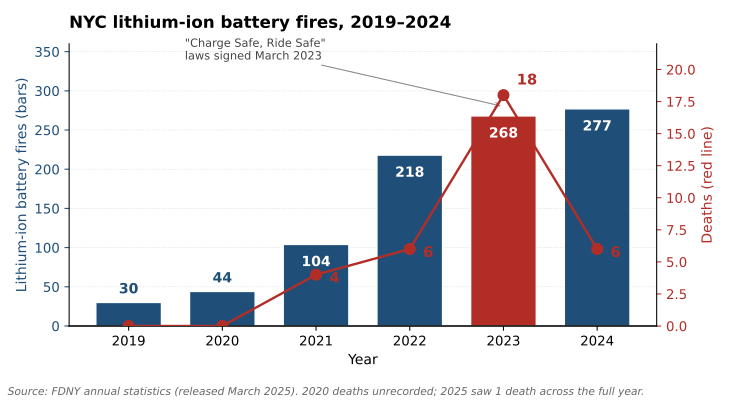
The FDNY only began counting lithium-ion battery fires in 2019 — the same year the pandemic broke open the city’s app-based food economy. Therefore, the growth curve runs almost like a textbook hazard outrunning its codes.
| Year | Li-ion fires (NYC) | Injuries | Deaths |
|---|---|---|---|
| 2019 | ~30 | 16 | 0 |
| 2020 | 44 | — | — |
| 2021 | 104 | 79 | 4 |
| 2022 | 218 | 147 | 6 |
| 2023 | 268 | 150 | 18 |
| 2024 | 277 | ~84 (Q3) | 6 |
| 2025 (full) | — | — | 1 |
Numbers come from FDNY annual statistics and the Maryland Energy Innovation Institute review.
Notice that deaths tripled in one year while fires only rose 20% (Gothamist). So the lethality of the average fire kept climbing faster than its frequency. The FDNY later traced this pattern to larger, refurbished “Frankenstein” packs charging in the same rooms where people slept.
Two fires that forced the politics
Statistics rarely move legislatures. Specific deaths do.
June 20, 2023 — 80 Madison Street, Chinatown
Just past midnight, a 3-alarm fire tore through HQ E-Bike Repair, a ground-floor shop in lower Manhattan. The blaze killed four upstairs residents — two men, ages 71 and 80, and two women, 62 and 65 — and critically hurt two more. Marshals then traced the cause to a lithium-ion pack on the first floor.
So why did this fire shift politics? Because of the inspection record. As THE CITY reported, the shop had drawn FDNY citations since 2021 for illegal cords and crowded battery storage. A May 9 surveillance check missed the basement, where dozens of bikes and packs later turned up among the debris. NYC’s new ban on refurbished packs had also taken effect on March 20, 2023. Yet before this Madison Street fire, no city inspector had written a single violation under it. The first one finally went to 80 Madison Street the day four people died there.
November 12, 2023 — Albany Avenue, Crown Heights
Five months later, just before 4:30 a.m., a fire broke out in the basement of a Crown Heights brownstone. It raced up three storeys before crews arrived in under four minutes. Three generations of one family — 81-year-old Albertha West, her 58-year-old son Michael, and 33-year-old grandson Jamiyl — died at Kings County Hospital (Gothamist). Fourteen others, including a firefighter, suffered injuries.
The cause: an e-scooter pack charging in the doorway and stairwell. FDNY Chief of Department John Hodgens described it bluntly — devices that smolder for a few seconds, then erupt into flame. Then-Commissioner Laura Kavanagh called them “ticking time bombs”. She openly blamed online retailers and food-delivery apps profiting from a workforce stuck with uncertified gear.
Why these battery fires kill in seconds
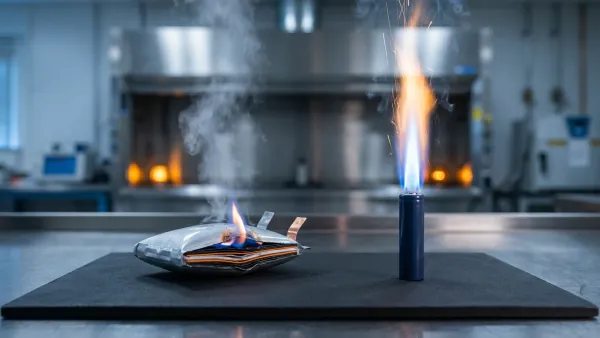
A lithium-ion cell holds a lot of chemical energy in a tiny space. So long as cell temperature, voltage, and casing stay inside spec, the cell releases that energy slowly. However, any breach of that window triggers exothermic side reactions. For instance, common breaches include an internal short, an overcharge, a drop, or a hot day. Above roughly 150 °C, those reactions then self-sustain. The cell enters thermal runaway: the electrolyte vapourises, the separator collapses, gas vents, and a jet flame often ignites. Meanwhile, internal cell temperatures during runaway reach 600 to 1000 °C.
The key fact for an occupant: cell-to-cell propagation in a multi-cell pack happens fast. For instance, an e-bike pack typically holds 40 to 80 cylindrical 18650 cells; an e-scooter pack runs even larger. Once one cell vents into its neighbours, the heat input then drives the whole pack into runaway within seconds to minutes.
The 13-second number
Researchers at UL’s Fire Safety Research Institute, UL Solutions, and the FDNY measured this hazard precisely in a 2025 Fire Technology paper. In a purpose-built single-family structure, the team overcharged a seated e-scooter pack inside a closed bedroom and timed every step.
- 13 seconds from first smoke to ignition, with a jet flame about 6 to 7 feet above the pack.
- ~20 seconds from first smoke to a battery-gas explosion that blew out the bedroom windows.
- ~30 seconds to flashover of the room.
So this hazard does not give you time to grab an extinguisher from the hallway. Yet many delivery riders park their bikes in the only doorway. So in that layout, survival comes down to roughly 30 seconds.
Toxic gases: HF, CO, and the rest
Before flames appear, a venting cell sheds a chemical cocktail. First, hydrogen fluoride (HF) comes from the breakdown of the fluorinated electrolyte salt LiPF₆. Also, carbon monoxide and CO₂ come from electrode and binder decomposition. Finally, hydrogen, methane, ethylene, and a long list of organic compounds round out the mix. Module-scale HF in confined spaces hits tens of ppm — well above acute exposure limits. However, in residential fatalities, carbon monoxide probably drives most deaths because CO accumulates in seconds while HF release runs slower.
Also, the off-gas can reach explosive concentrations before ignition (Nature Scientific Reports). So the loud “pop” survivors describe maps directly to a deflagration of vented gas inside the room.
Chemistry matters as well. Specifically, NMC (nickel-manganese-cobalt) packs carry higher energy density and dominate the cheap aftermarket. Also, they vent more gas per kWh and propagate faster. However, LFP (lithium iron phosphate) packs run heavier but stay thermally more stable. For more on this trade-off, see our LFP vs NMC battery safety deep dive. In 2023 NYC, almost everything in the delivery fleet still ran NMC, and most of it had never seen a UL lab.
Most battery fires happen with no charger plugged in
Among the FDNY’s most striking findings, released in 2024, nearly 60% of 2023 battery fires happened while no charger touched the pack. This counters intuition. So what dominates? Latent damage. A cell weakened earlier by impact, overcharge, or refurbished cells of unknown provenance can run away hours, days, or months later. A devastating May 2024 fire in NYC came from a moped pack. The FDNY said it had sat unplugged for two years before failing.
Layer in the delivery realities. One bike running multiple shifts. Hot pack swaps between rides. Mismatched chargers. Packs bought online for a fraction of OEM price. Cramped multi-occupancy storage. The size of the problem grows legible.
Charge Safe, Ride Safe: the 2023 NYC laws
On March 2, 2023, the New York City Council passed a five-bill package known publicly as “Charge Safe, Ride Safe”. Mayor Eric Adams signed it on March 20. Together with companion bills later that year, this package rewrote micromobility battery rules in the United States. Two laws carried most of the weight.
Local Law 39 of 2023 — the certification mandate. It prohibits the sale, lease, rental, or distribution of any e-bike, e-scooter, or matching pack inside city limits. The product must carry certification from an accredited testing lab to recognised UL standards. As the NYC Department of Consumer and Worker Protection summarises:
- E-bikes must comply with UL 2849.
- E-scooters and other personal e-mobility devices must comply with UL 2272.
- Packs themselves must comply with UL 2271.
The law took effect September 16, 2023, with civil penalties up to $1,000 per device type for first offences. New York became the first U.S. city to make UL certification a condition of sale for an entire vehicle class.
Local Law 42 of 2023 — the ban on second-use cells. It now stands as unlawful to assemble, recondition, sell, or offer for sale a pack built from second-use cells. Fire investigators call these “Frankenstein” packs. This single class of product caused most of the worst battery fires of 2023: cells of unknown age, often hand-welded together with no working BMS. Local Law 42 took effect March 20, 2023.
The supporting laws filled in the edges. Local Law 38 directed FDNY to run a public-information campaign in ten languages. Annual reporting on lithium-ion fires now happens under Local Law 40. Food-delivery apps must include battery safety in worker information packets under Local Law 41. A trade-in program under Local Law 131 lets delivery riders swap uncertified gear for compliant gear at low or no cost.
Then in 2024, the city added teeth. Local Laws 49 and 50 of 2024 gave FDNY concurrent enforcement powers and the right to padlock retailers that repeatedly sell uncertified product.
What UL 2271, 2272, and 2849 actually test
The whole regulatory edifice — local, federal, and increasingly international — sits on these three standards. So a quick translation matters.
UL 2271 — Batteries for Light Electric Vehicles. First, this standard evaluates the pack as a system of cells, BMS, casing, and connectors. The protocol then covers overcharge, forced discharge, external short, temperature cycling, vibration, shock, drop, projectile, crush, and propagation testing. Pass criteria: no fire, no explosion, no rupture that exposes a hazardous voltage. Also, SGS labs note that NYC mandates this standard for any LEV pack with no alternatives.
UL 2849 — Electrical Systems for E-Bikes. UL published the current binational version on June 17, 2022. The standard treats the e-bike as a single integrated system: pack, charger, motor controller, motor, wiring, and rider interface. It first requires the pack to comply with UL 2271 (or equivalent). Then it evaluates the combined system for fire and shock under realistic charging and riding. The reason UL 2849 matters: a fine cell married to a mismatched charger can still ruin a flat. UL 2271 alone would never catch that.
UL 2272 — Personal E-Mobility Devices. Initially written for hoverboards after the 2015–16 fire wave, this standard now applies to e-scooters and similar gear. Similarly to UL 2849, it covers the full electrical drive system. It also adds class-specific tests, including a drop test to simulate ordinary user mishandling.
In practice, a UL-certified product means an OSHA-recognised Nationally Recognized Testing Laboratory has put a sample through a defined abuse regime. The same lab can run factory inspections to verify ongoing conformity. The 2023 NYC crisis did not happen because these standards did not exist. They did. The gap: nothing required the seller of a $250 Amazon pack to have met them.
The federal and international response
NYC’s actions hit like a cymbal crash. Washington had moved more slowly toward the same beat.
CPSC, December 2022. The U.S. Consumer Product Safety Commission sent a letter to more than 2,000 manufacturers, importers, and retailers urging compliance with UL 2849 and UL 2272. The agency flagged 208 micromobility incidents across 39 states and 19 deaths from January 2021 through November 2022.
H.R. 1797 — Setting Consumer Standards for Lithium-Ion Batteries Act. Bronx Representative Ritchie Torres introduced this bill on March 24, 2023. It directs the CPSC to set a mandatory federal standard within one year of enactment. The House passed it 378–34 on May 15, 2024. However, the Senate stripped it from a December 2024 funding package. As of writing, no federal mandatory standard for micromobility packs exists.
Other U.S. and Canadian moves. First, California adopted a UL 2849 / EN 15194 mandate in October 2023. Then Toronto followed in April 2024. Also, the 2024 International Fire Code folded in micromobility provisions referencing UL 2272 and UL 2849, plus new in-building storage and charging limits.
United Kingdom. London faced the same crisis on a slightly different timeline. London Fire Brigade logged 143 e-bike fires and 36 e-scooter fires in 2023 — one every two days. The toll: 3 deaths and roughly 60 injuries. National numbers: 11 deaths in 2023, the worst calendar year on record. Of London’s first-half-2023 fires, at least 40% involved a converted bike. At least 77% involved a pack failure — almost always cheap online packs that never met UK safety rules.
European Union. Regulation (EU) 2023/1542 entered into force on August 17, 2023. It replaces the 2006 Batteries Directive with a directly enforceable rule covering the whole pack life cycle. The text carves out a “Light Means of Transport” category for e-bikes and e-scooters. Performance and durability requirements took effect in August 2024. A digital battery passport will arrive in February 2027. The regulation primarily targets sustainability — recycled content, carbon footprint, cobalt due diligence. Yet its safety and serviceability rules also close many of the gaps NYC 2023 exposed.
Did the laws work? The 2024–2025 numbers
By any reasonable measure, the answer reads as yes, partially, and with caveats.
The FDNY’s March 2025 report on calendar year 2024 told a striking story:
- Lithium-ion battery fires in 2024: 277 — almost identical to 2023.
- Deaths in 2024: 6 — down from 18 in 2023, a 67% reduction.
- Injuries through September 30: down to roughly 84 from 114 in the same period of 2023 — a trend ULSE links directly to Local Law 39.
- Non-structural fires: 133 in 2024 vs. 90 in 2023 — so a much larger share now happens outdoors, where people do not sleep nearby.
- In 2025, FDNY Commissioner Lillian Bonsignore reported only one lithium-ion death in the entire calendar year (PIX11).
The FDNY refuses to overclaim. Fires did not stop; deaths did plummet. The layered package changed where and how New Yorkers charge. First, Local Law 39 throttled the legal supply of uncertified gear. Then Local Law 42 banned the worst refurbished packs. Meanwhile, Local Laws 49 and 50 let FDNY padlock chronic violators. The trade-in program also reached delivery riders directly. A steady drumbeat told everyone to charge outside, never overnight, never in the hallway. Yet none of that changed whether the packs themselves still failed.
By March 2025, the FDNY E-Safety Task Force had run 983 inspections, written 782 summonses (including 77 criminal), and obtained 20 vacate orders. DCWP had also performed more than 650 brick-and-mortar inspections since Local Law 39 took effect.
Yet caveats temper any victory lap. The first death of 2024 came on February 23. Twenty-seven-year-old data journalist Fazil Khan died in a Hamilton Heights apartment fire that started in a third-floor unit. Six delivery riders shared that unit. As THE CITY reported, tenants had filed 311 complaints about e-bikes charging in the building. The 311 line routed those complaints to the Department of Transportation, not enforcement. Khan died after warnings the system never acted on.
In Q1 2025, FDNY also reported a 53% jump in structural lithium-ion fires over 2024. The residual battery fires now concentrate inside homes where uncertified packs already entered service before the law. London’s experience tracks: 2025 shaped up as the city’s worst year on record, with 165 incidents through late September.
A black market in uncertified packs also persists. As City & State New York reported, buyers can still source uncertified gear online or in neighbouring counties. UL-certified packs can cost up to 18, who may need multiple packs per shift. The economics that produced the 2023 wave still partly operate.
Lessons from NYC battery fires for fire-safety practice
Several conclusions follow directly from the NYC data, and they generalise far beyond the five boroughs.
1. Pre-market certification works upstream of the fire. A 67% drop in deaths during a year of flat fire counts ranks as a striking natural experiment. The result reads as the clearest evidence we have on UL 2849/2271/2272 as a public-safety lever.
2. Pack-only certification fills only half the gap. Madison Street’s basement likely held packs that on paper had once met spec. Mismatched chargers, modified electronics, second-use cells, and damaged packs defeat any cell-level qualification. So system-level UL 2849 testing and Local Law 42-style refurbished-pack bans need to ride together.
3. The hazard window runs in seconds, not minutes. FSRI’s 13-second-to-ignition number belongs on the wall of every code-writing committee and every architect drawing residential layouts. Charging stations cannot sit in egress paths. They cannot share a room with sleeping occupants. The “charge outside” message rests on physics, not PR.
4. CO probably matters more than HF in residential fatalities. HF makes the dramatic headline. However, the CO time constant runs in seconds while HF release lasts tens of minutes. For occupant-survivability modelling and for code-mandated detection, CO sensors deserve the same weight as smoke alarms.
5. Online marketplaces remain the loophole. Brick-and-mortar inspections caught the most flagrant 2023 offenders. However, the bulk of substandard product still arrives by parcel. Both London and New York have asked their national governments to close this loophole. As of mid-2026, neither has.
6. Equity sits inside fire safety. The riders most exposed to battery fires also have the least money for safe alternatives. Trade-in programs, certified-gear subsidies, and worker-protective rules on gig fleets do not sit next to fire policy. They form the operational version of it.
For the broader risk-framing math behind this kind of call, see our F-N curve and societal risk primer. Likewise, the underlying chemistry sits in our lithium-ion battery basics explainer. Also, our take on EV vs gas car fires explains why “EV fires” and “e-bike battery fires” do not share an exposure profile.
The honest summary
In short, NYC’s 2023 battery fires gave the world a one-city, one-year natural experiment on micromobility battery safety. Hardware physics had not changed. Yet the codes did. So did the death toll. Eighteen New Yorkers paid the cost of that knowledge. The honour we owe them: not letting any other city learn the same way.
Cite this article
Dinh, D. C. (2026, May 23). NYC's 2023 Battery Fires: 268 Incidents, 18 Deaths. PyroRisk. https://pyrorisk.net/blog/nyc-2023-battery-fires-268-incidents-18-deaths/
Recent posts
Featured posts
Categories
Comments
Related posts
Are EV Fires Really More Common Than Gas Car Fires?
Across U.S., Swedish, Australian, Norwegian and Polish data, EV fires happen 20 to 80 times less often than gas car fires per registered vehicle.
LFP vs NMC Battery Safety: Why Chemistry Decides Fire Risk
LFP vs NMC battery chemistry sets the fire risk before any vent opens. Here is why one chemistry burns hotter, vents more gas, and explodes more often.
Why a LiPo Battery Is Really a Lithium-Ion Battery
A LiPo battery is a lithium-ion battery. The polymer only names the gel and pouch. Here is why that matters for fire safety.