LFP vs NMC Battery Safety: Why Chemistry Decides Fire Risk
LFP vs NMC battery chemistry sets the fire risk before any vent opens. Here is why one chemistry burns hotter, vents more gas, and explodes more often.
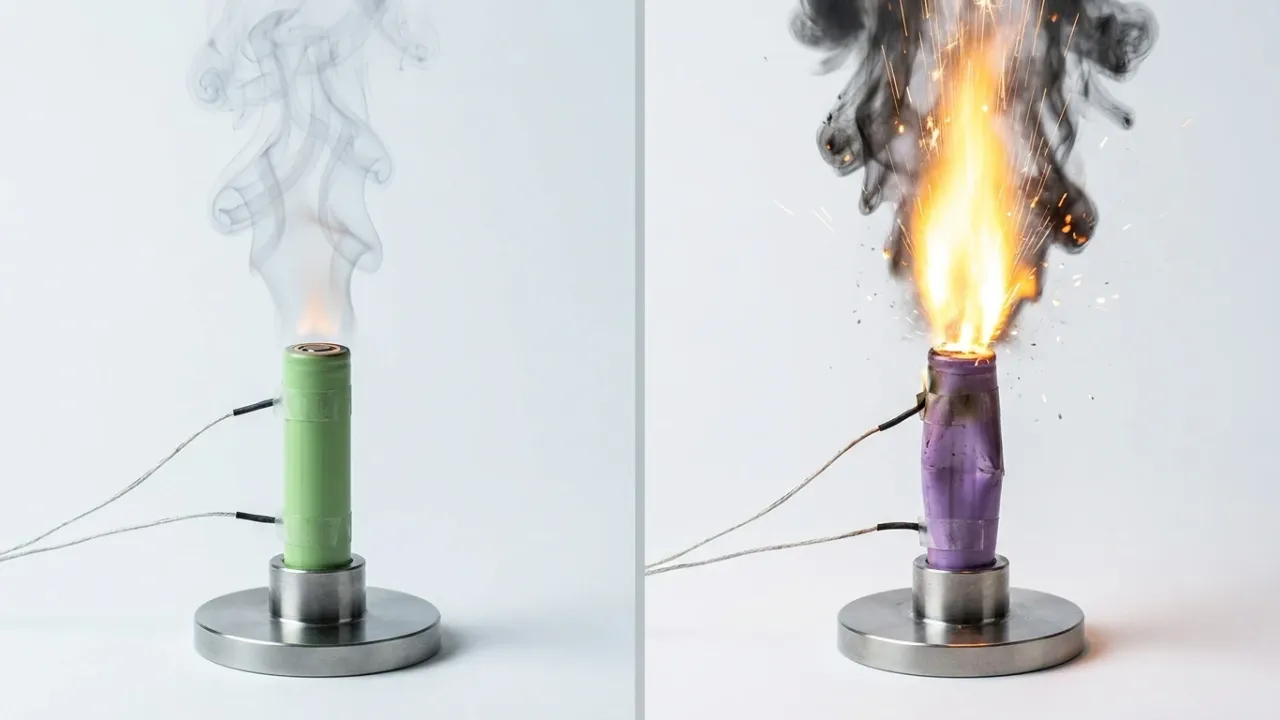
A lithium iron phosphate cell vents. A high-nickel NMC cell often explodes. Yet the split looks small on paper, and fire data still tells a clear story. So this post breaks down LFP vs NMC chemistry for fire safety teams.
First, the bond strength sets the gap. The P–O bond in LFP holds tight under heat. However, the metal–oxygen bond in NMC gives way much sooner. Therefore, one cathode keeps its oxygen locked. Meanwhile, the other lets it loose at 140 °C.
That single fact drives every number you will read below.
TL;DR
- LFP’s olivine cathode locks its oxygen inside a strong (PO₄)³⁻ cage; NMC’s layered oxide starts releasing oxygen at just 140 °C.
- In Golubkov’s 2014 adiabatic tests, LFP peaked at 404 °C with no distinct runaway trigger; NMC hit 678 °C and an LCO/NMC blend hit 853 °C.
- LFP cells absorb roughly 3x more external heat per Wh before failing than NMC (0.9–1.1 kJ/Wh vs 0.31 kJ/Wh).
- NMC keeps an energy-density edge, reaching up to 300 Wh/kg versus LFP’s 90–160 Wh/kg.
- About 85% of new grid storage (BESS) now runs LFP, versus a projected 1% NMC share by 2030.
- The January 2025 Moss Landing fire (LG NMC cells) destroyed 55% of 100,000 batteries onsite; no LFP fire has matched that scale.
LFP vs NMC: two crystals, two safety paths
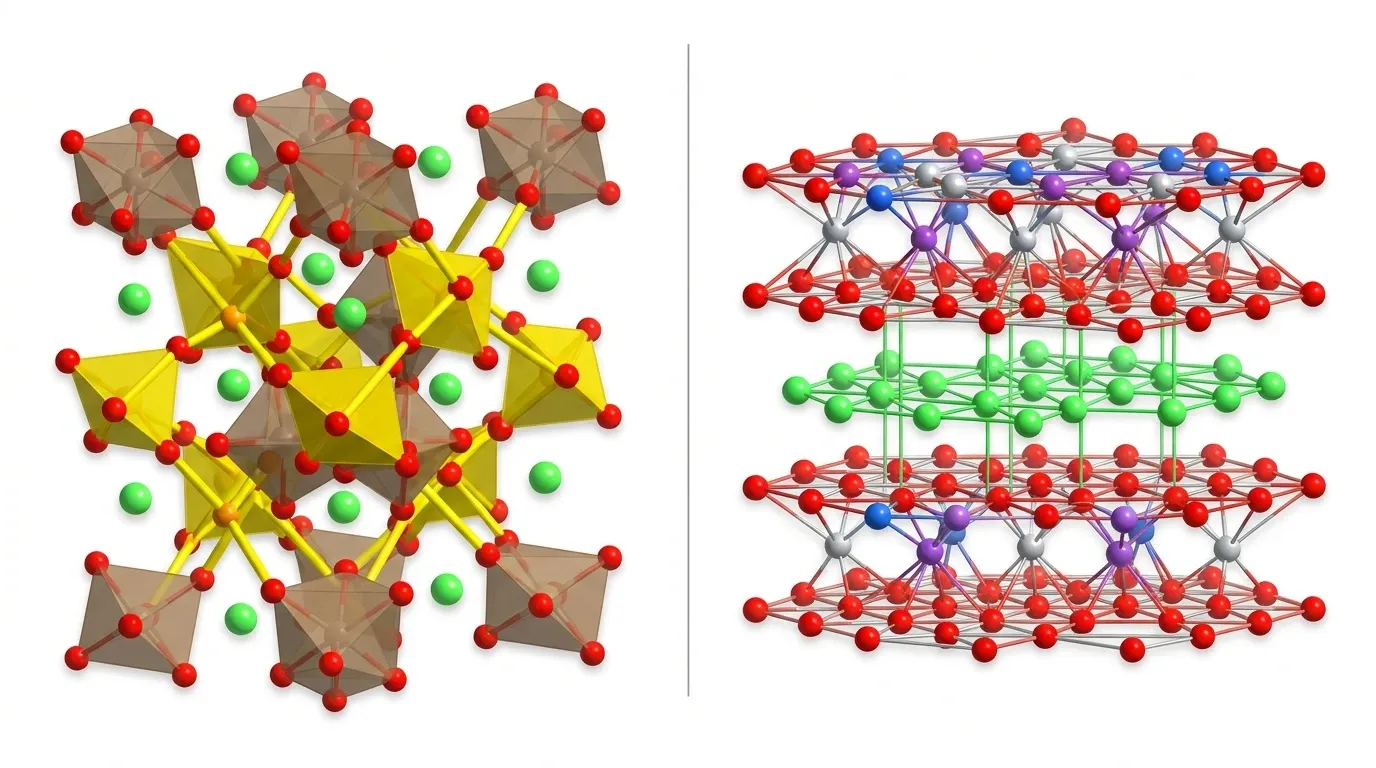
The LFP vs NMC split is not just a tweak on the same recipe. They form two different crystal families. So the safety story starts with the lattice, not the cell.
LFP uses an olivine frame. Goodenough’s team at UT Austin first showed it in 1997. Each oxygen sits inside a strong (PO₄)³⁻ cage. Furthermore, the iron sites link only through this cage. As a result, no Fe–O–Fe path can dump oxygen.
NMC, in contrast, uses a layered oxide. Lithium fills one set of slots. Next, nickel, manganese, and cobalt fill the alternate layer. As nickel rises, those layers weaken on charge. Then, at full charge, the lattice starts to give up oxygen at low temperature.
A famous Brookhaven study confirmed it. The team tracked NMC811 with in-situ XRD/MS. They saw layered-to-spinel slip near 150 °C. They also saw oxygen leave the lattice as low as 140 °C. In contrast, LFP stays put through the same heat ramp. For the wider chemistry context, see our lithium-ion battery basics primer.
Energy density: where NMC still wins
The same rigid frame that keeps LFP safe also caps its energy. The olivine lattice packs less tightly than a layered oxide. In addition, LFP runs at 3.2 V at the cell level. NMC sits closer to 3.6 V.
| Parameter | LFP | NMC (typical) | NMC (high-Ni) |
|---|---|---|---|
| Practical capacity | 120–160 mAh/g | 160–180 mAh/g | up to 200 mAh/g |
| Cell voltage | 3.2 V | 3.6 V | 3.7 V |
| Gravimetric energy | 90–160 Wh/kg | 150–220 Wh/kg | up to 300 Wh/kg |
| Volumetric energy | 227–396 Wh/L | 500–700 Wh/L | up to 760 Wh/L |
CATL’s 2024 LFP cells now hit 205 Wh/kg. Similarly, the BYD Blade 2.0 LMFP pack reaches 190–210 Wh/kg. So the gravimetric gap keeps shrinking. However, the volumetric gap will stay. It comes from crystal density itself. For example, CATL’s Qilin pack hits 255 Wh/kg in NMC form while the LFP version reaches just 160 Wh/kg in the same shell.
Thermal runaway: the LFP vs NMC numbers that matter
Fire engineers measure thermal runaway with three points. T1 marks the self-heating onset. T2 marks the trigger. T3 marks the peak. Feng’s 2019 review in Applied Energy set the modern definitions.
The most cited dataset comes from Golubkov et al. in 2014. They drove 18650 cells at full charge into adiabatic ramps. Their numbers settled the LFP vs NMC debate:
| Cell | T1 (°C) | T2 (°C) | T3 max (°C) | Vent gas (mmol) |
|---|---|---|---|---|
| LCO/NMC blend | 149 | 208 | 853 | 265 |
| NMC | 168 | 223 | 678 | 149 |
| LFP | 195 | none | 404 | 50 |
So the LFP cell starts to heat later. It reaches a far lower peak. It also emits five times less gas.
Moreover, recent ARC tests on car-size cells push the LFP vs NMC gap even further. A 107 Ah LFP cell against a 129 Ah high-nickel NMC cell gave T3 of 491 °C versus 1,000 °C. The LFP cell also gave 8,600 seconds of warning. By contrast, the NMC cell gave just 256 seconds. That delivers a 33× safety margin for the BMS.
State of charge swings the gap further still. An LFP power cell jumps from 1.8 °C/min at 25% SOC to 953 °C/min at 100% SOC. So shipping rules near 30% SOC really do save lives.
Inside the NMC family, more nickel means less stability. For instance, NMC811 lets oxygen go at 140–150 °C. NMC622 holds out to 200 °C. Meanwhile, NMC111 and 532 stay stable past 250 °C. So the move from NMC532 to NMC811 over five years has raised the bar for every battery management system.
Decomposition chain: why each cell fails at its own pace
Thermal runaway runs as a chain, not one event. Each step has its own kinetics. The widely cited Feng review in Energy Storage Materials lays it out:
- 80–120 °C: SEI layer falls apart. The graphite then sees the raw electrolyte.
- 130–165 °C: PE/PP separator melts. An internal short can follow.
- 150–215 °C: High-Ni NMC dumps lattice oxygen. The slip from layered to spinel begins.
- >200 °C: Free oxygen attacks the hot solvent. LiPF₆ breaks down to PF₅, then HF.
- 250–275 °C: Low-Ni NMC and LFP reach onset. LFP keeps its frame. NMC runs away.
A subtler insight comes from a 2018 Joule paper. For NMC811, free cathode oxygen can reach the anode before the separator collapses. So chemical crosstalk, not the short alone, can fire the cascade. That fact resets the old playbook for high-Ni cells.
LFP vs NMC heat release and the HF gas catch
Cone calorimetry tells a sharp LFP vs NMC story. For example, at full charge, an LFP cell gives off about 60% less heat per cell than an NMC cell. The Ditch et al. CSBC dataset shows 13.7 kJ/cell for LFP. By contrast, NMC gives 34.0 kJ/cell, and LCO gives 37.3 kJ/cell. For a primer on this method, see our cone calorimeter explainer.
NIST values per Wh tell the same story. LFP cells take 0.9–1.1 kJ/Wh of outside heat to fail. NMC cells fail at 0.31 kJ/Wh. So LFP needs roughly three times the heat input per Wh.
A counter-point: LFP can still release a lot of HF gas. Larsson et al. found 20–200 mg of HF per Wh across seven cell types. LFP pouches sat at the high end. The reason proves simple: more electrolyte burns before the cell hits its lower peak. POF₃ adds another 15–22 mg/Wh.
The vent gas itself differs by chemistry. In Golubkov’s dataset, LFP gas had ~41% H₂ and ~27% CO₂. CO sat at just 4%. NMC gas reached 13% CO. The blend reached 28% CO. So LFP gives a less toxic mix per gram of vent.
However, a reanalysis by Shen et al. ranked LFP vent gas as the most explosive per unit volume. The high H₂ fraction lowers the lower flammability limit. So poor venting in a closed BESS room can still bite. The simple “LFP always wins” line needs that caveat.
Under nail penetration, the gap looks stark. An LFP cell at 50% SOC reached just 40 °C. NMC622 reached 89.4 °C. LCO reached 81.1 °C. In dual-heat-source module tests, every NMC module caught fire. Every LFP module merely vented liquid.
Why phones use NMC and grid storage uses LFP
The market split lines up with chemistry. Each segment trades safety against density and cost.
Phones need the highest volumetric density. The cell still sits inside a tight shell. So most phones run LCO. Laptops and power tools, in particular, mix in NMC. Yet LFP simply cannot fit in a phone.
EVs split along range and price. For instance, premium long-range cars run NMC or NCA. Standard-range and value cars instead run LFP. Tesla told the SEC in 2022 that nearly half of its Q1 cars used LFP. BYD now runs LFP across its entire line. Specifically, the new BYD Blade 2.0 charges from 10 to 97% in 9 minutes. CATL’s third-gen Shenxing LFP charges 10–80% in under 4 minutes. So fast charging no longer remains an NMC monopoly.
Grid storage has also fully shifted. For example, BloombergNEF projects only 1% NMC share for new BESS by 2030. LFP holds about 85% of stationary storage today. Tesla moved Megapack production to CATL LFP cells around 2021. Then in 2025, Tesla also signed a $4 billion LFP deal with LG. CATL LFP cells now ship with 6,000-cycle warranties. NMC packs, by contrast, sit at 1,000–2,300 cycles. Add the 30% cost edge, and no one picks NMC for new BESS today.
What the standards now say about LFP vs NMC
UL 9540A acts as the consensus method for fire propagation in BESS. The standard runs through four levels: cell, module, unit, and installation. Each level only fires if the one below it propagates. Today, modern LFP cells often pass at the cell level. However, NMC and NCA cells almost always escalate.
A 2024 study in ACS Energy Letters tested NMC and LFP cells side by side at 100% SOC. The NMC modules all caught fire and propagated. Many LFP samples never flamed. The same paper warned that hazards do not scale linearly from cell to module. So cell-only data alone can mislead BESS designers.
UN 38.3 still applies to all chemistries the same way. However, NMC cells run closer to their thermal limit during T.2 and T.7. So failures in transport skew toward higher-energy cells. China’s new GB 38031-2025 demands “no fire, no explosion” for two hours after thermal runaway. CATL’s Qilin became the first cell to pass it in April 2025.
Insurers tracked the same trend. Lockton’s 2024 review finds that NMC now rarely shows up on new projects. About 80% of utility BESS now runs LFP. DNV’s 2024 Battery Scorecard calls LFP the chemistry of choice for stationary storage.
Moss Landing and the LFP vs NMC failure record
The strongest case for LFP comes from the field. On January 16, 2025, Vistra’s Moss Landing 300 MW/1,200 MWh facility caught fire. The fire destroyed 55% of the 100,000 batteries onsite. Local officials evacuated 1,200 to 1,500 residents.
The chemistry came from LG NMC. Specifically, the pack design used a 1950s PG&E turbine hall, not modular containers. So the design lost the compartments that modern UL 9540A layouts rely on. Soil tests later showed cobalt, nickel, copper, and manganese above limits. Such metals come with NMC by design. Yet an LFP system cannot leave that signature.
The Moss Landing event was not unique. For example, the 2019 APS McMicken explosion used LG NMC pouches, and eight firefighters and one police officer ended up in hospital. Likewise, the 2024 Gateway Energy Storage fire in San Diego used 14,796 LG NMC cells and burned for five days. In short, the major fires all share a chemistry.
EPRI’s BESS Failure Incident Database shows a 97–98% drop in fire rate from 2018 to 2024. Two trends drive that drop. First, NFPA 855 and UL 9540A took hold. Second, the industry switched to LFP. LFP fires do happen. Yet none has matched the scale or duration of the major NMC events.
The trade-offs LFP does not escape
LFP brings no free lunch. For instance, cold weather hits it hard. Cells lose 20–30% of usable capacity between 0 and 10 °C. Below –20 °C, they lose up to 50%. Furthermore, charging below 0 °C plates lithium metal, and that metal can later short the cell.
The flat voltage curve also confuses the BMS. As a result, SOC estimation drifts. Packs need a full charge often to recalibrate. So poor pack design can drive cell imbalance. Likewise, sustained high-power output in cold weather still favours NMC.
For aerospace and satellites, NMC and NCA still rule. Mass and volume drive every kilogram up there. NASA’s Fractional Thermal Runaway Calorimeter program keeps testing them precisely because lighter alternatives do not yet exist.
What LFP vs NMC means for fire safety engineers
For two decades, “lithium-ion battery” looked like one hazard class. However, the data above kills that view. The 200 °C gap in oxide breakdown onset matters. A second 600 °C gap in peak runaway matters too. Likewise, the 3:1 gap in heat release matters. In short, these gaps are categorical, not incremental.
So a 1,200 MWh LFP plant cannot fail like Moss Landing. Its cathode lacks the oxygen path that fed the chain. That gives the LFP vs NMC bottom line for siting and design.
For risk assessments under NFPA 855, treat LFP and NMC as two hazards. Use chemistry-specific propagation kinetics. Use chemistry-specific gas profiles. Pick suppression systems to match. Insurance underwriting and standoff distances should follow the same logic.
LMFP, sodium-ion, and solid-state cells all sit on the horizon. CATL’s Naxtra sodium-ion already runs from –40 to +70 °C with 10,000+ cycles. So the discipline of testing each chemistry on its own terms only grows in value. The shift to LFP is no fashion. It marks fire engineering reading the data.
Cite this article
Dinh, D. C. (2026, May 2). LFP vs NMC Battery Safety: Why Chemistry Decides Fire Risk. PyroRisk. https://pyrorisk.net/blog/lfp-vs-nmc-battery-safety/
Recent posts
Featured posts
Categories
Comments
Related posts

Why a LiPo Battery Is Really a Lithium-Ion Battery
A LiPo battery is a lithium-ion battery. The polymer only names the gel and pouch. Here is why that matters for fire safety.
Are EV Fires Really More Common Than Gas Car Fires?
Across U.S., Swedish, Australian, Norwegian and Polish data, EV fires happen 20 to 80 times less often than gas car fires per registered vehicle.
Lithium-Ion Battery Basics: How They Work and Why They Burn
What a lithium-ion battery is, how the 'rocking chair' of ions works, and why this Nobel-winning chemistry also carries real fire risk.