Stack Effect: Why Stairwell Pressurization Fails in Winter
On the coldest night of the year, stack effect can reverse a stairwell pressurization system and pull smoke into the stairs occupants flee through.
A stairwell pressurization fan that passes its acceptance test in July can still fail on the coldest night of January. The reason: stack effect, the simple physics of warm air rising inside a tall, heated building. So a smoke-control system sized for a mild morning can quietly invert when a polar vortex arrives. This post walks through the physics, the US and European code frameworks, the fires that proved the point, and the design moves that survive a real winter.
TL;DR on stack effect and pressurization
- First, stack effect scales with the indoor-outdoor temperature gap, so winter pressures run 3 to 5 times higher than summer.
- In a 30-story building at −18 °C, total envelope stack pressure can reach ~180 Pa — far above the 12.5 to 25 Pa a fan holds across a stair door.
- Below the neutral plane, stack pressure adds to the fan and can jam doors shut past the 133 N opening-force limit.
- Above the neutral plane, stack pressure fights the fan and can reverse the door pressure, so smoke seeps into the stair.
- Field measurements in 15 US high-rises confirmed both failure modes, and four landmark fires — MGM Grand, First Interstate, Cook County, Plasco — show the same chimney behaviour.
- Finally, the fixes exist: multi-point injection, modulating fans, vestibules, shaft compartmentation, and winter commissioning.
A tale of two calculations
Picture a consulting engineer in Atlanta sizing the stair pressurization fan for a new 30-story tower. It happens in July. So the acceptance test runs on a mild 22 °C morning. The fan delivers a textbook 25 Pa across every stair door, all twelve open doors stay under the 133 N force limit, and the system passes NFPA 92. Sign-off, occupancy, move-in.
Six months later the same building sits under a polar vortex. Outside reads −18 °C while inside holds +21 °C. Then a trash-room fire starts on the 4th floor. The fan then kicks on as designed. Yet on the 28th floor, smoke seeps around the stair door from the corridor. On the 2nd floor, a fleeing tenant cannot haul the door open against what feels like a sealed vault. The fan still runs. However, the physics has changed.
This is the pressurization paradox. A system whose design chases one static pressure target can flip on the coldest day of the year. Stack effect plays the villain here. Despite its age — Wilson and Tamura at Canada’s National Research Council described it quantitatively in 1968 — it stays a stubborn blind spot in real commissioning.
What is stack effect?
Stack effect is the pressure difference that builds across a building envelope because warm indoor air weighs less than cold outdoor air. In a heated tower wrapped in winter air, the inside column of air weighs less per unit height than the matching outdoor column. So the pressure difference across the wall grows with height, and the whole building behaves like a chimney.
The driving equation
For a shaft at uniform temperature, the classic form reads:
Here and mean outdoor and indoor air densities in kg/m³, m/s², and means the vertical distance from the neutral pressure plane. Substituting the ideal-gas relation and standard atmospheric pressure gives the engineering form used in the ASHRAE Handbook of Smoke Control Engineering:
The result comes out in pascals, with in kelvin and in metres. A handy rule: in cold climates, stack effect makes about 4 Pa across each floor of a tall building. For a 30-story building (≈ 100 m) at −18 °C outside and +21 °C inside, the total comes to:
That figure represents the total envelope pressure, spread about the neutral plane. It dwarfs the 12.5 to 25 Pa that NFPA 92 asks the fan to hold across a stair door.
The neutral pressure plane
Specifically, the neutral pressure plane (NPP) marks the height where inside and outside pressures match. Below it in winter, outdoor pressure wins and air leaks inward. Above it, inside pressure wins and air leaks outward. With evenly spread leakage, the NPP sits near mid-height. However, leaky lobbies, tight upper floors, and open service shafts can shove it up or down. Wilson and Tamura showed that a 183 m building at a 56 K gap holds about 500 Pa of total stack pressure. Of that, a leaky entrance lobby alone can soak up 200 Pa — enough to make the front doors nearly impossible to budge.
Why winter beats summer every time
Winter wins because the indoor-outdoor temperature gap runs far larger than in summer. Summer produces a reverse stack effect: the cooled interior sits below the outdoor temperature. Yet the summer gap stays small, often 5 to 15 K, with a 24 °C interior against 30 to 38 °C outside. Winter gaps reach 30 to 50 K. Because stack pressure scales with that gap, winter pressures run 3 to 5 times larger. Worse, winter stack pushes smoke upward — the same way occupants climb to flee a lower-floor fire.
What should stairwell pressurization do?
Stairwell pressurization should hold the stair shaft above the corridor pressure at every floor, so leakage flows outward through the door cracks and smoke stays out. Two equations govern the design. The first is the density relation above. The second is the orifice equation for flow through the leakage gap around each door:
Here for a typical door perimeter gap and means the effective leakage area. Overall, the fan must supply enough air to feed every gap while holding the target pressure.
NFPA 92 and the IBC set the floor and the ceiling. On the low side, sprinklered buildings need 12.5 Pa (0.05 in. w.g.) across a smoke barrier; non-sprinklered ones need 25 Pa. On the high side, the IBC caps the stair-to-building difference at 87 Pa (0.35 in. w.g.). That ceiling comes not from smoke physics but from people. The IBC ties pressure to door-opening force through:
In this equation means the self-closer force, the door width, the door area, and the knob-to-edge distance. For a standard 3 × 7 ft door with a 10 lbf closer, 87 Pa produces roughly 133 N (30 lbf) of opening force. Above that, a child, an elderly tenant, or someone carrying a load cannot open the door.
NFPA 92 does say the target must hold “under maximum anticipated conditions of stack effect and wind effect.” In practice, though, many designers plug in one winter temperature — often a mild one — and so under-build for the worst night.
How does the paradox unfold in winter?
The paradox unfolds as two simultaneous failures at opposite ends of the building, with jammed doors below the neutral plane and smoke ingress above it. In a uniformly leaky building with the NPP at mid-height, winter stack effect breaks a running fan in both directions at once.
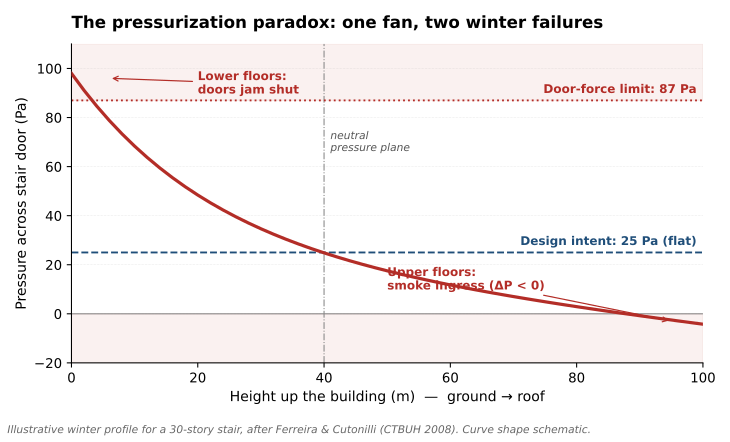
Lower floors, below the NPP. Here stack pressure pushes the same way as the fan, namely stair to building. So the two pile up together. On the bottom floor of a 30-story tower at a 39 K gap, stack can add ~60 to 70 Pa on top of the 25 Pa fan target, sailing past the 87 Pa force limit. The result: occupants cannot open the door.
Upper floors, above the NPP. Here, in contrast, stack pressure fights the fan. The stair tends to sit below the warm interior pressure. If the fan cannot win, the door pressure reverses. The result: smoke from a corridor fire slips into the stair.
Ferreira and Cutonilli (2008) modelled exactly this for a 30-story building at −14 °C. With a plain, non-compensated fan, the stair-to-building pressure at the top fell to −2.5 Pa. Thus the differential had reversed. Meanwhile, the door force at the bottom blew past the limit. The fan ran the whole time. It simply failed at both ends.
Field evidence from real winters
The deepest recent field study comes from Strege and Ferreira (2017) in Fire Technology. The Jensen Hughes team measured door pressures in 15 high-rises across Cleveland, Baltimore, Minneapolis, and Philadelphia during January to March 2013. Buildings ran 44 to 150 m tall; outdoor air ranged −12 °C to +15 °C.
Their numbers tell the story:
| Location in shaft | Measured differential | Airflow direction |
|---|---|---|
| Lower floors | −2.7 to −24.9 Pa (avg −12.0 Pa) | Into the shafts from the building |
| Upper floors (13 of 15 buildings) | +0.5 to +34.9 Pa (avg +11.2 Pa) | Out of the shafts into the building |
Also, two of the buildings already ran stair pressurization. Strikingly, the team found that turning the stair fan on could increase vertical air movement through unprotected elevator shafts. In other words, the fan could worsen smoke spread by piling onto the stack-driven pressure. They also warned that “simplified algebraic calculations may underpredict” the real differentials, and urged multi-zone or CFD analysis instead.
The lesson for practitioners runs blunt. A hand calculation that ignores leakage, HVAC, and wind hands you optimistic numbers. So real winter weather can beat the design target.
When smoke found the stairs
History keeps proving the point. Four fires across four decades show what a vertical shaft does when cold weather turns it into a chimney.
MGM Grand, Las Vegas, 1980. A first-floor fire killed 85 people in this 26-story hotel. Yet most victims — 61 of 85 — died on the 19th through 26th floors, as far from the flames as possible. NFPA tied those upper-floor deaths to smoke riding elevator shafts, stairwells, and unsealed seismic joints, driven by stack effect. The hotel had no stair pressurization, and the HVAC system kept circulating smoke until its plastic tubing melted. So the MGM Grand became the textbook reason U.S. high-rises now require pressurized stairs and sealed shafts.
First Interstate Bank, Los Angeles, 1988. Fire gutted five floors of a 62-story tower mid-way through a sprinkler retrofit. Crews arriving on the fire floor found smoke entering all four stair shafts around the doors. When they opened doors to fight the fire, heat and smoke poured into the stairs and rose fast. Observers saw smoke leaking from the elevator shaft at the 42nd floor — 30 floors above the fire. Stack effect carried it there.
Cook County Administration Building, Chicago, 2003. A 12th-floor fire in this 35-story building killed six people in a stairwell. The smokeproof design leaned on smoke louvers that, through maintenance and code lapses, never vented properly. When crews opened the stair door, smoke entered and climbed; doors above stayed locked. NIST later found the six most likely would have survived if the louvers had worked as intended. Although those stairs relied on venting rather than pressurization, the lesson holds: a shaft scheme that hangs on one mechanical element fails occupants when that element does.
Plasco Building, Tehran, 2017. A fire in this 17-story tower spread up the single stair shaft to the 15th storey without significant horizontal growth, then helped trigger a full collapse 3.5 hours later. Twenty-two people, including sixteen firefighters, died. Moreover, the building had one staircase and no pressurization. On a cold January morning, stack effect turned that shaft into a flue.
The early warnings researchers logged
Documented winter troubles predate every one of those fires. Tamura (1980) reported on tests run in December 1976 on a 17-story Ottawa apartment hotel. Under winter conditions, stack-driven pressure reached 39 Pa across the exterior wall and reversed the intended flow at the stair door before the vestibule fans could catch up. Later, Achakji and Tamura (1988) showed that single-injection systems pile excess pressure near the fan and starve the floors far from it. Winter stack flow makes that uneven profile worse.
How do NFPA 92, EN 12101, and the French rules compare?
All three code families require designers to consider stack effect, but they differ sharply in pressure targets, velocity criteria, and how explicitly they force a winter analysis. The comparison below condenses the key parameters:
| Parameter | NFPA 92 / IBC (US) | EN 12101-6 / -13 (EU) | IT 246 / IGH IT (France) |
|---|---|---|---|
| Min ΔP, doors closed | 12.5 Pa sprinklered; 25 Pa non-sprinklered | 50 Pa (2005 classes); 30 Pa min (2022) | 20 Pa |
| Max ΔP (door force) | 87 Pa → 133 N | Implicit via 100 N door force | 80 Pa |
| Open-door velocity | 1.0 m/s | 0.75 m/s escape; 2 m/s firefighting | 0.5 m/s at fire floor |
| Stack effect treatment | Named, no design temperature set | Pressure-distribution analysis required ≥ 60 m | ”Normal conditions”; compartmentation limits height |
The US framework names stack and wind but sets no explicit design temperature, so the worst-case choice falls to the engineer. Europe moved further in October 2022, when EN 12101-6 split into two parts: EN 12101-6:2022 for components and kits, and EN 12101-13:2022 for design, calculation, installation, and acceptance. The 2022 revision sets a uniform 30 Pa minimum overpressure, defines a system response time, and — critically — demands an explicit pressure-distribution analysis for buildings 60 m and taller, with CFD or multi-zone modelling recommended. It also requires distributed supply at least every three storeys above 11 m.
France, meanwhile, runs a dual regime. For public-access buildings (ERP), Instruction Technique 246 requires 20 to 80 Pa across the closed stair door plus at least 0.5 m/s through the fire-floor door. For high-rises (IGH), the Arrêté of 30 December 2011 keeps the same 20 to 80 Pa band and offers two approved schemes: Solution A supplies the stair and exhausts the corridor, while Solution B pressurizes the airlock vestibules directly. Notably, French compartmentation caps each IGH compartment at 2,500 m² or 75 m, which deliberately shortens the height over which stack effect can act on any one shaft. Neither French text, however, mandates a worst-case winter temperature; sizing assumes “normal conditions” of 20 °C and 1.2 kg/m³.
Overall, the pattern reads clear. The newer the code, the more it forces stack effect out of the footnotes and into the calculation.
Designing for January, not July
Five moves separate a system that works in winter from one that only looks good in summer.
First, inject at multiple points. Klote’s Handbook of Smoke Control Engineering and EN 12101-13 both push supply every two to three floors. This flattens the pressure profile, so no single floor sees a spike or a dip. Achakji and Tamura’s stairshaft measurements showed exactly why a single roof fan cannot do this alone.
Second, modulate the fans. Variable-speed drives reading live pressure can chase the changing outdoor temperature, wind, and door positions. ASHRAE’s RP-1203 and RP-1447 test programs — the latter run at NRC Canada’s full-scale 10-story facility — showed these compensated systems hold target across far more door-opening scenarios than fixed-speed fans. Barometric relief dampers add a passive safety valve against door-force violations on the lower floors.
Third, add vestibules. A small lobby between corridor and stair splits the total pressure across two doors in series. So each door keeps a manageable force while the smoke barrier doubles. French IGH design uses precisely this architecture, with the vestibule itself pressurized.
Fourth, compartment the shaft. Smoke-tight doors every 10 to 15 floors cut the chimney into shorter sections, each with a smaller stack-driving height. European practice does this often; NFPA 92 allows it as a performance path.
Fifth, model and commission for the real climate. Size the fan for the 99 % heating design temperature, not the average winter day, and verify the design with a multi-zone tool such as NIST’s free CONTAM rather than a one-line hand calculation. Climate change does not retire this concern, either. Miller and Beasley (2009) and a 2025 review of 122 stack-effect studies both note that polar-vortex cold snaps keep reaching temperate cities even as average winters warm. A design pegged to the average trend drifts further from the worst-case event.
Finally, commission in winter. NFPA 92 demands acceptance testing at every floor but never names a season. So write a winter re-test into the project specification, with pressure profiles logged at an outdoor temperature at or below 0 °C. Still, no code requires it. Yet it remains the only honest proof the design works on a January night.
For the related trap of trusting one mechanical element too far, see our sprinkler design mistakes deep dive. To see how engineers weigh rare-but-severe failures like these, read our F-N curve and societal risk primer. And for the combustion basics behind smoke movement, start with what is fire.
The honest takeaway
Treat the building as a thermodynamic system, not a box with a fan on the roof. Its pressure field comes from the column of warm air it holds. On the coldest night, that column overwhelms a fan sized for a mild morning. The codes already ask for stack effect; the failure, however, lives in design shortcuts and summer-only testing. A smoke-control system tested in July tells you only that it worked in July. The fire that kills people starts at 3 a.m. on a Tuesday in January. The system that saves them must answer to that night, not a mild summer morning.
Cite this article
Dinh, D. C. (2026, May 29). Stack Effect: Why Stairwell Pressurization Fails in Winter (Updated July 24, 2026). PyroRisk. https://pyrorisk.net/blog/stack-effect-why-stairwell-pressurization-fails-in-winter/
Recent posts
Featured posts
Categories
Comments
Related posts
5 Sprinkler Design Mistakes That Cause Catastrophic Fires
The five sprinkler design mistakes that show up again and again in fire loss data — from commodity errors to ESFR clear-zone failures and cold-storage timing.

ASET vs RSET: The Inequality Behind Every Evacuation Plan
ASET vs RSET decides whether a building passes. Here come the timeline, the tenability limits, the equations, and the one term that swings the answer most.

Euroclass A to F: How Europe Rates Reaction to Fire
A Euroclass such as B-s1,d0 comes from the SBI test. Here is what each letter measures, and why a component class never proves a facade will hold.