pyrorisk.net · Fire Science & Risk Fire Case Studies
Grenfell Tower Fire: The Cladding Physics Behind 72 Deaths
The Grenfell Tower fire began as a kitchen fire. See how polyethylene cladding, a stay-put plan that outlived the building and gamed tests killed 72 people.
Online: pyrorisk.net/blog/grenfell-tower-fire-the-cladding-physics-behind-72-deaths/
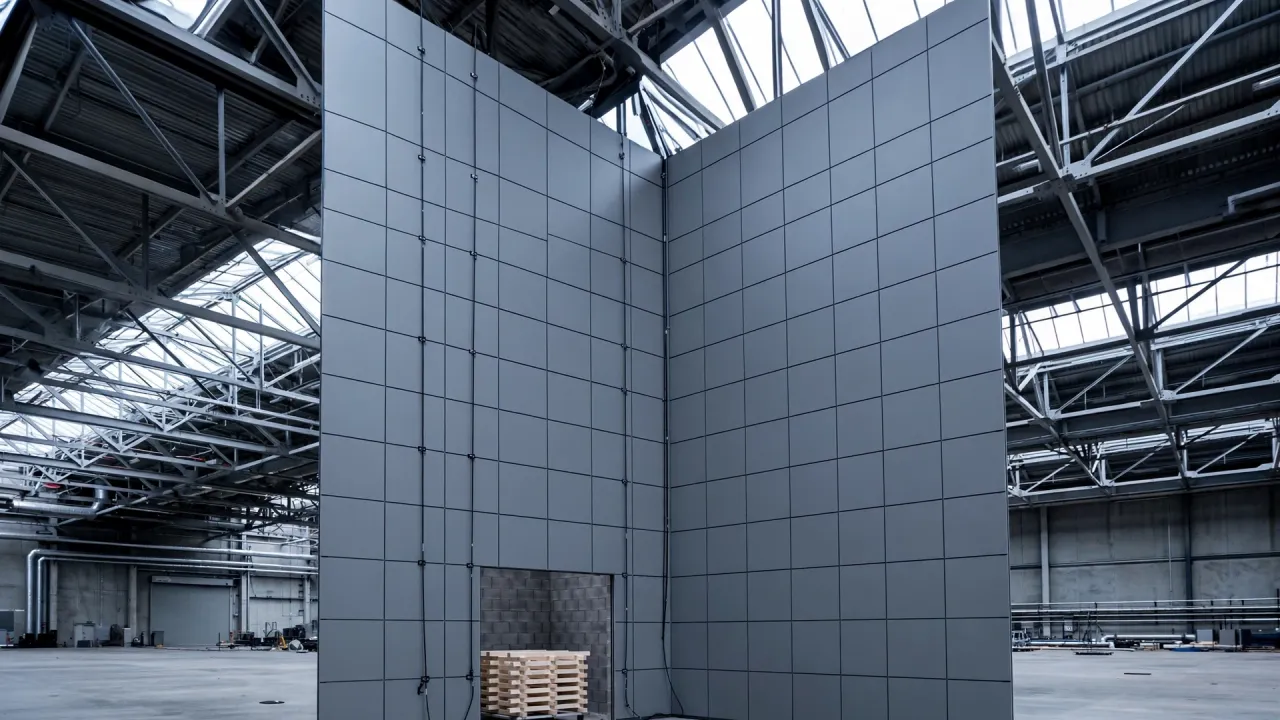
In the early hours of 14 June 2017, an electrical fault in a fridge-freezer started a fire in a fourth-floor kitchen of Grenfell Tower in west London. The public inquiry later called it “no more than a typical kitchen fire”. Yet 18 minutes after it broke out of the flat, flames reached the roof of the 24-storey block, and 72 people died. This case study follows the fire science of the Grenfell disaster. It explains why the cladding burned like fuel and why the stay-put advice outlived the building it relied on. It also shows why the tests that could have flagged the wall never ran on it, and what has changed by October 2026.
TL;DR
The fire
- A kitchen fire in Flat 16 broke into the cladding at about 01:09 and reached the roof at 01:27.
- The polyethylene core of the Reynobond 55 PE panels was the main fuel, at roughly 120 MJ per square metre of panel.
- Burning polyethylene dripped and spread the fire down and sideways, while the decorative crown carried it around the top.
- Fire and smoke came back in through windows and kitchen extractor fans, so compartmentation failed early.
The failures
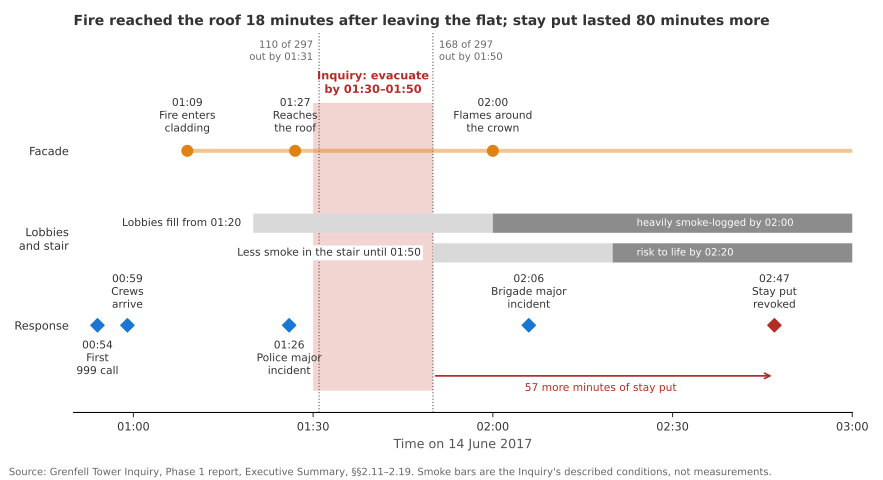
- The Inquiry found that the stay-put advice should have ended between 01:30 and 01:50. It ended at 02:47.
- The panels got through on Class 0, a surface rating that never tested the burning core.
- Nobody ever ran a large-scale test of the Grenfell wall. In 2017 the same kind of system failed BS 8414 in under 9 minutes.
- By October 2026, police had sent files on 20 organisations and 54 people to prosecutors, and 39% of monitored unsafe-cladding buildings had finished repairs.
What happened at Grenfell Tower on 14 June 2017?
A fridge-freezer fault started a fire in Flat 16 on the fourth floor. About 15 minutes after the first 999 call, it broke into the cladding and climbed the east face to the roof in 18 minutes.
Grenfell Tower was a concrete block of 129 flats, finished in 1974. According to volume 1 of the Phase 1 report, it stood just over 67 m tall, with 24 storeys above ground and a single staircase. Before its 2012–2016 refurbishment, the Inquiry judged it “largely impervious to fire”. The refurbishment then added a rainscreen cladding system, new windows and a decorative crown at the top. The Phase 1 report sets out the first half hour of the night:
| Time | Event |
|---|---|
| 00:54 | First 999 call from Flat 16 |
| 00:59 | First crews arrive |
| 01:09 | Fire breaks into the cladding |
| 01:21 | First 999 call from floor 22 |
| 01:26 | Police declare a major incident |
| 01:27 | Fire reaches the roof |
| 01:31 | 110 of 297 people have escaped |
The Inquiry found the most likely route out of the kitchen. Specifically, hot smoke softened the uPVC window jamb until it deformed and collapsed. As a result, a path opened into the cavity between the insulation and the panels. Flames from the open kitchen window offered a less likely second route. Either way, a combustible wall sat a few centimetres from an ordinary kitchen.
Why do some sources say 71 deaths and others 72?
Both counts hold, because each uses its own definition. The fire killed 71 people present that night, including Logan Gomes, stillborn after his mother escaped.
Maria del Pilar Burton escaped but died seven months later, and the Inquiry recorded that the fire did not directly cause her death. Still, the government’s 2026 annual report speaks of 72 lives lost, counting hers. Overall, 227 of the 297 people in the tower escaped.
What was the Grenfell façade made of?
Mostly fuel. From the outside in, the Grenfell wall held composite panels with a plastic core, a ventilated air gap, foam insulation, and plastic window surrounds. Only the concrete behind them could not burn.
| Layer | Product | Role in the fire |
|---|---|---|
| Panels | Reynobond 55 PE, cassette form | Main fuel; burning drips |
| Air gap | Ventilated cavity | Chimney path |
| Insulation | Celotex RS5000 PIR, some Kingspan K15 | Added to the climb |
| Cavity barriers | Siderise, wrong size | Did not seal the gap |
| Windows | uPVC jambs | Route out of the flat |
| Crown | Composite panels | Spread fire sideways |
The panels were aluminium composite material (ACM). Each one bonded a 3 mm polyethylene core between two aluminium sheets 0.5 mm thick, so the panel measured 4 mm overall. The architect had wanted zinc, but the client chose the polyethylene panel “largely on the grounds of cost”, in the words of the Phase 2 report. Behind the panels, most of the insulation was Celotex RS5000 PIR foam, while only about 5% by area was Kingspan K15 phenolic foam.
Why did the polyethylene cladding burn like fuel?
Because the core was fuel. Polyethylene releases 40–46 MJ per kilogram when it burns, close to petrol, and each square metre of panel carried nearly 3 kg of it.
A simple estimate shows the scale. To get the energy per square metre of panel, multiply the core density by its thickness and by the heat of combustion:
Here is the fuel energy per square metre, is the density of polyethylene, is the core thickness and is the heat of combustion. The value of 43 MJ/kg sits in the middle of the measured range. For example, a bomb calorimeter gave 46.3 MJ/kg for the Grenfell-type core in DCLG test 1. In flaming combustion, the FAA’s polymer data give an effective 40.3 MJ/kg. So the estimate spans about 110 to 130 MJ/m², and the order of magnitude holds.
Now picture a strip of panel 2 m wide and 5 m tall, about the area a window fire licks. At 120 MJ/m², those 10 m² hold roughly 1.2 GJ. That is over a quarter of the 4,500 MJ that the timber crib releases in a full-scale BS 8414 test. In other words, the wall did not merely line the fire. It was the fire. The heat release rate post explains why this stored energy matters less than how fast it comes out.
Why do melting and dripping matter?
They move the fire in directions a wall should never carry it. Polyethylene melts at 130–135 °C, the Inquiry noted, while the thin aluminium skins melt at 660 °C, far below flame temperatures.
Once the skins fail, the core flows out, ignites and drips. Specifically, the Inquiry found that burning polyethylene fell from the crown and from the column panels. The drips lit fires lower down, which then climbed again. As a result, the flame fronts moved diagonally across each face of the tower. In the 2017 government test of the same panel type, BRE found afterwards that “no PE ‘filler’ material” remained above the combustion chamber. The core had melted out and burned. Our post on pyrolysis covers how heat turns a solid plastic into burning vapour.
Does the panel fixing method matter?
Yes, a great deal. Cassette panels hang on hooks as folded trays, and their folded edges expose the core. Riveted flat panels do not.
According to the Inquiry, Arconic held data from early 2005 showing that the cassette form “reacted to fire in a very dangerous way and could not be classified”. A French laboratory later rated the riveted form Euroclass C and the cassette form Class E. Grenfell used the cassette form. So a class earned in one fixing said nothing about another. The Euroclass A to F post explains what those letters do and do not cover.
How does the cavity act like a chimney?
Hot gas rises fast in a narrow vertical gap. The cavity drew flames upward, starved them of air so they stretched taller, and let the facing surfaces heat each other by radiation.
However, writers often overstate the size of that effect. A 2024 systematic review notes that several authors quote cavity flames 5–10 times taller than open flames. Yet the same review adds that this holds only for combustible cavities, while non-combustible ones roughly double the flame height. In one Fire Technology study between non-combustible plates, flames grew to at most 2.2 times their open height. Even that took a burner output per metre, divided by the gap width, above about 300 kW/m². So the cavity amplifies spread, but the large multipliers need walls that burn too. At Grenfell, both sides of the gap did. The radiant heat post covers how facing hot surfaces feed each other.
How much more heat did the polyethylene core release?
About 77 times more than a non-combustible build-up, in bench tests. McKenna and co-authors tested each façade layer in the cone calorimeter.
Their summed peak heat release rates came to about 1,471 kW/m² for ACM PE over PIR foam. In contrast, a non-combustible-core panel over stone wool totalled about 19 kW/m². The authors called this sum a “very crude assessment”. Still, their summed heat of combustion per area also tracked which full-scale tests passed. The ranking matters most: the polyethylene core dominated, and the foam added a smaller share. Our cone calorimeter guide explains how the instrument measures those numbers.
Why did the cavity barriers not stop the fire?
Because the fire did not need the cavity. Cavity barriers sit behind the panels, so flame running up the burning outer face simply went around them.
The Inquiry also found faults in the barriers themselves. Siderise supplied them for gaps wider than its tests covered, and the cladding contractor left the barrier design incomplete. Still, the deeper point is physical. In short, a cavity barrier is a back-up layer for a wall that does not burn. It cannot make a combustible rainscreen safe, because the molten core carries fire past any barrier line.
How did the fire get back inside the flats?
Through the windows and the kitchen extractor fans. The outside fire broke the glass, and the fan units deformed and fell out, which let fire and smoke into flat after flat.
Inside Grenfell, the second line of defence was also weak. For example, some fire doors had no working self-closers, and firefighting operations wedged others open or broke them down. The Phase 2 report added that replacement front doors fitted in 2011–2012 fell short of the fire-resistance standard. In addition, Arup’s Dr Barbara Lane found that some doors rated for 60 minutes held for as little as 20. The fire resistance rating post explains why a rated door can fail in service.
The escape route then filled in a clear sequence. Many lobbies had begun to fill with smoke by around 01:20, and by 02:00 a significant number were heavily smoke-logged. Meanwhile, the stair held less smoke until about 01:50. By 02:20, however, its smoke posed a risk to life. Even then, the Inquiry found, some people could still get down it. That window is the real-world core of any ASET vs RSET argument about Grenfell. For how smoke kills, see smoke inhalation.
Why did the stay-put advice fail?
Stay put assumes that a fire stays in its flat. The cladding broke that assumption within minutes, but the advice stood until 02:47, long after the building had stopped protecting anyone.
Stay put is a design strategy, not a firefighting habit. It rests on compartmentation: each flat holds a fire long enough for crews to put it out. So for a sound block with one stair, it is rational. A full evacuation down one stair would put more people in the smoke path than staying would. The London Fire Brigade’s preliminary report quotes the BS 9991:2015 definition. The people in the flat on fire leave, while everyone else “can safely remain” unless heat or smoke reaches them.
At Grenfell, however, the façade removed the premise. In her expert report, Dr Lane concluded that the strategy had “effectively failed by 01:26”. The Inquiry’s chairman then found that a decision to evacuate “could and should have been made between 01.30 and 01.50”. In his view, that would likely have meant fewer deaths. Meanwhile, the second half of the night shows how much time slipped away:
| Time | Event |
|---|---|
| 01:50 | 168 of 297 people have escaped |
| 02:06 | Fire brigade declares a major incident |
| 02:20 | Smoke in the stair a risk to life |
| 02:47 | Stay-put advice revoked |
| 08:07 | Last survivor leaves the tower |
Why did the whole system fail, not just one call?
Because nothing existed to support a change of plan. The Inquiry found gaps in planning, equipment and information long before anyone made a decision that night:
- No plan B. National guidance told fire services to plan for compartmentation failure, yet Grenfell had no contingency evacuation plan, and commanders had no training to spot the need.
- No way to tell residents. The building had no evacuation alert system, so the only channel was the 999 call.
- Poor information flow. Control room staff lacked an overall picture, and early on staff told some callers that the fire was only on the fourth floor.
- A repeat of Lakanal House. The 2009 Lakanal House fire killed six people, and similar shortcomings in handling 999 calls came back.
The firefighters showed “extraordinary courage”, the Inquiry said, and control staff “undoubtedly saved lives”. By 01:50, 168 of the 297 people had escaped. Phase 2 then drew the wider lesson. Building guidance assumed that meeting the rules on fire spread would keep fires compartmented and make evacuation unnecessary. That assumption, it said, needed “urgent attention”. Stairs also matter here; the stack effect post shows how smoke moves in a tall stairwell.
Which fire tests should have caught the Grenfell cladding?
A full-scale BS 8414 test of the actual wall would have. Instead, the panels passed on Class 0, a small-scale surface rating that never exposed the polyethylene core to fire.
In England, Approved Document B offered several routes to show that a wall over 18 m met the rules:
| Route | What it tests | Weakness at Grenfell |
|---|---|---|
| Class 0 | The exposed surface only | Tested the skin, not the core |
| Euroclass | One product, one fixing | Riveted class did not cover cassette |
| Limited combustibility | The material | Insulation claims proved false |
| BS 8414 with BR 135 | A whole wall system | Never run on this wall |
| Desktop study | Expert judgement | No parent test existed |
Why was Class 0 a loophole?
Because it rated a surface, and a thin aluminium skin passes surface tests easily. Meanwhile, the core behind it never met the flame.
The Inquiry found that a select committee had urged the government in December 1999 to adopt the large-scale test, “thereby abandoning Class 0”. The government neither acted on that nor reviewed it. Class 0 stayed in the guidance until after the fire, although it “could and should have been removed years earlier”. Meanwhile, the panel’s 2008 BBA certificate contained false statements, the Inquiry found, including that it “may be regarded as having a Class 0 surface”. The reaction to fire vs fire resistance post explains why such surface classes answer a different question.
How did the manufacturers game the tests?
The Inquiry found “systematic dishonesty” among the firms that made and sold the panels and insulation. These are the Inquiry’s findings, not court rulings.
Those firms, it said, “engaged in deliberate and sustained strategies to manipulate the testing processes, misrepresent test data and mislead the market”. Its chapters on Arconic, Celotex and Kingspan then set out how each one did it.
For example, Celotex tested its RS5000 foam to BS 8414 in May 2014, with BRE’s complicity, according to the Inquiry. The rig carried fire-resistant magnesium oxide boards “placed in critical positions to ensure that it passed”. Yet BRE’s report left the boards out, which made it “materially incomplete and misleading”. Kingspan, for its part, sold K15 for years on the back of a 2005 test of an earlier formulation. Its own system tests in 2007–2008 were, in the Inquiry’s word, “disastrous”. The Inquiry also found that BRE’s wider testing work was “marred by unprofessional conduct, inadequate practices, a lack of effective oversight, poor reporting and a lack of scientific rigour”.
Who should have checked the wall itself?
The fire engineer and building control. Yet, according to Phase 2, Exova’s fire strategy stayed a draft that never analysed the external wall.
The council’s building control, the report found, “failed to perform its statutory function of ensuring that the design of the refurbishment complied with the Building Regulations”. As a result, no single person ever held the full picture of the wall’s materials and how they would burn.
Did any test show the danger before the fire?
Yes, several did. A government-funded test in 2001, Arconic’s own tests from 2005 and Kingspan’s tests in 2007–2008 all pointed at the hazard. None of them changed the guidance.
In 2001, a large-scale BRE test of ACM PE “burned violently”, with flames 20 m high within five minutes. Yet the government neither published the result nor warned the industry. After the fire, the government ran seven BS 8414 tests in July and August 2017. They paired three panel cores with three insulation types, in seven combinations. Test 1, with ACM PE over PIR foam, ended after 8 minutes 45 seconds.
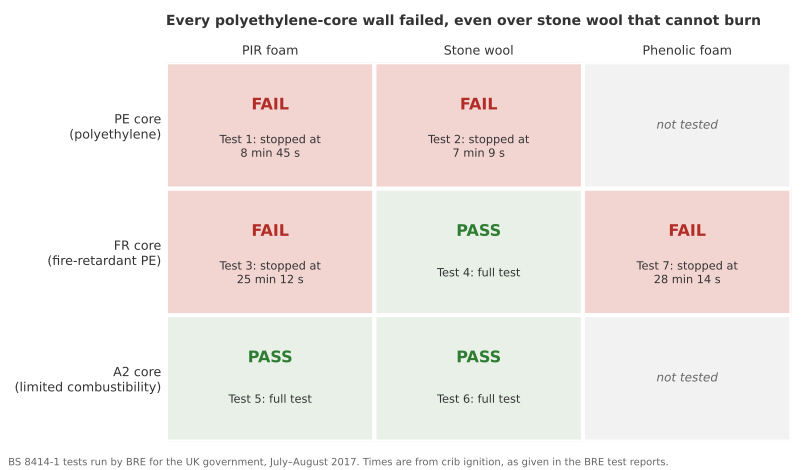
Two results stand out. First, ACM PE failed even over stone wool, which does not burn. In fact, test 2 stopped sooner, at 7 minutes 9 seconds. A 2025 computer reconstruction by Wang, Galea and co-workers put that gap down mainly to variation in the timber crib. Either way, the insulation came second; the panel decided the outcome. Second, catching Grenfell needed no new test. The existing tests had already caught the problem, but their results stayed hidden or shelved, or nobody asked for them.
Is BS 8414 enough on its own?
It remains the best tool the system had, but it has limits. Each result covers only the exact wall tested, and its pass criteria rest on judgement more than physics.
The fuel load of the timber crib can vary between about 4,500 and 9,000 MJ within the allowed tolerances, according to a University of Central Lancashire thesis. A 2020 appraisal in Fire Technology by Schulz and co-authors went further. It argued that the BR 135 temperature criteria “lack any scientific basis”. The ASTM E84 vs ISO 9705 post shows the same pattern elsewhere: a test answers only the question its setup asks.
Was Grenfell the first cladding fire of its kind?
No. UK fires at Knowsley Heights in 1991, Garnock Court in 1999 and Lakanal House in 2009 all gave warnings. Arconic also knew of cladding fires in Dubai in 2012 and 2013.
Abroad, the Phase 2 report records ACM PE fires at Mermoz Tower in Roubaix and Tamweel Tower in Dubai in 2012, Lacrosse in Melbourne in 2014, and The Torch and The Address in Dubai in 2015.
At home, the Inquiry found that BRE’s reports on the early UK fires were “far from comprehensive”. As a result, they gave the government a “false impression” that the guidance was working. After Lakanal House, the coroner’s call to review Approved Document B “was not treated with any sense of urgency”. Each event added a data point that should have changed the risk estimate. Our F-N curve post explains why rare fires with many deaths deserve that extra weight.
The hazard has outlived Grenfell, too. In February 2024 a fire in Valencia’s Campanar district killed 10 people in a block clad in aluminium–polyethylene composite. Then, in November 2025, the Wang Fuk Court fire in Tai Po, Hong Kong, killed 168 people. That fire did not involve ACM, though. Its fuels were scaffold netting and foam boards over windows on blocks under repair. Still, the lesson generalises: any continuous combustible layer on a tall façade acts as a vertical fuse.
What has changed since the Grenfell Tower fire?
The rules for tall residential walls tightened in stages, and the inquiry’s work moved to prosecutors. Repairs to unsafe cladding remain far from finished in October 2026.
| Date | Change in England |
|---|---|
| Dec 2018 | Walls of homes 18 m or taller: A2-s1,d0 or A1 only |
| Dec 2022 | Composite panels with a PE core banned at any height |
| Mar 2025 | National classes, including Class 0, dropped |
| Sep 2026 | Second stair for new flats 18 m or taller |
The legal texts are SI 2018/1230 and SI 2022/603. The class and staircase changes came through Approved Document B circulars, and schemes already in the system had transition periods.
The Phase 2 report made 58 recommendations. In February 2025 the government accepted its findings, taking 49 recommendations in full and 9 in principle. By September 2026, it reported 30 of 61 tracked recommendations as complete, a count that includes three left over from Phase 1. Remediation still lags behind. The August 2026 data track 4,724 buildings of 11 m or more with unsafe cladding. Of these, 39% have finished works. Of 516 high-rise ACM buildings, 93% have finished.
On 30 September 2026, the Metropolitan Police sent all its files to the Crown Prosecution Service. The files cover 20 companies and organisations and 54 individuals. Offences under review include corporate and gross negligence manslaughter, fraud and misconduct in public office. The prosecutors have committed to decide before the tenth anniversary of the fire in June 2027. Even so, a referral does not mean a charge.
What are the limits of this case study?
This post summarises the Grenfell Inquiry’s findings, not a court’s. The Inquiry could not rule on civil or criminal liability, and every person and firm named keeps the presumption of innocence.
Some companies dispute parts of the Inquiry’s conclusions. The fuel-load estimate above is illustrative: the 3 mm core comes from the Inquiry, but the density is a typical value for polyethylene. Cavity flame multipliers also remain uncertain. Finally, the status figures reflect sources available on 6 October 2026 and will date quickly.
Key takeaways
The Grenfell Tower fire started as an ordinary kitchen fire. The wall turned it into a disaster: each square metre of polyethylene-cored panel held around 120 MJ, and burning drips spread fire down and sideways. Then fire came back in through windows and fans, and compartmentation failed within the first hour.
Stay put depended on that compartmentation, so the advice outlived the building’s ability to protect anyone. The Inquiry found that evacuation should have started between 01:30 and 01:50. Yet no plan, alarm or information flow existed to make that switch.
Finally, the testing system failed in layers. Class 0 rated a skin, not a wall, and makers gamed the large-scale tests. Nobody tested the wall as built. For anyone specifying a façade, the lesson follows directly: demand full-scale evidence for the exact system, read the whole test report, and keep a plan B for when the building stops doing its job. As the ALARP post argues, compliance alone does not equal safety.
Cite this articleHow to cite
Dinh, D. C. (2026, October 6). Grenfell Tower Fire: The Cladding Physics Behind 72 Deaths. PyroRisk. https://pyrorisk.net/blog/grenfell-tower-fire-the-cladding-physics-behind-72-deaths/
Recent posts
Featured posts
Categories
Comments
Related posts
Fire Case Studies
Notre-Dame Fire: Why an 800-Year-Old Roof Burned in Hours
The 2019 Notre-Dame fire grew for half an hour in a 100 m oak attic before anyone called firefighters. See the fuel, the lead, the vaults and the rebuild.
Fire Case Studies
Station Nightclub Fire: Why 100 People Had Only 90 Seconds
The Station nightclub fire killed 100 people in 2003. See how stage gerbs, acoustic foam and one narrow inner door left the crowd about 90 seconds to escape.
Fire Safety Engineering
2-Hour Fire Wall: What a Fire Resistance Rating Measures
A 2-hour fire resistance rating means a wall survived a 1918 furnace curve, not a real fire. Here is what the test proves, and where it falls short.