pyrorisk.net · Fire Science & Risk Fire Safety Engineering
2-Hour Fire Wall: What a Fire Resistance Rating Measures
A 2-hour fire resistance rating means a wall survived a 1918 furnace curve, not a real fire. Here is what the test proves, and where it falls short.
Online: pyrorisk.net/blog/2-hour-fire-wall-what-a-fire-resistance-rating-measures/
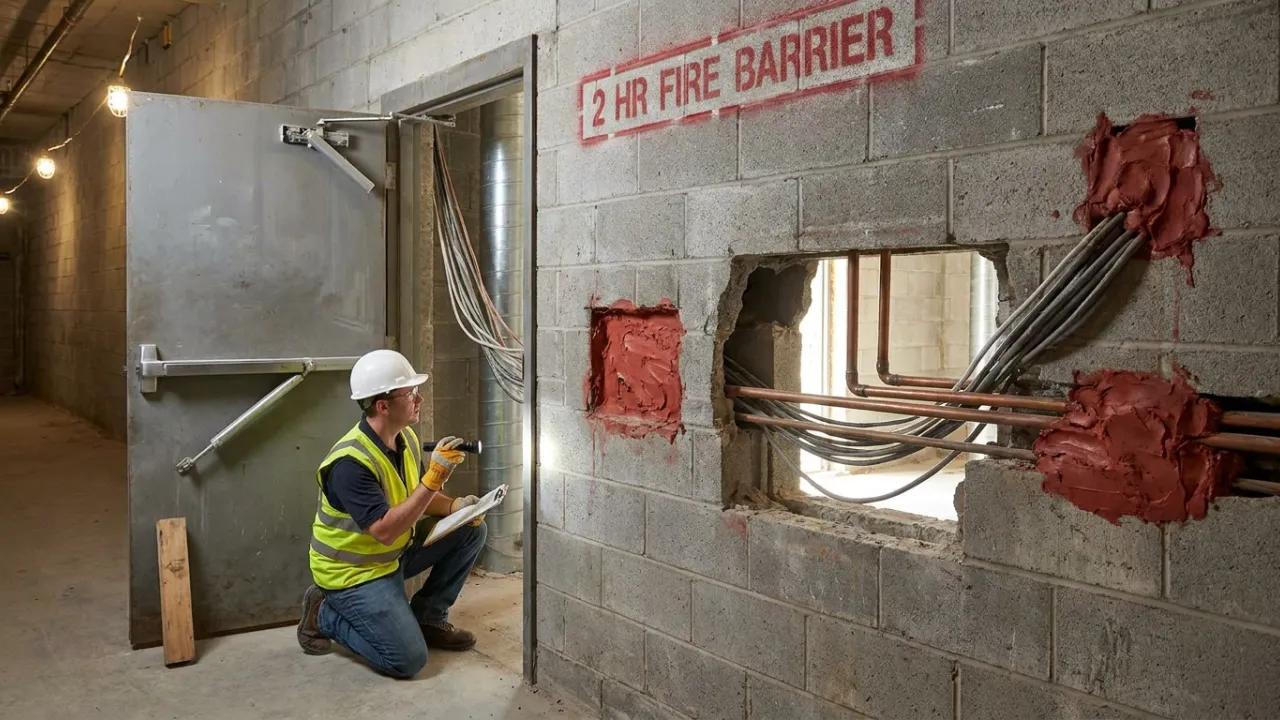
A wall stamped “2-hour” sounds like a promise. Most people read it as two hours of safety on the far side, whatever burns on the near side. That reading misses the point, because a fire resistance rating records how one sample wall behaved inside a gas furnace, following a heating curve drawn up in 1918. It says nothing direct about your building, your fuel or your fire. So this post takes the label apart: what the furnace measures, where the curve came from, and why real walls fail in ways the test never sees.
TL;DR
What the rating actually certifies
- A 2-hour fire resistance rating means one representative specimen survived 120 minutes of a standard furnace exposure. It held its load, blocked flame and hot gas, and kept its cool face cool enough.
- The heating curve dates from ASTM’s first fire test standard in 1918. It rises forever and never cools, unlike any real fire.
- Simon Ingberg linked furnace time to real fires in 1928 through an “equal-area” idea. Later scientists found no theoretical basis for it.
- Codes hand out ratings by occupancy, height and escape routes. They do not calculate the fire your building will actually face.
Where real walls part company with the lab
- A worked office example comes out near 35 minutes of equivalent furnace exposure, far below 120. A small window or a library fire load pushes the demand past 2 hours.
- Penetrations, fire doors and later alterations cause most real failures. At Grenfell, flat doors meant to last 60 minutes held for as little as 20.
- Battery rooms still get 2-hour walls tested against the slow cellulosic curve, although thermal runaway heats far faster.
What does a fire resistance rating actually measure?
A fire resistance rating measures how long one tested assembly meets three pass criteria inside a standard furnace. So the number ranks products. It does not predict a real fire.
Europe spells the criteria out in EN 13501-2. Each letter names one job, and the number records the last full period the wall managed.
| Letter | French origin | What the wall must do |
|---|---|---|
| R | Résistance | keep carrying its load |
| E | Étanchéité | stop flame and hot gas passing |
| I | Isolation | keep the far face cool |
So REI 120 means all three held for 120 minutes. EI 60 means integrity and insulation held for 60, with no load-bearing claim at all. Extra letters cover radiation (W), impact (M), self-closing (C) and smoke (S). Also, every fire resistance rating comes in fixed steps: 10, 15, 20, 30, 45, 60, 90, 120, 180, 240 and 360 minutes. Our post on reaction to fire versus fire resistance covers the material classes that sit beside these ratings.
US practice expresses the same fire resistance rating as an hourly figure, tested to ASTM E119, UL 263 or NFPA 251. However, the logic stays identical. A specimen goes into a furnace, the furnace follows a curve, and the clock stops at the first failure.
How cool must the far side stay?
Cool by code standards, yet still hot enough to burn skin. EN 1363-1 fails insulation once the average rise on the unexposed face reaches 140 K, or any single point rises 180 K.
Those limits come straight from the EN 1363-1 test method. ASTM E119 uses almost the same figures: a 250 °F (139 °C) average rise and a 325 °F (181 °C) single-point rise. So a wall can pass insulation while one spot on its safe side sits near 200 °C, hot enough to burn a hand. The criterion asks only that the wall itself should not ignite things on the far side.
Integrity, by contrast, uses cruder tools. Technicians hold a cotton pad against gaps, push gap gauges into cracks, and watch for flaming that lasts 10 seconds or more. A failure on any one criterion therefore ends that part of the fire resistance rating.
Why does the US test add a fire hose?
Because a wall that survives the heat may still crumble when water hits it. After exposure, most US wall assemblies face a hose-stream test that mimics firefighting and thermal shock.
Spalled plaster, shattered glass or a punched-through board all count as failure. Europe, meanwhile, handles impact through the optional M classification. So an ASTM hour and a European hour do not share an identical meaning, even before the furnaces themselves disagree.
Where did the standard fire curve come from?
From a committee’s best guess, made before fire science existed as a field. The first edition of ASTM E119 appeared in 1918, and its curve has barely moved since.
Europe and most of the world write the cellulosic curve as one equation, from ISO 834-1 and reproduced in EN 1363-1.
Here gives the furnace temperature in °C, and counts minutes. The curve climbs fast, then flattens. It reaches 842 °C at 30 minutes, 945 °C at one hour, 1,006 °C at 90 minutes and 1,049 °C at two hours, as the fsetools ISO 834 reference confirms.
ASTM E119 uses a table of points instead. It sets 538 °C at 5 minutes, 704 °C at 10, 843 °C at 30, 927 °C at one hour and 1,010 °C at two hours. The two curves sit close together, though not on top of each other.
Simon Ingberg of the National Bureau of Standards, now NIST, ran the column tests behind the curve between June 1917 and December 1918. According to Law and Bisby, in a Fire Safety Journal history of fire resistance, “the discipline of fire science did not exist in any form that would be recognised today.” Flashover, ventilation control and compartment dynamics all came later. Yet the curve behind every fire resistance rating froze first.
Why does the equal-area rule matter?
Because it turned a furnace clock into a design requirement. Ingberg proposed in 1928 that two fires do equal damage when the areas under their temperature curves match.
For his report, Tests of the Severity of Building Fires, Ingberg burned real rooms of furniture and records. He measured the area under each temperature curve above roughly 150 to 300 °C, then equated a given fire load per square metre of floor to a duration of standard exposure. So more fuel meant more hours, and codes could now assign a fire resistance rating by fuel load.
The idea stuck. However, it rests on nothing physical. Drysdale, quoted by Law and Bisby, put it bluntly: “there is no theoretical justification for the hypothesis.” A short, very hot fire and a long, cool one can share the same area, yet they heat a steel beam or a timber panel in completely different ways. For that reason, researchers later built rival severity measures.
Which other curves exist?
Several nominal curves cover faster, hotter or cooler fires. Each one still offers a fixed shape rather than a model of a specific fire.
| Curve | Equation or shape | Typical use |
|---|---|---|
| Cellulosic | building contents | |
| Hydrocarbon | petrochemical fires | |
| External | plateau near 660 °C | façade elements |
| RWS, UL 1709 | fast rise to 1,200–1,350 °C | tunnels, jet fires |
For example, the hydrocarbon curve from EN 1363-2 passes 900 °C within five minutes and levels at 1,100 °C. By contrast, the cellulosic curve needs over 20 minutes to reach 780 °C. That gap matters for tunnels and battery rooms, as later sections show. Our post on road tunnel fire risk covers the design fires behind the steepest curves.
What happens inside a fire resistance furnace?
A gas or oil burner heats one face of a full-size specimen. Operators throttle the burners so the measured temperature tracks the standard curve, minute by minute, until the specimen fails.
The furnace also holds a slight positive pressure, so hot gas pushes through any crack. Meanwhile, thermocouples on the cool face log the insulation criterion. The test sounds simple. Yet three details change the fire resistance rating more than most users realise.
Do different furnaces give the same result?
No, and the gap used to reach 25%. The sensor that controls the burners shapes the heat the specimen actually receives.
ISO 834-1 and EN 1363-1 now require plate thermometers to control the furnace. North American labs long relied on shielded thermocouples instead. Heat transfer above 800 °C runs mostly through radiation, and a thin thermocouple responds differently from a flat plate. Wickström (1994) introduced the plate thermometer to fix this. In his Fire Technology paper, the same structure could earn about 25% longer resistance under ISO than under ASTM.
Plate thermometers narrowed the spread sharply. According to an EU harmonisation project, furnace-to-furnace scatter after 45 minutes fell from more than 100 °C to less than 10 °C. So older ratings and cross-border comparisons still carry that historic noise. Our post on fire tests that disagree tells the same story for flame-spread tests.
Why can a restrained floor score lower?
Because US ratings treat restraint as a label, not as a physical model. A NIST test series found a restrained floor rated 1 hour, while its unrestrained twin rated 2 hours.
ASTM E119 and UL 263 let a floor or roof pass either “restrained” or “unrestrained”. Under IBC §703.2.3, every assembly counts as unrestrained unless the designer proves restraint to the building official, as UL’s guidance for designers explains. Common sense suggests restraint should help. Yet the NIST floor tests showed the reverse for one full-scale system. One recent paper even argues that the unrestrained rating bears no relation to how these floors behave in real buildings.
What can the furnace not see?
Quite a lot. It tests one isolated, pristine specimen, usually no wider than 6 m, under a steady load and a heating curve that never falls.
- Smoke and toxicity. The furnace records no smoke leakage unless someone adds an S test.
- Real structural loads. Buildings push and twist their walls as members expand.
- The cooling phase. Real fires decay, and structures often fail while they cool.
- Penetrations. Real walls carry pipes, cables and ducts, while the furnace wall usually carries none.
How do real fires differ from the standard curve?
Real compartment fires grow, flash over, burn steadily, then decay, while the standard curve only climbs. So a fire resistance rating and the length of a real fire have no fixed link.
Law and Bisby describe fire resistance duration as decoupled from time in a real fire. For example, a small, well-ventilated room can burn out before the furnace test reaches its halfway mark. Meanwhile a deep, poorly ventilated store can smoulder and burn for longer than any rating. Our post on t-squared fire growth covers the growth phase that the furnace skips entirely.
What does a parametric fire add?
A cooling branch, plus a shape tuned to the room. Eurocode EN 1991-1-2 Annex A builds the curve from fuel load, window size and the thermal properties of the walls.
Three inputs drive it. First comes the fuel load density . Then comes the opening factor , where gives the window area, its height, and the total internal surface. Finally the wall linings enter through their thermal inertia, . The heating branch then reads as follows, per EN 1991-1-2 Annex A.
The fictitious time stretches or squeezes the clock, with in hours.
When equals 1, the heating branch closely follows ISO 834. A larger window pushes up and gives a shorter but more severe fire. Less ventilation gives a cooler, longer one. Crucially, once the fuel runs low, the curve turns down and falls at a set rate.
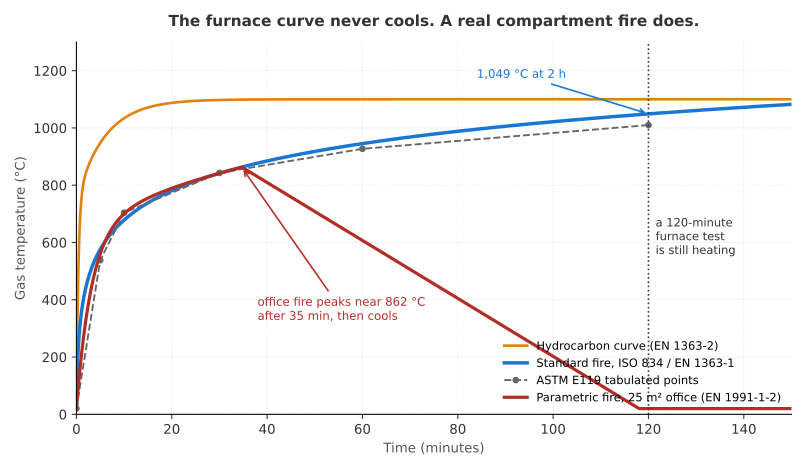
The chart runs the parametric model for the office in the worked example below. Its heating branch almost traces ISO 834, because comes out at 1.00. Then it peaks near 862 °C after 35 minutes and cools at roughly 10 K per minute. By 118 minutes the fire has gone out, while the furnace behind a 2-hour fire resistance rating still pushes upward.
Do structures fail during cooling?
Yes, and the furnace test cannot reveal it. Steel beams shrink as they cool and pull on their connections, and concrete keeps losing strength after the flames die.
For instance, researchers compared Eurocode parametric curves with the large BRE Cardington tests of 1999 and 2000. Their review of the decay phase found that the fixed Eurocode cooling rates do not match the measured decay. So a structure can reach its most critical state after the gas temperature has peaked. Our post on steel and concrete critical temperatures shows how that cooling-phase pull tears connections apart.
What about fires that travel?
Large open floors rarely burn all at once. Instead the fire moves across the plate, burning one patch hard while the rest heats more slowly.
Stern-Gottfried, Law and Rein built the Travelling Fires Methodology at the University of Edinburgh from 2007 onward. It splits the exposure into a near field of roughly 1,200 °C under the flames and a cooler far field ahead of them. No single furnace curve captures that uneven heating.
Have modern fuels changed the picture?
Yes. Synthetic furniture burns far faster than the wood and cotton of a century ago. UL tests found modern rooms flashing over in under 5 minutes, against about 29 minutes for legacy rooms.
The side-by-side burns, published in Fire Technology, timed a modern room at about 3 minutes 30 seconds to flashover. UL’s own summary of the research describes modern fires reaching flashover more than eight times faster. The standard curve, however, still describes the fuel mix of 1918. Our post on heat release rate explains why that burning rate drives everything else.
How long would a real office fire last?
Roughly 35 minutes of equivalent furnace exposure, for a small office with one window and masonry walls. That falls far below a 120-minute fire resistance rating.
EN 1991-1-2 Annex F converts a real compartment fire into minutes of standard exposure. The method, called time equivalence, multiplies four terms.
Here gives the design fire load density in MJ per square metre of floor. The factor reflects the linings, covers ventilation, and corrects for the material of the member. Per EN 1991-1-2:2002 Table F.2, takes 0.04 for above 2,500, 0.055 between 720 and 2,500, and 0.07 below 720. Designers also use 0.07 as the default when nobody assesses .
How does the worked example run?
Take a 25 m² office, 3 m high, with one 2.4 × 1.5 m window. Masonry walls give , and the office fire load comes to 511 MJ/m².
The window area gives m² and a height m, with no roof openings. First, the ventilation ratio sits within the permitted range of 0.025 to 0.25.
Next comes the horizontal-opening term, which plays no part here because the room has no roof openings.
Then the ventilation factor follows from the room height and the window ratio.
Finally, the four terms multiply out, with .
So this office fire does about as much damage as 35 minutes in the furnace. A 2-hour fire resistance rating covers more than three times that demand, so here it looks generously conservative.
When does the demand exceed 2 hours?
When fuel rises or ventilation falls. Shrink the window to 1.25 m², and the same office fire load produces 68 minutes. A library-level fire load passes 120 minutes even with the original window.
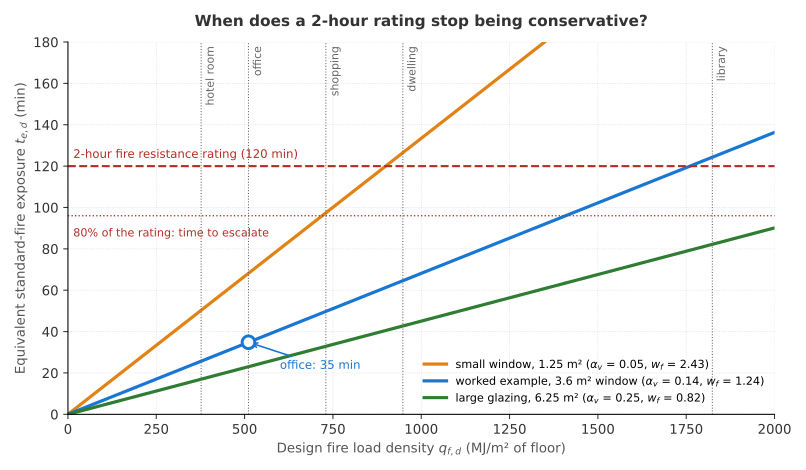
The chart holds the room fixed and changes only fuel and glazing. With the original window, equivalent exposure reaches 120 minutes at about 1,760 MJ/m². A small window drops that threshold to about 900 MJ/m², within reach of an ordinary dwelling. Large glazing lifts it beyond 2,600 MJ/m². So the same 2-hour wall can hold a big safety margin in one room and none in the next.
Two warnings apply. First, defensible inputs can shift by a factor of two or more. Second, time equivalence only covers the heating phase, so it ignores cooling and travelling fires. Law’s 1997 review of the formulae concluded that time equivalence offers little use as a design parameter. Treat it as a sense check, not as proof.
Why do fire-rated walls fail in real buildings?
Mostly because the built wall no longer matches the tested one. Holes for services, faulty doors and later alterations defeat far more walls than furnace-level heat does.
A fire resistance rating attaches to one specific assembly. In the US that means a UL directory design number, and in Europe an EN classification report. Change the stud gauge, the board type or the fixings, and the rating no longer strictly applies. Extended-application rules can bridge small gaps. Still, each step moves the design further from anything a furnace ever saw.
- Penetrations. Every pipe, cable tray and duct needs a tested firestop, or it turns into a chimney. Surveys name unsealed services as the most common defect.
- Fire doors. A door wedged open, missing its self-closer, or fitted with the wrong seals no longer counts as a rated door.
- Alterations. Each contractor who drills a new hole can breach the wall, so compartmentation needs upkeep like any other system.
One commercial survey firm reported in 2023 that about 65% of the buildings it audited had at least one breached fire wall. That figure comes from an industry provider, not a peer-reviewed study. Even so, it matches what inspectors describe.
What did Grenfell show about fire doors?
That rated doors lose their rating through neglect. Arup’s Dr Barbara Lane found that flat entrance doors meant to resist fire for 60 minutes held for as little as 20.
The Phase 1 report found that effective compartmentation failed early. Some fire doors stood open and failed to close, because they lacked working self-closing devices. Lane’s evidence also described doors with no coordinated maintenance regime. In short, each door kept its fire resistance rating on paper, while the built door fell far short of it.
Does “fire wall” mean every 2-hour wall?
No. In US codes a true fire wall must stay standing even if the building collapses on one side. Most 1-hour and 2-hour walls count as fire barriers or fire partitions instead.
Codes hand out each fire resistance rating by occupancy, height, escape distance and firefighter access. They do not calculate your building’s fire. So the same element may need a higher rating in a tall hotel than in a low office, purely because failure there costs more lives. The International Building Code then splits rated walls into three families.
| Element | IBC section | Defining feature |
|---|---|---|
| Fire wall | §706, NFPA 221 | stands alone if one side collapses |
| Fire barrier | §707 | runs continuous to the deck above |
| Fire partition | §708 | typically 1 h, may stop at a rated ceiling |
The distinction matters because the furnace test never certifies collapse behaviour. A true fire wall under NFPA 221 divides a structure into separate buildings, so its stability comes from structural design rather than from the E and I criteria. The UK’s Approved Document B follows the same logic, tying ratings to building class.
Why do battery rooms strain the 2-hour rule?
Because thermal runaway heats far faster than the cellulosic curve. Battery fires bring jet flames, gas deflagrations and toxic smoke, which look more like hydrocarbon or explosion loads.
Even so, NFPA 855 asks for rooms holding energy storage systems to sit behind fire barriers with a minimum 2-hour fire resistance rating. Site guidance establishes those barriers through ASTM E119 or UL 263, which means the same slow furnace curve. NFPA 855 also leans on UL 9540A propagation tests to set unit spacing, which fits the hazard. Yet the wall itself still carries a fire resistance rating earned against heat that ramps up gently.
Electric vehicles in car parks raise the same question. Full-scale vehicle tests have shown peak heat release rates of 5–10 MW for both battery and petrol cars. Battery fires then add hydrogen fluoride and re-ignition hours later. So NFPA’s parking-garage research programme now studies hazards that existing ratings never had in mind. Our posts on thermal runaway propagation and off-gas detection cover the cell-level physics.
Where is fire resistance design heading?
Toward calculating the fire instead of assuming one. In other words, engineers model a specific compartment fire and the frame’s response.
- Performance-based design. Engineers replace the standard curve with a parametric or travelling fire, then analyse the whole frame rather than one member.
- Reliability-based design. Fire resistance becomes a target probability of failure, in line with the EN 1990 basis of design, rather than a fixed number of hours.
- Critiques of the furnace itself. Law and Bisby (2020) describe a concept so embedded that fire science has failed to kill it.
For now, though, the hourly fire resistance rating remains the currency that codes, insurers and building officials trade in.
How should you read a 2-hour rating in practice?
Read the fire resistance rating as a classification that buys approval, never as a survival time. Six habits keep it honest.
On the design
- Never read the rating as minutes of safety. For any important space, check the real thermal demand with time equivalence or a parametric fire. If the demand reaches about 80% of the prescriptive rating, move to performance-based design.
- Check large, fuel-heavy or poorly ventilated spaces. Open floor plates larger than about 500 m² deserve a travelling-fire check, rather than trust in one uniform furnace rating.
- Design for the cooling phase. Where a parametric fire shows a decay branch, confirm that the structure’s worst moment does not arrive after the peak.
On the building
- Build exactly what the lab tested. Match the UL design number or EN classification, record every penetration and firestop, and claim a restrained rating only with evidence.
- Treat compartments as maintained assets. Re-survey firestopping each year in higher-risk buildings and after any services work. Inspect fire doors and self-closers on a fixed cycle.
- Look beyond ISO 834 for battery hazards. Where jet flames or deflagration can occur, back the 2-hour barrier with UL 9540A data, explosion venting and a hydrocarbon-curve check.
Key takeaways
A 2-hour fire resistance rating tells you that one specimen outlasted a furnace for 120 minutes, following a curve drawn up in 1918. That curve rises forever. Ingberg’s 1928 equal-area rule linked it to real fuel loads, yet fire science later found no physical basis for the link. So the rating works as an index for comparing products and satisfying codes. It does not work as a clock.
Real fires, however, differ in both directions. The worked office example comes out near 35 minutes of equivalent exposure, and its parametric fire burns out before two hours. Shrink the window or fill the room with paper, though, and the demand passes 120 minutes. Travelling fires, cooling-phase failures and synthetic furniture all sit outside what the furnace measures.
Most real failures happen at the details. Unsealed penetrations, propped doors and later alterations turn a tested wall into an untested one, as Grenfell showed with doors that held 20 minutes instead of 60. Battery rooms also add a heating rate the cellulosic curve never contemplated. So read every fire resistance rating as a starting point, then check the fire, the fuel and the wall that actually got built.
Cite this articleHow to cite
Dinh, D. C. (2026, September 22). 2-Hour Fire Wall: What a Fire Resistance Rating Measures. PyroRisk. https://pyrorisk.net/blog/2-hour-fire-wall-what-a-fire-resistance-rating-measures/
Recent posts
Featured posts
Categories
Comments
Related posts
Fire Safety Engineering
Critical Temperature: Why Steel Softens and Concrete Spalls
The 550 °C critical temperature of steel comes from a load ratio, not from metallurgy. Here is the real physics, and why hot concrete explodes.

Fire Safety Engineering
ASET vs RSET: The Inequality Behind Every Evacuation Plan
ASET vs RSET decides whether a building passes. Here come the timeline, the tenability limits, the equations, and the one term that swings the answer most.
Fire Safety Engineering
Ionization or Photoelectric Smoke Alarm? Why Experts Split
Ionization alarms beat a photoelectric smoke alarm by seconds in flaming fires, then lose by 30 minutes in smoldering ones. Here is why experts still split.