pyrorisk.net · Fire Science & Risk Fire Testing
Euroclass A to F: How Europe Rates Reaction to Fire
A Euroclass such as B-s1,d0 comes from the SBI test. Here is what each letter measures, and why a component class never proves a facade will hold.
Online: pyrorisk.net/blog/euroclass-a-to-f-reaction-to-fire/

Every European datasheet carries a short string such as B-s1,d0. That string gives the Euroclass of the product. First the letter ranks how much the product feeds a fire. Then the two suffixes rank smoke and burning drips. So the system looks tidy, and for a lining board it works well. Yet that same tidy letter sits at the heart of the worst fire-safety failure in recent British history. This post therefore walks through the tests behind each class, the numbers that split them, and the point where a Euroclass stops helping.
TL;DR
How the classes work
- EN 13501-1 sorts products into A1, A2, B, C, D, E and F. Smoke classes s1 to s3 and drip classes d0 to d2 then sit alongside.
- The standard runs no test of its own. Instead it blends five methods, and EU law fixes every number.
- A furnace at 750 °C and a bomb calorimeter draw the A1/A2 line. So that line marks combustibility.
- One test draws the B, C and D lines: the Single Burning Item, EN 13823. Its propane burner delivers 30.7 kW ± 2.0 kW into a corner.
- Class B needs FIGRA ≤ 120 W/s and THR600s ≤ 7.5 MJ. Then class C needs ≤ 250 W/s, while class D needs ≤ 750 W/s.
Where the scheme stops working
- Results scatter between labs by 21% to 34%. So a product near a boundary can pass in one lab, yet fail in the next.
- Class E means little, because a 15-second match-sized flame must merely not spread 150 mm in 20 seconds.
- A Euroclass rates a component, but never a built wall. Grenfell Tower, on 14 June 2017, killed 72 people and proved that gap.
- External walls therefore need system tests such as BS 8414 with BR 135. Or they need a legal floor of A1 and A2-s1,d0 materials.
What does a Euroclass actually rate?
A Euroclass rates how much a product feeds a growing fire in its end use. The standard behind it, EN 13501-1:2018, sets up a scheme rather than a test.
Read that difference carefully, because it explains most of the confusion. EN 13501-1 gathers data from five separate methods. Then it maps that data onto one short string. Specifically, the methods cover a furnace, a bomb calorimeter, a corner fire, a small flame and a radiant panel. Meanwhile the legal limits sit in Delegated Regulation (EU) 2016/364. That text replaced Commission Decision 2000/147/EC, which had launched the scheme in February 2000.
Three product families run on their own ladders:
- General products use A1, A2, B, C, D, E and F.
- Floorings also add the subscript “fl”. So the ladder reads A1fl through Ffl.
- Pipe insulation likewise adds the subscript “L”, giving A1L through FL.
Electric cables run a fourth ladder, Aca to Fca, under EN 13501-6. That scheme borrows the same logic, but applies it to a cable rig, so this post leaves it aside.
What do the letters mean physically?
Each letter in a Euroclass marks the stage at which a product stops mattering. A1 adds nothing at any stage, while F adds freely or never faced a test.
| Class | Physical meaning |
|---|---|
| A1 | No contribution to fire at all. Non-combustible. |
| A2 | Limited combustibility. Almost no effect on fire growth. |
| B | Combustible, yet very limited effect. Will not flash a room over. |
| C | Combustible, with limited effect. Flashover comes later. |
| D | Combustible, with medium effect. |
| E | Combustible, with high effect. Resists a small flame briefly. |
| F | No performance found, or fails E. |
Regulators treat A1 and A2 together as “non-combustible”, though an A2 product does burn a little. Below that line the ladder ranks speed rather than presence. So it asks how fast heat arrives, and how soon a room reaches flashover.
What do the s and d suffixes add?
The suffixes rank two hazards the Euroclass letter ignores. One covers smoke, while the other covers flaming drips. Both come from the same corner test.
Smoke splits three ways. So s1 means little or no smoke, s2 means moderate smoke, and s3 sets no limit. Drips also split three ways. Then d0 means none, d1 means none lasting beyond 10 seconds, and d2 covers the rest.
Still, the numbers matter more than the words:
| Smoke class | SMOGRA | TSP600s |
|---|---|---|
| s1 | ≤ 30 m²/s² | ≤ 50 m² |
| s2 | ≤ 180 m²/s² | ≤ 200 m² |
| s3 | No limit | No limit |
Both suffixes apply to classes A2 through E. A1 needs neither, since it does not burn, and F carries none. Floorings work differently again. Their smoke runs s1 or s2 only, measured in percent-minutes, and nobody rates drips. That fits a flat scenario, because a drip there falls nowhere.
So B-s1,d0 reads as a full sentence. Very limited effect on fire, then the lowest smoke band, and finally no flaming drips inside the watch window.
Which tests produce a Euroclass?
Five methods feed the scheme, and each one owns a different part of the ladder. Two set the combustibility floor, one sets fire growth, one sets ignition, and one handles floors.
EN ISO 1182 — the non-combustibility furnace
This method asks whether a material reacts at all at 750 °C. A small cylinder goes into a tube furnace. Then thermocouples watch what follows.
Three numbers decide it: the furnace temperature rise ΔT, the mass loss Δm, and the time of sustained flaming tf. Class A1 demands ΔT ≤ 30 °C, Δm ≤ 50% and tf = 0. Then class A2 relaxes those to ΔT ≤ 50 °C, Δm ≤ 50% and tf ≤ 20 s. Note how little room A1 leaves, since zero seconds of flame means exactly that.
EN ISO 1716 — the bomb calorimeter
Here a sample burns fully in pressurised oxygen. Then a water jacket captures the energy released. The result gives the gross heat of combustion, written PCS.
Limits depend on where the layer sits. A substantial layer carries mass ≥ 1.0 kg/m² or thickness ≥ 1.0 mm, while a non-substantial layer falls below both. So labs burn the layers of a mixed product one by one.
| Layer type | A1 limit | A2 limit |
|---|---|---|
| Whole or substantial | ≤ 2.0 MJ/kg | ≤ 3.0 MJ/kg |
| Outer thin layer | ≤ 2.0 MJ/kg | ≤ 4.0 MJ/m² |
| Inner thin layer | ≤ 1.4 MJ/m² | ≤ 4.0 MJ/m² |
| Product as a whole | ≤ 2.0 MJ/kg | ≤ 3.0 MJ/kg |
Class A1 needs both the furnace and the calorimeter. Class A2 instead needs the calorimeter, plus either the furnace or the corner test. One further route exists for A2. For example, a thin outer layer at PCS ≤ 2.0 MJ/m² qualifies, provided the corner test also returns FIGRA ≤ 20 W/s, THR600s ≤ 4.0 MJ, no flame at the edge, s1 and d0.
EN 13823 — the Single Burning Item
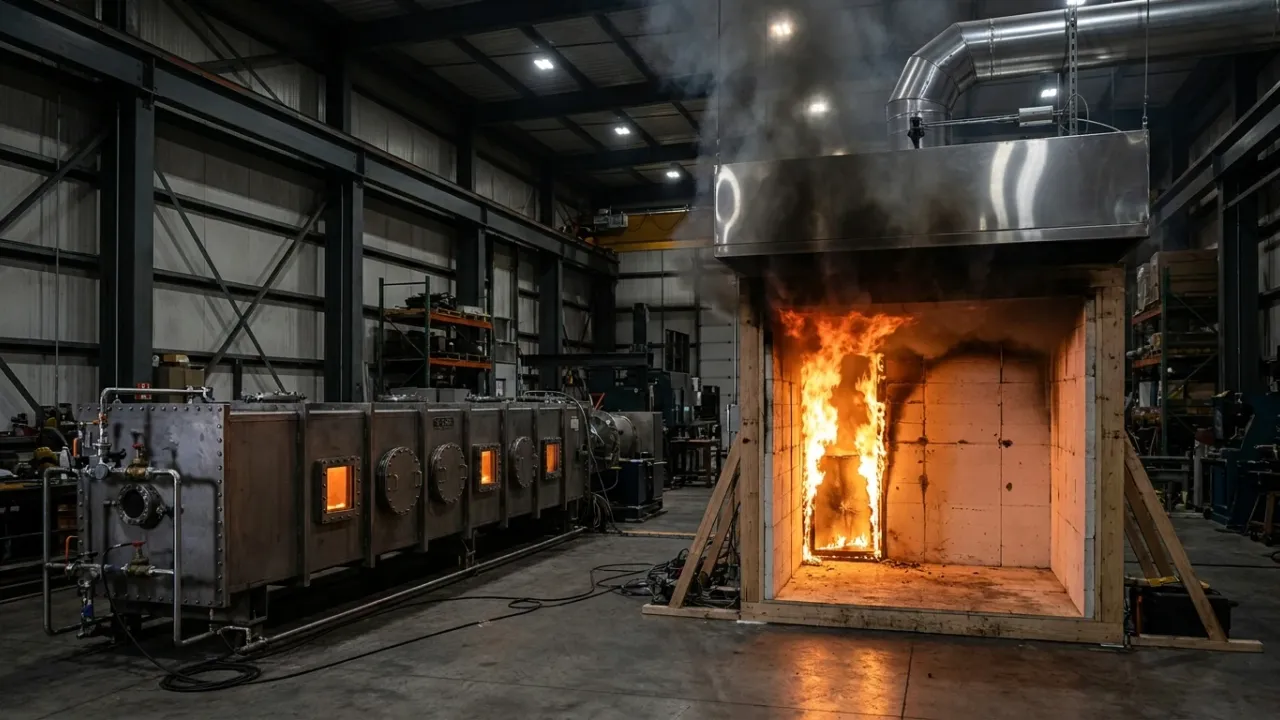
The Single Burning Item test, or SBI, drives the whole middle of the Euroclass ladder. It stages one burning object in the corner of a room.
The sample forms a right-angled corner from two wings. One wing measures 1.0 m × 1.5 m, while the other measures 0.5 m × 1.5 m. Thickness stops at 200 mm. Then a trolley rolls that corner into a steel box lined with calcium-silicate board. Above sit a hood, a collector and an exhaust duct. Sensors in the duct read temperature, light loss, oxygen, carbon dioxide and flow, while extraction runs near 0.6 m³/s.
The ignition source deserves its own line. A triangular propane sand-box burner sits at the foot of the corner. It delivers 30.7 kW ± 2.0 kW over roughly 300 cm², or about 40 kW/m². People round that to “30 kW” in conversation, yet the calibration tolerance genuinely matters. Meanwhile a second burner, set away from the sample, gives a baseline for heat and smoke.
Timing follows a fixed script. The whole run lasts 1200 seconds. First the main burner lights at t = 300 s. Then the scoring window covers t = 300 s to t = 900 s. So every headline number describes the first 600 seconds of exposure.
EN ISO 11925-2 — the small-flame test
This method draws the E/F line. It also backs up classes B, C and D. A 20 mm propane flame meets an upright sample at 45°.
Samples measure 250 mm × 90 mm. The flame touches either the face, 40 mm up from the edge, or the bottom edge itself. Exposure lasts 30 seconds for B, C and D, but only 15 seconds for E. Then the lab asks one question: did flame spread Fs reach 150 mm in time? Filter paper below catches drips, and its ignition forces a d2 class on the spot.
EN ISO 9239-1 — the radiant panel for floors
Floors burn differently, so they get their own method. A flat sample faces a graded radiant flux for 30 minutes.
The scoring quantity here is critical heat flux, or CHF. Specifically, it means the flux at the furthest point the flame reached. So A2fl and Bfl need CHF ≥ 8.0 kW/m², Cfl needs ≥ 4.5 kW/m², and Dfl needs ≥ 3.0 kW/m². Fire creeps sideways along a floor rather than climbing a wall. Here, therefore, the radiant flux does the work a corner plume does elsewhere.
How does the SBI split A2, B, C and D?
Two numbers split them: FIGRA and THR600s. Both come from heat release rate in the exhaust duct. A third check then asks whether flame reached the far edge of the long wing.
Heat release comes from oxygen-consumption calorimetry, the same principle that runs the cone. Smoke likewise comes from light loss in that duct. From those two signals the standard builds four indices.
FIGRA, the fire growth rate index, takes the steepest average rise in heat release:
That quotient behaves badly at the start, because the denominator sits near zero while the numerator sits in noise. So the standard switches the sum on only after enough heat has come out:
The 0.2 MJ switch governs the A2/B line. Then the 0.4 MJ switch governs C/D.
THR600s simply adds up heat release across the window:
SMOGRA mirrors FIGRA, but it uses smoke production rate and its own scale factor:
TSP600s then adds up smoke over the same 600 seconds.
Next come the limits themselves, as fixed by Regulation (EU) 2016/364:
| Class | SBI limits (EN 13823) | Small flame (EN ISO 11925-2) |
|---|---|---|
| A2 | FIGRA ≤ 120 W/s; no flame at edge; THR600s ≤ 7.5 MJ | — |
| B | FIGRA ≤ 120 W/s; no flame at edge; THR600s ≤ 7.5 MJ | 30 s; Fs ≤ 150 mm in 60 s |
| C | FIGRA ≤ 250 W/s; no flame at edge; THR600s ≤ 15 MJ | 30 s; Fs ≤ 150 mm in 60 s |
| D | FIGRA ≤ 750 W/s | 30 s; Fs ≤ 150 mm in 60 s |
| E | — | 15 s; Fs ≤ 150 mm in 20 s |
| F | — | Fs > 150 mm in 20 s |
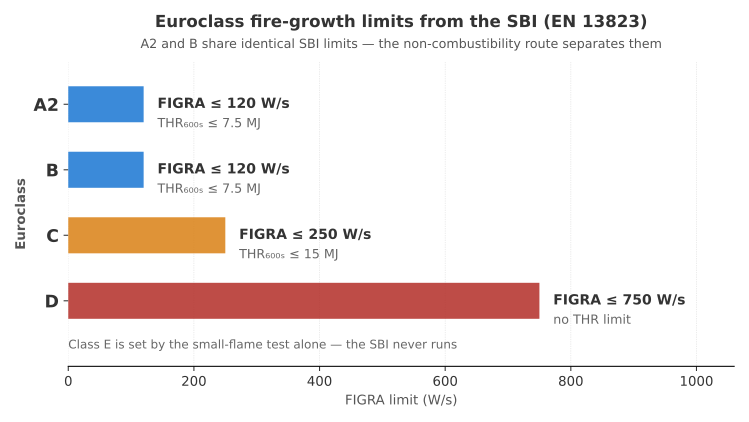
Look hard at the first two rows, because A2 and B carry identical SBI limits. What splits them lies outside the SBI, since an A2 product must also clear the furnace or the calorimeter. So the step from “limited combustibility” to “very limited effect” rests on a combustibility route, not on fire growth.
Pipe insulation runs the same rig with looser limits, since lagging presents a different shape. A2L and BL allow FIGRA ≤ 270 W/s. Then CL allows ≤ 460 W/s, while DL allows ≤ 2100 W/s.
Why did Europe build the SBI?
Europe built the SBI as a cheap stand-in for the full-scale room corner test, ISO 9705. That reference fire steps a corner burner from 100 kW to 300 kW inside a standard room.
CEN/TC 127 developed the method through the 1990s, because the Commission wanted to replace a patchwork of national classes. Fires at Düsseldorf airport and in the Channel Tunnel sharpened that appetite. National classes then gave way to the Euroclass scheme from 1 January 2001.
Calibration aimed at one target. Ideally, FIGRA from the SBI should predict flashover in ISO 9705. Reported correlation reached about 95% for linings, and roughly 90% of materials tracked well. SMOGRA, by contrast, tracks poorly across the two scales. That gap matters, because smoke drives most fatal exposure in enclosures.
How repeatable is an SBI result?
Less repeatable than one printed number suggests. Between labs, results scatter by roughly 21% to 34% as a relative coefficient of variation.
Those figures come from the second round robin, run through EGOLF. Van Mierlo and Sette (2005) reported them in HERON. Inside one lab, the spread ran 11% to 20%. Between labs it widened to 21% to 34%. First, though, the authors dropped very low mean values, since small absolute scatter looks huge against a near-zero mean.
Work out what that means at a boundary. Take a product whose true FIGRA sits on the A2/B line. Then take the middle of the scatter band:
A single result then carries a 95% interval of about
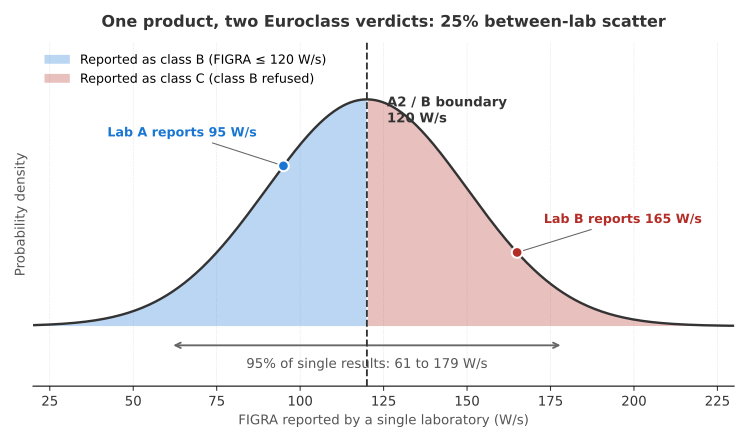
So one lab reports 95 W/s and grants class B, while another reports 165 W/s and refuses it. Neither lab did anything wrong. The scatter belongs to the method, and mounting and fixing of the sample dominates it. So a Euroclass near a boundary carries more uncertainty than the certificate shows.
Two further weak spots showed up in the round robins. First, FR polycarbonate released plenty of heat in the SBI, yet it never flashed over in ISO 9705. Second, a metal-faced sandwich panel released almost nothing at more than half the labs, then flashed over in ISO 9705 anyway. So the method both over-predicts and under-predicts, depending on the product.
Thermoplastics that melt deserve special suspicion. Because the corner shape lets molten material run away from the flame, that escape flatters the result. Anyone who has read the UL 94 drip criteria will know the pattern. Geometry decides a grade as much as chemistry does.
Why does a Euroclass miss facade behaviour?
A Euroclass rates one component under one corner fire. An external wall behaves as a system instead. So the main drivers of a facade fire never show up in the SBI.
List those drivers and the gap opens up. First, a vented cavity behind a rainscreen creates a chimney effect. Flames then climb past several storeys and radiate back onto the wall above. Meanwhile wind reshapes the attack, and burning debris falls to light fires below. Cladding, insulation, membranes, cavity barriers and fixings also interact. So a 20-minute corner test with a 30.7 kW burner shows none of that, because nobody designed it to.
What happened at Grenfell Tower?
A kitchen fire on the fourth floor reached new rainscreen cladding, climbed the tower and killed 72 people on 14 June 2017. Every component involved carried reaction-to-fire evidence.
The Phase 1 report, from 30 October 2019, named the primary cause. Polyethylene cores in the Reynobond 55 PE panels drove the rapid vertical spread, because they acted as a source of fuel. Then PIR and phenolic foam behind those panels added to the rate and extent.
The Phase 2 Report, from 4 September 2024, went further. It found that Arconic, Celotex and Kingspan had “engaged in deliberate and sustained strategies to manipulate the testing processes, misrepresent test data and mislead the market”. Three findings show the mechanics:
- Arconic learned from testing that Reynobond 55 PE performed badly in cassette form. After 2013 it chose to certify the panel as Class E whatever the form, yet told neither its UK customers nor the BBA. A French lab later rated the riveted form Class C and the cassette form Class E, in December 2014. Still, Arconic stayed silent.
- Celotex ran a BS 8414 test in May 2014 with non-combustible magnesium-oxide boards at critical spots. Then it marketed RS5000 as the first PIR board to pass BS 8414, but without naming those boards.
- Kingspan sold K15 phenolic insulation from 2005 as fit for any wall above 18 m, whatever the design. Only about 5% of the Grenfell insulation by area was K15. Still, the Inquiry found that this false market drew Celotex in as a rival.
The Inquiry also found the BRE complicit for certain products. Much of the wider failure it traced to incompetence at the British Board of Agrément. So the lesson runs deeper than any one material. A component class gave no assurance about the built wall, and the assurance chain around it failed too.
Which large-scale tests fill the gap?
System tests on a full wall fill it, and Europe currently runs a dozen of them. Specifically, a survey across 2017 to 2024 counted 12 national methods in use.
The main ones look like this:
- BS 8414-1 and -2 in the UK, judged against BR 135. One version uses a masonry substrate, while the other uses a steel frame. Limits then apply to temperature rise at set heights and times.
- DIN 4102-20 in Germany. Its rig geometry sits close to BS 8414, though neither method uses secondary openings.
- SP Fire 105 in Sweden. The rig carries a 6 m × 4 m wall with window openings and a projecting eave.
- LEPIR II in France. Here a two-storey compartment carries real windows.
- NFPA 285 in the USA. This method judges non-load-bearing wall assemblies containing combustible parts.
- ISO 13785-1 and -2, at intermediate and large scale.
Exposure runs from about 15 to 45 minutes across these methods. Fire sources, rig sizes and pass criteria also differ. So a pass in one method transfers to none of the others, and no Euroclass substitutes for any of them.
Even the best-known method draws criticism. A critical appraisal in Fire Technology made three points about BS 8414. First, the test never measures the heat flux hitting the facade. Second, the wood-crib fire load can vary by at least a factor of two. Third, ambient ventilation shifts the thermal attack. Later work in the same journal modelled how wind and fire source change that exposure. Empirical does not mean worthless, though. It does mean a pass carries wider tolerance than most specs assume.
A harmonised European method has now arrived. In 2017 DG GROW funded project SI2.825082, led by RISE with BAM, BRE, Efectis and ÉMI. The result offers two exposure levels, medium and large, and both cover fire spread and falling parts. Validation drew input from 29 labs, then ran four facade systems at three labs for 24 tests. Finally the Commission approved the roughly 250-page report in 2024, and CEN is carrying it toward a standard.
What did the UK change after 2017?
The UK banned combustible materials outright in the external walls of taller homes. Regulation 7(2) of the Building Regulations 2010 carried that change, while SI 2018/1230 brought it into force on 21 December 2018.
Under the ban, anything forming part of an external wall on a relevant building must reach Class A1 or Class A2-s1,d0. Initially a relevant building meant any building with a storey at least 18 m up that contains a dwelling. Later extensions then pulled in hospitals, care homes and student housing. Meanwhile Regulation 7(3) exempts a short list, such as gaskets, sealants, cavity trays and membranes.
Note what that did to the evidence route. For those buildings the ban removed BS 8414 as an option, because no large-scale pass rescues a combustible material there. Then an amendment to Approved Document B took effect in England on 1 December 2022. It dropped the trigger height to 11 m for insulation, fillers and spandrel or balcony parts. Subsequently the Building Safety Act 2022 and PAS 9980:2022 joined that regime for existing stock.
Across Europe, though, the picture diverges sharply. Reaction-to-fire classes harmonised cleanly, yet facade rules stay national and height-based. Germany, France and Sweden each want different large-scale evidence. So one product with one Euroclass can pass in one Member State and fail in another. Closing that gap is exactly the point of the new European method.
Can you translate a Euroclass into BS 476 or ASTM E84?
No. These systems use different rigs, sample orientations, ignition sources and criteria. Any mapping therefore stays approximate, and no regulator treats it as binding.
That warning needs repeating, because comparison charts circulate widely and look official. Use the table below to orient yourself, but never to justify a spec:
| Euroclass | UK BS 476 (old) | German DIN 4102 | French M-class | US ASTM E84 |
|---|---|---|---|---|
| A1 | Non-combustible | A1 | M0 | No equivalent |
| A2-s1,d0 | ~Class 0 | A2 | M0 / M1 | ~Class A |
| B | ~Class 0 | B1 | M1 | Class A: FSI 0–25 |
| C | ~Class 1 | B1 | M2 | Class B: FSI 26–75 |
| D | ~Class 3 | B2 | M3 | Class C: FSI 76–200 |
| E | — | B2 / B3 | M4 | — |
| F | — | B3 | — | — |
ASTM E84, the Steiner tunnel, reports a Flame Spread Index against red oak at 100 and cement board at 0. Yet it watches surface flame spread and nothing else, so no reliable route runs from FSI to FIGRA. The quarrel between E84 and room-corner results covers that ground in detail. French M-classes come from NF P92-507, while German B1, B2 and B3 come from DIN 4102-1. Even the popular pairing of M1 with B-s1,d0 carries a caveat in its own sources.
Which materials land in which Euroclass?
Chemistry maps onto the Euroclass ladder fairly well. Mineral products hold the top, while treated organics hold the middle and raw polymers hold the bottom.
- A1: concrete, stone, brick, ceramics, glass, steel, mineral wool, fibre cement, including low-organic gypsum.
- A2: mineral-wool-cored sandwich panels, many fibre-cement boards, paper-faced plasterboard, and also ACM with a mineral-filled core.
- B: pressure-treated fire-retardant timber, some phenolic foams, plus FR-modified products.
- C and D: raw solid timber and most wood panels, typically near D-s2,d0. Denser or thicker timber can approach C, though.
- E and F: EPS, XPS and PUR or PIR foams without protection, such as bare insulation boards, plus many thermoplastics.
Many A1 products never see a furnace at all. Commission Decision 96/603/EC lists materials deemed Class A1 without further testing. They must contain no more than 1.0% organic matter, spread evenly. That route, known as CWFT, saves real money. Still, it grades by material family rather than by testing the actual product. So check the make-up before you accept the claim.
Now place the Grenfell products on that ladder. ACM with a polyethylene core ended up classed only as E in cassette form. PIR and phenolic insulations remain combustible plastics. Neither reached A1 or A2. Instead their use on tall buildings rested on system tests that turned out to be misrepresented.
How should you read a Euroclass on a datasheet?
Read a Euroclass as an incomplete claim until you hold the classification report. The letter alone says nothing about the set-up in which the product earned it.
Six habits then close most of the gap:
- Ask for the full string and the report. A bare “Class B” hides the smoke and drip suffixes, while a bare “Class 0” comes from a withdrawn British scheme.
- Check the tested end-use set-up. Substrate, cavity, joints and fixings all shift results, so a class holds only for what the lab built.
- Check the standard editions. EN 13501-1:2018 and EN 13823:2020 carry different dates on purpose.
- Distrust a result near a boundary. Given 21% to 34% scatter, a FIGRA just under 120 W/s needs backing.
- Refuse translated classes. If a product carries only ASTM E84 Class A, ask for testing to EN 13501-1 instead.
- Never read a component class as facade evidence. For external walls, demand a system test on the exact build-up.
One more thing changed recently. Regulation (EU) 2024/3110, the new Construction Products Regulation, entered force on 7 January 2025. It replaced Regulation 305/2011, and most of it applies from 8 January 2026. So it brings a Digital Product Passport, mandatory Environmental Product Declarations and a new System 3+ level. Crucially for fire, though, it leaves the reaction-to-fire framework alone. EN 13501-1 and its methods stay in force until new harmonised specs appear.
Key takeaways
The Euroclass scheme does its job well inside its own scope. It ranks how much a product feeds a growing fire. A corner test calibrated against a real room fire produces that ranking, while EU law fixes every boundary. So for linings, boards and finishes inside a room, the letter carries real information. Harmonising all of that across the Member States was also a genuine achievement.
Two limits deserve permanent attention. First, the numbers scatter. A between-lab spread of 21% to 34% can move a product across a boundary while the product itself stays the same. So a single result near 120 or 250 W/s should never carry a life-safety call alone. Second, and far more seriously, a Euroclass rates a component. Cavities, storeys, wind and falling debris belong to systems, yet the SBI never had to see them.
Grenfell settled that argument at appalling cost, because panels and insulation held classes while the built wall killed 72 people. So the rule for anyone specifying an external wall stays simple. First screen materials with the Euroclass, then demand system evidence on the exact build-up you intend to build. Overall, the letter answers a smaller question than a facade asks.
Cite this articleHow to cite
Dinh, D. C. (2026, July 31). Euroclass A to F: How Europe Rates Reaction to Fire. PyroRisk. https://pyrorisk.net/blog/euroclass-a-to-f-reaction-to-fire/
Recent posts
Featured posts
Categories
Comments
Related posts
Fire Testing
Heat Release Rate: Why HRR Is the King of Fire Science
Why heat release rate is the single most important number in fire science: how labs measure it, what it predicts, and why it outranks smoke toxicity.

Fire Testing
UL 94 V-0 Decoded: What the Plastic Fire Rating Means
A UL 94 V-0 mark means a plastic bar self-extinguishes under a 50 W flame. Here is what the test measures, and the four things it never promises.
Fire Testing
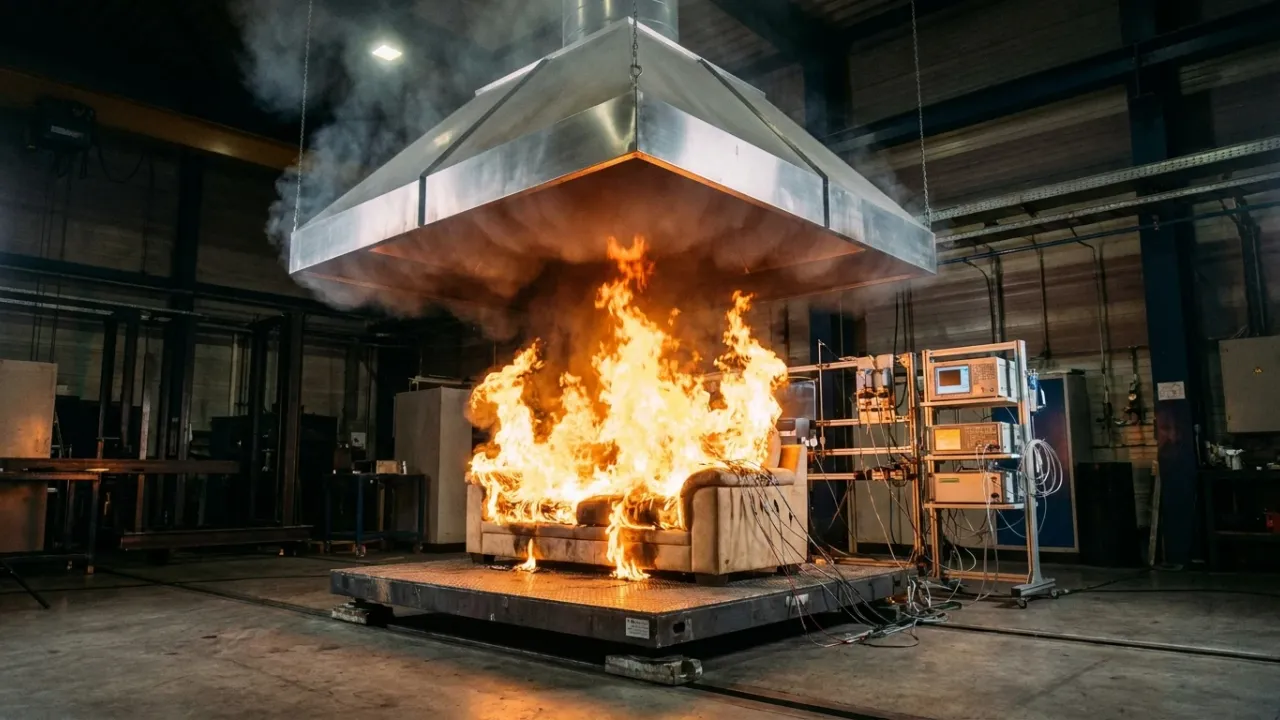
ASTM E84 vs ISO 9705: Why Fire Tests Disagree on Walls
How the ASTM E84 Steiner Tunnel and the ISO 9705 room corner test can rate the same wall lining Class A and a flashover hazard, and which to trust.