Smoldering vs Flaming: The Fire That Kills You in Sleep
A smoldering fire shows no flame and little heat, yet it loads a house with carbon monoxide for hours while you sleep. Here is the chemistry that kills.
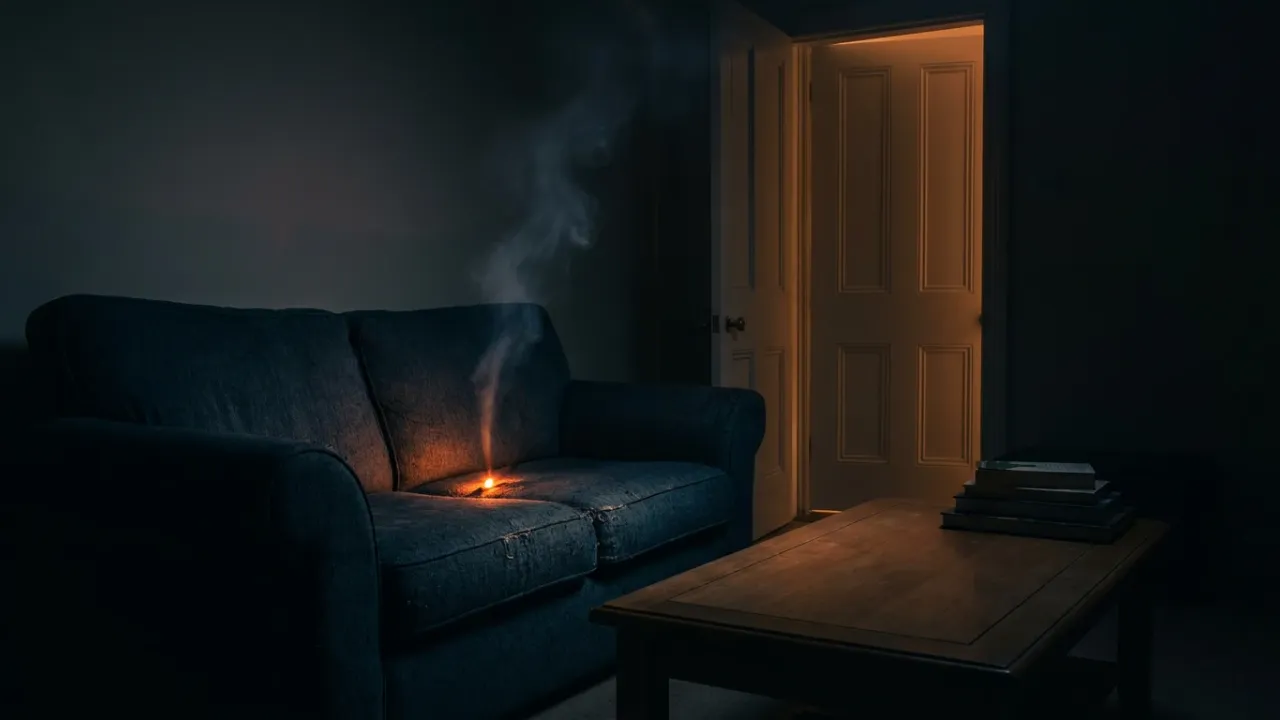
Most people picture the same death in a house fire. Flames come. The heat and the roar wake you. You run. But the fire that kills the most people at night does none of that. It shows no flame. Almost no light escapes it. It makes little sound. And it never gets hot enough to wake a sleeper. So a smoldering fire kills by chemistry, not by heat.
TL;DR
- Smoldering burns with no flame. Oxygen attacks the hot solid itself.
- A smolder front creeps at about 0.1 mm/s, so it can run all night.
- The cool fire is the deadly one. It makes 6 to 10 times the carbon monoxide of a clean flame.
- Fires that start on soft furniture lead all home-fire deaths in the US, near 600 a year.
- Such fires kill about 14 times more often than other home fires.
- Smolder-started fires cause more than a quarter of US fire deaths.
- Being asleep was the top human factor in fire deaths, at 46%.
- A sleeper in 400 ppm of carbon monoxide is badly poisoned in four hours.
- Ionization alarms can lag a smoldering fire by 15 to 50 minutes.
- Fit photoelectric smoke alarms and carbon monoxide alarms near every bedroom.
What is a smoldering fire?
A smoldering fire is slow, flameless burning at the surface of a solid. Oxygen attacks a hot char directly and releases heat right there. No flame sits above it.
That single fact splits combustion into two families. Flaming is a gas-phase reaction: the solid heats up, sheds volatile gas, and that gas mixes with air and burns in a bright flame above the surface. Smoldering is a surface reaction, so nothing burns in the open air. The heat appears inside the material, exactly where you cannot see it.
Because it is a surface reaction, smoldering stays picky about fuel. It needs a porous material that forms a char when hot. So the list of smolder-prone materials is short and familiar: foam, cotton, sawdust, cellulose insulation, tobacco, and peat. Each one holds a huge internal surface for the reaction. Each one lets air seep inward. And each one traps heat, which helps the reaction feed itself. Solid plastics that simply melt cannot smolder at all.
Permeability matters as much as chemistry. Air has to reach the reaction zone through the pores, and Darcy’s law sets that flow:
Here gives the permeability of the material, the gas viscosity, and the pressure gradient driving the flow. Squeeze the pores shut and collapses, so the air stops arriving. Researchers measured that limit directly: cotton packed above about 225 kg/m³ behaves like a solid block and becomes hard to ignite at all.
The oxygen threshold runs remarkably low. Flaming needs a rich atmosphere, yet a smoldering front can hold on at oxygen levels near 3%. So a smoldering fire survives conditions that would snuff out any flame.
How fast does a smoldering fire spread?
A smolder front creeps at roughly 0.1 mm/s. That runs about ten times slower than flame over a solid surface, and up to a hundred times slower than flame spread in general.
Near its limit the pace drops further still. Recent work on the minimum self-sustaining smolder recorded fronts as slow as 0.5 cm/h at a front temperature near 300 °C. Push the oxygen, density, or moisture past that point, and the reaction quenches for good.
Oxygen supply, not chemistry, sets the pace. The front can only consume fuel as fast as air delivers oxidizer to the char, so the velocity follows a simple mass balance:
In that expression is the oxygen mass flux reaching the front, the fuel density, and the mass of oxygen needed per unit mass of char. Starve the flux and the front crawls. Feed it and the front speeds up and runs hotter, until the airflow finally cools the reaction faster than the reaction can heat itself. Then it dies.
Direction matters too. In opposed smolder the front advances against the airflow, and it settles quickly into a steady, heat-transfer-limited crawl. In forward smolder the front travels with the flow, so hot product gas sweeps ahead and preheats fresh fuel. That builds a separate pyrolysis front running ahead of the char oxidation, and the whole thing turns unsteady. Field data on peat fires show both modes at once, with downward spread running cooler, near 300 °C.
This slowness offers no mercy. Instead it is the entire weapon. A fire that advances a few centimeters an hour can run all night, quietly filling a house with poison, without ever announcing itself.
Why does a cigarette on a sofa kill so often?
A cigarette is too weak to flash fabric into flame, yet it is a nearly perfect smolder igniter. It delivers a small, steady heat flux for many minutes, right inside the one place where air still reaches the foam.
Picture the classic fatal fire. Late at night, a lit cigarette slips down between the seat and back cushions of a sofa. It cannot set the cover fabric alight. But it can start a smoldering spot in the fabric and the foam or cotton batting underneath.
Then the reaction creeps through the cushion for hours. It makes heat, smoke, and poison gas the whole time, while showing no flame and casting no light. Meanwhile the people asleep upstairs never smell the smoke in time. The rising carbon monoxide instead pulls them deeper into sleep, so they die of poisoning, often before a single flame appears.
The statistics behind that scene are brutal. According to NIST, which has chased this problem for decades, the gas alone can turn deadly within about half an hour. That happens well before any flame. Fires that begin on soft furniture lead the causes of home-fire death in the United States, near 600 deaths a year. Such fires also prove about 14 times more likely to kill than other home fires. And smolder-started fires account for more than a quarter of US fire deaths, with similar shares abroad.
The human-factors data sharpen the point. The US Fire Administration found that the leading human factor in residential fire deaths was simply being asleep, at 46%. Physical disability followed at 30%, then alcohol impairment at 16%. Smoke, not burns, does most of the killing. So the slow smoldering path reaches a sleeping person unusually well.
One honest caveat belongs here. These national figures come from voluntary reporting, and the human-factor field is coded in only part of the records. So “asleep in 46% of cases” describes that coded subset, not every fire death.
Why does the cooler fire kill more sleepers?
Because temperature is not what kills you in a residential fire. Chemistry is. And smoldering runs at exactly the temperature that maximizes poison per gram of fuel.
Smoldering peaks near 500–700 °C in the char oxidation zone, with the coolest fronts around 300 °C. A flame runs far hotter. The adiabatic flame temperature for ordinary hydrocarbons in air sits near 1,950 °C, and real fires reach roughly 1,500–2,000 K.
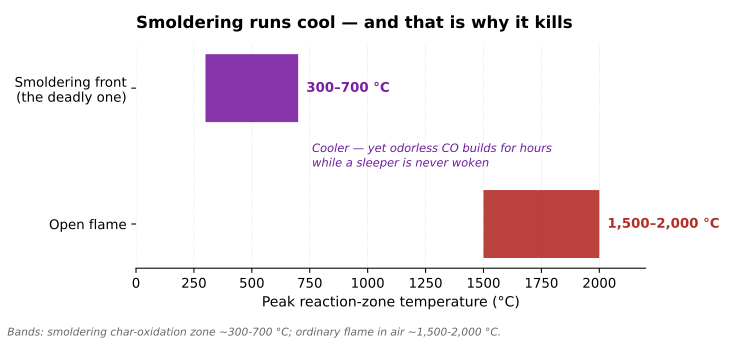
So why does the cooler fire win? Three effects stack up.
First, chemistry. A cool, air-starved reaction cannot finish oxidizing its fuel, so it makes far more carbon monoxide per gram. A hot flame burns clean and mostly makes carbon dioxide instead.
Second, no arousal cue. A flame gives you light, sound, and a wave of heat. A smoldering fire gives you none of those. Its heat stays too weak and too local to warm the room, so nothing wakes the sleeper.
Third, duration. A flaming room fire either kills or burns out in minutes. A smoldering couch runs for hours, and every one of those hours adds to the dose in a sleeper’s blood.
Why does smoldering make so much carbon monoxide?
Smoldering is the extreme case of oxygen-starved combustion, and starved combustion makes carbon monoxide. So it produces some of the highest yields of any common fire short of a post-flashover blaze.
Fire scientists index that starvation with the equivalence ratio:
Below 1.0 a fire runs fuel-lean, hot, and efficient. Above 1.0 it runs fuel-rich, and the chemistry sours fast. Smoldering sits at the far end of that scale, where oxygen never arrives quickly enough to finish the reaction.
One ratio tells the story better than any yield table. In smoldering effluent, carbon monoxide and carbon dioxide appear in roughly equal amounts. In clean flaming smoke, the same ratio falls near one to ten. So the slow fire ships about ten times the poison for the same carbon dioxide.
Here is how the yields compare, in grams of carbon monoxide per gram of fuel consumed:
| How it burns | Yield (g/g) |
|---|---|
| Smoldering peat | ~0.17 |
| Smoldering foam or cotton | ~0.1–0.2 |
| Clean flame, flexible foam | ~0.028 |
| Clean flame, polymers at Φ < 1 | ~0.01–0.05 |
| Starved flame at Φ ≈ 1.5–2 | ~0.2 |
| Post-flashover flame | ~0.24 ± 0.09 |
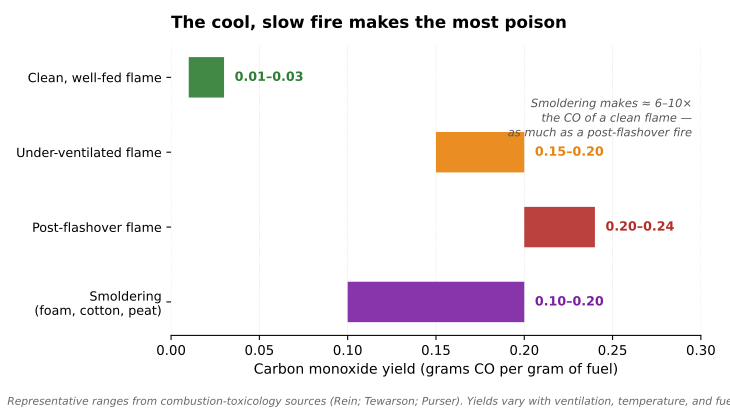
Read the chart carefully, because the honest comparison has a limit. Smoldering makes roughly 6 to 10 times the carbon monoxide of a clean, well-ventilated flame. Against a starved room fire after flashover, though, it runs comparable rather than higher. The order-of-magnitude gap belongs specifically to the clean-flame comparison.
Treat every number above as condition-specific. Yields depend on ventilation, temperature, moisture, and scale, so they are not material constants. The 0.17 g/g figure comes from boreal peat, while foam and cotton vary around it. What they share is the signature: a carbon monoxide to carbon dioxide ratio near unity.
Does smoldering foam also release cyanide?
Yes. Flexible polyurethane foam is a nitrogen-rich polymer, so its effluent carries hydrogen cyanide alongside carbon monoxide.
That matters because cyanide is roughly 35 times more acutely toxic than carbon monoxide, and it acts faster. Carbon monoxide starves your blood of oxygen over hours. Cyanide jams the enzyme that lets your cells use oxygen at all, so collapse arrives in minutes. Our post on smoke inhalation works through both mechanisms in more depth.
Cyanide yields also climb with the equivalence ratio, exactly like carbon monoxide. Non-flaming decomposition of foam produces mainly isocyanates and carbon monoxide, yet under-ventilated and smoldering conditions push the nitrogen toward cyanide instead.
Then comes the unsettling part. A toxicity assessment of foam combustion products found that flaming foam produces blood levels consistent with simple carbon monoxide exposure, so the standard models work. Smoldering foam did not behave that way. It appears to release still-unidentified toxicants that help explain deaths which carbon monoxide and cyanide alone cannot. In practice, treat any standard toxicity model as a lower bound for smoldering.
How does carbon monoxide kill you in your sleep?
Carbon monoxide kills by taking the seats that oxygen needs. It binds hemoglobin 200 to 250 times more tightly than oxygen does, forming carboxyhemoglobin, written COHb, which carries nothing.
The Haldane relation captures that competition:
Here is the affinity ratio, near 200 to 250. So even a trace of carbon monoxide in the air captures a large share of your blood. The damage then doubles, because bound carbon monoxide also warps the release curve, so whatever oxygen still rides on your blood clings on instead of feeding tissue.
The gas gives no warning at all. It has no color, no smell, and no taste, and it does not sting your nose. So a sleeping body has no reason to wake.
Dose, not concentration, decides the outcome. The Coburn-Forster-Kane equation is the standard toxicokinetic model, linking inhaled concentration, exposure time, breathing rate, blood volume, and hemoglobin content to COHb uptake. Purser’s simplified form makes the arithmetic easy:
In that equation gives the level in ppm, the breathing rate in litres per minute, and the time in minutes. Now put a sleeper into it. A sleeping adult breathes only about 6 L/min, so the loading looks slow: roughly 0.1 points per minute at 400 ppm. But sleep supplies the other factor. Four hours at that level gives about 24% COHb, and six hours gives about 36%. Double the concentration to 800 ppm, and four hours reaches roughly 48%.
Those numbers land squarely on the dose-response ladder. A healthy adult starts near 0.5%, and smokers run higher. At 10–20% comes a headache with coordination mostly intact. At 25–30% the poisoning turns severe. Near 40% confusion and loss of coordination arrive, so a person can no longer act to save themselves. Above 50% is usually fatal.
For context on the air side, NIOSH sets the immediately dangerous level at 1,200 ppm. A smoldering sofa in a closed house passes a few hundred ppm easily, and the sleeper simply supplies the hours.
Vulnerability shifts the whole ladder down. The AEGL analysis treats 40% as a reasonable lethality threshold for healthy adults, yet death can occur near 15–20% with heart disease, alcohol, or cyanide in the mix. Carbon dioxide in the effluent makes it worse still, since it drives faster breathing and speeds every other uptake.
Why doesn’t the smell of smoke wake you?
Because nothing in a smoldering fire triggers arousal. The comforting belief that the smell of smoke will wake you fails on every channel your body has.
The lethal gas is odorless, so smell offers nothing. No flame means no light reaches your eyes. Almost no sound travels. Heat stays too low and too local to warm the room. And the one thing that does reach you, the rising carbon monoxide, only deepens the sleep it found you in.
That is the cruel symmetry of the smoldering scenario. Every hour of warning it gives you is an hour spent making you less able to use it.
When does a smoldering fire burst into flame?
A smoldering fire flames when a sudden gulp of air reaches hot char. The transition is a gas-phase ignition event, so it needs both a flammable mixture of pyrolysis gases and a hot enough surface to light them.
In a sofa the trigger is usually a burn-through. The smolder wave eats through the underside of a cushion, which opens a path for buoyant airflow straight into the hot zone. Investigators studying fire patterns on upholstered furniture observed a burn-through in every test where the transition happened.
Laboratory work fills in the mechanism. Studies of flexible foam tie the transition to the velocity of a secondary char oxidation wave, forming in voids behind the smoldering front. A review of the transition sets an oxygen threshold near 10%, below which flaming generally does not occur, plus a critical oxidizer velocity. And bench tests that enhanced buoyant airflow through foam raised smolder rate and temperature sharply, after which flaming followed.
So one smoldering couch threatens you in two separate ways. It can poison sleepers slowly through the night. Or it can flip to flame and drive the room to flashover within minutes. NIST notes that about two-thirds of fire deaths occur in fires that reach flashover, and that furniture without a fire barrier flashed a room over in under seven minutes, against more than twenty minutes with one.
Why does your smoke alarm miss a smoldering fire?
Because the most common alarm technology is tuned to the wrong particles. Smoldering smoke is cool and coarse, while ionization sensors respond best to the fine particles of a fast flame.
The gap is large. An ionization alarm can lag a smoldering fire by 15 to 50 minutes compared with a photoelectric unit. It also produces most nuisance alarms, from toast and steam, so it is the type people disable. A photoelectric alarm scatters light off the large particles that smoldering smoke is made of, so it alarms far earlier in exactly the phase that dominates fire deaths.
Treat the specific minute figures as indicative rather than exact, since they vary with fuel and geometry. The direction, though, is well established across NIST and UL testing: photoelectric wins on smoldering, ionization wins slightly on flaming.
A carbon monoxide alarm outside the bedrooms may give the earliest warning of all in this specific scenario, because the smoldering couch produces gas long before it produces much visible smoke. Yet it cannot replace a smoke alarm, since it will miss a fast flaming fire entirely. So fire services recommend both: photoelectric or dual-sensor smoke alarms, plus separate carbon monoxide alarms outside every sleeping area and on every level.
How should engineers model a smoldering fire?
Use smoldering-appropriate yields, and stop borrowing numbers from well-ventilated flame tests. That single substitution changes the tenability answer by close to an order of magnitude.
Four practical rules follow from the science above:
- Set carbon monoxide yields near 0.1–0.2 g/g for smolder-dominated scenarios, not the 0.01–0.03 g/g of a clean flame.
- Include hydrogen cyanide explicitly whenever the fuel contains nitrogen, which covers essentially every foam mattress and sofa.
- Treat the standard dose model as a lower bound, given the evidence that smoldering foam releases toxicants nobody has yet identified.
- Lower your COHb threshold for vulnerable occupants. Design to 15–20%, not 40%, where residents may have cardiac or respiratory disease.
Detection design deserves the same rethink. The heat release rate of a smoldering couch is trivial, often a few tens of watts, so heat detectors and sprinklers will not respond at all. The incubation period, not the flaming phase, is the design case. Anything that only sees a growing flame arrives after the fatal dose.
What actually protects you?
Early warning does nearly all the useful work, because a smoldering fire hands you hours if anything is listening. The habits below are cheap and dull, and they all buy time before the poison takes hold.
- Fit photoelectric or dual-sensor smoke alarms. Put them in and near every bedroom, and in any room with a sofa. Skip ionization-only models for this job.
- Add carbon monoxide alarms. Place one outside each sleeping area and on every floor, and interconnect them if you can.
- Keep smoking away from soft furniture. No cigarettes near a couch, a bed, or an armchair, and never when drowsy.
- Choose safer furniture. Prefer sofas and mattresses that resist cigarette ignition, and models with an internal fire barrier that delays flashover.
- Close bedroom doors at night. A closed door slows the gas as well as the flame.
The honest takeaway
The fire that kills you in your sleep is the one that never looks like a fire. It sheds no light, makes no noise, and stays too cool to wake you, all while it converts a sofa into an odorless poison at ten times the rate a clean flame would. Its slowness is not mercy but method, since every quiet hour adds to the dose in your blood. So treat the flame as the obvious threat and the smoldering ember as the real one. Give yourself an early warning, and the hours that fire spends working against you become the hours that save you.
Cite this article
Dinh, D. C. (2026, July 14). Smoldering vs Flaming: The Fire That Kills You in Sleep (Updated July 24, 2026). PyroRisk. https://pyrorisk.net/blog/smoldering-vs-flaming-the-fire-that-kills-in-your-sleep/
Recent posts
Featured posts
Categories
Comments
Related posts
Smoke Inhalation: Why the Upper Layer Kills You First
Smoke inhalation kills more fire victims than flame does. Here is the toxic upper layer, the CO and HCN dose, and the FED clock that times your escape.
How Hot Is Fire? Adiabatic Flame Temperature vs Reality
Fire has no single temperature. The adiabatic flame temperature sets a 1,950 °C ceiling, yet real fires burn at 800–1,200 °C. Here is why.
Radiant Heat: Why Fire Jumps the Gap Between Buildings
Convection burns up; radiation burns across. How radiant heat, the T⁴ law, and view factors decide whether fire ignites the house next door.