pyrorisk.net · Fire Science & Risk Fire in Daily Life
Space Heater Season: Why 3 Feet and Off at Night Save Lives
A space heater starts a small share of US home heating fires but causes most of the deaths. Radiant heat, tip-over physics and sleep explain why.
Online: pyrorisk.net/blog/space-heater-season-why-3-feet-and-off-at-night-save-lives/
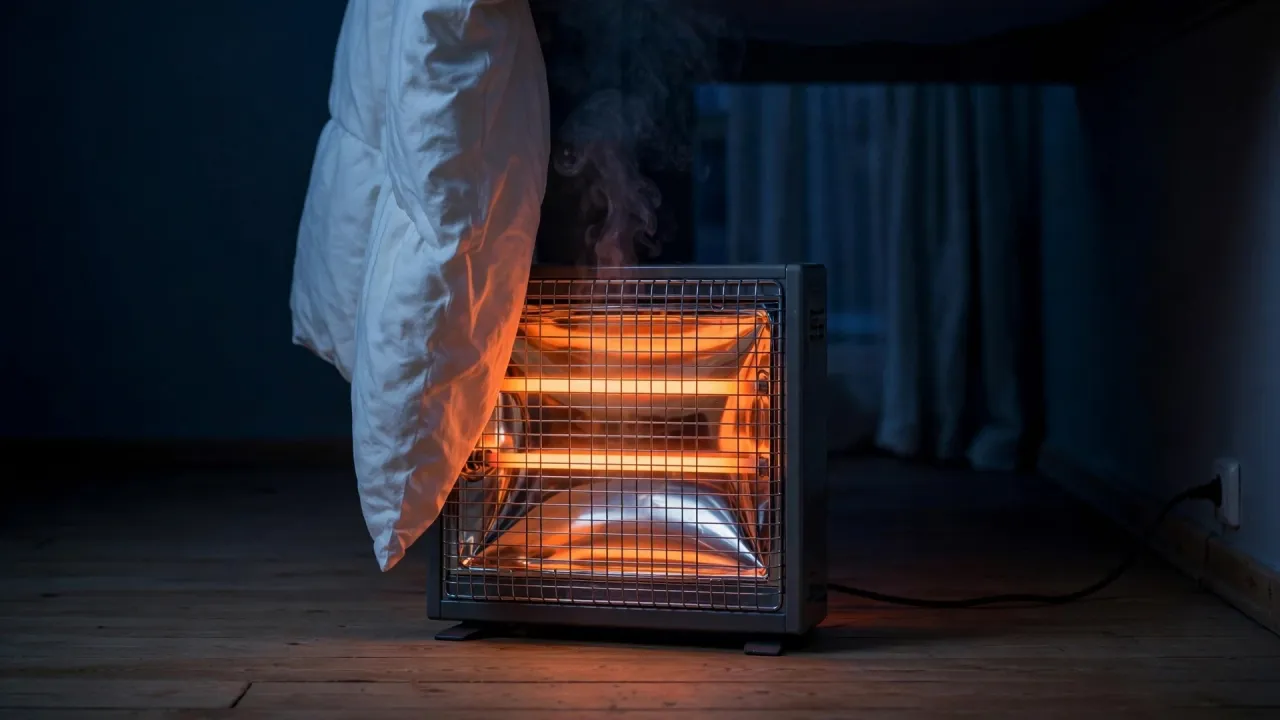
Every winter, the space heater turns into the most dangerous appliance in many homes. In the US, space heaters and heating stoves start about three in ten home heating fires, yet they cause nearly three-quarters of the deaths. Physics explains the gap. A glowing element can hit a nearby blanket with as much heat as it takes to ignite cotton. But that heat fades fast with distance, so one metre of clear space solves most of the problem. The trouble starts at night, when bedding slides off the bed and nobody stays awake to notice.
TL;DR
The numbers
- US fire departments attend about 37,365 home heating fires a year (2020–2024), with 417 deaths. Space heaters and heating stoves cause 73% of those deaths, but only about three in ten of the fires in most NFPA counts.
- Portable heaters cause 3% of residential heating fires but 41% of the fatal ones, according to USFA.
- Heating fires between midnight and 6 a.m. make up 13% of heating fires but 43% of the deaths.
The physics and the fix
- At 2 cm from the grille, CPSC measured about 10–25 kW/m² from radiant heaters. That overlaps the 8–25 kW/m² that ignites sheets, towels and paper.
- At 1 m, a simple estimate gives about 0.14 kW/m², some 50–100 times below those limits.
- So switch the space heater off at bedtime, keep 1 m clear, and plug it straight into the wall. Then link your smoke alarms, and add a CO alarm for any heater that burns fuel.
Why is a space heater the deadliest heating appliance?
Because it puts a heat source next to things that burn, in the rooms where people sleep. Space heaters start a modest share of heating fires, yet they cause most heating fire deaths.
NFPA’s heating safety page puts US home heating fires at 37,365 a year for 2020–2024, with 417 deaths and 1,260 injuries. Space heaters and heating stoves caused 73% of the deaths and 70% of the injuries. The same page gives them 30% of the fires. However, NFPA’s January 2026 release says 47% for the same years. Earlier NFPA figures sit near the lower number, at 33% for 2016–2020 and 29% for 2019–2023. Also, nearly half of heating fires, 46%, happen from December through February.
The US Fire Administration looked at portable units alone. Its topical report counts about 1,100 portable space heater fires a year in residential buildings for 2017–2019, with 65 deaths. These fires made up only 3% of residential heating fires, yet 41% of the fatal ones. In USFA’s records, they caused 29.3 deaths per 1,000 fires, against 1.5 for other heating fires. That gap partly reflects the comparison, since most other heating fires stay confined to a chimney or burner. Still, half of portable heater fires spread beyond the room where they started.
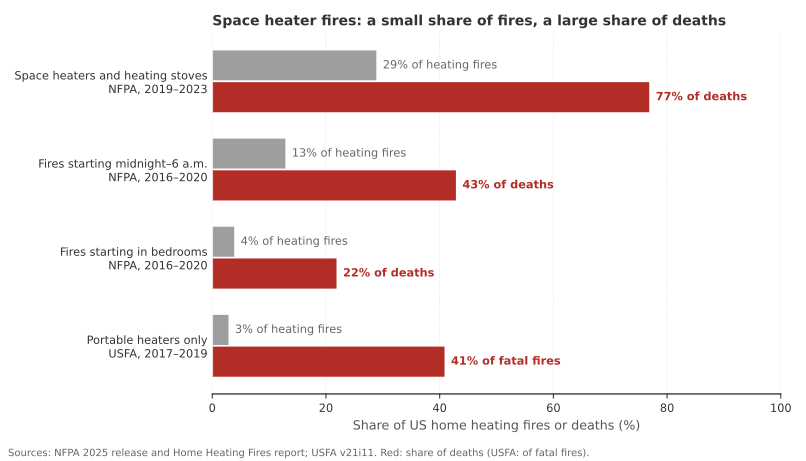
Every factor that brings a space heater close to a sleeping person pushes up its share of deaths, to about three to fourteen times its share of fires.
Why do NFPA, USFA and CPSC numbers differ?
They count different things. NFPA’s space heater group includes fixed heaters and wood stoves, while USFA and CPSC count only portable units.
| Source, years | Scope | Fires/yr | Deaths/yr |
|---|---|---|---|
| NFPA, 2020–24 | all home heating | 37,365 | 417 |
| USFA, 2017–19 | portable heaters | 1,100 | 65 |
| CPSC, 2019–21 | portable heaters | 1,600 | 70 |
| CPSC, 2017–19 | portable electric | 1,400 | 50 |
USFA says space heaters “may be fixed (stationary) or portable”, and wood stoves count too. CPSC uses its own method, as in its 2025 release. So never add these rows together. Still, every cut tells the same story: few fires, many deaths.
Are heating fires getting rarer?
Yes, slowly. US heating equipment fires fell from over 70,000 a year in 2000–2003 to about 42,000 in 2020, and NFPA thinks better heater design helped.
NFPA’s Home Heating Fires report says tip-over cut-offs and better guarding of heating coils likely played a part. England shows a similar trend. There, accidental home fires started by space heating appliances fell 44% between 2010/11 and 2019/20. Yet the death pattern holds there too. In the five years to March 2026, these appliances started 3.2% of accidental dwelling fires but caused 8.0% of the deaths, according to Home Office table FIRE0602.
Where does the 3-foot rule come from?
From habit and from heating codes, not from a space heater test. NFPA and CPSC both repeat 3 feet, about 1 metre, and the physics backs it with a wide margin.
CPSC already told consumers in 2002 to keep heaters “at least three feet from bedding, drapes, furniture, or other flammable materials”. NFPA’s heating tip sheet applies the same distance to furnaces, fireplaces and wood stoves. It also asks for a three-foot “kid-free zone” around open fires and space heaters. Installation codes use similar numbers. For example, OSHA’s construction rules require 36 inches at the sides and rear of radiant-type temporary heaters, but only 12 inches for circulating types.
Product standards, by contrast, do not set a distance. UL tests radiant heaters by draping cotton “fire indicators” over or near them, then checks for ignition within a fixed time. CPSC staff found two weaknesses. First, a pass-or-fail test cannot say how close a space heater came to igniting its cloth. Second, a 2004 CPSC memo warned that white test cotton may absorb heat differently from dyed home fabrics. So the clearance on your label reflects the maker’s advice, not a law of physics.
How does a radiant space heater ignite a blanket?
By radiation. A glowing element keeps pouring energy into any fabric that faces it, until the fabric reaches its ignition temperature.
Heaters come in two broad kinds. Fan and convection heaters warm the air, and air carries heat poorly. So, as CPSC staff note, such air heaters cannot raise an object above their exhaust temperature, typically 100–200 °C. A radiant space heater differs. Under UL’s standards, it has a visibly glowing element at 650 °C or more, with no upper limit.
CPSC’s 2005 flux mapping report explains the danger. “Radiant energy transmission is capable of continuing to heat an object’s surface until its temperature approaches that of the heating element.” Ignition temperatures of household materials run from 233 °C for paper to 590 °C for wool. So a 650 °C element can drive almost any fabric past its limit. The report writes the net exchange between the element (1) and a target (2) as follows.
Here covers emissivity, gives the geometric view factor, and . At 650 °C (923 K), a black surface emits . That sets an upper bound for a target pressed against the element. Our post on radiant heat between buildings explains view factors in more depth.
What heat flux ignites bedding and towels?
Between about 8 and 25 kW/m² for most household fabrics and paper. In one CPSC-cited test, cotton batting 6 inches from a real heater ignited at just 5.4 kW/m².
Engineers call the lowest flux that can ignite a material its critical heat flux, or CHF. CPSC’s fire-indicator studies give the most direct data for home textiles.
| Material | Flux (kW/m²) |
|---|---|
| Sheets, cotton duck, terrycloth | 8–12 |
| Cheesecloth, paper towels, newsprint | 11–25 |
| Ten fabrics, lab apparatus | 15–25 |
| Foam, smoulder onset | 7–13 |
| Cotton batting, ignited 6 in from a heater | 5.4 |
Two points matter here. First, CPSC found that CHF depends strongly on the number of layers and how they hang. So a crumpled duvet against a grille behaves nothing like a single sheet in a cone calorimeter. Second, foam can smoulder at far lower flux than it needs to flame. Hadden and colleagues found that polyurethane foam began to smoulder at 7 kW/m² in their largest samples, but flamed only at 30 kW/m². A smouldering item can later burst into flame, and our post on smouldering vs flaming fires covers that transition.
How long does a fabric take to ignite?
Minutes, once the heat flux clears the fabric’s limit. Yet just below that limit, the same fabric can sit for weeks without igniting.
For thin fabrics, an engineering form of the thermally thin result gives the time to ignition. Tewarson’s approach subtracts the critical flux from the incident flux.
Here gives the fabric’s heat capacity per unit area, and TRP stands for thermal response parameter. Wanna and Tewarson’s study of fabric ignition reported TRP values of 500–2,439 kW·s/m² for ten fabrics. For example, take a fabric with a TRP of 1,000 kW·s/m² and a CHF of 12 kW/m². Against a grille at 20 kW/m², it ignites in about s, roughly two minutes. At 13 kW/m², however, the same estimate gives about 17 minutes. Below 12 kW/m², it never ignites.
Thick materials follow a different form instead.
Babrauskas reviews both forms and their limits in Fire and Materials. The practical lesson: ignition time swings wildly near the critical flux. So a space heater that “has been fine for weeks” may sit just below the threshold. Then a blanket shifts 3 cm.
How much heat does a real space heater give off?
Up to about 25 kW/m² at 2 cm from the grille in CPSC tests. That matches the flux that ignites cotton sheets and towels.
CPSC mapped four radiant heaters built to UL standards with a water-cooled heat flux gauge.
- Heater A, a 1,320 W portable unit, peaked at 9.7 kW/m² at 2 cm.
- Heater C, a 1,500 W portable unit, peaked at 14.1 kW/m² at 2 cm.
- Heater D, a 1,500 W fixed wall unit with an open coil, reached 25.3 kW/m² at 2 cm. It still topped 11 kW/m² at 10 cm.
Heaters A and C emitted most strongly near the bottom of their grilles. That low hot spot matters, since it sits level with bedding that slides to the floor. Earlier CPSC work also measured 2.3 and 6.4 kW/m² at 6 inches from two fixed heaters. The hotter unit ignited draped terrycloth in under 30 seconds. So CPSC staff proposed a design limit of 5 kW/m² at 6 inches from any point on a radiant heater.
Why does 1 metre of clearance work?
Because radiant flux falls roughly with the square of distance. At 1 m, a 1.5 kW space heater delivers only about 0.14 kW/m², far below any fabric’s ignition limit.
A rough model shows the scale. Assume half of the electrical input leaves as forward radiation, so . That round number serves for illustration only; nobody measured it. Then treat the element as a point source radiating into a hemisphere. This holds once exceeds the element’s size of about 0.2–0.3 m.
| Distance | Estimated flux | Compare with |
|---|---|---|
| 0.15 m (6 in) | 5.3 kW/m² | cotton batting ignition, 5.4 |
| 0.30 m (1 ft) | 1.3 kW/m² | full sun, about 1 |
| 0.50 m | 0.48 kW/m² | |
| 0.91 m (3 ft) | 0.14 kW/m² | 50–100 times below fabric CHF |
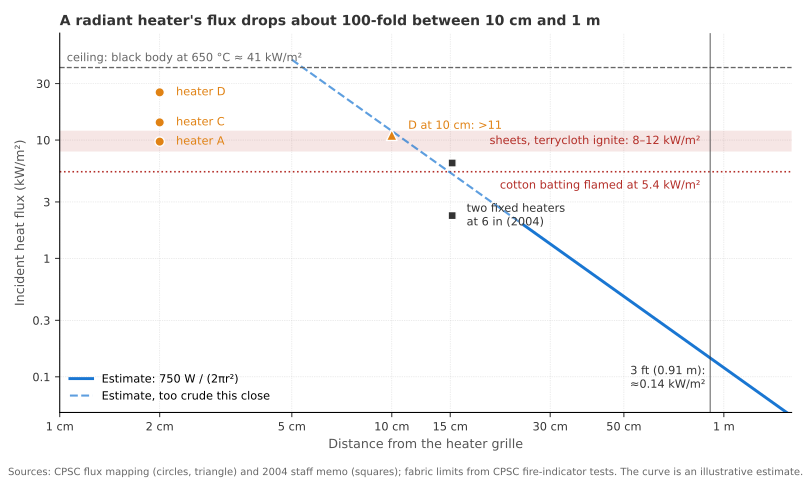
The 15 cm estimate agrees with the flux that ignited cotton batting. So the crude model gets the order of magnitude right. Up close, though, the inverse-square law overshoots. There, flux tops out at , and the view factor reaches 1 only when the target covers the grille. A draped towel or a fallen duvet does exactly that. So the real hazard comes from contact, and the 1 m rule works because it rules out contact even when things fall over.
Are oil-filled and fan heaters safe?
Safer, but not safe. They have no glowing element, yet oil-filled heaters still appeared in 11.6% of US portable heater fires.
Their surfaces run much cooler than a radiant element. However, covering any space heater traps heat and drives its parts past their design temperature. That explains the “WARNING: Do not cover” marking that IEC 60335-2-30 requires on many room heaters. The same standard also tells users not to run glowing radiant heaters on a timer, “since a fire risk exists if the heater is covered or positioned incorrectly.”
Why do space heaters tip over?
Because many stand tall on a small base. In our example, a slim tower heater topples once tilted about 14°, so a bump from a pet or a door can knock it over.
Consider a rigid heater with its centre of gravity at height . Its tipping edge sits a horizontal distance away. So it falls over under gravity alone once tilted past a critical angle.
The geometries below serve as our own illustrations, not measured products.
| Heater type | (m) | (m) | |
|---|---|---|---|
| Oil-filled, splayed feet | 0.15 | 0.30 | 27° |
| Low box heater | 0.10 | 0.12 | 40° |
| Slim ceramic tower | 0.09 | 0.35 | 14° |
That explains why makers add ballast and wide feet. The standards also test stability directly. According to a 2023 CPSC staff review, UL 1278 tilts movable heaters 10° in any direction, and they must return upright. The 2002 edition of IEC 60335-2-30 placed portable heaters on a 15° incline instead. Yet a real bump adds kinetic energy, so the true margin falls below what suggests. The energy needed to tip a space heater over follows this form.
For a 3 kg slim tower, that comes to about 0.34 J. For comparison, a 100 g apple gains the same energy falling 35 cm. A 12 kg oil-filled heater needs about 4 J, twelve times more.
How does a tip-over switch work?
Most use gravity. A ball rolls off its seat, or a plunger drops, as the heater tilts or lifts, and that opens the heating circuit.
Yet UL 1278 does not require a tip-over switch at all. Instead, it overturns the heater onto softwood covered with one layer of terrycloth, which must not char or ignite. Only when a space heater needs its switch to pass that test does UL 1278 require the switch to act before the critical balance angle.
Do tip-over switches actually work?
Mostly, but often late. In a 2023 CPSC test of 27 heaters, 15 of the 25 switches cut power only after the heater had passed its tipping angle.
The CPSC staff assessment found other gaps too. All 25 switches opened at 90°. But 16 heaters switched back on by themselves when set upright. One sample kept running when turned upside down, and UL 1278 has no test for inverted heaters. A space heater that falls face-down onto a rug has its switch open. A heater leaning against a bed or sofa at 30°, however, may keep heating.
What other safety features can fail?
Overheat cut-outs, wick holders and auto-reset limiters. Each forms a second line of defence, and each has failed before.
- Overheat protection. On 4 June 2026, Vornado recalled about 255,000 small tower heaters. Melted parts could ignite “if the thermal cut off or fuse does not timely activate.” The firm had 32 reports of overheating, including eight fires.
- Fuel heaters. A 1995 kerosene heater retrofit replaced wick holders that could stop the tip-over device from putting out the flame.
- Auto-reset limiters. The 2014 edition of UL 1278, in force from 2016, eliminated auto-reset temperature limiters. A limiter that cycles a heater under a blanket all night acts, in effect, like a timer for ignition.
Why should you never plug a space heater into an extension cord?
Because a 1,500 W heater draws 12.5 A for hours. Any worn contact or thin cord along that path turns into a small heater of its own.
On 120 V, the current follows from the power rating.
On 230 V, the same heater draws about 6.5 A, and a typical 2 kW European unit about 8.7 A. The current alone does not start fires, though. Duration does, because most home loads run in short bursts while a space heater runs near full load all night. Heat in any added resistance scales as . For example, take a worn outlet contact with an extra 50 mΩ.
That 7.8 W lands in a few cubic centimetres of plastic. At 8.7 A on 230 V, the same contact still dissipates about 3.8 W. A thin lamp cord also adds heat along its whole length, and when coiled or covered it cannot shed that heat. These figures serve as illustrations, not measurements.
Every major body gives the same advice. CPSC says to plug a space heater directly into a wall outlet, never into an extension cord or power strip. ESFI adds that nothing else should share that outlet. In USFA’s data, electrical failures played a part in 12% of portable heater fires with a known cause, and short-circuit arcs in 5%.
Why is “just for the night” so dangerous?
Because sleep removes the person who would notice. Heating fires between midnight and 6 a.m. make up 13% of heating fires but 43% of heating fire deaths.
Three effects combine at night.
- Fuel moves. Bedding and clothes shift during sleep and fall onto floor heaters. In bedroom heater fires, bedding (16%) and clothing (12%) led the items first ignited.
- Fire grows slowly, then fast. A smouldering duvet or foam item can go unnoticed for a long time, then burst into flame.
- Detection comes late. Sleep dulls smell and hearing, and many homes lack working alarms.
NFPA’s heating report adds that bedrooms host just 4% of heating fires but 22% of the deaths. Meanwhile, USFA found smoke alarms present in only 41% of portable heater fires in occupied homes. Yet NFPA’s smoke alarm report puts the death rate about 60% lower in homes with working alarms. Our post on ionization vs photoelectric alarms explains which type catches a smouldering bedroom fire first.
CPSC puts it bluntly: never leave a portable heater on while you sleep. It also warns that a space heater in a small room can dangerously overheat children, older adults and people with disabilities.
What happened at Twin Parks?
A space heater started the 2022 Bronx fire that killed 17 people. But failed self-closing doors turned one burning apartment into a building-wide smoke disaster.
On 9 January 2022, fire broke out in a duplex apartment on the second and third floors of Twin Parks North West, a 19-storey tower. The New York City Council later said a defective space heater in a bedroom caused it. Seventeen people died, eight of them children, all from smoke inhalation. The apartment’s self-closing door failed to shut, and a stairwell door on the 15th floor stayed open. So smoke spread up through the building. Press reports citing FDNY sources said the heater had run for days, as a Bronx Times retrospective recalls. No published FDNY report confirms that detail, though.
The heater supplied the ignition, yet the doors set the death toll. Our post on 2-hour fire walls explains why a wall only works when its doors close. For residents, the lesson runs simpler: a space heater left on for days in a bedroom marks the highest-risk use of all.
Do fuel-burning heaters add a carbon monoxide risk?
Yes. Unvented kerosene, propane and butane heaters burn indoor air and can release carbon monoxide, which no smoke alarm detects.
CPSC notes that unvented gas space heaters need an oxygen depletion sensor, or ODS. This device shuts off the gas when oxygen falls and the pilot flame lifts. CPSC also advises keeping a window open at least one inch and doors open to the rest of the home. However, an ODS reacts to low oxygen, not to CO from a badly tuned burner, so it cannot replace a CO alarm.
France shows the scale of the problem. Each year, according to Santé publique France, about 1,300 accidental CO poisoning episodes involve nearly 3,000 people, and CO kills about a hundred. The agency advises never running auxiliary heaters, or chauffages d’appoint, nonstop. One regional health agency goes further and sets a two-hour limit on continuous use.
Which standards cover space heaters?
UL 1278 in North America and IEC/EN 60335-2-30 in Europe. Both test stability, overheating and what happens when a heater falls over.
- UL 1278 covers movable and wall- or ceiling-hung electric room heaters rated 600 V or less. Fixed radiant units fall under UL 2021.
- UL 647 covers unvented kerosene heaters, which must shut off when tipped.
- IEC/EN 60335-2-30 covers convector, fan, radiant, oil-filled and panel heaters, and it underpins the CE mark.
- EU Ecodesign rules set minimum efficiencies, and portable electric heaters must state: “This product is only suitable for well insulated spaces or occasional use.”
The EU’s Regulation 2015/1188 set those rules from 2018. Then Regulation (EU) 2024/1103 replaced it from July 2025, closing a loophole for heaters sold without controls. It also makes a fire-safety point. Glowing radiant heaters “could therefore accidentally get in touch with flammable elements”, so portable ones “should only be operated manually”. In other words, the EU chose not to push them toward controls that switch on with nobody present.
How should you use a space heater safely?
Keep 1 metre clear on every side, switch it off when you sleep or leave, and plug it straight into the wall. Then fit linked smoke alarms and test them.
- Hold 1 m (3 ft) clear on all sides, including above and behind.
- Turn it off when you sleep or leave. Heat the bedroom first, then switch off at bedtime.
- Prefer oil-filled or convection heaters near beds, sofas and curtains.
- Buy certified heaters with tip-over and overheat protection, and check the CPSC recall list.
- Plug into a wall outlet, with nothing else on it. If the plug feels hot, stop.
- Never cover a space heater or dry clothes on it.
- Link smoke alarms in bedrooms, outside sleeping areas and on every level.
- Fit a CO alarm for any fuel-burning heater, and never run one overnight.
For landlords, heavy space heater use signals poor central heat, so fix the heat and the self-closing doors.
What are the limits of this evidence?
Read the numbers as strong evidence of direction, not as precise forecasts for your home.
- Categories differ. NFPA, USFA and CPSC count different heaters, and even NFPA’s own fire shares disagree.
- NFIRS runs incomplete. It captured about 68% of NFPA-estimated US fires in 2017–2019, and many fields read “undetermined”.
- Twin Parks details come from council and press reports, not from a published fire marshal report.
Key takeaways
A space heater kills out of all proportion to the fires it starts. In the US, space heaters and heating stoves cause 73% of home heating fire deaths from roughly 30% of the fires. Portable heater fires, in turn, make up 3% of heating fires but 41% of the fatal ones.
The physics explains the danger. A radiant element can deliver 10–25 kW/m² to fabric a few centimetres away, enough to ignite sheets, towels and paper. Yet the flux falls roughly with distance squared, so 1 m of clearance leaves a 50–100-fold margin.
Night turns a near miss into a death. Bedding slides, tip-over switches act late, and sleeping people notice smoke late. So switch the space heater off at bedtime, keep 1 m clear, plug it into the wall, and link your smoke alarms. For any fuel-burning heater, add a CO alarm and fresh air.
Cite this articleHow to cite
Dinh, D. C. (2026, September 29). Space Heater Season: Why 3 Feet and Off at Night Save Lives. PyroRisk. https://pyrorisk.net/blog/space-heater-season-why-3-feet-and-off-at-night-save-lives/
Recent posts
Featured posts
Categories
Comments
Related posts
Fire in Daily Life
Overloaded Power Strip: How a Daisy Chain Starts a Wall Fire
A power strip fire rarely starts in the cord. It starts at a worn contact that no breaker can see. Learn the physics of daisy chains and how to stay safe.
Fire in Daily Life
Turkey Fryer Fireball: The Physics of Water in Hot Oil
A turkey fryer holds five gallons of hot oil over an open flame. See why 100 g of ice makes 200 L of steam, how pots overflow, and how to fry safely.
Fire in Daily Life
Chimney Fire Science: Why Creosote Turns Flues Into Fuel
A chimney fire can hit 1090 °C and crack a clay flue liner in minutes. Here is the creosote science behind it, and why an annual sweep stops it.